




From Childhood Challenges to Creative Worlds: Sanjay Patel and Vicky Roy at The South Asian Literature and Art Festival

- Through animation and photography, the two artists transformed their early adversities into powerful visual languages that honor their memory.
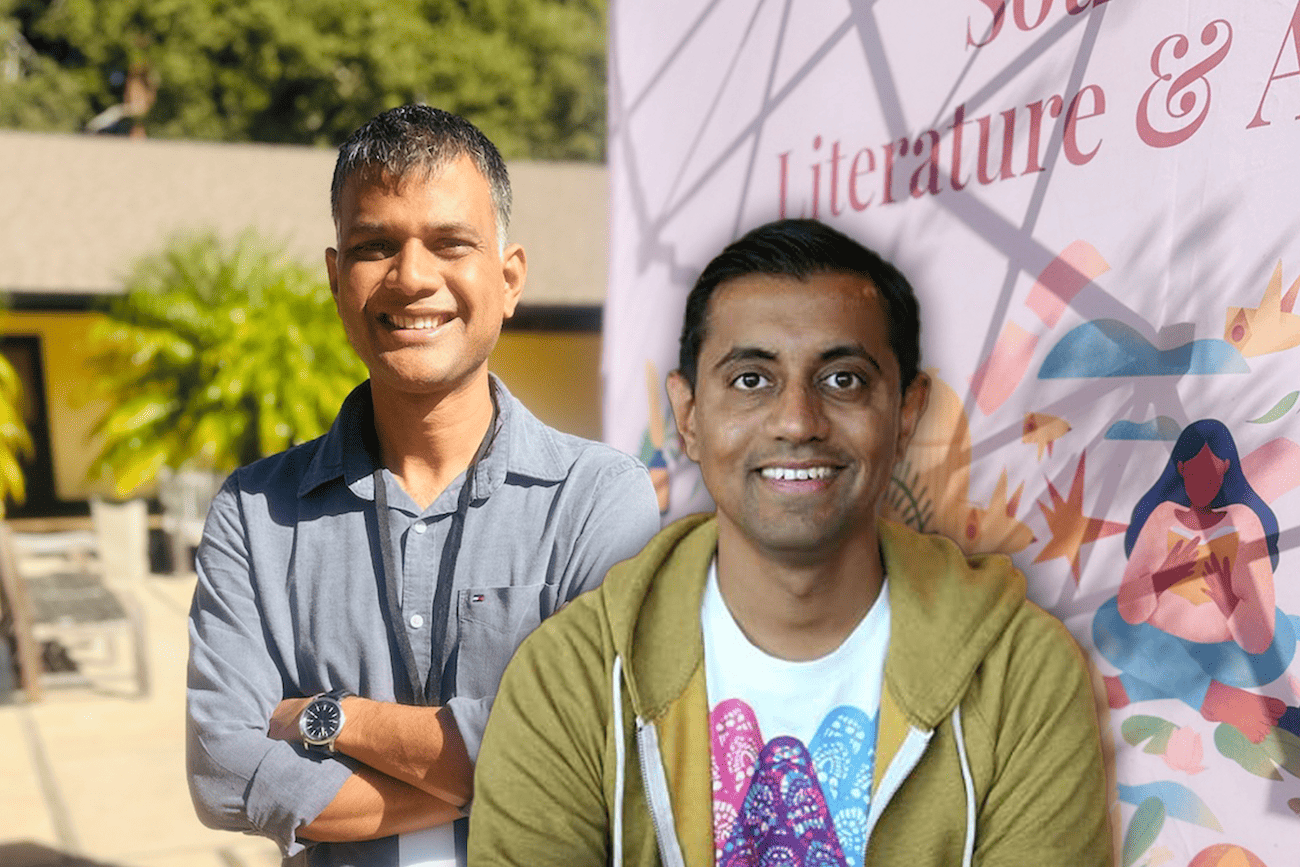
The South Asian Literature and Art (SALA) Festival 2026 opened on September 26 at Menlo College in Atherton, California, under the theme “The Global Gaze, The South Asian Soul.” Among the many remarkable conversations of Day 1, two stayed with me for their deeply personal exploration of childhood, vulnerability, cultural identity, and the transformative power of art: those with animator and filmmaker Sanjay Patel and photographer Vicky Roy.
Their professional journeys could hardly be more different. Patel has spent decades creating animated worlds at Pixar and translating his South Asian heritage into stories for global audiences. Roy emerged from extreme childhood adversity to become an internationally recognized photographer documenting marginalized communities and landscapes.
Yet beneath their very different creative practices was a striking common thread: both found ways to transform difficult or complicated childhood experiences into creative purpose.
Sanjay Patel: Animating heritage and giving back to his five-year-old self,
Sanjay Patel is a trailblazing animator, illustrator, and author who spent decades shaping modern classics at Pixar, including Ratatouille, Monsters, Inc., and The Incredibles. He directed the Oscar-nominated short film Sanjay’s Super Team, which reimagined his Hindu upbringing through Pixar’s lens.
His creative evolution has continued through his animated series Ghee Happy and his exciting new film development project with Warner Bros. Animation, Bad Karma.
During the “Epic Tales” session, Chaitanya Sareen interviewed Patel, and in my own conversation with him, I found myself immediately drawn to his warmth. He is exceptionally kind, observant, compassionate, generous, and inclusive. There was an ease about him that made our conversation feel personal very quickly.
Patel described how, at five years old, living in a motel on Route 66 and watching American cartoons, he once thought it would be cool to be known as “Travis.” That small childhood detail reveals the cultural disconnect he was navigating. He was growing up between worlds, surrounded by American popular culture while also carrying a South Asian and Hindu heritage. Over time, he learned that his bicultural identity was good, not something to run away from.
His teachers at school and later at CalArts helped establish his artistic foundation, giving him the tools to turn those childhood cultural tensions into rich, universal storytelling.
Patel knew early that drawing was his superpower. One of the delightful details we discovered during our conversation was that his childhood doodles always consisted of eyes and noses. He says he loves drawing the letter “J” but absolutely hates drawing the letter “N.”
His artistic journey also included a reluctant transition from traditional drawing to digital art. He initially resisted the change but eventually accepted a position at Pixar with Steve Jobs, who was not afraid to “fail,” at a lower salary of $ 50,000 with “stock options.” Pixar’s then-Chief Creative Officer John Lasseter and his brother jokingly warned him that the studio would “break his pencils” and make him work digitally, but that it would make him stronger.
What initially sounded like a threat ultimately became an important expansion of his creative vocabulary. Digital tools did not replace his artistic instincts; they added another facet to them.
But the emotional core of Patel’s current work is much more intimate. His childhood was marked by the absence of a stable, emotionally present maternal figure, while his father worked constantly to make a living. Art became a way to process experiences that were difficult to understand and articulate as a young child.
He spoke about his desire to give back to his five-year-old self. He became teary-eyed while discussing his upcoming book, which addresses his mother’s mental health issues. Creativity can sometimes become a language for experiences that have no other language. Patel also spoke candidly about the need for creative artists to have isolation and space to heal and create. That need, he acknowledged, can sometimes conflict with the responsibilities of being a householder.
Sanjay’s Super Team is a modern retelling of the stories of Shiva, Parvati, Ganesha, and Kartikeya. What was once part of his private childhood imagination has become part of a global visual language. His personal vulnerability has now become a source of universal joy.
Young children arrived carrying dog-eared copies of his books, eager to have them signed. Patel’s experience watching animation with his own children has also given him new insights into his own legacy. The stories he once encountered as a child have now become stories that another generation can inherit.
The venue had completely sold out of his books, but Patel happily wrote my daughter Abha’s name on a flier and my name and Goddess Durga on bookmarks. There was something deeply moving about watching a new generation encounter an artist whose work had been born partly from his own childhood.
His work suggests that cultural heritage does not have to remain frozen in the past. It can be reimagined, animated, and brought to life for the future.


Vicky Roy: If Sanjay Patel’s story is about reconnecting with the child he once was, Vicky Roy’s story begins with the extraordinary challenge of surviving childhood itself. Roy’s life story is a testament to resilience: extreme adversity transformed into breathtaking visual art. Roy ran away from home and found himself alone on the brutal streets of New Delhi, working as a ragpicker and dishwasher before finding shelter with the Salaam Baalak Trust NGO.
A chance encounter with a British photographer sparked his passion for photography. He later earned a camera, received a formal apprenticeship, and eventually received a prestigious MIT Media Fellowship. His photography exhibitions and monographs, including Street Dreams and This Scarred Land: New Mountainscapes, have traveled from New Delhi to the Houston FotoFest Biennial.
But the significance of Roy’s camera cannot be separated from the circumstances in which he grew up. Roy was deprived of a traditional childhood. No maternal protection. He had to find ways to survive. And eventually, he found a camera. Roy has described how photography literally saved his life. The camera gave him a way to see and document the world around him, including marginalized urban landscapes and majestic mountain landscapes.
The boy who had once been forced to survive on the streets eventually became an artist capable of looking at vulnerable communities with extraordinary empathy.
What is particularly inspiring is what Roy has chosen to do with the success he has achieved. Rather than seeing photography simply as a personal career, he has made it a vehicle for giving back.
He is currently working on an ambitious documentary titled Everyone is Good at Something. For this project, he has already collected approximately 200,000 to 300,000 life stories. His goal is to showcase the disabled community in India, create widespread social awareness, and give back to society through his active collaboration with the India Inclusion Foundation.
His work demonstrates how a painful beginning does not necessarily dictate the purpose of an entire life.
Sanjay Patel and Vicky Roy overcame contrasting childhood challenges. One navigated cultural identity in America, with a mother with mental disability, and the other fought for basic survival to discover their unique creative voices. Through animation and photography, both artists transform their early adversities into powerful visual languages that honor their memory and bring visibility to others.
With roots in Georgia and the Bay Area, and her heart still tethered to a childhood mango tree in Mumbai, India, Monita Soni approaches writing as a contemplative practice. A path to honor humanity. She has published hundreds of movie reviews, book critiques, poems, and essays, and contributed to combined literary works. Her two books are “My Light Reflections” and “Flow Through My Heart.” You can hear her commentaries on Sundial Writers Corner, WLRH 89.3 FM.