




Sushi, My Friend — The Black Labrador Who Taught Me More About Emotional Connection Than Anyone Else

- Here’s why I dedicated my forthcoming book, “Attunement to Others: Multispecies Cohabitation in the Anthropocene,” to my canine compadres.

“They should watch out for you, o eater of insects. One snap of those jaws would take out most of them. But there they go, heading right for you, as if you were no more than a giant rock lying in the grass. They shower you like confetti, and you—not a twitch!”
***
“The butterflies are in the air again, moving off, in the direction of the shore. I want to call your name, but the word dies in my throat.
Oh, my friend, my friend!”
— Sigrid Nunez, The Friend
On August 14th, 2015, we adopted Sushi from the Oklahoma City Animal Shelter. A black lab mix, Sushi was my first dog. I was 36 at that time. I wasn’t a dog lover. When I was younger, I was mortified by dogs. My wife, though, was an ardent dog lover. She always wanted a dog and in 2014, almost adopted a dog named Blanca in Irvine, California. Riding on her enthusiasm, we looked at dogs that were up for adoption in OKC when she was staying for the summer months with me in Norman, Oklahoma. The plan was to take the dog with her to Irvine when she would begin teaching her September quarter at UC-Irvine. We saw a black lab named Beatrix on the website and were drawn to her. My wife insists now that I chose Sushi, although that memory is a bit hazy for me. When we drove to the shelter, the caretaker said that the dog was called “Shootsie.” My Assamese tongue could not roll over the “t” and the “sie”—so I suggested we call her Sushi. Shorter, cuter. We took Sushi home the same day.
Sushi immediately warmed up to my wife jumping into our bed when she got the invitation. The two of us, however, didn’t get off to a very good start. I wasn’t used to sleeping with a dog in bed and would often banish myself to the living room sofa when I woke up startled as my body came into contact with canine fur or limbs. Cleaning up her stinky poop when we took her out for a walk revolted me and almost made me retch. It took me a long time to get used to it.
I also had some wrong ideas about the human-canine relationship having been conditioned to think of it in terms of the master-pet binary. Imagining, though, is remotely close to actually living with a dog. The retractable leash initially gave me the illusion of absolute sovereignty. I would put the leash on Sushi, take her for a walk in the neighborhood, and imagine that I could control her, Cesar Milan-like, with a simple click of the button. Not the dog whisperer, but the hand controller—this is how I conjured an epic version of masculinity for myself as I was accustomed to think about the human-dog relation in terms of domination and mastery. It was my hand that was the sovereign, the one that commanded her, or so I imagined.
How mistaken I was! In humbling first encounters with the intractable nature of animal agency, Sushi disabused me of that sense of sovereignty by growling, chewing through the elastic leash at least three times, and running off on her own while I, acutely feeling my lack of fitness, would huff and puff after her in panic screaming her name and pleading with her to get back. It was my wife who taught me how walking the dog was not an expression of control, but a developing relationship of trust. Building trust took time and required me to meet Sushi at her level. I just had to let the dog be—harder done than said though. Like picking up her poop, this took time and practice.
For a variety of reasons, my wife couldn’t take Sushi with her to Irvine in September 2015. She asked me to keep her in our apartment in Norman. I was hesitant and nervous but agreed. How could I say no to her? I was gradually getting used to taking Sushi for walks twice a day and began looking forward to our joint adventures in an adjoining meadow I named the “old field.” I also began taking her to doggy “day-care” every Monday and Wednesday as I had a busy teaching schedule. She would go there in the morning, play all day, expend all that incredible puppy energy, and come back home and conk out in the evening. When I watched TV, she would put her head and paws on my lap, snoring contentedly. Occasionally, she would wag her tail and make “coo” sounds in her sleep. I was sure she was dreaming about her daytime adventures with me and her other canine pals. On the days I left her in the rented apartment I lived in at that time, the highlight would be getting back, seeing her at the window wagging her tail excitedly at the rate of knots, and then opening the door to see her joyously welcoming me. I loved those welcomes and slowly got used to her sleeping on the bed. Earlier, I would wake up startled when I inadvertently contacted her body; now, my heart would melt when she would occasionally put her paw on my hand. I knew we had become friends—she had come to stay.
***
In October 2018, doctors noticed a few spots in my dad’s bladder. When I went to India in December that year, we went for check-ups in Guwahati and Delhi. At that time, we were told that while those spots were cancerous, they were not advanced enough to warrant chemotherapy. I returned to Norman in January. In late February, while I was out for a walk with Sushi, I got a call from my cousin that the earlier diagnoses were mistaken. The cancer had spread quickly and had already progressed to Stage 4. I called the cancer specialist in Delhi who said that my dad had to begin intensive monthly chemotherapy sessions immediately as it was already too advanced. I asked him how long he thought my dad had. He replied that a year was probably being optimistic. Once the semester was over, I returned to India in May with a return ticket booked for August 12th. It was the year I was going up for tenure at the University of Oklahoma—so, I thought I would get back in August and return in December to check on my dad again. I thought I had the time; he had the time.
In “Cancer is a Funny Thing,” physicist J.B.S. Haldane, who acquired Indian citizenship, and eventually died of colorectal cancer, wrote:
My final word, before I’m done,
Is “Cancer can be rather fun”.
Thanks to the nurses and Nye Bevan
The NHS is quite like heaven
Provided one confronts the tumour
With a sufficient sense of humour.
I know that cancer often kills,
But so do cars and sleeping pills;
And it can hurt one till one sweats,
So can bad teeth and unpaid debts.
A spot of laughter, I am sure,
Often accelerates one’s cure;
“Provided one confronts the tumour/With a sufficient sense of humour”—this couplet encapsulates my dad’s attitude to cancer in the beginning. He was a remarkably healthy, cheerful and optimistic person. In fact, there were times when his cheerful optimism was jarring. He could have been a bit more empathetic and understanding of some of my darker moods and moments of extreme self-doubt, I felt, instead of repeating like a broken record that everything would be alright. Sometimes things didn’t turn up right, as he and I were soon to realize. When I first spoke to him on the phone after his diagnosis and initial rounds of treatment, he reacted to his illness with his characteristic optimism—he was confronting the tumor with his more than sufficient sense of humor. He would be alright, he said.
By the time I got to India, things had changed. Cancer was showing its decidedly cruel and unfunny side. Successive rounds of chemotherapy had weakened my dad. While he was trying to maintain his more than sufficient sense of humor, he would often wheeze or complain of tiredness. He looked worn, tired, and aged. We would shuttle back and forth between Guwahati and Delhi for his chemotherapy sessions. He was fairly alright in June, his old cheerful and optimistic avatar emerging in fits and starts. But, after my mother’s birthday in July, the decline was swift and precipitous.
By end July, the cheerfulness and optimism had almost completely gone. He couldn’t control his bodily functions and had to wear a diaper. I could sense his deep sense of shame when the nurse and I had to help him clean up. He didn’t like being naked in front of me and would avert his eyes when I would clean up after him, holding my nose to keep the smell of shit at bay. Incidentally, I was much more disgusted cleaning up Sushi’s excretions than his. By August, he was steadily becoming delirious. A multitude of tubes had been inserted into his body, and I could sense that he was suffering immensely.
The time of my departure for the U.S. was arriving. I was undecided whether I should stay or leave. In a moment of lucidity, his old, cheerful side emerged. Go, he said, with that radiant megawatt smile that would enliven any space he was in. This is an important year for you, I have lots of people to take care of me here, he said. Reluctantly, I left for Delhi on August 12 and waited in the lounge of the airport for my midnight flight to New York. In moments that resembled the numerous Hindi film melodramas I watched when younger, I had reached the check-in gates when something held me back. I decided not to leave and booked a ticket back to Guwahati for the next day. I was glad I did. When I saw him in the hospital on the evening of August 13th, my dad had already lost consciousness. A black liquid was flowing out steadily through the tubes inserted into his nose. He passed away at 8.00 AM on August 14th, 2019.
***
I always thought my dad disliked dogs. He used to tell me about a “bulldog” named Shamu who was apparently around when I was very young, although I have no memory of him. Shamu was poisoned by someone as he wouldn’t let anyone steal mangoes from our tree. But that was the only dog he ever talked about. When Sushi first began living with us, both my dad and mum were horrified. Who would take care of it? What if it shits and pees in the apartment? How can you let it sleep with you in the bed? The dog, they intoned, has to be treated like a dog. It is not a person, it is an animal, it should be treated like an animal. Its spit, its shit, its pee and its hair are disgusting.
These all-too-familiar recriminations cohered with my impression of my parents’ disgust with dogs, attitudes that left a mark on me as well. A few weeks before his passing, however, a strange incident occurred. My dad was already delirious by that point, often recalling random events from his past. Since I couldn’t connect them in any coherent fashion, I would often hum and haw in agreement to humor him, without always paying attention. It was a hot and humid late July or early August afternoon in the hospital, and, after lunch, I was settling down to read a book as my dad rested. Suddenly, his hand grazed mine and he said he wanted to tell me something important. Immersed in my book, I didn’t look up and distractedly asked him what he wanted. This time, the pressure on my hand increased as he asked me to listen carefully to what he was about to say.
The note of urgency in his voice impelled me to listen carefully. I had a dog once, he said. Who? Shamu?—I asked. No, he said, another dog. His father was a civil engineer and was posted then in the town of Abhayapuri in Assam. My father’s family was a large one—four brothers and three sisters. While in Abhayapuri, a street dog adopted the family as its own. My father was in middle school then and would play with the dog. He was very attached to the dog, he said. The dog would often walk my father and siblings to their school. After a few years, my grandfather was transferred to Guwahati. They decided to leave the dog behind in Abhayapuri. By this time, my attention was riveted on my dad’s face. I noticed that his eyes were clouding as he recalled his last view of the dog as their family jeep left Abhayapuri. The dog, he said, ran after the jeep barking till it could keep up no longer. A week or so later, a neighboring shopkeeper from Abhayapuri informed them that the dog had passed away. The dog refused food after the departure of my dad’s family and probably died of grief. My dad’s grip on my hand tightened. He kept repeating—kukurtu mur bondhu asil (the dog was my friend). Tears rolled down his eyes.
Besides my writing and research, my two canine companions also inspired me to teach a self-designed upper-level undergraduate class at the University of Oklahoma that I have, rather pompously, titled “Dogs in Global Cultural Production.”
The story haunted me and I wondered why my dad had never mentioned anything about it earlier. I was busy with official affairs and the myriad rituals after my dad’s cremation. So, I didn’t have time to ask anyone about it. Once the dust had settled somewhat, I asked my mum whether she knew anything about this dog. She couldn’t recall dad mentioning it to her and asked his surviving siblings about the dog. All of them were amazed that my dad remembered.; most of them had forgotten about the Abhayapuri dog. One of my uncles, a year and a half younger than my dad, told us that the dog’s name was Jili.
***
In the “Acknowledgements” section of my forthcoming book, Attunement to Others: Multispecies Cohabitation in the Anthropocene, I dedicate the book “to my canine compadres, Sushi and Roxy, who have taught me more about attunement than anyone else.” Roxy, a Lab-Pitbull-Dalmatian mix, came into our lives five months before my dad’s passing. In good ole’ anthropomorphic fashion, I call Sushi the wise one and Roxy the tough kid. Roxy’s story deserves time and space on its own and I will not elaborate on that here as her connection with my dad was minimal (another dog!!!—he rolled his eyes when he heard that we’d adopted Roxy). But the sentiments I express in my “Acknowledgements” are sincere. My turn towards multispecies literature, cinema and theory wouldn’t have been possible without the presence of Sushi and Roxy. They have been my greatest teachers and invaluable companions. They are “cum panis” in multispecies thinker, Donna Haraway’s, resonant sense, “messmates at the table.”
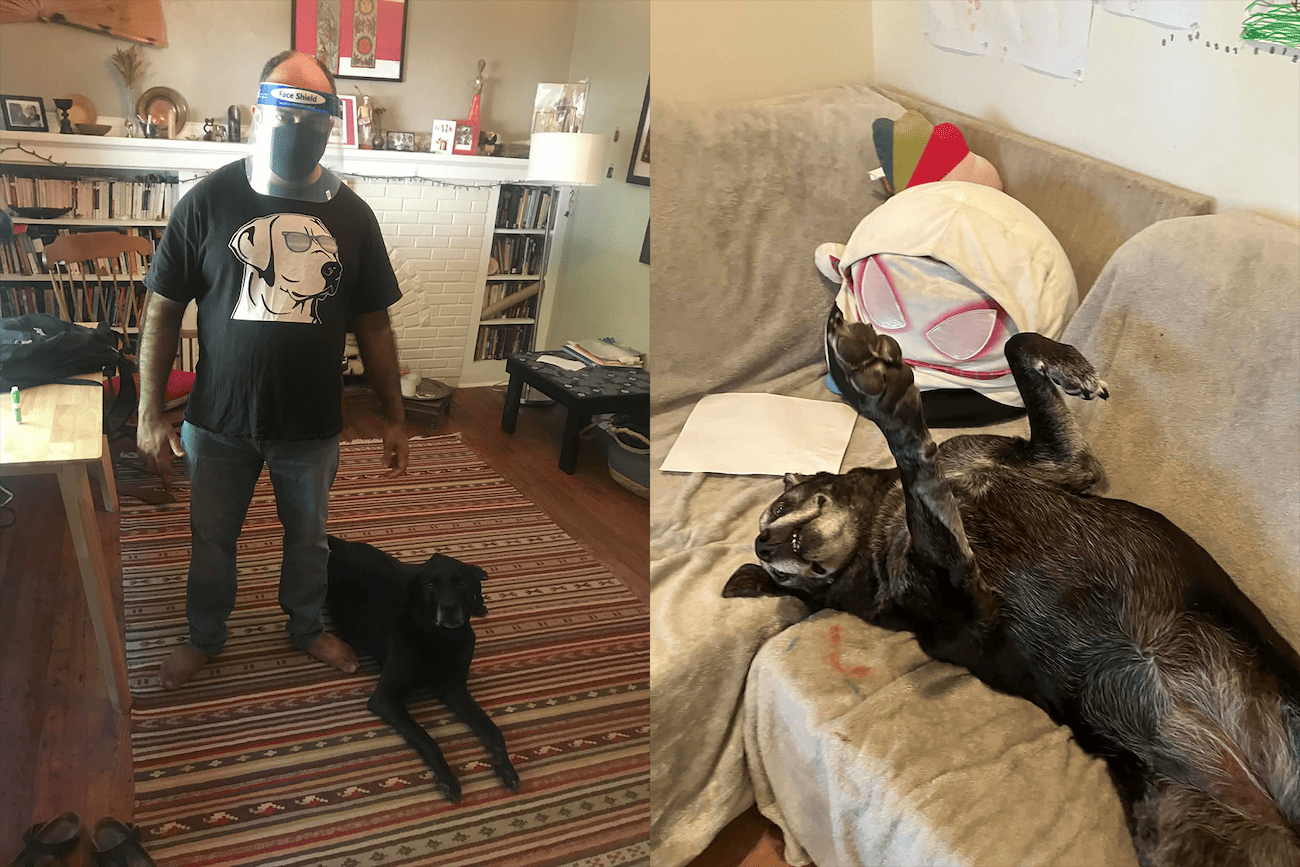
Besides my writing and research, my two canine companions also inspired me to teach a self-designed upper-level undergraduate class at the University of Oklahoma that I have, rather pompously, titled “Dogs in Global Cultural Production.” I have now taught that class twice, the first time in Fall 2020 when death-dealing COVID was raging incessantly, and we (those who did not have health exemptions) were asked to teach in-person. The photo above is just before my first day of teaching that class, where I am posing with Sushi. As I dressed up like Bane from Batman to walk into the valley of the shadow of death, I wrote in a mock-ironic way in my Facebook post intended to criticize my university’s decision to make us teach in person, who would I have by my side? A dog, obviously!
A text I’ve taught in both iterations of the class is Disgrace by the South African Nobel laureate, J.M. Coetzee. As David Lurie, the very unlikeable protagonist of the novel, ferries the dead corpses of euthanized dogs to be incinerated, we come across the following sentence: “Well, now he has become a dog-man: a dog undertaker, psychopomp; a harijan.” One of the best students I have had the privilege of teaching was intrigued by this idea of the dog-as-psychopomp (although in the novel, Lurie positions himself as the dogs’ psychopomp) and wrote a wonderful paper connecting the Mahaprastanika Parva (Book 17) from The Mahabharata, the story of Jezebel from the Bible, Disgrace, Martinican novelist Patrick Chamoiseau’s novel Slave Old Man (which we also discussed in class) and The Twilight Zone episode titled “The Hunt.”


Reading the student’s memorable paper—I was amazed at what he was able to pull together in a space of 16 pages—and pursuing my own research on the persistence of the idea of the dog-as-psychopomp in various cultures across the globe helped me recall, ruminate and speculate about the meaning of my dad’s story about Jili. Of course, we could interpret my dad’s story as a suppressed expression of guilt at the betrayal of his childhood bondhu. But could there be other ways of approaching his story, which explains his guilt, remorse, affection and disgust for dogs simultaneously? The key for this, I suggest below, is the story of the Pandava king Yudhistir and his dog in the Mahabharata. As a hard-core atheist, I usually disavow any belief in an afterlife, although I am always interested in spiritual forms of worlding (One of the best compliments I got in my classes was from a Christian student who said I talked like a theologian, although I’d outed myself as an atheist in the first session of class). Could it be that as my dad was approaching the end of his life, Jili appeared to him as psychopomp ushering him into the afterlife? He felt guilty for abandoning his bondhu, but maybe his bondhu’s ghostly pawprints never left his side. All he had to do was to take time and look. The untimeliness of debilitation and impending death maybe allowed him that time.
What is intriguing in Coetzee’s sentence is the ambiguous juxtaposition of “psychopomp” with “Harijan.” Disgrace powerfully probes the connections between racialization and animality; but, maybe there is a connection it institutes here between caste and animality that needs to mined further by way of the Mahabharata. Harijan, the condescending Gandhian term for lower-caste populations could be familiar to Coetzee through the political history of South Africa where the famous Indian anticolonial leader had a major role to play. But the juxtaposition of these terms also takes us back to the Mahaprastanika Parva where the portrayal of the dog-as-psychopomp exists cheek-by-jowl with a narrative about caste. The Pandava king Yudhistir, son of Dharma, loses all his brothers and his wife, Draupadi, as he walks towards heaven. His only companion is a dog that begins following him on the way and becomes absolutely devoted to him. In my first language, Assamese, dogs are often described as “prabhubhakta”—devotee of the lord—and the roots of that term can be traced to this episode. When Yudhistir reaches the gates of heaven, he is allowed to enter. But the gods will not allow the dog to enter. It is an unclean animal, a pollutant. Yudhistir refuses to abandon his companion, his bhakta. Dharma reveals himself to be the dog and Yudhistir finally enters heaven.
This persisting cultural narrative of the dog-as-psychopomp is evident in the title of a fascinating collection of Assamese short stories on canines titled Swargarohonor Songee (Companion in the Ascent to Heaven) (https://thewire.in/books/of-dogs-and-men-an-assamese-anthology-explores-the-many-representations-of-canines). Sushi may have been positioned as my compadre in the journey into the valley of the shadow of death in my mock-ironic Facebook post from 2020, but she would be better cast as my swargarohonor songee. Through her companionship, she showed me a swarga, a heaven on earth that I never thought was possible. The anthropologist Veena Das reads this episode from the Mahabharata via the lens of the ethics of noncruelty. I agree largely with her ethical interpretation but prefer more the religious scholar Wendy Doniger’s reading who views this episode via an unresolved antinomy about caste in the competing claims of two trajectories within Hinduism: the strict caste laws of the older Vedic traditions and the devotional practices of bhakti that critiques strictures of caste and purity (https://scroll.in/article/1093795/dogs-are-essential-to-my-life-indologist-wendy-doniger-writes-about-her-pets-in-her-memoir). Doniger writes:
…the Mahabharata–composed sometime between 300 BCE and 300 CE – was not yet ready to choose between the two competing religious views. The solution? The dog suddenly vanishes and is revealed to have been, all along, the god Dharma, the moral law incarnate…There was no dog. And so, there is no problem. In this way the great Epic sidesteps rather than resolves a dispute between two very different kinds of Hinduism, a dispute in which the crucial factor is a dog.
After a long period of disappearance and silence in my dad’s life, where he seemed to have disavowed his love and attachment for his childhood bondhu, Jili reappeared when he was at the gates of death. As swargarohonor songee, I like to believe that Jili ushered him to the afterlife. But could his lifelong disgust at and disavowal of dogs, the absent presence of dogs from his life, reveal the residues of a caste-inflected cultural unconscious where his subjectivity was shaped? I am not, of course, saying that caste explains my dad’s horror of the presence of dogs in any essentialist sense. Our everyday encounters with animals are riddled through with antinomies and contradictions. We can be cruel, hostile, convivial, indifferent and loving towards animals. Calcified cultural attitudes are often rendered brittle in the smithy of everyday interactions with animals. In the South Asian context, such complex and ambivalent attitudes are evident in both Islamicate and Hindu-inflected lifeworlds, both of which, in different ways, consider the dog an “unclean animal.” There are heterogenous ways of cohabiting with animals that are not reducible to a single vector. However, our subjectivities are shaped in the milieus we inhabit, and not acknowledging how a caste-inflected worldview shapes particular ways of inhabiting and navigating the world would also be a disavowal of the impact of persisting cultural patterns and narratives.
How did most Indians of my father’s generation (and mine) encounter dogs? While keeping “breed” dogs at home has become a relatively common practice in the neoliberal era, a lot of encounters with canines for earlier Indian generations was with the street dog (this hasn’t changed tremendously). Indian streets, as the multispecies ethnographer Yamini Narayanan memorably put it, are “trans-species environments.” The street dog is one of the most common free-range animals in South Asian cities and villages. Tough, hardy, resilient and independent, the street dog is also viewed as filthy, unclean and a vector of zoonotic diseases. The moral panic about the vaccination and culling of street dogs is fairly routine in Indian urban spaces, revealing a class-caste horror of the “unclean” street. After all, the etymology of “pariah,” often connected with street dogs, comes from the Tamil paraiyan, which refers to the population of lower-caste drummers who are considered “unclean” because of their contact with animal skins and hides. Caste is a spatial-sensory order whose phenomenological dimensions, as Aniket Jaware reminds us, are predicated on the haptic. Caste is about touching and being touched. Why are dogs not allowed in heaven? Once again, Doniger: “…when he (Yudhistir) starts to bring his dog into heaven with him, the gods object that there are no dogs in heaven, because dogs–whom Hindus regard as unclean animals, scavengers, omnivores–would lick the sacrificial offerings and pollute them.” Dogs revel in the haptic, the olfactory and the gustatory, all considered the senses of pollution. They lick, eat and smell what is dirty (how many times have I been horrified when my dogs smell poop?), they shed hair and eject bodily matter and effluvia, they transgress the boundaries of purity and pollution. When my Savarna dad expressed his disgust at Sushi sleeping in my bed, shedding her hair and spit on the place I rested in, was he activating these unconscious cultural attitudes evinced towards “unclean” beings? Could his repressed love for and guilt about Jili and his disgust for dogs exist on the same continuum? I certainly think so.
***
Sometime in the late 90s, my brother and I heard the piteous whining of a puppy, probably from the litter of one of the many nameless street dogs in our lane, at the threshold leading to our house. The puppy had an injured leg and couldn’t move properly. The puppy looked so helpless, soooooooooo cuuuuuute!!! We wanted to bring it in. Our parents stopped us. Familiar statements we grew up with ensued: Who is going to take care of it? Who is going to clean its poop and pee? Despite our pleas, they wouldn’t let us bring the puppy inside. A person we knew from the nearby basti came and took it away. To be absolutely honest, my brother and I never tried to find out what happened to the puppy. Out of sight was out of mind.
***
Our son was born in 2021, around eighteen months after my father’s passing. My wife correctly, I think, surmises that his dawning consciousness of death is connected to a dog. There were two dogs in his daycare, Rosie and Birdie. One day he came back from daycare and kept repeating that Rosie “went to the grass.” As with my dad’s incoherent ramblings towards the end of his life, I didn’t pay much attention to his statements. Who cares much about “unreliable narrators” anyway, I joked with my wife. My wife took his statements much more seriously and found out that Rosie had indeed passed on from an age-related ailment. Our son probably picked up the expression “went to the grass” from his daycare.
My son never met his grandfather. But nowadays, he looks at pictures of my father and says that his grandfather “went to the grass” (he doesn’t quite get the concept of cremation yet). My son is lucky, though, to have met and spent five years (and counting) with Sushi though. He is very close to her and calls her his “sister.” This year, Sushi turned twelve, a grand old age for big dogs like her. On August 14th, 2026, it will be her eleventh year with us. Signs of age and mortality are everywhere. She has arthritis, struggles with walking and getting into and out of the car, and doesn’t quite have the same appetite. Literary critic Alice Kuzniar writes that melancholia predicates our relationship with our close animal companions. We have the sense that very soon, they will no longer be with us. Companion animals exist in the temporal space of the “not yet.” We will outlive them and their inevitable deaths will always arrive in an untimely fashion. I have the same feelings when I watch Sushi struggle to get into the car, sometimes refuse the food she liked once, generally lacking energy. The melancholic premonition that she “went to the grass” in an untimely fashion is ever-present.
But when I look at her in her favorite resting position at night, on her back with her limbs pointing skywards, a surge of affection and gratitude wells in me. She has made me her bhakta. She (and Roxy) touched me with a sense of grace and wonder that I didn’t know was possible. I have learnt an incalculable amount about companionship, about codependency from them.
Sometimes Sushi grunts and moves with what I imagine is happiness while she sleeps. I still wonder if she dreams and what her dreams are like? Is she dreaming of the space where Jili walks with my dad? Is she expending ghostly reserves of her inexhaustible puppy energy with her flesh-and-blood adopted “sister,” Roxy, dogs like Shamu, Rosie and Birdie who made blink and miss appearances in this essay, and Jili, whose spectral footprints are spread all over my dad’s biography? With her paws pointing towards the sky (all religions and spiritual traditions, religious scholar David Weddle tells us, begins with gestures and gazes skywards), is she telling me how, when my time inevitably arrives in an untimely manner, she will be my swargarohonor songee?
Amit R. Baishya is Associate Professor of English at The University of Oklahoma. He is a literary critic and occasional translator from Assamese to English.