




‘Shame on You’: Stanford Graduates Walk Out on Sundar Pichai Over Google’s Contract With Israel

- Venture capitalist Vinod Khosla came to Pichai’s defense on X saying the walkout was "biased, idiotic, short-sighted and very selfish.”
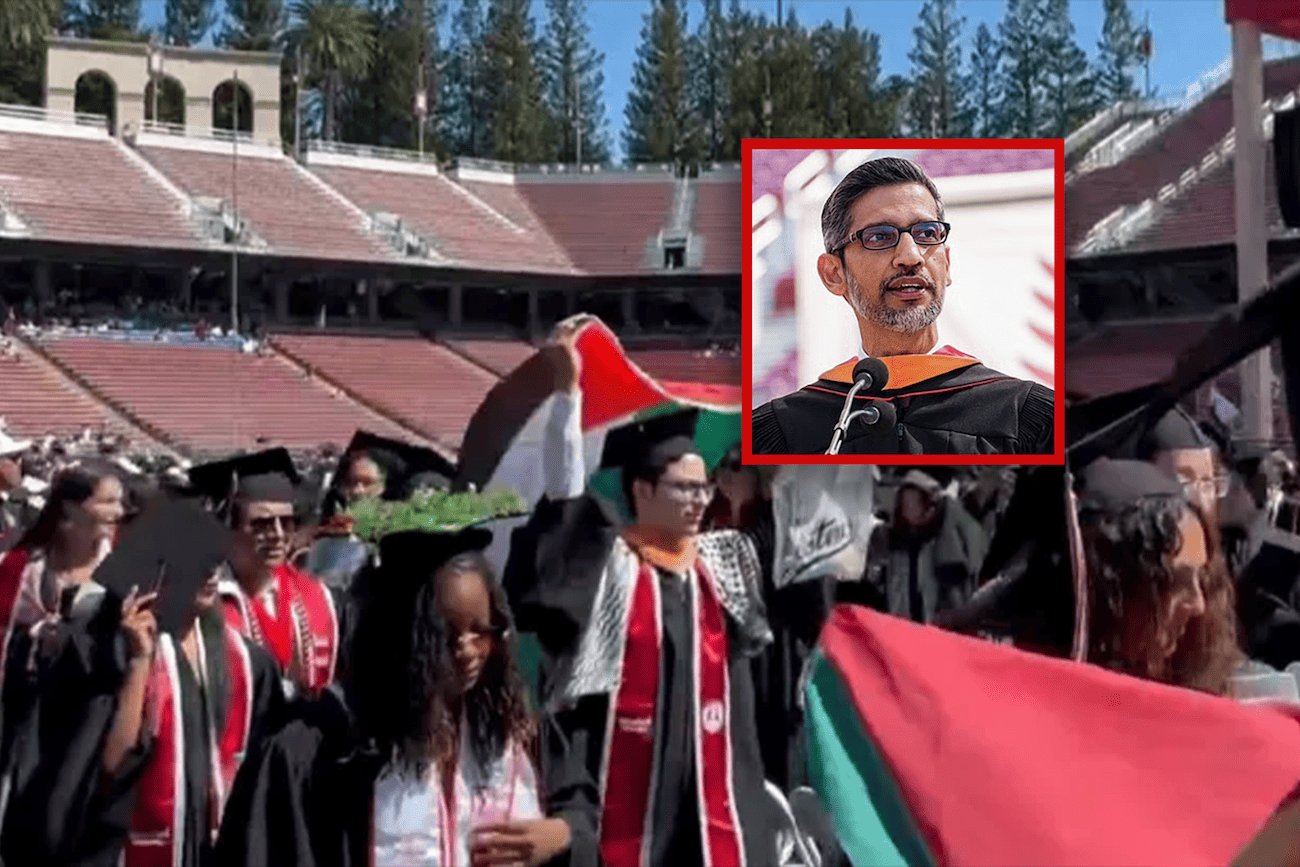

The Google and Alphabet CEO returned to his alma mater for only his second-ever commencement address — and was met with walkouts, boos, Palestinian flags, and chants of “Free Palestine.”
On Sunday afternoon, June 14, 2026, Sundar Pichai — the chief executive of Google and Alphabet, one of the most powerful technology executives in the world, and an alumnus of Stanford University’s materials science program — walked onto the stage at Stanford Stadium to deliver the university’s commencement address to the Class of 2026.
As he opened his remarks, dozens of graduates in black robes and Cardinal-red trim stood up from their seats on the field and walked out. Some waved Palestinian flags. Others raised painted banners. One read “GENOCIDE RUNS ON GOOGLE.” Another read “ICE SPIES WITH GOOGLE AI.” As they marched toward the exits, they chanted “Free, free, Palestine” and “Shame on you,” as TechCrunch reported, citing video of the ceremony verified by multiple journalists.
It was, as Fortune described it, “the latest tech executive to get the cold shoulder from graduates this year.” But the nature of the protest set it apart from everything else that had happened on commencement stages in the spring of 2026 — and the distinction, as The Next Web observed in its account of the event, matters significantly.
Not AI — Project Nimbus
The 2026 commencement season had already been defined by a specific and well-documented phenomenon: technology executives drawing boos and jeers from graduates anxious about artificial intelligence and its effects on their employment prospects. Former Google CEO Eric Schmidt was loudly booed at the University of Arizona, as Gizmodo reported, when he touched on AI — with some graduates also shouting “Epstein files” in reference to his alleged ties to Jeffrey Epstein. Real estate executives, semiconductor company leaders, and AI entrepreneurs had all faced variations of the same skeptical reception across campuses from California to Tennessee.
Pichai had been acutely aware of this pattern. On the New York Times’ “Hard Fork” podcast the month before, he had been asked directly how he would navigate potential boos at Stanford. His answer — that he would entrust younger generations to handle the technological shift while acknowledging graduates’ anxieties — was, as Fortune noted, a careful preparation for a specific kind of confrontation.
The confrontation that materialized on June 14 was entirely different in kind.
The walkout was organized by Stanford Students for Justice in Palestine — a chapter of the nationwide network of student-led activist groups — weeks before the ceremony. In a statement published on Instagram, the chapter accused Google of collaborating with the Israeli government and with companies including Palantir, the AI and analytics firm that has signed contracts supporting the Israeli military and the Trump administration’s immigration enforcement operation.
Their specific target was Project Nimbus — the approximately $1.2 billion contract that Israel’s Finance Ministry announced in April 2021, under which Google and Amazon supply cloud computing and artificial intelligence services to the Israeli government, including its defense and security agencies, as Yahoo News and Fortune both documented. The contract runs for an initial seven years. Critics, including the Electronic Frontier Foundation, have raised concerns about the transparency of both companies regarding the precise scope of the contract’s uses. Reports about its operational details have come largely from internal leaks, as Gizmodo noted.
Google’s own institutional history with Project Nimbus made the protest at Stanford particularly charged. In 2024, the company fired more than two dozen employees who had organized internal protests against the contract, fueling the “No Tech for Apartheid” campaign, as Yahoo News reported. The Stanford walkout was, as Fortune observed, “the third time activist groups have organized walkouts during commencements — following similar-size acts in 2024 and 2025 — each arranged to show support for Palestine and oppose U.S. ties to Israel.”
The student group’s statement, as quoted by Fortune, was direct about the day’s meaning: “Today, Sundar Pichai was met with the sight of hundreds of students who showed they could not be allured anymore with the talk of a dollar or rapidly expanding AI.”
The walkout was organized by Stanford Students for Justice in Palestine — a chapter of the nationwide network of student-led activist groups — weeks before the ceremony.
SFGate, whose reporter Matt Brown was present and posted real-time updates on X, reported approximately 200 graduates walked out, as cited by Fortune.
Pichai’s Response: No AI, No Nimbus — Just Optimism
What Pichai chose to do in response to the walkout was itself significant, and widely noted.
He carried on with his speech while dozens of graduates marched to the exits, as Gizmodo reported. And he did so having made a deliberate choice that Yahoo News described as his most pointed decision of the afternoon: he did not mention artificial intelligence once.
It was, as The Next Web wrote, “a restraint that breaks from his usual focus.” Pichai has spent the past year publicly and enthusiastically promoting Google’s AI agents vision, its Gemini-powered Mariner agent, and the broader case for AI as a transformative opportunity. At Stanford — in the room where he had earned his master’s degree, before a graduating class that had just experienced a walkout over his company’s contracts — he opted instead for what Yahoo News described as “advice to graduates on choosing optimism, working on hard things, and pursuing what excites them.”
It was, the reporters covering the event generally agreed, a tactically sound choice. The technology speakers who had drawn the most severe receptions this spring had done so by leaning into AI optimism before audiences primed for skepticism. Pichai had told the “Hard Fork” podcast that he understood the anxiety graduates felt. At the podium, he demonstrated that understanding by not asking them to set it aside.
The speech was also, as The Next Web noted, only his second commencement address ever — and his first delivered before a live audience. The first had been filmed in his backyard in 2020 for a graduating class that could not gather in person during the COVID-19 pandemic. His return to Stanford, where he completed his master’s in materials science and engineering in 1995 before later earning his MBA from Wharton, gave the occasion a certain personal symmetry. It was not the afternoon he had planned.
When asked for comment on the protest, a Google spokesperson referred journalists to Pichai’s remarks during his speech, as Fortune reported. Stanford University did not immediately reply to Fortune’s request for comment.
Vinod Khosla and Ro Khanna: A Public Debate Breaks Out


The walkout generated an immediate and revealing exchange on X between two of the most prominent Indian Americans in Silicon Valley and American politics — one of them a fellow honoree on Forbes’ just-released list of the 250 most successful immigrants.
Vinod Khosla — the Sun Microsystems co-founder and venture capitalist ranked 14th on the Forbes list, and one of Pichai’s peers in the Indian immigrant technology elite — reacted to the walkout with visible frustration. “The stupidity of these Stanford students to take the greatest opportunity for equality in humanity ever and to really free humanity and go walk out on Google and Sundar Pichai that’s pioneered that,” Khosla wrote on X. He called the walkout “biased, idiotic, short-sighted and very selfish,” arguing that the students had ignored the larger transformative potential of the technology Pichai’s company had helped build.
Congressman Ro Khanna — the Indian American representative from California’s Silicon Valley district and one of Congress’s most prominent progressive voices — responded directly to Khosla on the same platform. “Vinod, my understanding is these students walked out to protest Google’s contract with IDF given Israel’s genocide in Gaza,” Khanna wrote. “Wherever one stands on those contracts, I believe you would support their right of free expression and challenging authority.”
The exchange encapsulated a fissure within the Indian American political and professional community — between those who view the walkout as a misguided distraction from the transformative promise of technology, and those who see it as a legitimate expression of the same civic courage that has historically animated student protest movements at American universities.
The Broader Context: A Campus Movement With Institutional Consequences
The Stanford walkout did not occur in isolation. The university’s 2025-2026 academic year had been defined, in significant part, by sustained pro-Palestinian organizing. More than a dozen protesters were arrested June 5 after briefly occupying the university president’s office, as NBC News reported in its coverage of related campus demonstrations. Some of those arrested were subsequently suspended, and the group Stanford Against Apartheid in Palestine organized an “alternative graduation” — a People’s Commencement — in Menlo Park, just off campus, specifically to honor those whose degrees had been withheld as a result of their protest activities.
“Join us TODAY to celebrate and honor our arrested comrades who will have their degrees withheld for fighting against genocide,” the group’s Instagram post read, as NBC News reported. A speaker at the alternative ceremony told the assembled crowd: “You have made history with a record-breaking sit-in and a beautiful encampment. Today, you are graduating with a head held high.”
Outgoing Stanford President Richard Saller addressed the formal ceremony amid his own protest moment. Students had also walked out during his remarks, as NBC News documented, at the moment he read aloud: “Don’t let your convictions shut out your ability to listen and learn.”
For Pichai, the experience was a compressed lesson in what it means to be the face of a corporation whose business decisions have become inseparable from global political conflicts — in a year when his company fired the internal dissenters who raised these same objections, when its AI contracts have become a front in a campaign explicitly named “No Tech for Apartheid,” and when a generation of graduates at his own alma mater decided that the most meaningful statement they could make at their own graduation ceremony was to stand up and walk away.
He chose optimism from the podium. The graduating class chose something else.