




No Legal Authority : Federal Court Voids Trump’s $100,000 H-1B Visa Fee as an Unauthorized Tax

- A Boston judge's 42-page ruling, issued today, reverses nine months of chilling effects on skilled immigration — but the administration is expected to appeal.
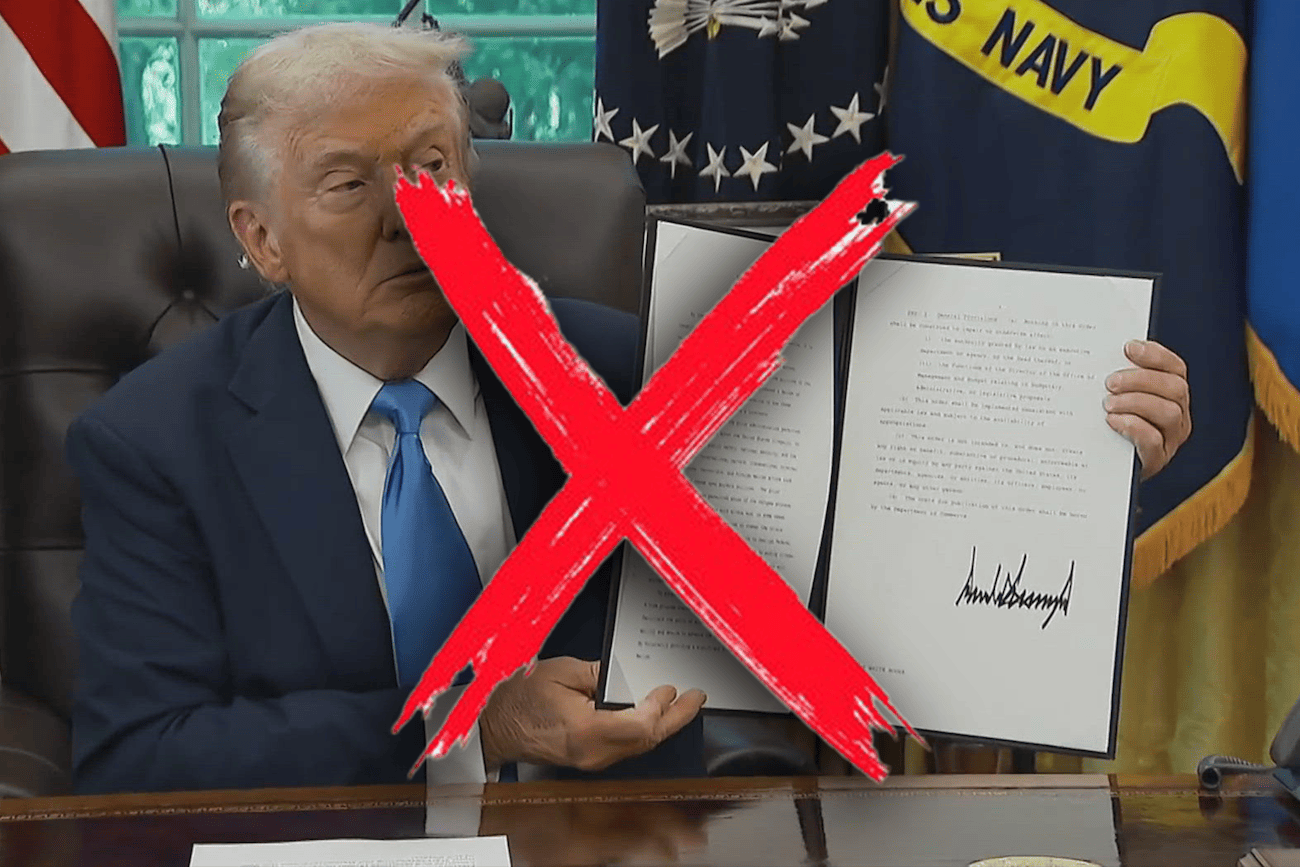

A federal judge in Boston struck down President Donald Trump’s $100,000 fee on H-1B visa applications Monday, ruling in a 42-page decision that the president had acted without legal authority and that the fee constituted an unauthorized tax that only Congress has the power to impose.
U.S. District Judge Leo Sorokin said that only Congress had the power to change federal immigration policy to include such a requirement, which he viewed as a tax, and that lawmakers had not given the executive branch permission to unilaterally make the change. “The President had no power or delegated authority to impose a tax on H-1B petitions,” Sorokin, an appointee of former President Barack Obama based in Boston, wrote in his ruling.
The ruling came in a lawsuit filed by 20 Democratic state attorneys general challenging the fee Trump announced in September, which dramatically raised the cost of obtaining H-1B visas. The case was led by California Attorney General Rob Bonta, according to the Washington Post.
From $5,000 to $100,000: Nine Months of Chilling Effect
The fee’s impact on the H-1B program had been immediate and severe. Employers seeking a visa for a foreign worker before Trump’s proclamation typically paid about $2,000 to $5,000 in fees, depending on various factors. The increase in fees had discouraged H-1B visa requests, according to court filings. As of February 15, U.S. Citizenship and Immigration Services had received just 85 payments of the $100,000 fee, the administration said in a March filing.
The fee had narrowed a major pathway for legal immigration used by tech companies, hospitals, and universities. The H-1B program offers 65,000 visas annually, with another 20,000 visas for workers with advanced degrees, approved for three to six years. Created by Congress in 1990, the program has become the primary legal pathway through which American technology companies, medical institutions, and research universities hire specialized talent from abroad — with Indian nationals historically comprising the largest share of recipients.
Trump had issued the fee by presidential proclamation on September 19, 2025, citing two provisions of the Immigration and Nationality Act giving the president broad authority to restrict noncitizen entry when he finds it would be “detrimental to the interests of the United States,” as Lawfare Media documented in its February 2026 analysis of the litigation.
The Legal Reasoning: A Tax by Any Other Name
The core of Judge Sorokin’s ruling turned on a constitutional distinction between a tax and a regulatory fee — a distinction with significant legal consequences, since the Constitution vests the power to levy taxes exclusively in Congress.
For Indian nationals, Monday’s ruling carries particular significance. The $100,000 fee had effectively priced out many small and mid-sized employers who relied on the H-1B program to hire Indian engineers, physicians, and researchers.
In his 42-page ruling, Sorokin ruled that the fee was an illegal tax on businesses and ordered it to be vacated. Sorokin used the Supreme Court’s justification in its 2012 case National Federation of Independent Business v. Sebelius, concerning fees imposed on Americans who did not sign up for the Affordable Care Act, to argue that the payment was a tax, not a penalty.
Sorokin drew the parallel carefully. “Here, the $100,000 payment requirement for all H-1B petitions does not aim to establish that hiring H-1B workers is illegal. The payment is not a penalty, just as the IRS fee in Sebelius was not, because it is not ‘punishment for an unlawful act or omission,'” Sorokin wrote.
The judge agreed with the plaintiffs who argued the fee imposed by President Trump’s executive order amounted to an “unauthorized tax,” as opposed to a “regulatory payment,” as the Trump administration contended. “The President has no authority to levy a tax unless such a power is delegated by Congress through statute,” Sorokin wrote.
A Split in the Courts
Monday’s ruling does not stand alone. The legal battle over the $100,000 fee has produced conflicting judicial decisions across different courts — a split that virtually guarantees appellate litigation.
In December 2025, U.S. District Judge Beryl Howell in Washington, D.C., reached the opposite conclusion in a challenge brought by the U.S. Chamber of Commerce and the Association of American Universities. Howell said in her opinion that Trump’s order “rests on a straightforward reading of congressional statutes giving the President broad authority to regulate entry into the United States for immigrants and nonimmigrants alike.” She wrote that “Congress has decided to delegate broad power to the President to restrict entry of noncitizens ‘[w]henever the President finds that such entry would be detrimental to the interests of the United States.'”


Howell had also addressed the policy merits in a notable passage. “To be clear, this decision in favor of defendants is not to dismiss or discount the past and ongoing contributions of H-1B workers to the American economy that plaintiffs highlight,” Howell added. “The effects of the H-1B program on the American economy or national security, whether positive or negative, are simply not at issue in this case.”
The Chamber of Commerce and Association of American Universities had filed an appeal of Howell’s ruling, according to Lawfare Media. With Sorokin now reaching a contradictory conclusion in Boston, the stage is set for the circuit courts — and potentially the Supreme Court — to resolve the split.
What the Ruling Means for Indian Skilled Workers
For Indian nationals — who constitute roughly 71 percent of H-1B visa holders, according to USCIS data cited in previous reporting — Monday’s ruling carries particular significance. The $100,000 fee had effectively priced out many small and mid-sized employers who relied on the H-1B program to hire Indian engineers, physicians, and researchers, dramatically narrowing the pipeline that has historically been the primary legal immigration pathway for Indian professionals to the United States.
The ruling lands against a backdrop of broader legal challenges to the Trump administration’s immigration policies. It also comes just two days after Sriram Krishnan, the senior White House policy adviser for artificial intelligence, announced his departure from the administration — a figure who had publicly and repeatedly advocated for maintaining skilled immigration pathways and who had personally spoken to President Trump and Vice President Vance about the contributions of Indian-born professionals to the American technology sector.
Whether the administration appeals Monday’s ruling — and given the D.C. Circuit’s contrary decision and the administration’s consistent posture in immigration litigation, an appeal appears probable — the immediate practical effect is to vacate the fee and restore the previous cost structure for new H-1B petitions, offering at least temporary relief to the technology companies, hospitals, and universities that have been navigating nine months of sharply elevated costs and dramatically reduced applications.
The Indian American community, which has watched both the fee’s imposition and the broader surge in anti-Indian rhetoric on social media through 2025 and into 2026 with mounting anxiety, received Monday’s ruling as the most concrete legal vindication of its interests since the H-1B controversy began.