




The Confederacy Rises Again: A Clarion Call to Indian Americans to Join the Fight Against Gutting of Voting Rights Act

- The protections that allowed our parents to come here, that allowed us to vote, work, own property, marry across lines that used to be illegal, all sit on the same constitutional and statutory foundation that is being kicked out from under Black Americans right now.

This week I watched a powerful campaign video from Shuchita Patel, an Indian American woman running for county commission in Forsyth County, Georgia. I won’t try to summarize it for you —go watch it. What it left me with was a question.
What are we doing to protect our country?
What is happening in this country, right now, in the span of the last ten days, is the most significant attack on civil rights in two generations. It is happening in plain sight, with the blessing of the United States Supreme Court, and most people I talk to don’t yet understand the scale of it.
Let me try to lay it out.
First, what the Voting Rights Act actually did.
Before we talk about what was just taken away, sit for a moment with what was built.
When Lyndon Johnson signed the Voting Rights Act in August 1965, there were six Black members in the entire U.S. House of Representatives — none of them from the South. By 1985, that number had more than tripled. By 1995 — thirty years after the VRA — it had grown roughly sevenfold, with the biggest single jump coming in the 1993 Congress after court-ordered redistricting under the VRA created new majority-Black districts across the South. The 1993 freshman class alone included thirteen new Black representatives, eight from Southern states that hadn’t sent a Black person to Congress since the 1800s. That class included James Clyburn of South Carolina.
Today there are 61 Black members in the House — about a tenfold increase from 1965 — and five Black senators, the highest number ever. The number of Black elected officials nationwide grew from a few hundred before the VRA to more than 9,000 by 2001. That is what the Voting Rights Act did. It is the single most successful piece of civil rights legislation in American history. And it is what the Roberts Court has now taken apart, brick by brick, over the last twelve years.
What the Supreme Court just did.
On April 29, 2026, in a case called Louisiana v. Callais, the Supreme Court issued a 6–3 ruling that, as Justice Kagan wrote in dissent, renders Section 2 of the Voting Rights Act “all but a dead letter.” Justice Alito’s opinion stops just short of saying out loud that Section 2 is dead. But it makes it nearly impossible for Black voters — or Latino, or Asian American voters — to challenge a discriminatory map in court. To win a case under the new framework, plaintiffs essentially have to prove a legislature intentionally discriminated on the basis of race, and not on the basis of partisanship. Since lawmakers can simply say they were drawing a map for partisan advantage — and partisan gerrymandering, the Court has already ruled, is non-justiciable in federal court — the door is now wide open.
This is not an accident. It is the culmination of a project John Roberts began as a young lawyer in the Reagan Justice Department, when he wrote memo after memo opposing the 1982 reauthorization of the VRA. He has now been a Supreme Court Justice for twenty years. He gutted Section 5 in Shelby County v. Holder (2013). He has now gutted Section 2 in Callais. By any measure of consequence, John Roberts is the most consequential Chief Justice in modern American history — not because of what he built, but because of what he tore down.
There is one more thing about Callais you should know. The Court originally took the case to decide a different question. After hearing argument in March 2025, the conservative majority reset the case for reargument in the fall and asked the parties to brief a new question — whether creating a majority-minority district as a remedy under Section 2 violates the Constitution. They reached out and pulled a Section 2 question into a case that wasn’t about Section 2, just so they could gut it. That is not how courts of last resort are supposed to behave. That is a political body in robes.
Alito’s data was bad. Possibly deliberately.
In his majority opinion, Alito claimed that Black voter turnout has now exceeded white voter turnout in two of the last five presidential elections, both nationally and in Louisiana. As The Guardian, The New Republic, and several election researchers have since pointed out, this claim came almost verbatim from a Trump DOJ amicus brief, and it relied on a methodology that no serious election scientist uses — calculating turnout as a share of the total over-18 population, including non-citizens and people barred from voting by felony convictions. Run the numbers the way researchers actually run them — as a share of the citizen voting-age population — and Black turnout has not come close to white turnout in any of the last three presidential elections in Louisiana. The Brennan Center’s Kevin Morris put it bluntly: “In zero out of the last three presidential elections did Black turnout come anywhere close to parity.”
The Supreme Court is not afraid of us. The state legislatures grinding through these maps in special sessions are not afraid of us. The Virginia justices who threw out three million votes are not afraid of us. That has to change.
Alito either didn’t check, or did check and used the bad numbers anyway. Pick whichever is worse.
Then came the states.
Within hours of the Callais ruling, Republican-led states moved. Louisiana suspended its May 16 primary — while early voting was already happening, after more than 100,000 votes had been cast and 42,000 absentee ballots had been returned — to redraw its map.
Florida signed a new gerrymander into law on May 4. Governor DeSantis’s lawyers told the legislature, in writing, that Callais effectively voided Florida’s Fair Districts Amendment — the anti-gerrymandering provision Florida voters approved by 63% in 2010. The new map could flip four Democratic seats to Republicans. The legislators who wrote it admitted, on the floor, that they made no effort to comply with Fair Districts. Voting rights groups sued within hours.
Tennessee held a special session and, on May 7, signed a new 9–0 Republican map into law. To do this, they sliced the city of Memphis — the heart of the state’s only majority-Black district, TN-9, the only district held by a Democrat — into three separate districts. The bill’s Republican Senate sponsor, John Stevens, repeatedly insisted on the floor that he and his colleagues were “not aware” of Memphis’s majority-Black demographics. Black legislators including Sen. London Lamar, Sen. Raumesh Akbari, and Rep. Justin J. Pearson told the chamber, plainly, that what they were watching was the revival of Jim Crow. They were the minority. The map passed. The NAACP sued the same day.
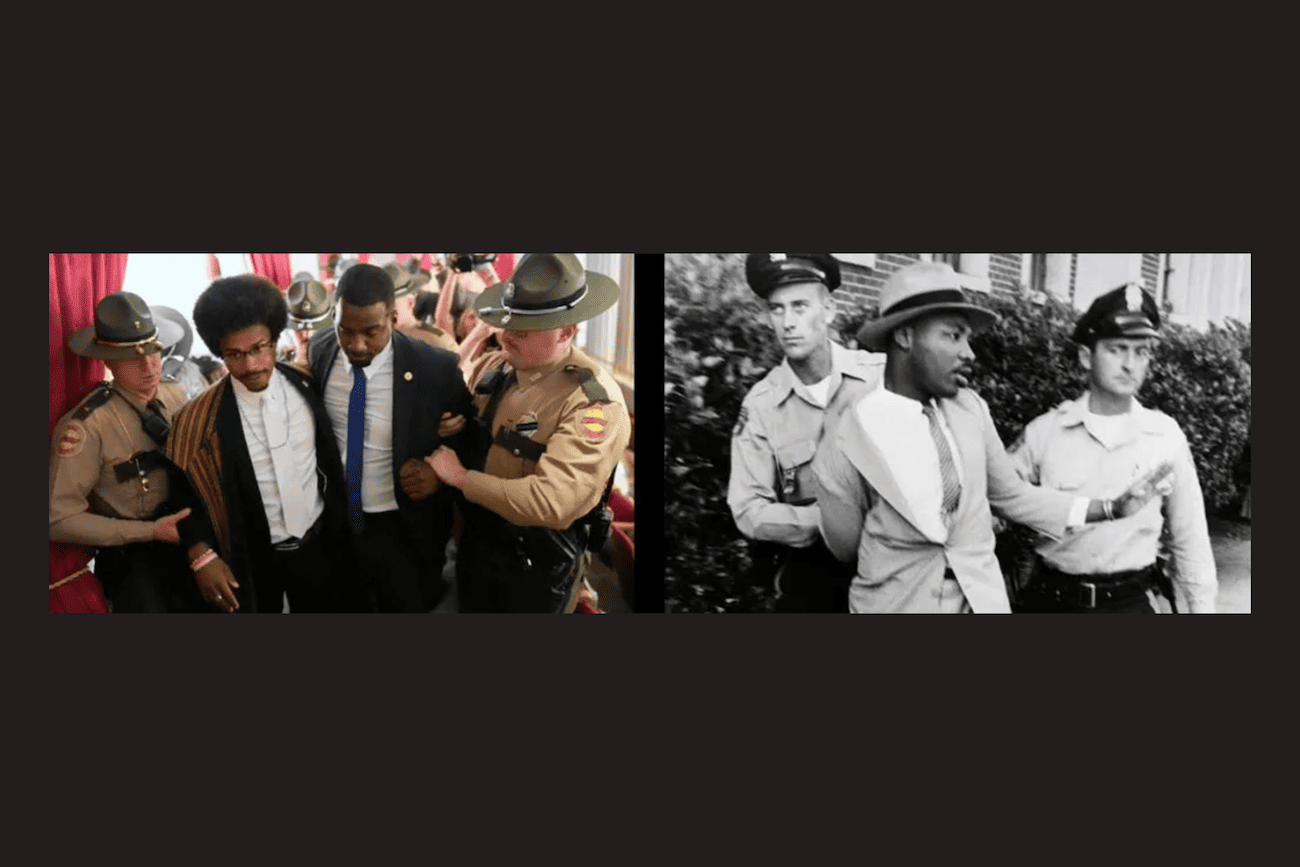
While the vote was happening, state troopers cleared the gallery. Rep. Pearson’s own brother, KeShaun Pearson, was arrested and removed in handcuffs. There are now photographs — the kind you should sit with for a moment before scrolling past — of a young Black congressman in 2026 being physically restrained by uniformed state troopers in a Southern statehouse, placed side by side with photographs of Dr. Martin Luther King Jr. being arrested in 1958 and of George Wallace standing behind a wall of state troopers a few years later. The visual rhyme is not subtle. It is not supposed to be. This is what Jim Crow looks like, reads the caption on one of these images. Do not look away. Pearson himself called what happened on the House floor that day a “political lynching.”
Texas had already done this in August 2025 — drew a five-seat Republican gerrymander, was struck down by a federal three-judge panel that found it an illegal racial gerrymander, and was then rescued by the U.S. Supreme Court in December, which stayed the ruling and let the map stand for 2026.
Mississippi is moving on three fronts at once. Governor Tate Reeves announced a special session before Callais was even decided, originally scoped to redraw the state Supreme Court districts after a federal judge ruled they violated Section 2 of the VRA. Within days of the Callais decision, Reeves told the Daily Caller he was now considering expanding the session to include congressional and state legislative maps — and pointed directly at the district of Rep. Bennie Thompson, the state’s lone Democrat in Congress and the only Black member of Mississippi’s congressional delegation. “We know that Mississippi’s majority-minority district was drawn race-consciously,” Reeves said. “I anticipate that the Mississippi Legislature certainly will reevaluate our state’s congressional map at the earliest opportunity.” Mississippi is roughly 38% Black — the highest Black population share of any state in the country. Alabama, the day after Callais, asked the Supreme Court to throw out the court-drawn remedial map from Allen v. Milligan (2023) — the case the same Supreme Court had decided just three years earlier. South Carolina is considering a special session of its own.
And then there’s Virginia.
This is the part that should make every American with a pulse pause.
In Virginia, when Democrats decided to fight back against the Republican gerrymanders, they didn’t just have the legislature redraw the map. They put it to the voters in a referendum. On April 21, 2026, more than three million Virginians went to the polls. They approved the redistricting amendment by roughly three percentage points.
On May 8, Virginia’s Supreme Court — by a 4–3 vote — threw the result out. The reasoning was procedural: that the legislature had taken its first vote on the amendment too close to the 2025 House of Delegates election, depriving voters of an “intervening election” to weigh in. The 6–5 Democratic-leaning map stays. The voters’ decision — explicit, recent, with massive turnout — was nullified.
Six Republican states changed their congressional maps mid-decade with no public vote. All allowed to stand. One Democratic state changed its map with the consent of three million voters. Struck down. You don’t have to be partisan to notice that the standards aren’t being applied evenhandedly.
Look at the map of who is doing this.
Here are the states that have moved or are moving to redraw their congressional maps to entrench Republican power in the wake of Callais: Alabama, Florida, Louisiana, Mississippi, South Carolina, Tennessee, Texas. Earlier in this cycle: North Carolina. Georgia is reportedly waiting for 2028.
Now here are the eleven states of the Confederacy: Alabama, Arkansas, Florida, Georgia, Louisiana, Mississippi, North Carolina, South Carolina, Tennessee, Texas, Virginia.
This is not a coincidence. It is not, as some commentators want to insist, simply about partisan power. The geography is the tell. The history is the tell.
There is a map circulating this week that makes the point even more sharply. It shows how every state’s senators voted on the Voting Rights Act in 1965. The states whose senators voted against the Act — both Nay — were Virginia, North Carolina, South Carolina, Georgia, Florida, Alabama, Mississippi, Louisiana, and Arkansas. Texas was split, with one Yea and one Nay. Now look at the list of states currently redrawing their congressional maps to entrench Republican power and dismantle majority-Black districts: Louisiana, Florida, Mississippi, Alabama, South Carolina, North Carolina, Texas. With the addition of Tennessee, which is its own story, it is almost exactly the same map. The states that voted against the Voting Rights Act in 1965 are, sixty years later, leading the charge to dismantle it. That is not a coincidence. That is institutional memory. That is a project that has been waiting for its moment.
Press enter or click to view image in full size


As the lawyer Marc Elias put it: “I am struck by the relish, by the glee, the joy that these southern states right now are taking in destroying Black opportunity districts.” Tennessee NAACP President Gloria Sweet-Love said the special session in Nashville reminded her of her teenage years — before the Voting Rights Act was passed in 1965.
There have only been four Black members of Congress elected from Louisiana since Reconstruction. Four. In 160 years. The 2024 map that Callais just struck down was the one that finally created a second Black opportunity district. It was a generational achievement. It lasted one election cycle.
What John Roberts wants you to believe.
To slightly adapt Orwell: the Court told you to reject the evidence of your eyes and ears. It was its final, most essential command. Chief Justice Roberts has spent the last several years giving speeches insisting that he and his colleagues are not “political actors,” that they are simply applying the law. Callais — a case the Court reached out to reframe so it could deliver a predetermined outcome, decided 6–3 along the same political lines as the appointing presidents, weaponizing methodologically dishonest data — is the answer to that claim.
I keep thinking about what a friend shared with me several years ago, after he visited the Pentagon and noticed how many bathrooms there were. His escort explained: the Pentagon is in Virginia, and when it was built, Jim Crow laws were in effect. Separate facilities were required by law.
Faulkner: The past is not dead. It is not even past.
A note to my fellow Indian Americans, and to other immigrants. I am writing this not just for my regular audience but also for my Indian American audience on American Kahani, because I want to say something specifically to the South Asian and broader immigrant communities in this country.
You and I are here in large measure because of what Black Americans built. The Immigration and Nationality Act of 1965 — the Hart-Celler Act, which abolished the racist national-origins quotas that had kept us out for decades — was passed in the same legislative wave, by the same coalition, in the same political moment, as the Civil Rights Act of 1964 and the Voting Rights Act of 1965. It is not metaphor. It is history. The civil rights movement, led by Black Americans who marched and bled and died, made the country we were allowed to enter.
When Black political power is being dismantled in the South — when the Voting Rights Act is being hollowed out, when majority-Black districts are being sliced apart, when state legislatures are openly returning to the practices of the Jim Crow era — that is not somebody else’s fight. The protections that allowed our parents to come here, that allowed us to vote, work, own property, marry across lines that used to be illegal, all sit on the same constitutional and statutory foundation that is being kicked out from under Black Americans right now.
If you are tempted to shrug and say “well, Black voters can still vote for whoever they want” — please do not miss the point. The point is not whether you can mark a ballot. The point is whether the lines around you have been drawn so that your ballot cannot ever produce a representative who answers to your community. That is what Callais and the new maps are doing.
We have been told something.
Another friend reminded me recently of the difference between American and French democracy: in America, citizens are afraid of their government. In France, the government is afraid of its citizens.
The Supreme Court is not afraid of us. The state legislatures grinding through these maps in special sessions are not afraid of us. The Virginia justices who threw out three million votes are not afraid of us.
That is the thing that has to change.
Not in November. Not in 2028. But NOW.
Ganpy Nataraj is an entrepreneur, author of “TEXIT – A Star Alone” (thriller) and short stories. He is a moody writer writing “stuff” — Politics, Movies, Music, Sports, Satire, Food, etc.