




Power Without Accountability: Mohan Bhagwat’s American Visit and the Constitutional Ambiguity of the RSS

- The problem is not that Bhagwat speaks abroad. The question is more exacting: who authorized a private ideological organization to represent the plurality of Hindu traditions, much less the plurality of India?
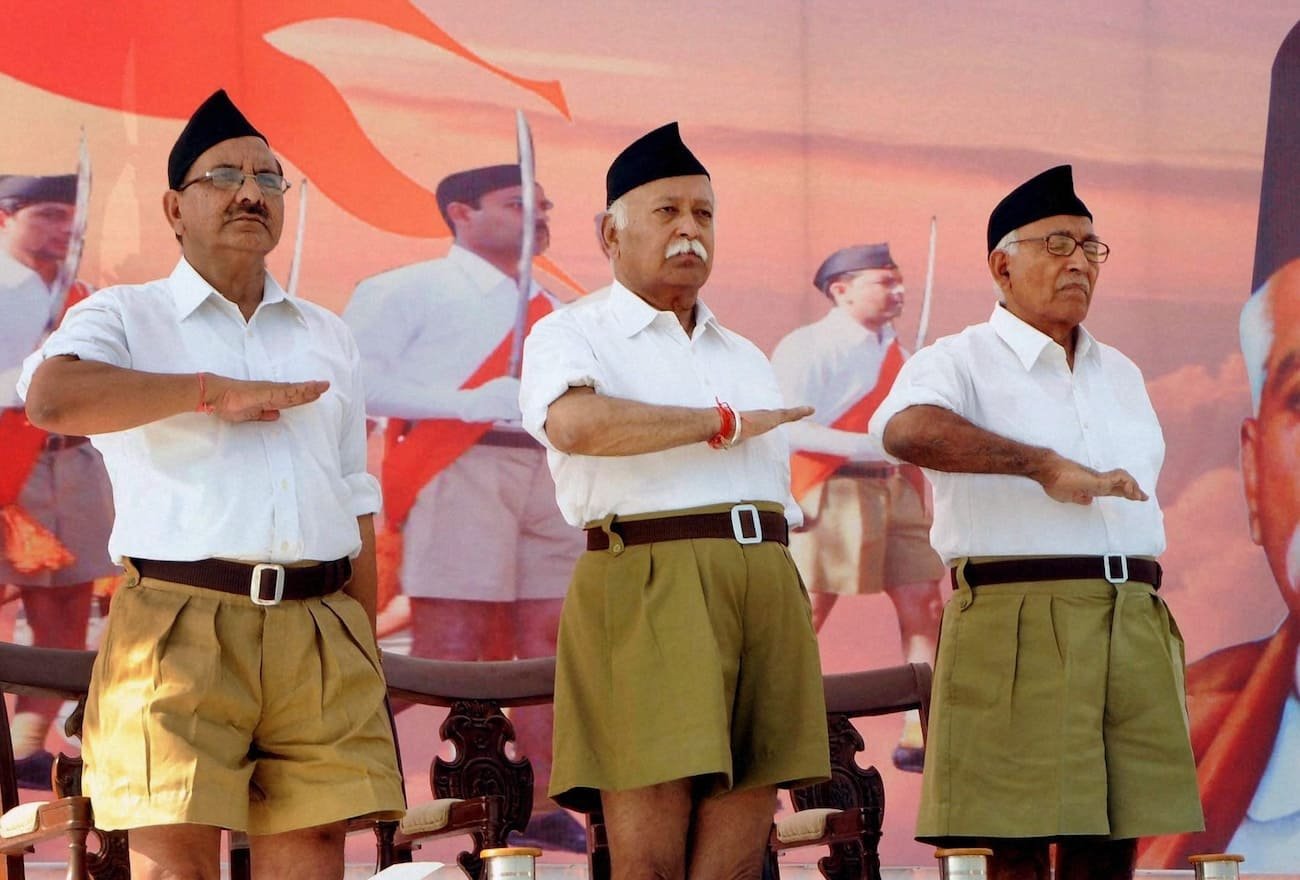

When Mohan Bhagwat speaks at Madison Square Garden, the significance of the occasion will not lie primarily in the size of the audience or in the familiar spectacle of diaspora enthusiasm.
Nor will it be settled by the contest between those who welcome him as a custodian of civilizational inheritance and those who oppose him as the leader of a majoritarian movement.
The more consequential question is institutional: in what capacity does the head of the Rashtriya Swayamsevak Sangh appear before an international audience? He is not an elected representative of India. He holds no constitutional office, answers to no legislature and exercises no authority formally recognized by the Republic. The RSS is not a political party, a department of government, a statutory cultural institution or an accredited representative of Hinduism. In law, it is a private organization.
Yet Bhagwat does not travel as an ordinary private citizen. His words are examined for signals about India’s political direction. Diaspora organizations receive him as a figure of national consequence.
Public officials and influential institutions are encouraged to treat engagement with him as engagement with something larger than the organization he formally heads. He can speak in the name of Hindu civilization, often in the name of Indian culture and, by implication, in the name of India itself.
Here lies the ambiguity at the heart of his visit: the RSS increasingly enjoys the representational privileges of public authority while retaining the legal latitude and limited accountability of a private association.
This position was not created through any formal transfer of power. It emerged through a convergence of organization, ideology and political success. The Bharatiya Janata Party does not conceal its historical origins in the Sangh. Many of its most powerful leaders, including the prime minister, were formed within the RSS. Its cadres reinforce the party’s electoral reach; organizations within the wider Sangh family work across education, labor, religion, welfare, tribal affairs and culture. The relationship is neither a secret conspiracy nor a simple chain of command. It is more durable than either: an ecosystem of shared formation, vocabulary and purpose, complicated by periodic disagreements over policy, leadership and political method.
This ecosystem permits an unusual division of institutional labor. The BJP governs, contests elections and answers—however imperfectly—to Parliament, courts and voters. The RSS works across a longer horizon: national character, civilizational memory, social organization and the moral boundaries of belonging. The party administers the state; the Sangh seeks to shape the meaning of the nation.
The arrangement is not unique to India. The United States has spent two centuries negotiating the influence of religious movements, ideological networks, corporate boards and philanthropic fortunes. The Religious Right has shaped electoral outcomes and judicial appointments. Think tanks—explicitly ideological—advise administrations. Billionaire philanthropists mark cultural institutions and public discourse.
American practice is uneven, and often late. What American democracy did develop, and what it still possesses as a usable principle, is this: institutional clarity and public scrutiny must accompany influence.
When evangelical leaders meet with American presidents, the meeting can be documented. When think tanks shape policy, their funding can be asked after. When corporate executives move between private wealth and public office, conflict-of-interest rules apply, however imperfectly.
Citizens can ask of any such power: through what mechanisms? With what accountability? The influence is not prohibited. The opacity is.
When American intellectuals, activists or religious figures travel internationally, they travel as representatives of themselves or of their explicit organizations—not as ambiguous carriers of national meaning. They are not simultaneously insulated from accountability and decorated with governmental prestige.
India faces a different difficulty: an organization that claims neither governmental authority nor accountability, yet increasingly exercises both through proximity and ideology. Because the two remain legally separate, each can emphasize distance when distance is useful. The government may describe the RSS as an independent cultural organization whose conduct is not attributable to the state. The RSS can say that it neither contests elections nor seeks office. Yet the organization’s international authority is amplified by the knowledge that those who govern India often acknowledge it as a source of ideological formation.
This is the institutional problem a mature democracy learns to make visible. India has not.
The outreach is no longer occasional. Bhagwat addressed the World Hindu Congress in Chicago in 2018. Senior RSS figures have since engaged institutions and communities across the United States, Britain and Europe. His present tour, undertaken during the organization’s centenary, is intended to reach the Indian diaspora on a still larger scale.
Each such appearance helps shift the RSS’s international status: from one association among many within Indian civil society to an unofficial interpreter of Indian civilization.
The difficulty is not that Bhagwat speaks abroad. The United States is right to protect his freedom to speak, just as it must protect the freedom of those who criticize or peacefully protest his appearance. A democracy cannot defend pluralism by suppressing lawful expression. Nor should Hindu Americans be asked to apologize for seeking cultural visibility. Every diaspora carries memory, faith and attachment across borders.
The question is more exacting: who authorized a private ideological organization to represent the plurality of Hindu traditions, much less the plurality of India?
Hinduism has no central church, single ecclesiastical hierarchy or authorized spokesman. Its civilizational abundance lies precisely in its refusal to become one thing. Its history contains devotion and scepticism, ritual and metaphysics, orthodoxy and rebellion.
That plurality has weight. Kabir unsettled boundaries between communities not through compromise but through spiritual conviction—he did not demand that Hindu tradition unanimously endorse his vision. The Bhakti traditions challenged inherited hierarchies, yet they did not insist that all who called themselves Hindu follow their path.
Vivekananda carried a confident Hindu voice abroad. He spoke for Hindu civilization with force and clarity, but he did not demand a uniform political Hinduism. He understood that confidence does not require unanimity. Gandhi made his faith a discipline of moral responsibility rather than an entitlement to collective supremacy. Ambedkar exposed what civilizations conceal when reverence becomes a substitute for reform. These were not marginal figures in Hindu intellectual history. They represent the civilization’s deepest confidence: that it can speak powerfully without demanding obedience.
The RSS claims to defend Hindu tradition. No organization, however extensive or disciplined, inherits an entire civilizational inheritance merely by claiming to protect it. Civilizational confidence means something more precise. It means the willingness to defend the tradition’s plurality against those who would reduce it—even if the reduction promises greater political power.
That is what separates a guardian of a civilization from an organization seeking to monopolize it.
India, too, is larger than any ideological account of its civilization. The Republic was not constituted as the political expression of a religious majority. It was created as a common home in which numerical strength would not determine the moral worth of citizenship. Its audacity lay in making equal belonging the foundation of nationhood in a society marked by extraordinary religious, linguistic and caste diversity.
To represent India is not simply to celebrate its majority civilization. It is to accept responsibility for every Indian—including those who do not share the majority’s faith, those who interpret it differently and those who reject its use as a basis of political authority.
To represent India, therefore, is not simply to celebrate its majority civilization. It is to accept responsibility for every Indian—including those who do not share the majority’s faith, those who interpret it differently and those who reject its use as a basis of political authority.
This distinction becomes especially important in the diaspora. Hindu Americans rightly insist that their religion should not be caricatured, their temples should be protected, their children should not inherit shame for practices they do not hold, and prejudice against Hindus should be recognized as prejudice. These are legitimate claims of equal citizenship.
But equality is indivisible. A diaspora cannot persuasively demand protection as a minority in America while endorsing conditional belonging for minorities in India. It cannot invoke American pluralism to defend its own identity and dismiss Indian pluralism as an alien restraint. The principle that protects a Hindu temple in New Jersey is continuous with the principle that protects a mosque in Uttar Pradesh and a church in Odisha.
The most confident defense of Hindu dignity would understand this reciprocity. It would say: because we know what it means to be a minority, we will be especially vigilant about minority dignity where Hindus form the majority.
That would be civilizational confidence of a high order—one that converts historical memory into ethical imagination rather than permanent grievance.
Here lies India’s deepest vulnerability, one that Bhagwat’s visit exposes but does not resolve.
A mature democracy distinguishes between challenging an organization and betraying the nation. It understands that criticism of power is the luxury of confidence, not the mark of disloyalty. An American who questions the influence of evangelical networks on policy faces no question about patriotism. A European who examines the role of conservative think tanks in shaping education policy is not accused of being anti-European. Disagreement, in a confident democracy, is treated as what it is: the exercise of citizenship.
India increasingly does not make this distinction. An Indian who questions the RSS’s institutional opacity is often assessed for hidden allegiances. To scrutinize the organization’s relationship with government is to invite the suspicion of anti-nationalism. To ask who authorized an ideological organization to represent Indian civilization is to be marked as hostile to Hindu identity or, more darkly, to national unity. The “Pakistani agent” smear or the “anti-national” epithet becomes the answer to substantive questions.
This is not loyalty to the nation. It is loyalty to an organization. It mistakes the defense of institutional accountability for the betrayal of national interest.
Nations that confuse themselves with their dominant ideologies—that treat questioning power as questioning the country—are not displaying strength. They are confessing uncertainty about where the nation ends and the organization begins. A polity sure of itself can afford to have its institutions examined. A polity unsure of the distinction lashes out, because the examination threatens to reveal that the distinction was never secured.

India’s defensive reaction to critiques of the RSS signals something urgent: that the nation is not yet confident enough to distinguish between its government, its majority religion and its ruling ideological organizations. It treats these as a seamless whole to be defended rather than as distinct entities to be examined.
Bhagwat’s visit therefore presents the RSS with an opportunity more demanding than assembling a sympathetic audience. If it wishes to be heard as the bearer of a universal message, it must be prepared to answer universal questions.
Does its conception of the Hindu nation guarantee an equal and unqualified place to Muslims and Christians—not merely as protected communities, but as co-authors of India? Does it accept that a citizen may reject Hindutva and remain no less Indian? Will it condemn hatred against minorities with the same clarity with which it condemns hostility towards Hindus? How does it confront caste not simply as a social distortion but as a hierarchy that has often received religious sanction? Does it recognize that Hindu pluralism includes the freedom to refuse the RSS’s interpretation of Hinduism?
These are not hostile questions. They accompany any serious claim to moral leadership.
The institutional ambiguity cannot be resolved in New York. It must be addressed in India. A constitutional democracy should know where consequential authority resides and how that authority may be examined. If an organization influences public policy, political appointments, education, cultural institutions or the ideological direction of government, citizens are entitled to understand the character of that influence.
What are its rules of membership and internal decision-making? How are its leaders selected and held accountable? How are its finances and institutional relationships organized? When ministers, officials or diplomats participate in RSS-linked programs, are they acting in a public or private capacity? When overseas organizations describe themselves as culturally independent but draw inspiration, personnel or direction from the Sangh, what is the precise relationship? Where does voluntary cultural work end and quasi-public authority begin?
Answering such questions does not require prohibition or persecution. It requires democratic clarity. The RSS has every right to organize, advocate and seek influence. But influence of national consequence should carry obligations proportionate to its power. At a minimum, that means transparent institutional and financial structures; disclosure when formal consultations occur between government and ideological organizations; clear rules governing the participation of public officials in partisan or ideologically affiliated events; and candor about the organizational relationships connecting domestic and overseas bodies.
The principle should apply not only to the RSS but to every religious, corporate, ideological or civil-society organization that acquires sustained influence over the state. The democratic concern is not the identity of the organization. It is unaccountable power.
American criticism must also withstand scrutiny. Some accounts flatten India into a morality play and treat every assertion of Hindu identity as evidence of extremism. American institutions have not applied their concern for religious freedom with perfect consistency. A credible response to the RSS must avoid selective indignation, theological illiteracy and civilizational condescension.
But inconsistency in the critic does not answer the criticism. The most persuasive RSS response would not be to classify every objection as anti-Hindu prejudice. It would be to demonstrate, through words, organization and conduct, that Hindu self-respect requires no one else’s political diminishment.
The RSS cannot reasonably remain private when accountability is demanded and become quasi-official when recognition is offered. It cannot claim a cultural constituency larger than itself while remaining insulated from the contestation that public representation entails. It cannot enjoy the prestige of proximity to government and invoke complete distance whenever that proximity is examined.
A confident organization would not need the shelter of that ambiguity. It would recognize that public legitimacy does not come merely from numbers, discipline, longevity or access to government. It comes from accepting that those over whom one exercises influence have the right to ask who authorzed it, how it operates and what limits it observes.
Madison Square Garden may provide grandeur, applause and international visibility. But representation is not conferred by the size of a hall or the enthusiasm of an audience. It is earned by the breadth of belonging one is prepared to defend.
The deepest question raised by Bhagwat’s American journey is therefore not whether the RSS has become powerful. That is no longer in doubt. It is whether that power is willing to accept a constitutional ethic—whether it can distinguish between strength and secrecy, between confidence and control, between speaking for a tradition and silencing those who hear it differently.
India’s capacity to answer this question will reveal something essential about the nation’s own confidence. A state that cannot distinguish disagreement from disloyalty, that treats questioning power as questioning identity, has already begun to confuse itself with the organizations it should be scrutinizing. That is not national strength. That is national fragility masquerading as unity.
If the RSS wishes to speak for India before the world, it must first demonstrate that the India for which it speaks includes—equally, securely and without qualification—everyone. And if India is to remain a democracy, it must demonstrate that those who ask this question are patriots, not traitors.
Satish Jha, former Editor, Indian Express Group and The Times of India Group writes on geopolitics, international affairs, and development.
Relax. Mohan Bhagwat, the RSS chief spoke and gone. No harm was done. Many like him will come and go. In his remarks, he did not say, he was speaking for the Hindu faith. The beauty of my Hindu (Sanatan Dharma) faith is that it is diverse collection of philosophies, traditions and local religious practices, rather than monolith with single leader and dogma like Christianity, Islam, and Judaism. No one tell us how to be a Hindu. We have had our shares of Shankaracharyas, Swamis and Gurus. Mohan Bhagwat spoke about philosophy of Kutumba. I believe in Kutumba philosophy. India is a diverse country with multitude of religions, languages, skin tones, cuisines and lifestyles. At the end, we proudly call ourselves INDIAN. This great Vashudhaiva Kutumbakam philosophy defines India. Many have tried to break us-divide us, but failed. We are one Kutumba.
Satish Jha demands under what authority did RSS leader speaks about India’ plurality? Interesting question . He forgets that India speaks for all faiths and people, Muslims speak under their unified Islamic authority, Christians under their institutional authority. Only the Hindus have no institutional system. Hindus are diverse, plural by nature and practicing mutual respect to all. Jha forgets all of this. Mohan Bhagwat was invited by the diverse diaspora & about 135-200 organizations. That is individual Hindu authority given to an Indian leader to speak about the most profound philosophical idea given to the world about Universal oneness! Jha can demand but he has no right to discredit RSS leader speaking to 6000 people of all faiths about being equal!
The author is a fanatic and a person with some grudge. Mohan Bhagwat talked about Kutumb and oneness. If you talk to any social studies professors and social workers, you will hear one and only one phrase: ” broken family. The very foundation of peace on the earth is a Happy family, which makes a Happy country and a Happy world. . He did not act as a preacher of Hinduism . And RSS is falsely narrated by Nehru for his personal gain to remain in power. Today, the Congress party is carrying the same narratives. Look into their activities. Only Sewa of people in distress.
Have you seen Indian Television in the last ten years? The Christian preachers of all colors are on TV and making a case of Chrisianity by fabricated stories.
For your information, learn to read Sanatan philosophy and spread it for peace on this earth,
Making such foolish cartoons will not bring peace.. Sanatan is the only way for peaceful coexistence on this earth.