




Divided Oneness: Mamdani Opposes Bhagwat’s Madison Square Garden Event — But Says the City May Lack Power to Stop It

- A coalition of 61 organizations, a thousand letters to Marco Rubio, an invocation of a 1939 Nazi-allied rally at the same venue, and the personal opposition of the first Indian American mayor in New York's history — and yet, as of Wednesday morning, the RSS chief's August 29 event is still on.
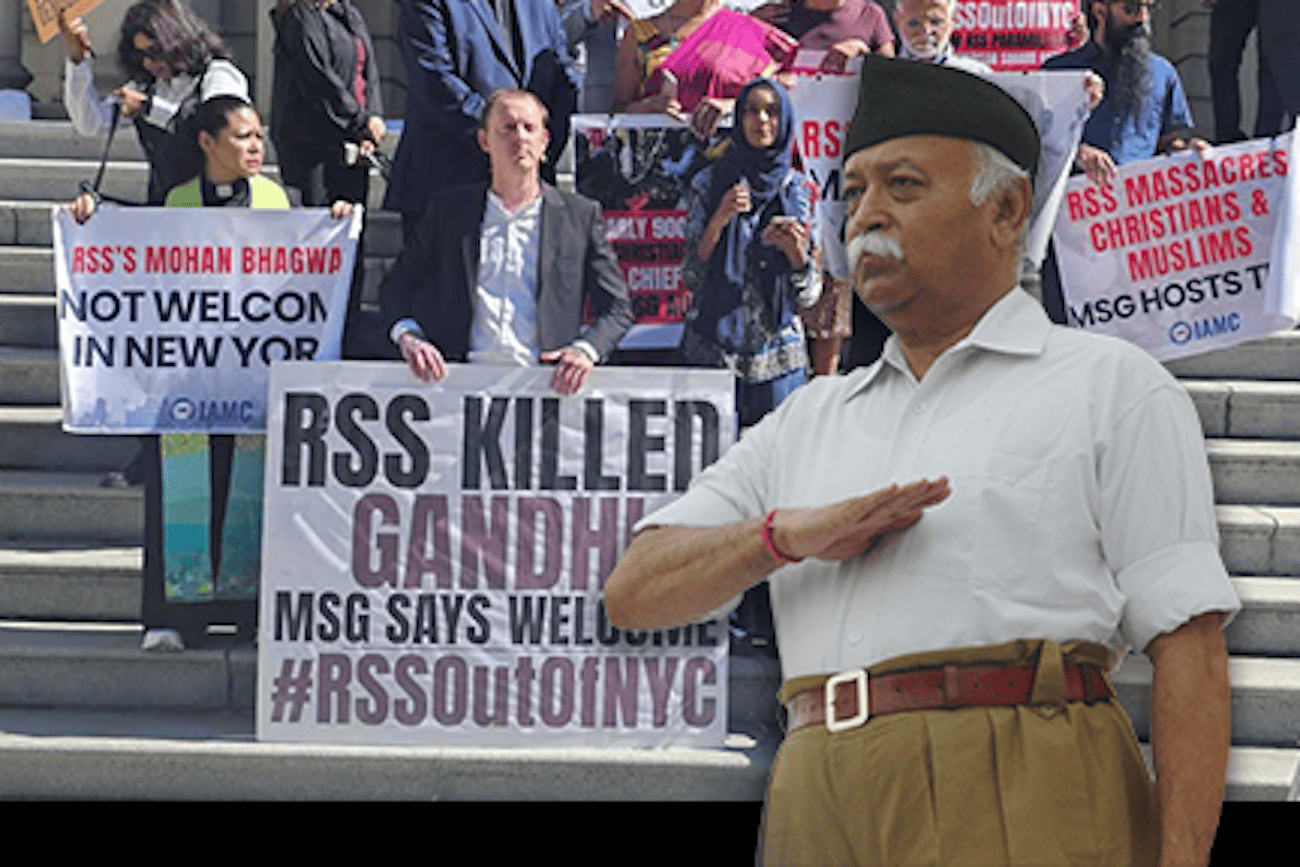

On Saturday, August 29, 2026, Mohan Bhagwat — the sarsanghchalak, or supreme leader, of the Rashtriya Swayamsevak Sangh, the century-old Hindu nationalist organization that anchors India’s ruling establishment — is scheduled to take the stage at Madison Square Garden before thousands of members of the Indian American community.
The event is titled the “Universal Oneness Celebration” and is organized by the American Hindus for Engagement and Dialogue Forum, known as AHEAD. It falls during the Hindu festival of Raksha Bandhan and during the RSS’s centenary year — the organization was founded in 1925 — and is part of a broader international outreach tour by Bhagwat that also includes stops in Canada and the United Kingdom.
AHEAD has presented the event in deliberately expansive, inclusive terms. The organization says the Universal Oneness Celebration is intended to promote “unity, not separation” and will include cultural programming and discussions about community service, respect for nature, and unity across traditions. The organization describes the event as seeking to extend the meaning of Raksha Bandhan beyond family relationships to broader ideas of mutual responsibility and respect across communities.
“I Don’t Support the Rally”
The most significant institutional response to the event came on Tuesday from New York City’s new mayor — himself the first Indian American to hold that office — at what was ostensibly an unrelated media briefing on emergency housing court cases.
Zohran Mamdani, 34, who won New York City’s Democratic mayoral primary in July 2025 before cruising to victory in November, was asked directly whether the city should intervene to cancel the August 29 gathering. His answer was careful, personal, and politically significant on multiple dimensions simultaneously.
“I don’t support the rally, but I don’t know if the city has any jurisdiction on canceling a private event,” Mamdani said. His wording placed the event’s future with the private venue rather than with City Hall, and was immediately parsed by both supporters and critics as a meaningful refusal to use mayoral power to stop a legal private gathering.
But the substantive content of his opposition went considerably beyond that formulation. Invoking his own family connection to India — his mother’s family remains in the country — Mamdani offered what amounted to a personal political statement about the values at stake.
“I also stand here as the first Indian American mayor in our city’s history, and my mother’s family is all still in India,” he said. “The vision of India that I was taught by my family and the one that I grew up being very familiar with was of a pluralistic society — a secular republic that believed in the belonging of each and every person who was from India.”
“It has been incredibly troubling to see the rise of a movement that is predicated on an exclusionary vision of any country, frankly,” he continued. “And so it is one that I find myself in deep opposition to — not only as an Indian American, but also as the mayor of a city that believes deeply in the belonging of each and every person, no matter their color, their creed, their religion, their faith, wherever they’re from.”
A Coalition of 61 Organizations — and a 1939 Parallel
The mayor’s opposition has been accompanied by a coordinated and growing institutional campaign against the event that has recruited 61 civil rights, faith, community, and advocacy organizations.
The organizations opposing the event represent a deliberately broad interfaith and civil rights coalition. According to Hindus for Human Rights’ official statement, organizations participating in the opposition include 18 Million Rising, the Arab Resource and Organizing Center, ASATA Asian Refugees United, Boston Coalition for Palestine, the Boston South Asian Coalition, the Coalition of Seattle Indian Americans, CodePink, the Council on American-Islamic Relations New York chapter, the Dalit Solidarity Forum, DRUM — Desis Rising Up and Moving, Ensaaf, Grassroots Asians Rising, Jews for Racial and Economic Justice, Judson Memorial Church, Justice for All, the Middle Church, the Movement for Black Lives, Muslims for Progressive Values, the New York Sikh Council, and dozens of others spanning the full spectrum of progressive civil society in New York and beyond.
At a press conference outside New York City Hall, Lander reached for one of the most charged historical comparisons available. He invoked Madison Square Garden’s hosting of a German American Bund rally in 1939 — when thousands of Nazi supporters filled the same venue — and said that Madison Square Garden “should not host this one.”
The elected officials who have formally called on Madison Square Garden to cancel the event include New York City Council Member Shahana Hanif, Brad Lander — the Democratic nominee for New York’s 10th Congressional District and former New York City Comptroller — and City Council Member Lincoln Restler, as the Hindus for Human Rights official statement and IAMC confirmed.
At a press conference outside New York City Hall, Lander reached for one of the most charged historical comparisons available. He invoked Madison Square Garden’s hosting of a German American Bund rally in 1939 — when thousands of Nazi supporters filled the same venue — and said that Madison Square Garden “should not host this one.”
City Council Member Hanif alleged that New York’s South Asian communities had experienced the effects of what she described as “the hateful ideology and violence associated with the RSS.”
Amin Zama of the Indian American Muslim Council was careful to draw a distinction that the opposition coalition has consistently maintained. “Our message today is not against Hindus,” Zama said. “Our message is against an ideology that seeks to define citizenship and national belonging through religious identity.”
Hindus for Human Rights, in its official statement, made the same distinction explicitly. “Hindus for Human Rights rejects the attempt to equate opposition to Hindu nationalism with anti-Hindu bigotry,” the organization wrote. “Hindutva is a political ideology. Speaking against it is essential to protecting Hindu communities from an authoritarian and exclusionary movement that seeks to subjugate the majority of Hindus and take away the freedoms of all Indians, regardless of faith.”
A Thousand Letters to Marco Rubio — and a USCIRF Recommendation
The campaign against the event extended beyond the arena of city politics and institutional organizing into federal advocacy and international civil society.
The Indian American Muslim Council confirmed in an official statement dated August 23 that more than 1,000 people from across the United States had written to Secretary of State Marco Rubio urging him to deny or revoke Bhagwat’s U.S. visa and cancel the August 29 event. The letters, collected by the IAMC and allied organizations, arrived after Bhagwat had already received his visa — he arrived in New York on Tuesday — but were framed as an ongoing demand for accountability.

The IAMC’s statement placed the visa demand in the context of a broader institutional reckoning with the RSS in Western countries. In a historic development in March 2026, the U.S. Commission on International Religious Freedom — an independent federal government commission — had recommended targeted sanctions against the RSS, including asset freezes and visa restrictions on RSS leadership, for what the commission described as its involvement in “acts of extreme violence and intolerance against members of minority groups for decades” and its mission of creating a Hindu nation that excludes Indian Muslims, Christians, Sikhs, and other minorities, as the IAMC statement documented.
The Congressional Research Service, the research arm of Congress, describes the RSS as a “hardline Hindu nationalist” organization, as the IAMC statement noted. Human Rights Watch has identified the RSS and its offshoots as “most responsible” for violence against Christians and “directly responsible” for the 2002 anti-Muslim violence in Gujarat, according to the same statement.
In Canada, where Bhagwat’s tour also includes a stop, more than 40 civil society, human rights, labor, and faith organizations had asked the Canadian government to bar him, and two Canadian Members of Parliament had called for the RSS to be banned, as the IAMC documented.
Hindus for Human Rights also published a report titled “Fibs, Fronts and Fixers: The Hidden Machinery Behind Mohan Bhagwat’s U.S. Visit,” which, the organization said, “traces the people and institutions organizing his appearances and examines apparent discrepancies between their public descriptions and documented connections to the RSS.”
The Organizers Push Back
These characterization of the event has been vigorously contested by AHEAD and its supporters.
AHEAD’s description of the Universal Oneness Celebration frames it in terms of cultural celebration, Raksha Bandhan, community service, and interfaith unity — a set of themes designed, as critics have argued, to make the RSS’s participation palatable to audiences unfamiliar with the organization’s history in India. The organization’s choice of name — American Hindus for Engagement and Dialogue —a and its event title — Universal Oneness — both adopt language of openness and plurality that its opponents describe as a deliberate rebranding of the organization’s political project.
For the Indian American supporters who have purchased tickets and are expected to fill at least a significant portion of Madison Square Garden’s 20,000-seat capacity, the event represents something entirely different: a celebration of their Hindu heritage, their community, and their connection to India during the RSS’s historic centenary year. That constituency — which overlaps, though not completely, with the Indian American community’s more BJP-aligned, more nationally conservative wing — has viewed the opposition campaign as an attack on their religious identity rather than a critique of a specific political ideology.
The tension between those two readings of the same event — as cultural celebration or as political platform for what critics describe as a Hindu supremacist organization — is itself the fault line running through the Indian American community’s response to the weekend’s events. And it is a fault line that, as Mayor Mamdani’s carefully calibrated Tuesday remarks demonstrated, not even the first Indian American mayor of New York City was willing or able to resolve by administrative fiat.
And so, as of Wednesday morning, the Universal Oneness Celebration is scheduled to proceed at Madison Square Garden on Saturday.