




‘Demystifying Hinduism’: Hindu Students Host a Landmark Conference at Rutgers University

- The day-long seminar was organized by the Coalition of Hindus of North America, in partnership with the university’s Hindu Students Council and the Hindu Chaplaincy.
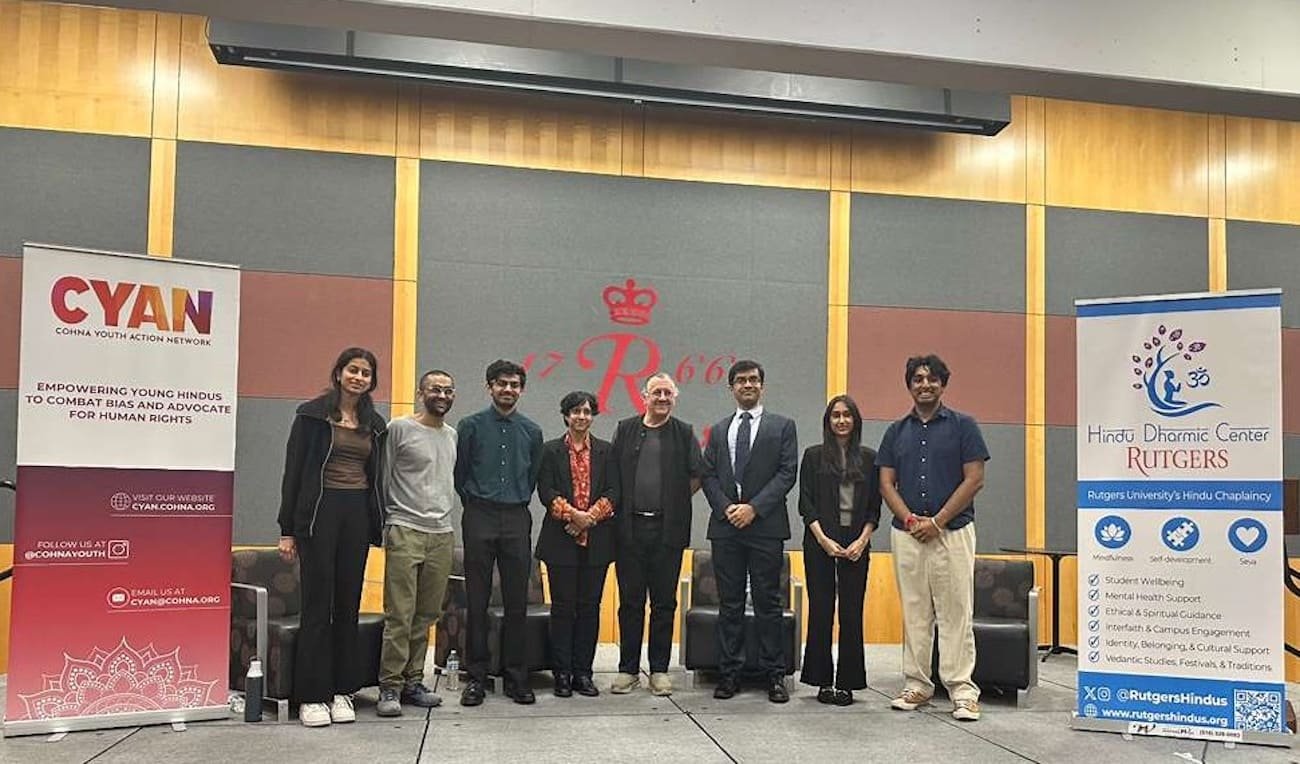

By any measure, it was just an ordinary Thursday on the Rutgers University campus in New Brunswick. Students moved between classes, the usual rhythms of a large state university carrying on undisturbed. But inside the Student Center, something less ordinary was taking place: more than 75 students, professors, educators, and community members had gathered to do something that, frankly, in 2026, feels quite radical — talk about Hinduism seriously, on its own terms, in an academic setting.
The event was “Demystifying Hinduism: Clarity Through Scholarship,” a day-long academic seminar organized by the Coalition of Hindus of North America and its youth wing CYAN (CoHNA Youth Action Network), in partnership with the university’s Hindu Students Council and the Hindu Chaplaincy on April 30.
Shyam Kumar, a junior in Political Science and vice president of CYAN, was elated. “It was a unique and refreshing counterpoint to the discourse we normally hear about Hinduism”. There was quite elation among the students who had organized the day, pride in ensuring that like students of other faiths, Hindu youth too could have an authentic space for scholars and students to discuss and debate Hindu dharma.
The seminar had been over a year in the making— the result of quiet focused advocacy, and a response to something rarely acknowledged — academic Hinduphobia. It’s a problem that manifests broadly in the education sector and across academia. It shows up in textbooks that reduce a philosophically sophisticated tradition to a list of rituals. It shows up in classrooms where Hinduism is taught through frameworks designed for other traditions and found wanting. It shows up in the near-total absence of Hindu scholars shaping the terms of their own tradition’s study. Indeed, as Hitesh Trivedi, the Hindu Chaplain at Rutgers said, “It has become the norm to see non-Hindus driving the conversation about Hinduism, which results in the systematic misrepresentation, trivialization, or hostile framing of Hindu traditions within institutional scholarly settings.”
For a community that has watched its tradition be flattened, politicized, and weaponized in institutional settings, “Demystifying Hinduism” was an act of civic and intellectual self-determination.
Neil Desai, a high school history teacher traced this pattern of academic Hinduphobia across decades of institutional practice and media distortion. He also highlighted how these skews are often structural and ultimately distort what young people come to believe about Hinduism.
Hindus Studying Hinduism — A Radical Space
Dr. Lavanya Vemsani, Professor of Indian History and Religions at Shawnee State University, unpacked the distorted lens by which we now learn or think about prominent Hindu female figures like Savitri, Draupadi, Kunti, Ganga, Urvashi, Satyavati. They are among the most complex and powerful women in any literary tradition anywhere in the world. For centuries they have lived on in the minds and stories of Hindus for the weighty deeds they accomplished, for the leadership and grit they demonstrated. In a world that seeks feminine role models to inspire young girls, you may not find better examples.
And yet, as Vemsani documented, their stories have been consistently flattened in contemporary academic texts, media, and popular culture — reduced to objects of sexual fascination, and stripped of their individual potency. They are ascribed modern political labels to further deny them the agency they demonstrated in their lives and to ensure that future generations of Hindus feel less and less connected to these timeless heroines. For the young Hindu women in the audience, many of whom had grown up with these stories only to watch them be misread or mocked in academic settings, Vemsani’s arguments resonated deeply.
Dr. Jeffery D. Long, Professor of Indian Philosophies at Elizabethtown College, traced the presence of Hindu thought in American intellectual and cultural life from the era of the Founding Fathers to the present, mapping its influence across figures as varied as George Harrison, Julia Roberts, and J.D. Salinger, and across cultural phenomena as wide-ranging as “M*A*S*H” and “Star Wars.” By tracing Hinduism’s interaction with American society, from the time of the Founding Fathers to contemporary pop culture, Long revealed a tradition that has not merely coexisted with Western modernity but has actively shaped it. The eye opening presentation highlighted how a tradition routinely treated as foreign and often outdated by media, academia and other institutions, is anything but.
The day closed with a lively student-moderated panel who asked questions ranging from historical research and textual representation to discussions that tackled the daily realities of being a Hindu student on an American campus: be it insistent invocation of caste as a lens for everything, debates on atheism, the misreadings of Hindu approaches to gender and pluralism and more.

“The invigorating presentations, the pointed questions, the energetic panel discussion, the food, and the enthusiasm of my fellow students, all made for a memorable day,” said Dhyey Ray, president of CYAN Rutgers and a senior in Biomedical Engineering. “I came away energized by the passion of the panelists and attendees, and with so much clarity on how to understand my faith and use it to guide important questions in life as I get ready to graduate.”
Scholarship as Resistance and as an Antidote
That discomfort, and the conviction that something could be done about it, was the raison-d’être of the event. In a North American academic landscape where Hinduism is too often dismissed as polytheistic folklore, conflated with caste-based oppression, or rendered invisible in mainstream religious studies curricula, Hindu Students built last Thursday’s event around a simple but demanding premise: that the antidote to Hinduphobia in academia is not grievance but better scholarship — rigorous, confident, fact based and open to good-faith engagement.
For a community that has watched its tradition be flattened, politicized, and weaponized in institutional settings, “Demystifying Hinduism” was an act of civic and intellectual self-determination. The fight, as these students and scholars showed, is not won by writing off the academy. It is won by doing better work inside it.
Pushpita Prasad is a storyteller and communications professional with a background in working with media, technology, and history. She is passionate about topics related to India, Human Rights, Hinduism, and Culture. Pushpita is involved with organizations focused on advocating for minorities, finding their stories, and helping to elevate their voices through multiple media and channels.