




Caste in Stone: In ‘Kali’s Daughter,’ Raghav Chandra Writes From the Marrow of the System He Critiques

- The monumental novel simply holds up the mirror and steps back. And in that mirror we see the half-lit faces of an entire republic—some burdened, some lighter, all caught in the same unblinking gaze.
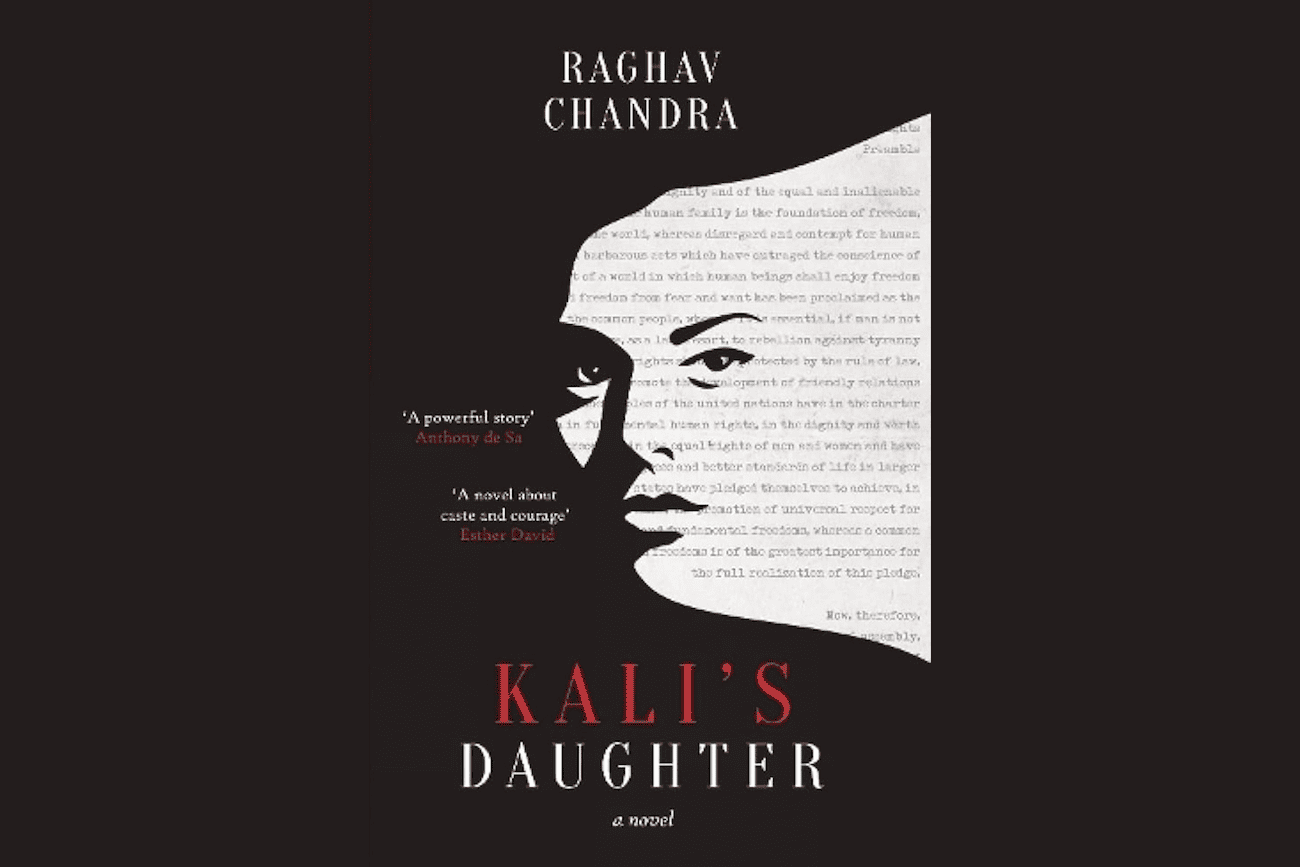

On a chilly November morning in Geneva, Deepika Thakur stands before the United Nations Human Rights Council. The city outside the window is crisp, ordered, indifferent. Inside her, the air is thick with the humidity of Bhopal’s narrow lanes, the weight of a father’s quiet endurance, and the echo of every slight she has carried since childhood. She is to speak for India on caste. She is caste. The moment is small on the page yet vast in its tremor—like a hand placed on cold wood that suddenly reveals a thousand other hands.
Raghav Chandra’s “Kali’s Daughter” is that rare novel which arrives not as argument but as revelation. At 356 pages it feels both intimate and monumental, a work of bureaucratic realism that refuses the usual comforts of polemic or sentiment. Chandra, a 1982-batch IAS officer who once served as Secretary to the National Commission for Scheduled Castes and Tribes, writes from the marrow of the system he critiques. Yet the book never reads like memoir disguised as fiction. It reads like a mirror held up to the republic itself—wooden, inherited, heavier than it looks.
Deepika is the first in her family to crack the civil services. From a modest Dalit home in Bhopal she travels to the Lal Bahadur Shastri National Academy of Administration in Mussoorie, where the hills are green and the hierarchies older than the buildings. There she meets Aman, the Brahmin son of privilege whose love is luminous yet laced with the invisible grammar of caste, and Vijay, the fellow Dalit whose solidarity carries its own quiet burdens. The academy is no mere training ground; it is a crucible. Conversations over mess-hall meals become dissections of reservation policy, merit, inter-caste marriage, beef taboos, the very air of India’s elite institutions. Chandra refuses to resolve these debates neatly. He lets them breathe, lets characters contradict themselves, lets the reader feel the friction.
What elevates the novel beyond documentary is its refusal to exoticize suffering. Deepika’s humiliations—subtle, everyday, bureaucratic—are rendered with a restraint that makes them more devastating. A colleague’s casual remark, a mother’s veiled sneer, the sudden silence when a surname is spoken—these are not dramatic set pieces but the steady drip that erodes stone. Her father’s refrain, “When you cannot fight the system, you must endure,” is not defeatism; it is the philosophy of survival handed down like an old wooden object passed from palm to palm.
Chandra’s prose carries a quiet, almost scriptural spareness. Sentences arrive short, deliberate, as though each has been weighed in the palm before release. There is sardonic humor—sharp as the edge of a filing cabinet—but never cruelty. There is suspense, woven through personal betrayals and professional dilemmas, yet the real tension lies elsewhere: in the gap between what India claims to be and what it still is. The Geneva framing device is masterful. Each time Deepika’s mind drifts back to Mussoorie or Bhopal, the reader feels the present moment thicken. The speech she must deliver becomes a mirror in which every earlier scene is reflected, distorted, clarified.
Chandra’s prose carries a quiet, almost scriptural spareness. Sentences arrive short, deliberate, as though each has been weighed in the palm before release. There is sardonic humor—sharp as the edge of a filing cabinet—but never cruelty.
The novel’s greatest achievement is its portrait of Deepika herself. Male authors writing ambitious women often falter into archetype. Chandra does not. Deepika is ambitious, vulnerable, strategic, tender, furious—sometimes all at once. Her interiority is rendered in stream-of-consciousness passages that feel lived rather than performed. We watch her calculate when to speak her caste and when to let it remain unspoken, when to endure and when the endurance itself becomes a form of violence. In one scene she stares at her reflection after a particularly wounding encounter and thinks not of revenge but of the version of herself that might have existed without the daily tax of other people’s assumptions. The question lingers: lighter or heavier?
Caste here is never abstract. It is tactile. It is the texture of a sari bought with the first salary, the smell of a hostel corridor, the precise inflection with which a senior officer pronounces a surname. Chandra draws on real incidents—documented cases that passed across his desk—yet folds them so seamlessly into the narrative that the line between fact and invention dissolves. The effect is uncanny: one feels the republic itself breathing through the pages, its contradictions, its hypocrisies, its stubborn capacity for hope.
What makes “Kali’s Daughter” a masterpiece is the way it implicates everyone. The upper-caste reader, the progressive bureaucrat, the diaspora Indian, even the foreign observer—none escape the gaze. The novel ends not with resolution but with a deeper question, the kind that settles in the bones. It asks what it means to represent a nation while carrying its oldest fracture inside your own body. And it answers, quietly, that representation itself is a form of endurance—and perhaps, one day, of transformation.
The structure is deceptively simple: present-day Geneva alternating with flashbacks that spiral inward toward Deepika’s childhood and outward toward the larger machinery of state. Yet the spiral is never mechanical. Each return to Geneva carries more weight, more memory, until the final pages achieve a kind of hushed crescendo. The last image—Deepika’s hand hovering, deciding—echoes long after the book is closed. One feels, suddenly, that the reader’s own hand has been resting on the same cold surface.


In the broader landscape of Indian English fiction, “Kali’s Daughter” occupies a singular place. It is neither the mythic sweep of Rushdie nor the intimate domesticity of Jhumpa Lahiri. It is closer in spirit to the moral clarity of early Naipaul, yet gentler, more hopeful, and far more rooted in the lived textures of contemporary India. Where other novels treat caste as backdrop or slogan, Chandra treats it as weather—inescapable, shaping every gesture, every silence. The result is a work that feels both urgently of its time and destined to outlast it.
Raghav Chandra has written a novel that does what the finest literature has always done: it makes the invisible visible, the ordinary profound. It does not preach. It simply holds up the mirror and steps back. And in that mirror we see not only Deepika Thakur but the half-lit faces of an entire republic—some burdened, some lighter, all caught in the same unblinking gaze.
This is a book that lingers like underground water—cool, persistent, impossible to ignore. It will be read in civil-service academies and drawing rooms, in small towns and capital cities, by those who have endured and those who have never had to. It will be taught, debated, remembered. For in its quiet, unflinching pages, Raghav Chandra has given us something rarer than outrage or elegy: a literature of clear-eyed endurance that still dares to imagine something better.
One closes the book and feels the weight in one’s own palm. The pattern is familiar—unbloomed lotuses, fish swimming against the current, an eye that watches without judgment. It has been passed down. Now it is ours to hold.
Satish Jha co-founded India’s national Hindi daily Jansatta for the Indian Express Group and was Editor of the national newsweekly Dinamaan of The Times of India Group. He has held CXO roles in Fortune 100 companies in Switzerland and the United States and has been an early-stage investor in around 50 U.S. startups. He led One Laptop per Child (OLPC) in India and currently serves on the board of the Vidyabharati Foundation of America, which supports over 14,000 schools educating 3.5 million students across India. He also chairs Ashraya, which supports about 27,000 students through its One Tablet per Child initiative.