




Netflix’s ‘Dorothy’: A Tamil Gangster Saga With a (Transgender) Love Story Few Would Dare to Tell

- This is not an easy watch and isn’t meant to be. It is not a perfect film, but I think it is the bravest one Karthik Subbaraj has made. This review contains spoilers.
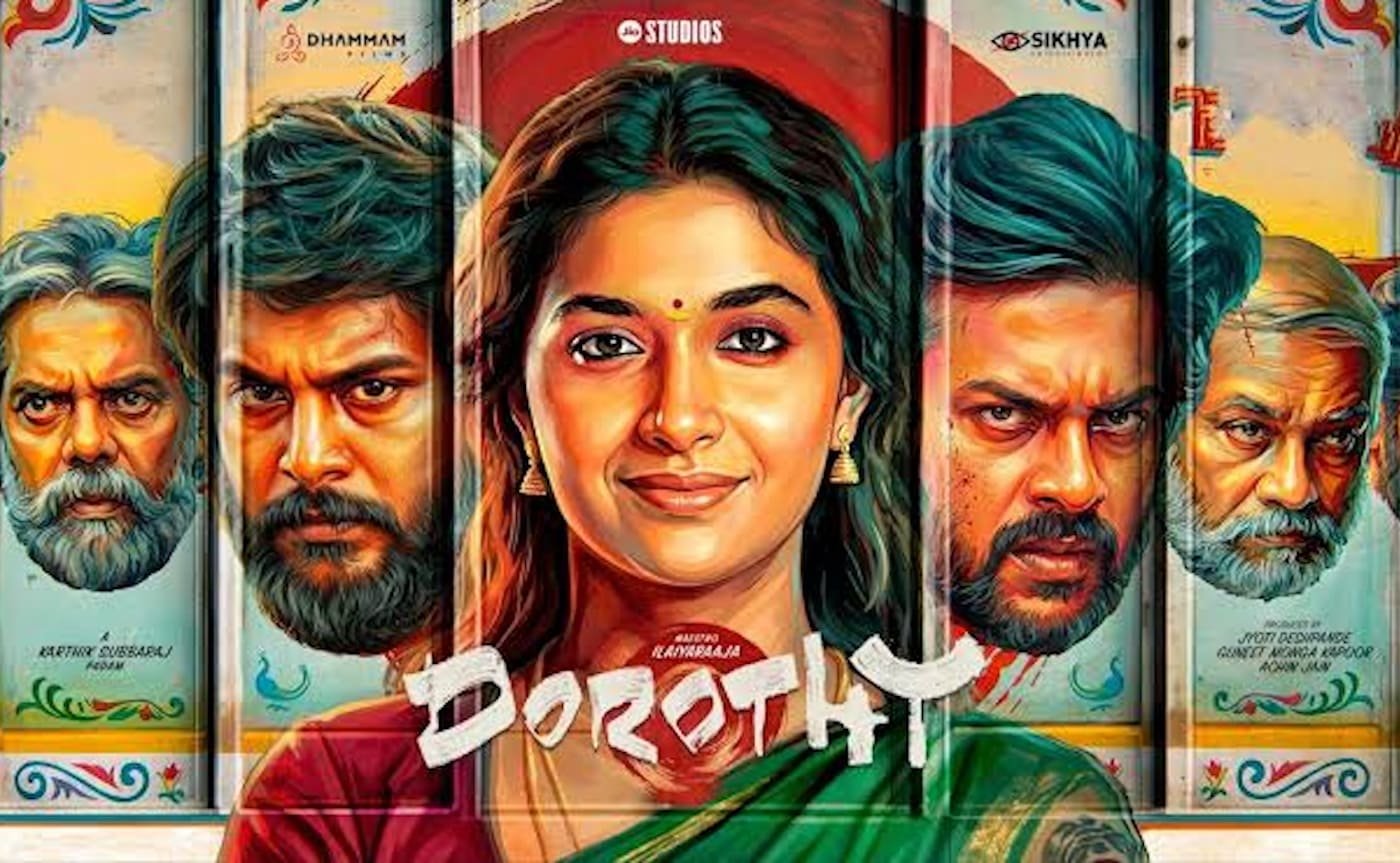

Karthik Subbaraj has spent more than a decade making films about men who have watched too many films. His heroes swagger like the posters on their walls, pick their fights in slow motion, and mistake menace for manhood. “Dorothy”opens in that familiar territory: a man in washed-out near-monochrome, a cigarette burned all the way down to the filter, telling us, flatly, “Subbu is dead. I killed him.” It is a terrific hook. I think it is also a kind of trick, because the film that follows is far less interested in the killing than in what the word “dead” might mean.
The man is Karthi (Rishikanth), a fatherless boy raised by a lower-caste mother. Subbu (Sananth) is the motherless youngest son of Veeraiya (Muthukumar), the local strongman, whose whistle carries across the village like a summons. The boys meet when Subbu rescues Karthi from a beating, and from then on they are inseparable, two kids who model themselves on Rajinikanth and Bruce Lee and plan to grow up into gangsters. Subbaraj has named them after the two halves of his own name. It could be a joke, or it could be a confession.
The village they grow up in is almost a character of its own, and not a kind one. Death is ordinary furniture here. In one of the film’s most chilling moments, young Subbu points out, almost casually, the spot where his mother’s and sister’s bodies were found.
Caste is the air everyone breathes. Veeraiya is happy to have Karthi at his table and at his side, but the idea of the boy marrying above his station is out of the question. I think this matters more than it first appears. A place that cannot make peace with a difference as small as caste is not going to make room for what comes next.
Then the film quietly swaps the boys’ places. Karthi becomes the right hand of Veeraiya and his older sons, steady around blood and untroubled by what the family does to women who love across caste lines. Subbu flinches and begins to fade. At a cockfight, while the men cheer the birds on, he is the one stroking a rooster as if it were a pet. Into this house comes Dorothy (Keerthy Suresh), a bride from Kerala married to one of Subbu’s brothers and treated as a pretty piece of domestic equipment. Subbu is enchanted. The village reads that as the obvious, sordid thing, and Subbaraj knows we will too.
It isn’t lust. Dorothy is simply the first woman Subbu has been close enough to study, and what he is studying is a life he has been denied. When she leaves the story, as suddenly and brutally as she entered it, the boy is told what boys in that world are always told, that crying is for girls. The film then becomes the story of a trans woman finding the courage to live as herself in a world built to beat that out of her. When she finally steps out, she takes Dorothy’s name.
Tamil cinema has mostly offered trans characters a short list of roles: the punchline, the ghost of “Kanchana,” or, now and then, the saint. Subbaraj does something more specific. He shows caste, family honor and rigid ideas of manhood pressing down on Subbu all at once.
It is worth knowing that Dorothy and Theodore come from the same two Greek words, “gift” and “God,” only in a different order. At first I wondered whether Subbaraj intended it. Then the film itself says it outright — there are lines describing trans people as a gift from God. It suits a character who was the same person all along, arranged differently on the outside.
Tamil cinema has mostly offered trans characters a short list of roles: the punchline, the ghost of “Kanchana,” or, now and then, the saint. Subbaraj does something more specific. He shows caste, family honor and rigid ideas of manhood pressing down on Subbu all at once, each one reinforcing the others. And he still lets a trans woman be the romantic lead of her own story, in a mainstream film scored by Ilaiyaraaja. In Tamil Nadu, where hero worship is practically the state religion, I think that takes real nerve.
He has the craft to back it up, and so does his crew. In “The Wizard of Oz,” Dorothy’s Kansas is sepia, and the world where she finds herself bursts into Technicolor. Subbaraj and his cinematographer, Thirru (S. Thirunavukkarasu), turn that around. Here the memories are the vivid part, and the present is drained of color, as if it were the thing that had died. Thirru gives the village a sunbaked, lived-in texture that makes its cruelty feel ordinary rather than staged. Midway through, he and Subbaraj hold a single shot far longer than is comfortable, and it does more than any dialogue could to show us Subbu coming apart.
And then there is Ilaiyaraaja. There is something fitting about a story set in that era being scored by the man whose songs were the soundtrack of Tamil Nadu in those very years. He folds Veeraiya’s whistle into the background score, and by the second half you flinch whenever you hear it. The songs, “Muthumani” and “Bommai” among them, sit inside the story instead of pausing it, and in a few places they say what the characters can’t. He has nothing left to prove, and yet I think this is the sound of a composer still listening very closely to the film in front of him.
Sananth gives the performance of his career, playing Subbu’s retreat into herself as a slow suffocation rather than a showy transformation. Rishikanth is just as good in a harder role. His Karthi has the Rajini swagger down, and the film watches it hollow out one compromise at a time. Keerthy Suresh isn’t on screen for long, but she makes Dorothy warm and real rather than a symbol.


None of this is flawless. At 150 minutes, the first half has a stretch, maybe five or ten minutes, that I think could have been trimmed or arranged differently. And yet Ganesh Siva’s editing is also what keeps you hooked, with its restless cutting between past and present and montages that rush through whole years of boyhood. Subbaraj seems to know he is asking a mainstream audience to sit with a subject it would rather avoid, and the pace is how he keeps them in their seats.
Some critics have argued that the caste thread is set up and then dropped. I don’t see it that way. It is the foundation the rest of the film stands on. Others have wanted the villains to get their comeuppance, and the film pointedly refuses. I think that is a deliberate choice. Real life rarely hands out tidy justice, and Karthi is no avenging hero. He has been shaped by the same prejudices as everyone around him, and his journey is not about defeating anyone but about unlearning what the village taught him. My own reservation is smaller. One sequence has Subbu violently attack another trans woman before her own reckoning, and I’m not sure the film earns what it later asks that scene to mean.
The last hour is where it all pays off. Karthi goes looking for the friend he grew up with and has to reckon with the woman he finds instead. It is genuinely hard to get through with dry eyes. I didn’t manage it. The final kiss could be read as just a romantic payoff, but in a society where people still hide who they are, I think it lands as something closer to an affirmation.
“Dorothy” is not an easy watch and isn’t meant to be. It is not a perfect film, but I think it is the bravest one Subbaraj has made.
Ganpy Nataraj is an entrepreneur, author of “TEXIT – A Star Alone” (thriller) and short stories. He is a moody writer writing “stuff” — Politics, Movies, Music, Sports, Satire, Food, etc.