




The Gloria I Knew Believed the ‘Last Girl’ to Be the Girl Whose Caste, Race, Class, Make the World Consider Her Expendable

- Gloria Steinem kept coming home to India. For two decades she stayed with my family, sat in circles with women and girls, helped me make books, and showed me that friendship could be a form of political work.
“My Forbesganj Garden invite us into a world of open gates and vibrant community. Ruchira draws on lost knowledge and cultural practices to connect us to the freedom of nature. It is a nature that honors the dignity of all life, refusing any hierarchical ordering or separation of the lifeforms that surround us.”
Gloria Steinem wrote those words for the introduction to my unpublished book of watercolors, My Forbesganj Garden. She knew that garden in my childhood home in Bihar. She had drunk tea beneath its trees and watched neighbors, relatives, women from our organizing circles, and young girls pass freely through its open gates.
She also knew what the paintings held. I had begun them after leaving New York for Forbesganj during the first year of the COVID pandemic. They were full of mango trees, frogs, insects, ancestors, fairies, and adventurous girls with skinned knees. They held my grief for children orphaned and exploited during the lockdown, and for the women and girls harmed by sex trafficking with whom I had worked for years.
Gloria saw that the garden was not an escape from politics. It was a vision of politics. No form of life stood above another. People, plants, animals, memory, and hope lived together. She found in my watercolors the same truth that had guided her life. Real change takes root when people and life forms discover one another, speak, and act together.
This was the Gloria I knew. She could enter a garden, a village, a classroom, or a room full of strangers and find the path that connected private experience to public power. She did it without jargon. She did it by listening. Then she returned.
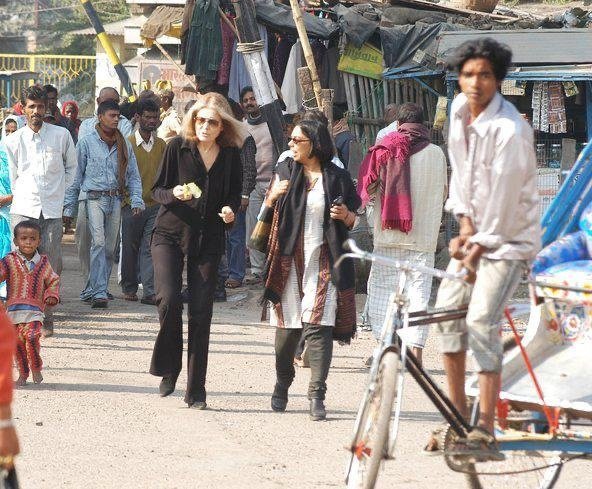
I first met her in February 2007, when I picked her up in a three wheeled auto-rickshaw and took her to a migrant settlement in Dakshinpuri, Delhi. A slight drizzle was falling. Dogs barked, children ran past us, and vendors called above the noise. A small group of women had gathered although most had urgent chores waiting at home. I was worried that they would leave as I translated Gloria’s English into Hindi. Nobody left.
Gloria began with a truth about herself. She told the women why she had had an abortion and why she had kept it secret for so long. They connected and began to speak about the inequalities in their own lives. She told them they belonged to a global sisterhood. “Remember you are not alone,” she said. “You have sisters who are listening and standing by you in your struggle for equality in a country as far away as mine.”
As we traveled back, I told her I had been unsure if the women would stay. She smiled and said something which has stayed with me. “All we have to do is honor each other with the Truth.”
I began to try this in my own organizing. Whenever I risked speaking a personal truth in a circle, another woman answered with hers. What had been hidden as individual shame became a recognizable pattern. What looked like private misfortune revealed a structure of power. Once we could see the structure, we could organize against it.
That afternoon Gloria gave me more than a phrase. She gave me a political method. She said she had learned this from Gandhian organizers in India working to calm caste violence in Ramnad, Tamil Nadu. She had come on a Chester Bowles Fellowship, to escape an unwanted engagement, had an abortion on the way in London and after two months in Miranda House in London, had got onto a train to learn about the real India. MN Roy’s widow had connected her to Gandhians walking from village to another and she had joined them with a cup and a comb. She saw first-hand the power of talking circles, and learned how listening to people helped them to listen to you, how going to people made them trust you and how change begins at the bottom and transforms the top.
Gloria and I realized that we had followed a similar journey We had both begun as journalists and become activists. We had each seen an injustice that made observation alone impossible. The work had carried us from recording the world to making it better for us and our sisters.
Visiting Forbesganj
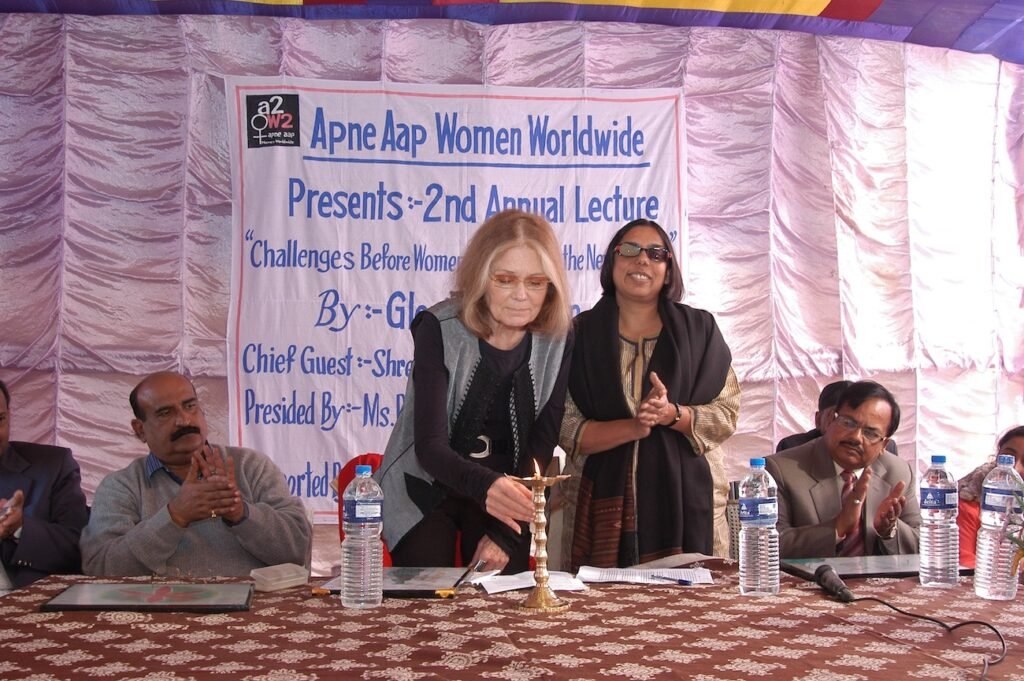
That very year I invited her to Forbesganj. Gloria gave up Jane Fonda’s birthday party to sit in a circle with a small group of Nat women resisting the intergenerational prostitution of women in their community. On December 14, 2007 she joined a public rally at Araria Mahila Mahavidyalaya and honored Fatima Nat Dhuniya and Meena Hasina, leaders of the Nat Mahila Mandal in Uttari Rampur. Both women had survived prostitution. Both were creating another future for their daughters.
“Courage is contagious, what you do will help other women, even in my country” Gloria told the gathering.
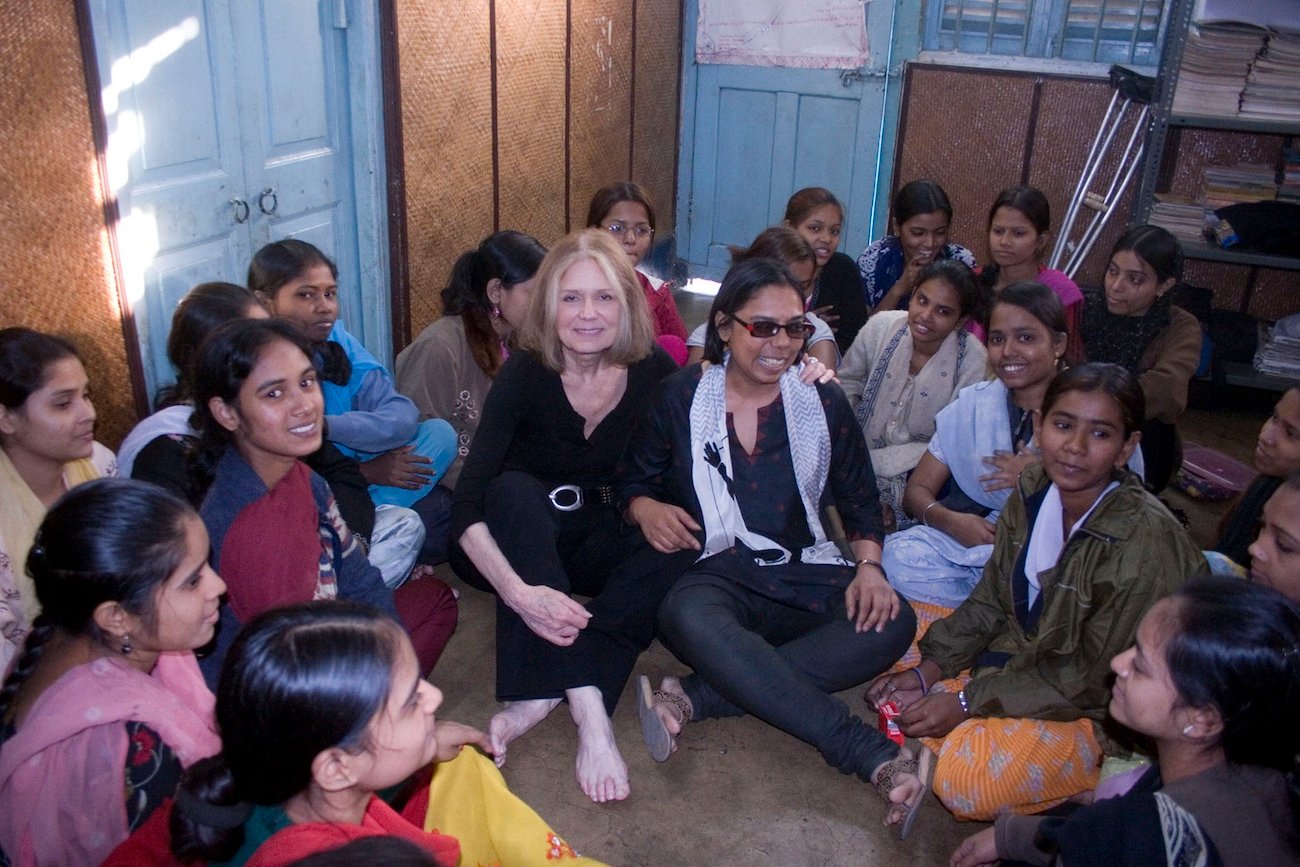
Then we left the stage and went to the women’s homes. She sat with their self-action groups. She visited our Nat Community Centre for The Last Girl and our school, the Kasturba Gandhi Balika Vidyalaya, where mothers were enrolling their daughters in school to interrupt the cycle of prostitution. She did not arrive in a sari or perform an Indian version of herself. She came in her black trousers, round glasses, and one of her interesting belts. She was entirely herself, and therefore able to meet the women as themselves.
Our friendship took root there. Gloria entered my life by turning her attention toward the women with whom I organized.
She became chair of the advisory board of Apne Aap Women Worldwide, the organization I had founded with twenty two women from a red light district. She came to our meetings and fundraisers. She sat with women who had survived prostitution and girls resisting the conditions that made them vulnerable to it. She understood why we sat in circles. In a circle, everyone can see everyone else. No one occupies the head. A voice can travel. A woman who has been treated as an object begins to experience herself as a citizen.
Gloria’s public life was vast, but her care often arrived through small acts. A telephone call. A handwritten note. A name passed to an editor. A guest room made ready.
In 2011, I was posted by UNICEF to Iran when I learned that I had cancer. I called Gloria. She was a cancer survivor herself. While I prepared to fly to New York, she arranged an appointment with Dr. Larry Norton, the medical director of the Evelyn H. Lauder Breast Center at Memorial Sloan Kettering Cancer Center.
When I reached her apartment, Gloria opened the door and said, “Welcome home.”
Those words contained everything. She had found the doctor. She had given me a place to stay. She had made sure I would not face the diagnosis alone. I had come from Iran for treatment in a city far from Forbesganj, yet the door opened and I was home.
Years later, when we co-wrote As If Women Matter, Gloria wrote, “Friendship is a country.” She said that although nearly thirty years, different continents, languages, and cultures separated us, our lives and work had become interwoven. I knew exactly what she meant. Friendship with Gloria had open doors, spare keys, worktables, hospital appointments, arguments, books, journeys, and circles of women who became family to one another.
She believed fluidity would be one of the defining ideas of this decade and end heirarchy. Fluidity loosened the categories used to assign work, authority, safety, and sexual freedom according to anatomy. It also carried a larger promise.
A desk in her living room, opposite the place where she wrote, became my writing desk. Her guest room became my New York home. In Delhi, the drawers of my desk accumulated the notes she left on yellow paper. My India home in Delhi, Kolkata and Forbesganj were her India homes as he visited again and again over decades.
We walked through Sonagachchi in Kolkata and lobbied legislators in Albany. We wrote, watched films, went to rallies, ate dinners, and spoke late at night across continents. The political and the personal did not compete in her life. Each gave meaning to the other.
Gloria was one of the most recognizable women in the world, yet she was constantly trying to send the microphone elsewhere. Editors, conference organizers, and political groups called because she wrote beautifully, spoke easily, and could make a radical idea intelligible to almost anyone. Often, she gave them somebody else’s name.
Creating Space for New Voices
Over the years, I received calls and emails that began, “Gloria asked us to reach out to you.” She would say that if someone else could do it, she wanted to step out of the way. This was not modesty. It was an organizing principle. A movement cannot depend on one permanent spokesperson. It must create new voices, new relationships, and new centers of courage.
Many people remember Gloria standing before an audience. I also remember the spaces she deliberately left empty so another woman could step into them.
In 2020, Vanity Fair asked her to name her heroes in real life. Her answer moved from Ruth Bader Ginsburg, Bella Abzug, Maxine Waters, and Elizabeth Warren to Ela Bhatt, artists, doctors, writers, and organizers in different parts of the world. Then I saw my own name.
I was astonished and deeply moved. The list was Gloria’s theory of leadership in miniature. A Supreme Court justice, a Senator could both be as important as a grassroots organizer. Fame did not determine value. Her motto in the same questionnaire was “We are linked, not ranked.” She did not merely say this. She arranged her life around it.
Her feminism grew through such links. She volunteered for Angela Davis’s bail committee. She traveled and lectured with the radical Black lawyer Florynce Kennedy. In October 1971, she raised her fist beside Dorothy Pitman Hughes in the photograph that came to symbolize the movement they were building together. Her deep relationships with Alice Walker, bell hooks, Beverly Guy Sheftall, Bella Abzug, Caroline Jenkins, Harry Belafonte, and many others connected feminism with Black freedom, labor rights, civil rights, culture, and grassroots power.
She learned from the farmworker movement led by Cesar Chavez. Indian Freedom Fighter and Gandhian Socialist Kamaladevi Chattopadhyay became what Gloria called the last teacher of her life. Kamaladevi showed her how women’s daily work, including spinning, weaving, and making things by hand, could enter the great political struggles of the world. She also taught her to question history organized around a single great man. She explained how the practices associated with Gandhi had been shaped by women, cooperatives, and countless organizers whose names rarely entered the official record.
Gloria recognized the same politics in Ela Bhatt and the Self Employed Women’s Association and her friend LC and Devaki Jain. She loved Ela and admired the patient way she built power with women workers from the ground up. She understood the women of Apne Aap for the same reason.
Her first loyalty was to the knowledge of the people living closest to a problem. That loyalty allowed her to change.
Earlier in her life, Gloria had coined the phrase ‘sex-worker’ as a more humane response to prostitution because criminalization punished women. Then Johnnie Tillmon of the National Welfare Rights Organization called her from Nevada. Unemployed women were being told to try prostitution as work or lose their government entitlements and benefits. Gloria joined Tillmon, Flo Kennedy, and welfare rights activists in protest. The state withdrew the threat.
When she returned to Nevada years later, she saw the guarded trailers of a legal brothel. She learned that women inside were being fed packets of noodles tossed across a barbed wire fence by a sympathetic neighbor who saw them controlled and starving. Legalization of the sex industry had legalized brothel keeping , pimping and sex-buying, but did not improve the lot of women.
Her visits with me to Sonagachchi changed her language too. Graffiti on walls carried two large words in English, “sex workers.” Besides the letters, women waited in lines near doorways while children stood inside.
Gloria came to understand that prostitution as an occupation was based on what she phrased ‘body invasion,’ with far-reaching and irreversible physical and mental health consequences. She used to tell me that only male prisoners understood the deep trauma that this inflicted.
‘Prostituted Woman’
She stopped saying “sex worker” and began to say “prostituted woman.” It explained absence of choice. It made room for the recruiter, trafficker, caste system, gender, race domination and poverty that had vanished from the earlier term. It forced questions. Who had the power to buy? Who was profiting? Who had choices? Who did not?
She did not hide the fact that she had once thought differently. She traced the path of her own learning. This was one of the deepest forms of integrity I saw in her. She did not treat consistency as more important than truth. Like Gandhi, she allowed experience to revise her ideas, and she made that revision visible.
At Apne Aap’s tenth anniversary at Jawaharlal Nehru University, she described a Third Way beyond the false choice between arresting women and legalizing the industry around them. Women in prostitution should not be arrested. They should have safety, education, health care, livelihood, legal protection, respect, friendship, and real ways to leave. The people who bought and sold their bodies should be held responsible. Buyers created the demand. Pimps, brothel owners, recruiters, and traffickers profited from it.
The idea had grown through listening. In Zambia, Gloria sat in a field with village women and learned that women were being trafficked to Lusaka because a dam had reduced their crops and elephants ate the maize that remained. The women said they needed an electric fence. Gloria helped raise the money. When she returned, the village had grown enough maize to feed its families and pay school fees. The women sang and danced around the crop.
The solution was not imported by an expert. It was named by the women who understood the problem. Gloria later wrote of this principle, “A person who experiences a problem is the one who knows its solution.”
She brought the same respect to language. She disliked words such as “intersectionality” or “neoliberalism” when plain words could carry the meaning. She often told me that the most radical thing a writer or speaker could do was to be understood.
I watched the truth travel in Delhi, Kolkata, Bihar, and New York. Gloria could speak with academics in a university and women in a village without talking down to either. She did not simplify the politics. She made the relationships within it visible.
Our book As If Women Matter emerged from this shared belief. We selected essays from four decades because I wanted Indian readers and organizers to have Gloria’s thinking in their hands. The writing moved from Hitler and the masculinization of wealth to work, menstruation, India, self esteem, Marilyn Monroe, pornography, Linda Lovelace, and Gloria’s experience as a Playboy Bunny. Her subjects varied, but the question beneath them remained constant. Where does hierarchy begin, and how do we interrupt it?
Gloria believed the first lesson in hierarchy was taught at home. A child sees one class of human beings give orders and another obey. If inequality is normal among the people we love, she wrote, we will accept it anywhere. Gender cuts a trench in the mind into which other hierarchies fall, including race, caste, class, and religion. The authoritarian family prepares us to accept the authoritarian state.
This understanding shaped Who Shall Come First?, the work she developed with Beverly Guy Sheftall on the connections among gender, race, and class. It was also central to her analysis of fascism. Strongmen seek to control women, birth, sexuality, and family life because public domination depends on private obedience. The struggle over a woman’s body is therefore a struggle over the shape of society.
Gloria examined production beside reproduction. Rich women and poor women could be controlled in different ways to protect inheritance, preserve caste or racial boundaries, secure labor, or produce more cheap labor. Work associated with men received wages and status. Work associated with women disappeared into duty. She wanted men to enter child care and women to enter breadwinning because flexible roles were more democratic and more human.
Ending Hierarchy
She believed fluidity would be one of the defining ideas of this decade and end hierarchy. Fluidity loosened the categories used to assign work, authority, safety, and sexual freedom according to anatomy. It also carried a larger promise. If gendered categories of work about who should be caregiver and who should be breadwinner could move, perhaps other boundaries that appeared permanent could move too.
Gloria called our planet Spaceship Earth. From above, she said, we cannot see the borders human beings have drawn. We see rivers, mountains, and the migratory patterns of people and other species. She opposed American imperialism because she believed citizenship required us to take responsibility for what governments did in our name. During a visit to Kolkata while the United States was bombing Iraq, she apologized at a public meeting on behalf of Americans. In our conversations about Israel, she said she did not believe states should be formed around religious identity.
These convictions were not separate from her feminism. Every border that sorts human beings into those who command and those who obey requires a story about why the ranking is natural. Gloria’s life was devoted to exposing those stories.
In April 2012, she brought a diverse group of organizers to India. The journey began at Gandhi Smriti in Delhi and moved through Kolkata and Bihar. In Araria, about five hundred women from red light areas and marginalized communities marched against trafficking, child marriage, dowry deaths, rape, and other forms of violence.
Gloria did not bring the visitors to display suffering. She brought them to meet women who possessed analysis, courage, and plans. She knew that solidarity also meant helping attention and resources travel toward people doing the work and also that people with resources learn from grassroots organizers.
Our public work in the United States grew from the same relationship. At the United Nations, at Smith College, at Asia Society, at the United Nations, and at gatherings for the Last Girl Awards, Gloria helped carry the knowledge of women in Bihar, Delhi, and Kolkata into American public life. We discussed trafficking, personhood, Kamaladevi, fascism, abortion, and the buying and selling of women and girls. We read from my anthology River of Flesh and Other Stories. We spoke with Ruby Sales about Gandhian thought, Black freedom, and India’s independence.
The rooms changed. The center did not. It remained the woman or girl furthest from power.
That is why the Last Girl idea spoke to Gloria. The last girl is the girl whose caste, race, class, or circumstances make the world consider her expendable. When she gains rights and choices, freedom expands for everyone. Gloria joined the awards as a speaker, presenter, and honoree, but she understood that the honor finally belonged to the girls whose refusal had made the movement possible.


One of the longest journey we made together began in January 2014. We traveled from Delhi to Jaipur, Patna, Forbesganj, Kolkata, and the waterways of Kerala. We later wrote a joint diary of the tour for The New York Times. What I remember most is the movement between stage and circle.
In our Delhi office, Gloria sat cross legged with ten teenage girls. One wanted to be a writer, another a dancer, and others teachers or health professionals. She asked what would help each of them tomorrow and the day after. Most said education. One girl remained quiet before answering, “The truth.” Her family might marry her to a man who would become her pimp. She wanted the truth about the future being chosen for her. Gloria never forgot her.
At the formal book launch, Gloria shared the stage with Ela Bhatt and me. Soon afterward, women from SEWA met women from Apne Aap for the first time. I wondered whether members of a respected trade union would recognize women made socially disreputable through prostitution as workers and sisters. Ela asked an Apne Aap member whether she could tell her family what she did. The woman replied that her husband had pimped her.
Surprise passed through the room, followed by recognition. The SEWA women closed by singing “We Shall Overcome” in Gujarati.
Gloria had often used a tree to explain how change grows upward from the roots. That day the image changed. She wrote that it was a banyan tree whose branches bend to earth, take root, and rise again until one trunk becomes a forest. “Globally, we have to become a banyan tree.”
Turning Sectators Into Participants
At the Jaipur Literature Festival, hundreds arrived separately for our session. Gloria asked everyone to introduce themselves to the people nearby. They might find a friend, a cause, a job, a fellow organizer, or even a lover. They came as an audience and left in groups. In a few minutes, she had turned spectators into possible participants.
In Kolkata, we visited the Kali temple and walked through Sonagachchi. On the bank of the Hooghly, our youth leader Uma Das told Gloria how she used to come to the river to find quiet from the abuse surrounding her in the brothel district. Uma’s mother had joined an Apne Aap circle, demanded her daughter’s admission to school, and helped her reach a residential hostel. Uma had returned as a leader to protect other girls. She embodied Gloria’s faith that the person who experiences a problem often knows its solution.
Then we came home to Forbesganj. Gloria met Fatima again, now literate, organizing, and inspiring women in other communities. Fatima later told me that Gloria’s embrace had been the first time a foreign or upper caste person had touched her with respect. About fifteen hundred people gathered beneath a bright tent for songs, speeches, and a performance against child marriage. The first handful of Apne Aap members had become hundreds.
That night Gloria stayed with my family. She visited the school and watched the girls dance and demonstrate self defense. She endured the winter cold and the mosquitoes. Once again the gates were open, and the world entered the garden.
Gloria’s intellectual life was alive in her home. A plaque honoring Mary Wollstonecraft stood in her yard. A painting of Kamadhenu hung above her bed. A many armed Kali greeted visitors near the entrance. She loved Jane Austen’s irony and Jo March’s determination to become a writer.
In Kerala, we traveled through the backwaters between brilliant green rice fields and talked about the matrilineal histories that had survived there. Gloria remembered that Marx and Engels had drawn ideas about communal life from accounts of the Iroquois Confederacy, yet had missed how much authority women held within it. By the end of the journey, she wrote, “India is my life, too.”
India was not a chapter she had closed after the two years she spent here in the 1950s. She kept returning across decades because her teachers, friendships, and politics were here. Between 2007 and 2019, she stayed with me in Delhi, Kolkata, and Forbesganj many times. Her presence in India was not nostalgia. It was continuing work.
During the women led demonstrations at Shaheen Bagh, Gloria sent an audio message from New York. She told the women defending their citizenship rights that they were not alone, and that women across the world were listening and watching. I played her recording from my phone into a microphone at the protest. At the same gathering, I released Vajood Aurat Ka, the Hindi translation of our book.
Her voice moved from her home in New York through my phone into a road occupied by Indian Muslim women who had made it a democratic classroom. It was exactly the journey we had wanted the book to make.
Gloria’s own books made such journeys for six decades. Her early The Beach Book grew from her time in India. Outrageous Acts and Everyday Rebellions gathered the reporting and essays that exposed structures of inequality. Marilyn: Norma Jeane restored a complicated woman to a life obscured by her image. Moving Beyond Words challenged inherited categories. Doing Sixty and Seventy confronted the erasure of older women. My Life on the Road showed how travel and listening formed her politics. The Truth Will Set You Free, But First It Will Piss You Off! distilled ideas into language people remembered.
For me, Revolution from Within was foundational. It showed that self esteem is political. A person who has been taught that she has no value will struggle to imagine that she has rights. Recovering authority over the self can become the beginning of resistance to authority imposed from outside.
Gloria’s intellectual life was alive in her home. A plaque honoring Mary Wollstonecraft stood in her yard. A painting of Kamadhenu hung above her bed. A many armed Kali greeted visitors near the entrance. She loved Jane Austen’s irony and Jo March’s determination to become a writer. She read Alice Walker’s The Color Purple, Bruce Chatwin’s The Songlines, and Sven Lindqvist’s Exterminate All the Brutes. Her favorite film was Marleen Gorris’s Antonia’s Line, about generations of women creating family and freedom on their own terms.
These were not items in a collection. They were companions in an unfinished conversation about how to live.
Gloria believed ideas had to remain unfinished because life keeps teaching us. Her politics had rigor without rigidity. Her clarity did not come from reducing the world. It came from looking for the connection among things that had been kept apart. The family and the state. Caste and gender. Race and reproduction. A village crop and the trafficking of women. Self esteem and revolution. Friendship and political work.
She once wrote, “When you do something, you don’t know if it is big or small, only time will tell, but you have to do it as if it matters.” That was how she worked. A call to an editor mattered. A doctor’s appointment mattered. A girl asking for the truth mattered. A circle in Bihar mattered. She did not need to know which act history would remember before deciding to do it.
On her last birthday, March 25, Gloria sent me a card. “I am glad our lives have overlapped,” she wrote. Then came her characteristic mischief. “My birthday, not yours.” She often imagined lives as circles that overlap. Mine had overlapped with hers in ways I was still discovering.
At our last meeting that summer, we spoke about reincarnation. Gloria said one life was enough for her. She looked frail, yet promised to live to 135 and see Donald Trump out of power. She dismissed him as nothing but a toupee. Her humor gave us a way to face politics without surrendering to it.
Sound of Her Laughter
I carry the sound of her laughter, but I also carry the work. The phone calls from people she had sent to me. The red shawl at Jaipur. Her voice reaching Shaheen Bagh. The desk in her living room. The girls dancing in Forbesganj. Her hand on my door when she said, “Welcome home.” Her question, followed by the stillness in which she waited for an answer.
When Gloria introduced My Forbesganj Garden, she wrote that my paintings invited readers into “a world of open gates and vibrant community.” She saw flowers, animals, people, ancestors, and adventurous girls living together without a hierarchy of worth. She saw grief enter the garden and become art, hope, and action. She saw that the gates stayed open.
“Her work invites each of us to find our own garden,” Gloria wrote.
I think that is where she has left us. Not inside a monument to one famous life, but at an open gate. Beyond it is a circle waiting for another voice. A truth that must be spoken clearly. A girl who has been placed last and must be brought to the center. A movement growing from the bottom up like the branches of a banyan taking root.
Gloria’s life and writing were her message. Now it is our work to keep the gates open.
Ruchira Gupta is an activist author, NYU Professor and founder of anti-sex trafficking NGO, Apne Aap. Readers who would like to learn more about this work, join it, or support the women and girls of our organizing circles can visit Apne Aap Women Worldwide. Her books include The Freedom Seeker, I Kick and I Fly, and As if Women Matter: The Essential Gloria Steinem Reader. Insta: RuchiraAGupta Twitter: RuchiraGupta