




Progressive Indian Americans Protest Outside San Francisco Consulate, Demand Protection of Democratic Rights in India

- Around 50 Indian citizens and Indian Americans express solidarity with Gen Z-led protests, calling for electoral accountability and an end to restrictions on peaceful demonstrations.
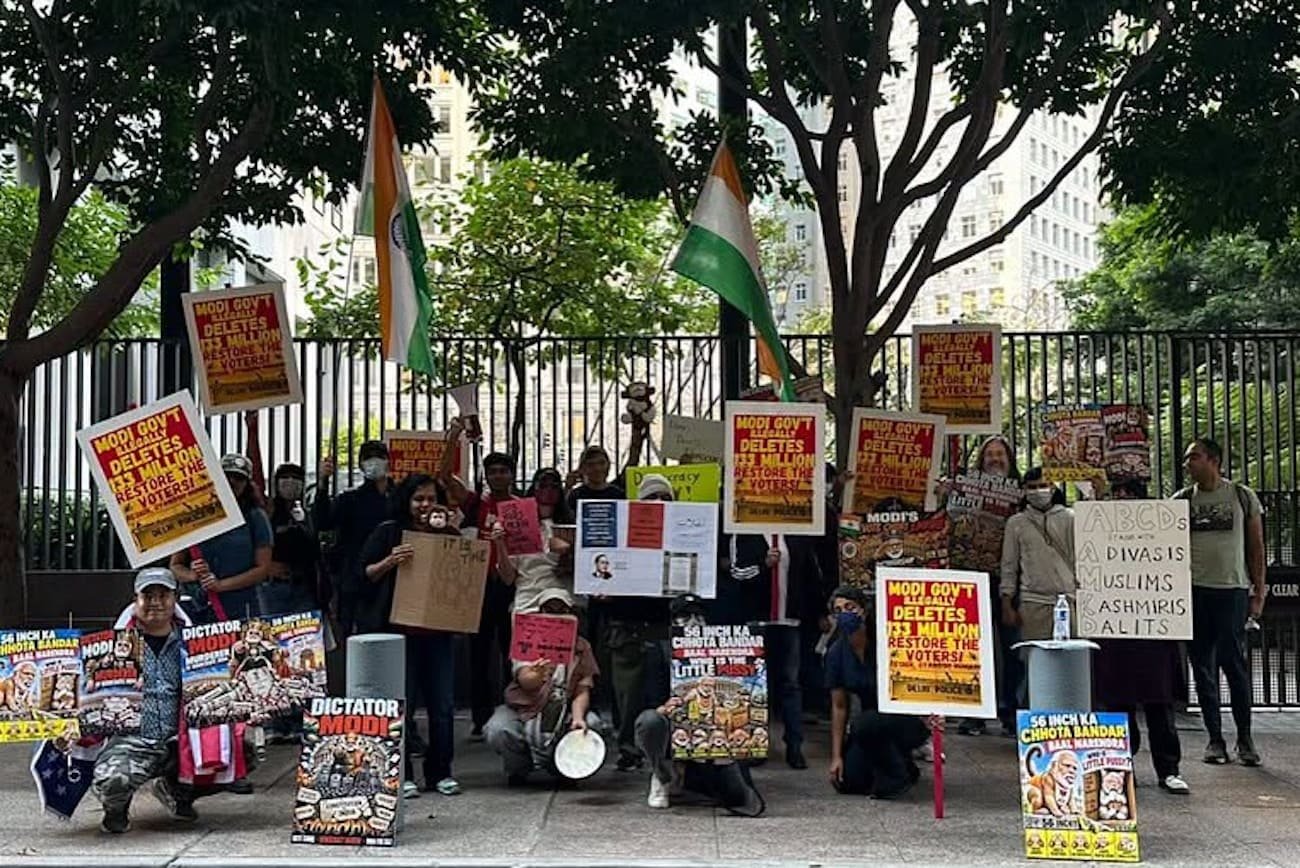

Around 50 Indian citizens and Indian Americans gathered outside the Indian Consulate in San Francisco on Thursday, October 15, to protest the Election Commission of India (ECI) and the Modi government’s response to ongoing demonstrations in India.
Organized by several Bay Area organizations, including the Bay Area chapter of Hindus for Human Rights, the demonstration began at 4 p.m. outside the Indian Consulate on StevensonStreet. Participants expressed solidarity with the youth-led Cockroach Janta Party (CJP) and other groups demanding electoral accountability and protection of constitutional rights.
Echoing the slogans of Gen Z protesters in India, demonstrators raised chants of “Modi, Gyanu, bye-bye,” “Gyanu, it’s done bro,” “Vote chor, gaddi chhod,” “Jai Bhim,” and “Inquilab Zindabad,” bringing the slogans of India’s ongoing protests to the streets of San Francisco.
Protesters also called upon Indian Consulate staff to join the demonstration, reminding them that they serve India and its people, rather than any government. The appeal underscored the demonstrators’ distinction between loyalty to the country and support for the government of the day.
The demonstrations follow the Election Commission’s Special Intensive Revision (SIR) of electoral rolls, which resulted in more than 130 million names being excluded from draft voter lists across Indian states. Opposition parties and civil society groups have questioned the scale of exclusions, alleging that eligible voters, particularly from marginalized communities, have been disproportionately affected.
The Election Commission maintains that the Special Intensive Revision (SIR) is intended to remove ineligible voters from electoral rolls. However, findings from Bihar raise questions about the need for extensive citizenship verification. According to The Indian Express, nearly 99% of the 68.6 lakh voter deletions in Bihar were attributed to deaths, migration and duplicate registrations, rather than citizenship concerns (Nath et al. 6-9).
The Commission has not disclosed how many non-citizens were identified. These findings have raised questions about whether such extensive verification requirements are justified, particularly amid concerns that eligible voters may also be excluded.
Concerns Over Constitutional Rights
Protesters also condemned the detention of demonstrators and restrictions imposed by Delhi Police, including the denial of permission for protests at Jantar Mantar.
Participants argued that such actions undermine freedoms guaranteed under Article 19 of the Indian Constitution, which protects freedom of expression and peaceful assembly, subject to reasonable restrictions. The demonstrators demanded the resignation of Chief Election Commissioner Gyanesh Kumar, restoration of eligible voters to electoral rolls, and protection of the right of CJP and other organizations to protest peacefully.
Indian Diaspora is Not a Monolith
The gathering also challenged the perception of the Indian diaspora as a politically homogeneous community. A 2024 Indian American Attitudes Survey conducted by the Carnegie Endowment for International Peace and YouGov found that 47% of Indian Americans approved of Prime Minister Narendra Modi’s performance, while 34% disapproved and 19% expressed no opinion.


In a separate report based on the same survey, published in July 2025, Carnegie found that 69% of respondents expressed concern about Hindu majoritarianism in India, reflecting the diversity of political perspectives within the diaspora.
The San Francisco demonstration formed part of a wider series of solidarity protests organized across the United States, including gatherings in Chicago, Los Angeles, Philadelphia, Austin and New York.
For participants, the gathering underscored a distinction between support for India and support for a particular government. Their demands centered on adherence to the Constitution, an accountable Election Commission, and the protection of citizens’ right to dissent.
The message from San Francisco was that geographical distance does not diminish the Indian diaspora’s stake in the country’s democratic future.
Siddhartha Shome is Co-Lead of Hindus for Human Rights Bay Area Chapter.