




Optical Illusions: How Statistics Produce a 7.8 Percent Headline Growth Rate While the Everyday Market Stalls?

- The ultimate error is not that the state's numbers are fictional. The error is far more dangerous: the numbers no longer describe the country being governed.

Imagine a king who rules a vast and divided realm. Half his kingdom lives in high-walled, paved cities where every coin is stamped, every contract is written in leather-bound ledgers, and every warehouse is inspected by royal scribes. The other half lives in sprawling, quiet valleys, trading woven baskets for grain, lending tools on a handshake, and keeping memories instead of records.
The king desires to know how wealthy his empire has grown. But walking every valley takes too long, and asking every peasant is far too chaotic. So, his royal mathematicians construct a Magic Map.
Instead of trudging through the mud, the mathematicians sit in the royal tower, study the tax logs of the paved cities, run complex geometric calculations, and paint a glittering map on the palace wall. Whenever the king asks if his reign is prosperous, the scholars point to the wall and say: “Look, Sire! The golden paint on the map is 8 percent brighter than it was last year!”
The king is overjoyed. He sits on his throne, confident that his kingdom is experiencing a golden age.
When you strip away the dense jargon of modern economic reports—the implicit deflators, the MCA-21 corporate databases, and the single versus double deflation frameworks—this is the core crisis of modern nation-states. The state has stopped using statistics to observe reality. Instead, it uses statistics to paint the map before the land has even been walked.
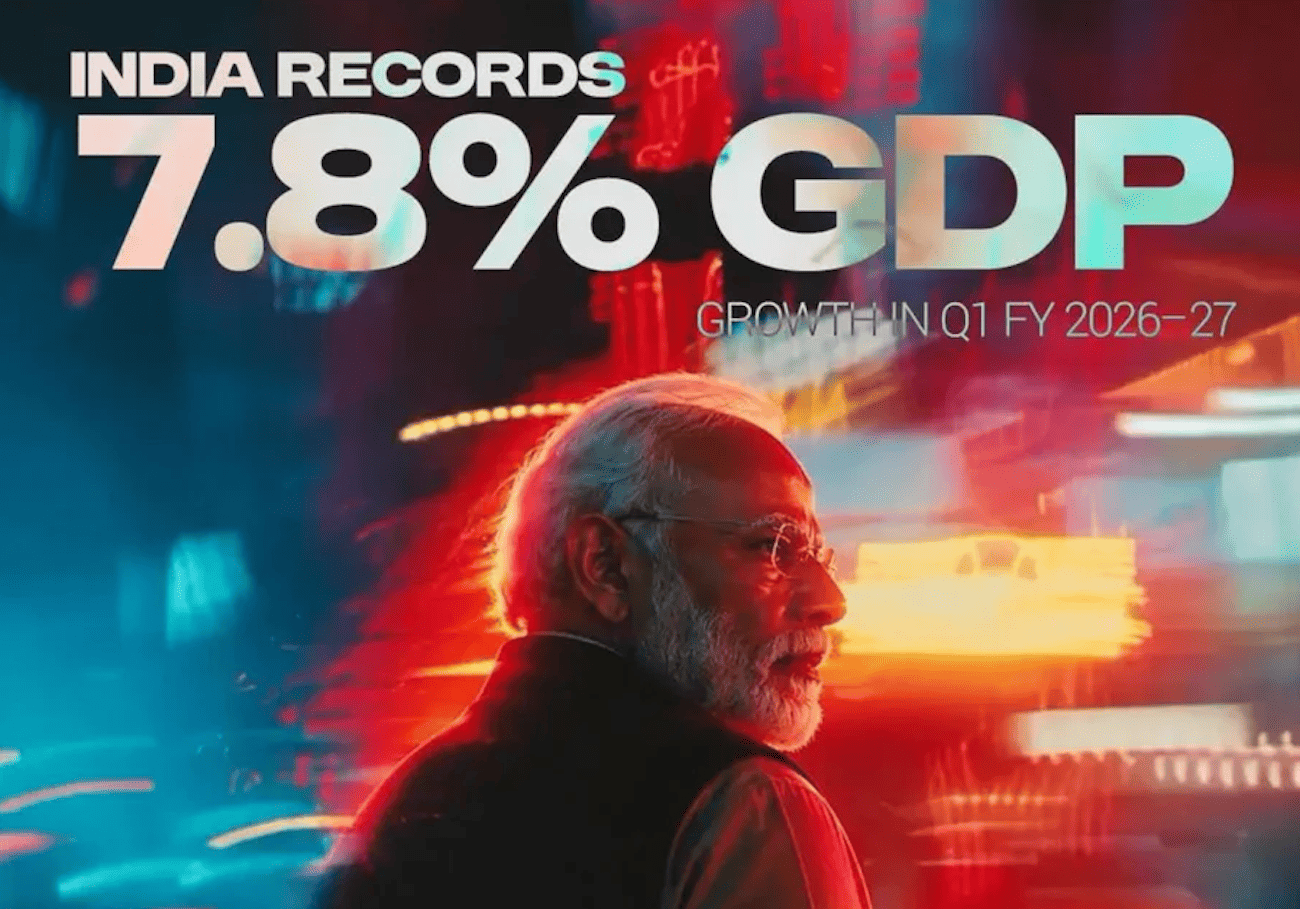
How do statistical towers produce a grand 7.8 percent headline growth rate while the everyday market stalls? You do not need a conspiracy, nor do you need to manufacture fake numbers out of thin air. You simply adjust the mechanical gears inside the calculator through three specific optical illusions:
When state authority becomes structurally obsessed with displaying flawless progress to credit rating agencies and global media, the governance architecture undergoes a profound, dangerous shift.
1. Shrinking Yesterday (The Denominator Illusion)
Growth is always a mathematical ratio between today and yesterday. If a child grows from 4 feet to 4 feet 2 inches, they have grown by 2 inches. But if royal records are quietly revised long after the year has ended to declare that the child was actually only 3 feet 8 inches last year, those same 2 inches suddenly look like a massive growth spurt. By revising prior-year estimates downward long after the period has closed, the baseline contracts. Small, modest physical gains today yield massive percentage leaps on paper. The actual volume of goods—truck freight tonnage, diesel burned, fertilizer bought—remains flat. The country did not expand faster; yesterday was simply made smaller.
2. The Falling-Cost Trap (Deflator Mechanics)
To convert raw money values into “real” physical output, economists divide output by an estimate of inflation called a deflator. When global commodity prices like oil and steel fall, raw input costs drop rapidly for factory owners. However, consumer prices at the local grocery store stay high. If the statistical office uses wholesale input prices (which dropped drastically) instead of consumer output prices to measure inflation, the formula drops toward zero or turns negative. Dividing money growth by a tiny or negative inflation number artificially inflates the final “real” output calculation. The formula misinterprets cheap raw ingredients as a surge in real human prosperity and physical production.
3. The Survivor’s Shadow (Sector Proxy Errors)
Nearly two-fifths of a developing nation’s output and the vast majority of its workforce exist in the unorganized, informal economy—the roadside eateries, small workshops, and village markets that do not file quarterly digital corporate reports. Because real-time data from these valleys does not exist, the state uses giant corporate filings (like formal tax logs) as a proxy for the entire country. During economic shocks, thousands of small, informal businesses collapse, and their customers migrate to the surviving corporate giants. The corporate giant shows record profits and market share. The statistical engine reads this corporate gain as total economic growth—counting the single survivor while ignoring the ten family shops that went under to make that survivor big.
When state authority becomes structurally obsessed with displaying flawless progress to credit rating agencies and global media, the governance architecture undergoes a profound, dangerous shift. The state retains its hands, but it severs its nerves. A human hand without nerves can still form a fist and crush an object, but it cannot feel if the stove it touches is burning the skin.
The Tax Harvest (Extraction): Tax machinery tracks formal invoice flows in real time with absolute mathematical precision. Yet, because it tracks transaction codes rather than human livelihoods, it remains blind to falling real wages among families paying indirect taxes on basic daily goods.
The Digital Wire (Delivery): Direct Benefit Transfer rails route cash to millions of accounts in a single day. Yet, because citizens are treated as destinations for state branding rather than active workers in a labor market, the system cannot tell whether that cash transfer is helping a family thrive or merely keeping them from starving after their local factory closed.
The Concrete Highway (Construction): The state deploys infrastructure with high velocity, paving multi-lane expressways across provinces. Yet, because the central dashboard cannot register the decay of informal purchasing power, the highway runs through local village economies that lack the money to buy fuel or pay tolls.
Execution functions at high technical efficiency. What fails completely is self-correction. When headline statistics are treated as proof of absolute success rather than diagnostic readouts, the feedback loop required to adjust tax burdens, fix structural unemployment, or reform trade breaks entirely.
You can satisfy international reporting agencies with flawless spreadsheets, but you cannot fool a factory owner who needs to sell real bars of soap or tons of cement. Private business owners do not build new assembly lines because a government release announces a 7.8 percent GDP growth rate. Balance sheets answer to real order books, not to deflator mechanics or promotional press kits. When headline numbers untether from reality, private corporate investment simply stays flat.


Seeing this massive disconnect, sophisticated institutional capital bypasses official headline metrics altogether. Analysts construct their own high-frequency Shadow Ledger by tracking physical, un-fakeable markers across the real land:
How many physical two-wheelers and tractors were sold in rural provinces?
How many gallons of diesel were actually burned by long-haul cargo trucks?
Are consumer goods companies selling smaller, cheaper “snack-size” packets of toothpaste and oil because families are cutting back?
Is non-food bank credit actually flowing to small local enterprise, or is it trapped in financial maneuvering?
By stacking these humble physical indicators together, private capital discovers where actual purchasing power lives, quietly ignoring the palace’s golden map.
Updating base years, refining calculation methods, and modernizing statistical ledgers are legitimate state functions. Nations are allowed to clean their books. The live, structural tragedy occurs when administrative legibility replaces diagnostic truth—when the state mistakes its own curated indicators for the living, breathing condition of its people. By insulating itself behind optimized numbers, the state trades long-term policy control for short-term narrative stability. The ultimate error is not that the state’s numbers are fictional. The error is far more dangerous: the numbers no longer describe the country being governed. And a state that insists on navigating by a painted map will eventually drive the ship directly into the reef.
Satish Jha, former Editor, Indian Express Group and The Times of India Group writes on geopolitics, international affairs, and development.