




The Dance Track That Answered a Lathi Charge: The Known Unknowns About the Anthem of India’s Gen Z Summer

- The source was a YouTube channel called Couple Comrade. The song was “Police Wale Babu.” And the two people behind it—or the one person behind the two-person name; nobody is quite sure.
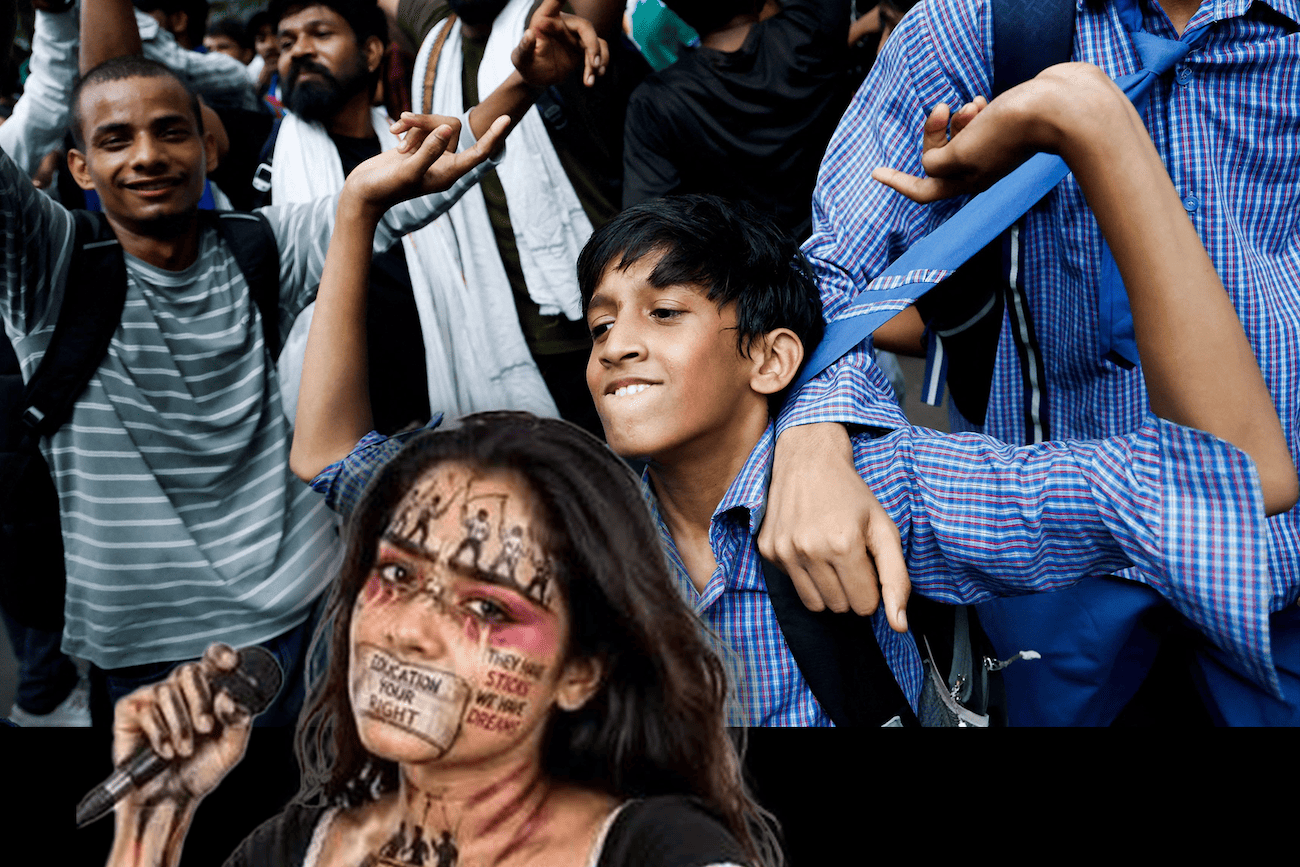

Two nights after the Delhi Police and the Rapid Action Force beat their way through a student march on Parliament, a portable speaker at the far edge of the Jantar Mantar protest site started playing a song nobody had heard before.
It had a DJ drop. It had a bass line built for a wedding baraat. It had a chorus that, translated loosely, went: Policeman sir, go ahead, hit me with your stick. The voice rising from my heart—how exactly are you going to silence that?
Shuddhabrata Sengupta, an artist with Delhi’s Raqs Media Collective who had been a regular visitor to the site, described in The Wire the moment he first heard it—on the unruly outer fringe of the protest, past the cordoned civic center with its library and medical desk and poster corner, in the zone where the slogans got risqué and the young women danced hardest.
The beat, he wrote, was hypnotic and slightly incendiary, and the song knew what had happened on July 20. Within days a remix cut to protest footage and memes was haunting his timeline, and he went looking for the source.
The source was a YouTube channel called Couple Comrade. The song was “Police Wale Babu.” And the two people behind it—or the one person behind the two-person name; nobody is quite sure—were, by any commercial measure, nobody at all.
The Dare
To understand why the song worked, you have to understand the joke it is built on, because it is the same joke the entire movement was built on.
The Cockroach Janta Party was born in May 2026 as political satire. Chief Justice of India Surya Kant had likened unemployed youth and social media activists to “cockroaches” and “parasites.” A digital communications strategist named Abhijeet Dipke, then a student in the United States, took the insult and made it a party name.
The NEET paper leak—the medical entrance exam that had just been compromised for lakhs of students—gave the joke a grievance. In early June Dipke flew home, walked out of Delhi airport holding a copy of the Constitution, and went to Jantar Mantar with a few hundred people. On June 28 the Ladakhi activist Sonam Wangchuk joined him and began a hunger strike demanding the resignation of Education Minister Dharmendra Pradhan. The crowds grew. The government waited.
Then, on July 20, the students tried to march on Parliament, and the police met them with batons, tear gas and pellet guns. More than a hundred protesters ended up in hospitals. Independent journalists and the protesters themselves put the videos online—many in the crowd had stopped watching television news altogether, convinced it was carrying the government’s line—and the footage did what footage does. Jantar Mantar overflowed into the surrounding streets. Solidarity protests sprang up in Mumbai, Kolkata, Patna, Bengaluru, Aizawl.
“Police Wale Babu” was uploaded on July 22. It does not ask the police to stop. It asks them to go ahead. Danda laga do—lay the stick on me. Reclaim the insult, reclaim the danda. A movement that had already turned “cockroach” into a badge now turned the lathi into a dance cue.
That is the second joke, and the cleverer one. The song’s verses keep switching between two addressees—the police wale babu and the DJ wale babu—until, by the end, they are barely distinguishable. Both are asked to raise the volume. Both are asked to drop something heavy. The lathi and the bass drop are, after all, percussion. And anyone under thirty in that crowd would have caught the reference: the title rhymes deliberately with “DJ Waley Babu,” Badshah’s 2015 party anthem, the most frivolous song of their adolescence, now repurposed for a sit-in at two in the morning.
The song is also, quietly, generous. One verse asks the policeman to smile—to show the human being under the uniform. Another promises that the crowd will dance if he will only blow his whistle. It never calls the police the enemy. It treats them as fellow citizens who might, if the beat were right, join in. That is Gandhi’s method in Bollywood’s form, and it is a very Indian way to protest.
Who Made It
Couple Comrade’s website describes the project as a music act that writes original songs about the news, the Constitution and the people it is meant to protect—every release reported, written and recorded in-house, in Hindi, Urdu and English. They have a phrase for it: musical journalism. Headlines turned into verses people actually remember. Their sign-off is “Songs for the record.”
The credits, though, name a single artist. The vocalist performs as ETS, formerly Emaar the Sher, and the track was released under the Emaar Music label. On Spotify, the artist page for “emaar the sher” shows 511 monthly listeners. The website speaks in the plural; the credits speak in the singular; nobody has yet confirmed whether Couple Comrade is a couple or one person with a good name. According to the act’s own account on Instagram, the project originally operated under the Emaar name until a trademark notice arrived from Emaar Properties—the Dubai real estate giant—and it rebranded as Couple Comrade.
The title track of that name is a love song of sorts: it asks whether a partner is willing to stand shoulder to shoulder, like a comrade, when the struggle is real rather than performed for social media. The name, in other words, is the thesis.
The song’s verses keep switching between two addressees—the police wale babu and the DJ wale babu—until, by the end, they are barely distinguishable. Both are asked to raise the volume.
No label, no film, no star. A couple, or a single artist, with a home studio, a copy of the preamble, and a grudge against a bad week.
The Two Soundtracks
The song did not land in silence. From the beginning, the CJP protest had been unusually musical, and its music came in two distinct streams.
The first was homemade, fast, and often machine-assisted. Within days of the party’s founding in May, independent creators were uploading CJP anthems—Haryanvi rap, hip-hop, a Kannada track by the musician Prasanna Bhojashettar—many of them, ThePrint reported, produced with artificial intelligence. The lyrics reclaimed the government’s own vocabulary: insects, parasites, lazy.
The Nagpur rapper Vinod Waghade, who performs as Garam Kalakar, told The Federal he had been in touch with the CJP since its founding days and collaborated on a track built around a single blunt question about who leaked the paper. In Bengaluru, the Malayalam singer-composer Sunil Koshy watched the July footage, found he could not stay a spectator, and composed and recorded a song for the protesters in under two hours.
The second stream was inherited. ThePrint’s list of the songs that became the movement’s de facto playlist reads like a family road-trip mix: “Hum Dekhenge,” “Sandese Aate Hain,” “Give Me Some Sunshine” from 3 Idiots, four from A.R. Rahman alone—“Vande Mataram,” “Jai Ho,” “Sadda Haq,” “Khoon Chala”—plus Salim-Sulaiman’s “Chak De! India” and Piyush Mishra’s “Aarambh Hai Prachand.” The reporter’s dry observation: a protest widely described as Gen Z had largely found its voice in songs that predate the generation leading it.
The Federal’s Yogesh Pawar recorded the moment that best explains why. Hours after the July 20 lathi charge, a shaken seventeen-year-old named Mihika Yadav stood among the regrouped protesters wondering aloud why demanding a fair future had become an act worth punishing. Someone in the crowd began singing “Sarfaroshi ki Tamanna”—the century-old ghazal associated with Ram Prasad Bismil and the freedom struggle. Within moments dozens of voices had joined. By the end of it, Pawar wrote, her fear had given way to a smile of steely resolve.
The revolutionary balladeer Sambhaji Bhagat, who has spent three decades singing at Dalit, farmers’ and workers’ movements in Maharashtra, offered Pawar the older explanation. Ambedkar, he said, used to remark that ten speeches could not equal the impact of one powerful song sung by a shahir before ordinary people. Speeches belong to leaders and slogans to campaigns. Songs belong to whoever sings them next.


“Police Wale Babu” sits at the exact intersection of the two streams: made in a bedroom by somebody nobody had heard of, but built on the bones of a Bollywood hit everyone knew.
Maro Sir, Aur Maro
The most remarkable thing about the song is that it was not, strictly, invented. The crowd had already written it with its bodies.
Sengupta’s Wire essay records three images from that week. A young woman in Mumbai, Rhea Ahir, who stopped a police van carrying detained protesters by standing in front of it until they were released. A teenage girl in glasses at Jantar Mantar, arms outstretched, shielding a line of young men from a raised lathi, her face half fear and half dare. And a young man named Bharat, who had come from Nagpur for the July 20 march and found himself surrounded by some fifteen Rapid Action Force personnel with batons. They beat him. He did not move. He said to them: Maro sir, aur maro. Hit me, sir. Hit me again.
Two days later a song said the same thing over a DJ drop.
Sengupta noticed the rhythm even before the song existed. On the night of the 20th, when the RAF marched in to dismantle the protest stage, the remnants of the day’s march stood and clapped—a slow, steady, sardonic applause that he recognized from the thump-thump of the tracks the students had been dancing to in the preceding days. The stage was rebuilt that same night. The night shift, as he called it, continued.
Write the Caption
One verse of “Police Wale Babu” asks the policeman to take the protester’s photograph and, tomorrow, to write the caption for history. It is a throwaway line, tossed off between bass drops. It is also the most self-aware thing in the song. The students at Jantar Mantar knew they were being documented—by surveillance cameras, by police, by one another—and they had decided that if the record was going to be written, they would write it themselves, in reels, in memes, in a chorus of azadi at two in the morning.
On July 25, three days after the track went up, Dharmendra Pradhan resigned. The following day the CJP suspended the protest, citing government assurances on its remaining demands, and the site was cleared. The songs, of course, were not.
Couple Comrade has never claimed the resignation. The website does not mention it. The Spotify page still says 511 monthly listeners, and the count will probably not move much, because the song did not travel through Spotify. It traveled through a speaker on a curb, a phone held up in a crowd, a remix on a stranger’s timeline, a news channel that needed a soundtrack for its footage. It traveled the way the shahirs’ songs traveled, and the way “Sarfaroshi” traveled for a hundred years before a seventeen-year-old reached for it after a beating.
The kids at Jantar Mantar asked the policeman to write their caption. He never did. They had already written it, and set it to a beat.
Ganpy Nataraj is an entrepreneur, author of “TEXIT – A Star Alone” (thriller) and short stories. He is a moody writer writing “stuff” — Politics, Movies, Music, Sports, Satire, Food, etc.