




India’s Student Unrest Unfolded in a Political Landscape Shaped by Two Strongmen: Narendra Modi and Amit Shah

- The unrest did not emerge in isolation. It unfolded against a regional backdrop in which governments in Sri Lanka, Bangladesh, and Nepal collapsed with startling speed.
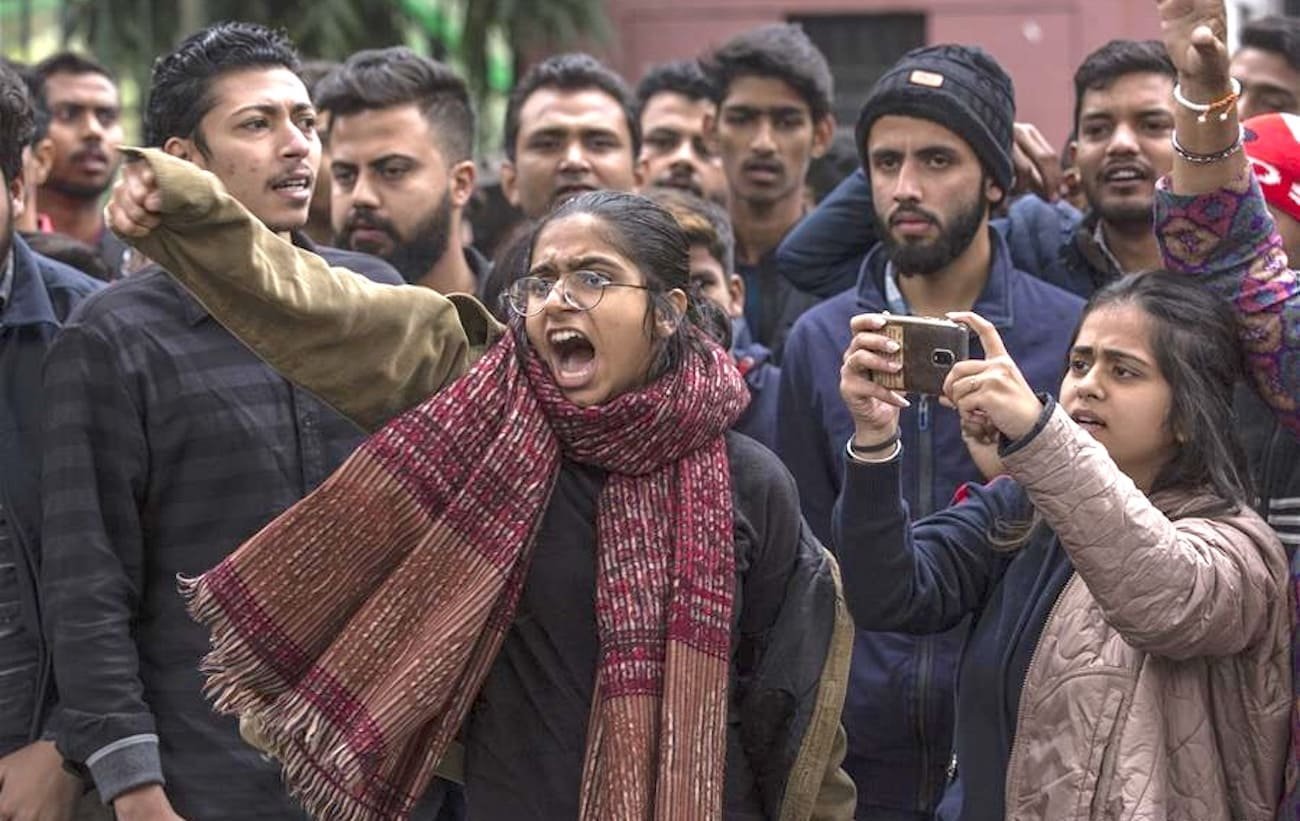

Student movements rarely emerge from abstraction; they ignite when a direct wound is felt, when a high ideal summons collective imagination, or when political actors intervene at moments of vulnerability. India’s present unrest began with all three.
The cancellations of NEET and other examinations, allegations of corruption, and the sudden collapse of trust in the very ladder that promised mobility created a moment of acute generational injury. Into this confusion stepped Sonam Wangchuk, whose moral authority resonated with students who had lost faith in every institution.
His intervention mattered, but he was not Jayaprakash Narayan. JP possessed decades of organizational experience, mass mobilization capacity, and a political imagination capable of turning moral force into national movement. Wangchuk’s appeal was ethical, not strategic, and the students’ anger was already primed by structural failures.
The unrest unfolded in a political landscape shaped by two Indian strongmen: Narendra Modi and Amit Shah. Their partnership produced a single deformation of the republic with three instruments.
Modi built a political machine so tightly aligned with his personal ambition that the party beneath him became an extension of his will. Shah consolidated the party-state and the federal coercive stack, converting dissent into file and fear. And around them, the regime turned education into ideological catechism, weakening the autonomy of universities, councils, and exam bodies. Machine in the party, coercion in the state, catechism in the classroom — three strands of one deformation.
But these three strands did not develop independently or sequentially. They formed a mutually constitutive logic. Catechism weakens the capacity for critical thought, making populations more susceptible to machine politics — to the reduction of citizenship into tribal loyalty and electoral transaction. Machine politics, in turn, requires coercion to silence the kinds of dissent that genuine inquiry would naturally generate.
When universities still teach students to ask why, when curricula still prize questioning, control becomes harder. Coercion thus becomes necessary to suppress the questions themselves. And coercion requires a population already habituated to obedience — to accepting authority without examination, to preferring catechism to inquiry.
This is not a conspiracy orchestrated by two men in a room. It is a logic. Once one strand takes hold, the others follow by necessity. The machine requires coercion because dissent will arise. Coercion requires catechism because questioning will emerge. Catechism requires the machine because humans who learn to ask will not forever remain loyal subjects. Each strand feeds the others.
Together, they form a closed system — a republic that has ceased to believe in the possibility of its own democratic renewal.
The student unrest did not emerge in isolation. It unfolded against a regional backdrop in which governments in Sri Lanka, Bangladesh, and Nepal collapsed with startling speed. India’s establishment watched nervously. With unemployment rising — CMIE data showed joblessness fluctuating between 7–8% through 2025–26 — and with household consumption diverging from official GDP projections, the NEET scandal struck at the last surviving reservoir of trust: the belief that hard work could still carve a path forward. But to understand how this trust eroded, we must understand the three eras of the republic and what each inherited, built, and then lost.
Independent India inherited a particular vision of public life. The founders believed that the state’s role was not to dictate answers but to create conditions for inquiry. Universities were meant to be autonomous spaces where truth mattered more than efficiency. Curricula were built on the principle of scientific temper — the habit of questioning, of testing claims against evidence, of building knowledge through doubt rather than dogma.
Exams were not mere sorting mechanisms; they were expressions of a deeper commitment: that citizenship required the capacity to think. The civil service, recruited through competitive examination, was meant to be a meritocratic ladder where effort could translate into dignity and mobility.
This equilibrium was fragile. It produced profound inequalities, violence, and exclusion. But it held because it preserved something crucial: the legitimacy of effort. Even when competition was brutal, even when outcomes were unjust, the system retained moral authority because it appeared fair — because the ladder seemed real.
After 1991, India liberalized its economy. The new bargain was different but still held: markets would generate growth, coalition politics would slow authoritarian overreach, and public life would still carry residue of older values — justice, dignity, the notion that democracy was not just voting but deliberation. Exams remained the ladder.
Competition ratios became extreme, but the structure retained legitimacy because it appeared fair. Universities lost some autonomy to market pressures, but they retained space for inquiry. The civil service became more technocratic but still believed, broadly, in constitutional process.
The equilibrium was thinner now, more dependent on economic growth and political restraint. But it held because effort still seemed to matter. If you worked hard, studied rigorously, passed the exam, you could rise. The system was unequal, but it was legible.
What distinguishes the crisis that began in 2014 is that all three pillars of the equilibrium broke simultaneously. The machine subordinated the party to personal ambition. The coercive apparatus silenced dissent. And the classroom ceased to be a space for inquiry and became a space for catechism
What distinguishes the crisis that began in 2014 is that all three pillars of the equilibrium broke simultaneously. The machine subordinated the party to personal ambition. The coercive apparatus silenced dissent. And the classroom ceased to be a space for inquiry and became a space for catechism — for the transmission of ideology rather than the cultivation of thought.
The consequences cascaded swiftly. If exams can be rigged, effort loses meaning. If universities are instruments of state ideology, inquiry becomes dangerous. If the civil service serves a leader rather than the constitution, legitimacy collapses. The equilibrium that had held India together through its most turbulent decades — not perfect, but functional — broke.
Even in a system where competition ratios were extreme, the exam structure retained legitimacy because it appeared fair. NEET shattered that illusion. Corruption did not merely distort outcomes; it destroyed meaning. When the ladder is rigged, those climbing it are not rising; they are being played.
The Philosophical Awakening of the Youth
When the Chief Justice publicly referred to unemployed youth as “cockroaches,” a digital retort — a sharp, subversive joke — transformed humiliation into solidarity and solidarity into movement. But this moment reveals something more profound than reactive anger. The students were not merely protesting injustice; they were asserting a philosophical claim about human dignity.
Humor became resistance; resistance became identity. And in that moment, India remembered something older than the republic: that human dignity is not granted by judges or bureaucrats, that it is not something the state can bestow or revoke, but something inherent — defended, renewed, and reclaimed through solidarity.
The students’ response was philosophically significant. When they laugh at the Chief Justice’s cruelty, they are saying more than “this is unjust.” They are saying: You cannot define us. We define ourselves. Your categories do not capture our worth. Your institutions do not own our dignity.
This is not merely moral awakening; it is the reassertion of human agency against systems designed to reduce it. And it points toward something deeper: the students are intuiting that corruption is not just about money — it is about the theft of meaning itself.
When exams are rigged, effort becomes meaningless. When the Chief Justice calls you a cockroach, the state revokes your humanity. Their response — through humor, solidarity, and collective refusal — is to reclaim what was stolen.
They are teaching the republic something it had forgotten: that dignity is the foundation of citizenship, and dignity cannot be manufactured by policy or decreed by judges. It can only be recognized, defended, and renewed through the choices we make about how we treat each other.
As the unrest grew, the government’s response revealed its inner disarray. A police complaint against the opposition leader for political speech signaled bewilderment rather than confidence. Modi and Shah were largely absent from sustained public engagement on the crisis, apart from a brief address on August 1.
This pattern of limited visibility reflected a deeper paralysis. Modi pursued symbolic engagements abroad, collecting awards from small nations; Shah appeared to lose the strategic clarity that once defined him. The state seemed unable to speak, unable to act, unable to imagine.
This is not a tactical withdrawal. It is existential. A state that has built itself on spectacle and coercion has no language for genuine dialogue. It can command, but it cannot persuade. It can punish, but it cannot inspire. When faced with a crisis that demands reconstruction, it has only the grammar of control — and control, once it fails, leaves only silence.
For twelve years, the delicate balance between hope and achievement, politics and economics, institutions and public trust has steadily eroded. The old equilibrium rested on a bargain inherited from an older republic — one that believed in shared inquiry as civic duty, in the possibility of vertical mobility through effort, and in the notion that public life could be built on something higher than power and fear.
That equilibrium held not because it delivered perfect outcomes, but because it preserved the legitimacy of effort and the dignity of the person.
Its breakdown marks the end of an era. Once equilibrium breaks, events accelerate. The student revolt is not an episode; it is a signal. The institutional collapse is not a malfunction; it is a verdict. The bewildered state is not a pause; it is an ending.
Reconstruction will require far more than administrative reform. It requires a reimagining of the relationship between individual, institution, and state — a new civic grammar built on three foundational shifts.
1. The Individual as Moral Agent
The republic must restore the individual as a moral agent, not a statistical unit or a piece in a political machine. This means:
• Exams designed for inquiry, not compliance: Examinations should test the capacity to think critically, to recognize assumptions, to build arguments from evidence — not merely the retention of predetermined answers. An exam that rewards rote learning is an exam that trains obedience. An exam that rewards thinking trains citizenship.
• Curricula that teach question-posing, not catechism: Education must return to its first principle — the cultivation of doubt, the habit of asking why, the belief that truth is discovered through inquiry rather than transmitted by authority. Science curricula should teach the method of science, not just its conclusions. History curricula should teach students to read sources, to ask whose story is being told, not to memorize narratives. Literature should teach the habit of interpretation, the recognition that meaning is constructed and contested, not given.
• Economic structures that make dignity visible: Growth statistics and employment numbers are not enough. A reconstructed republic must build economic structures that make visible the moral worth of work — that recognize labor not just as economic input but as the expression of human capability and contribution. This might mean wage structures that reflect human dignity, workplaces where voice is heard, production systems where the worker sees the value they create.
• Spaces of genuine democratic deliberation: From local councils to national institutions, the republic must create spaces where citizens are not subjects receiving decisions but participants in making them. This requires patience, institutional design, and a genuine commitment to listening.
2. Institutions as Autonomous Spaces for Inquiry
Institutions must recover their autonomy — from both state coercion and market pressure. They must be redesigned as spaces where truth matters more than efficiency.
• Universities insulated from ideology: Universities cannot be machines for producing outcomes aligned with state objectives. They must be spaces where scholars can pursue questions even when those questions challenge prevailing orthodoxies. This requires reformed appointment processes that prize scholarly judgment over political loyalty, funding structures that do not depend on state approval, and protection for dissenting voices.
• Exam integrity through transparent systems: Transparent digital audit trails, decentralized exam administration, real-time monitoring, and robust accountability mechanisms must make corruption not just morally wrong but practically impossible. An exam system rebuilt this way says to young people: We believe your effort matters. We have built institutions to protect that belief.


• Judicial independence through structural reform: Appointment reforms must restore the judiciary’s independence from executive pressure. Independent judicial commissions, transparent criteria for appointment, term limits that allow judges to speak freely without fear of retaliation — these are not technicalities. They are the conditions of justice itself.
• Media and civil society as genuine checks: A reconstructed republic must protect the institutional autonomy of media, academia, and civil society organizations — the spaces where alternative visions can be articulated and power can be checked. This requires legal protections, funding independence, and a cultural commitment to pluralism.
3. The State as Steward, Not Director
The state must redefine itself as steward, not architect of national destiny. Not the director of what citizens should think, believe, or become, but the guardian of the conditions in which dignity, meaning, and inquiry can flourish.
• Coercive apparatus reformed for constitutional service: The police, military, and security services must be rebuilt around the principle that they serve the constitution, not the government. This requires training, oversight, and a cultural transformation — the recognition that coercive force is legitimate only when it protects rights, not when it suppresses them.
• Civil service as constitutional guardian: The bureaucracy must recover its commitment to constitutional process, to the rule of law, to the notion that public service means serving the public, not the regime. This requires institutional reforms in recruitment and promotion, but more fundamentally, a restoration of the idea that the state serves the people, not the other way around.
• Policy built on evidence and dialogue: Economic policy, educational policy, social policy — all must be built on evidence, tested through dialogue, and adjusted based on outcomes. This sounds obvious, but it requires a state willing to acknowledge what data shows, even when it contradicts preferred narratives.
• Economic growth aligned with employment and dignity: The state must design economic structures that align growth with employment, that make visible the relationship between production and human welfare, that recognize that statistics that hide suffering are not measures of progress.
A Civilizational Reimagining
This is not nostalgia. It is not a return to some imagined past. It is civilizational design — the deliberate construction of institutions and practices that embody the values a republic must hold if it is to endure.
What distinguishes this project from mere reform is that it begins with a question: What kind of people do we want to become? What must our institutions be in order to cultivate those qualities?
A republic that wants citizens capable of judgment must have universities where judgment is learned. A republic that wants to honor effort must have exams that test real capacity, not mere compliance. A republic that wants to preserve dignity must have economic structures that make dignity visible. A republic that wants genuine democracy must create spaces where people are not subjects receiving decisions but participants in making them.
These are not separate projects. They form a single vision: a republic rebuilt on the principle that human dignity is non-negotiable, that inquiry is a civic duty, that effort has moral worth, and that institutions exist to protect these truths, not to violate them.
The Threshold
For thirteen years, India has been captured by men who believe the nation is merely an extension of their own ambitions. They built machines to control democracy, and then became captive to the machines they built. Their myths are exhausted. Their strategies have failed. What remains is the possibility of renewal.
India stands at a threshold. The strongmen have exhausted their myths. The institutions have exhausted their legitimacy. The youth have exhausted their patience. The equilibrium has broken.
The regional collapses in Sri Lanka, Bangladesh, and Nepal showed how quickly state authority can evaporate when legitimacy is lost. India has time — not infinite time, but enough to choose a different path. That path begins with the recognition that reconstruction is possible, but only if it is undertaken with civilizational ambition, with institutional rigor, and with a restored commitment to the idea that dignity, inquiry, and effort are the foundations on which republics are built.
What remains is the possibility of renewal — not through nostalgia, not through ideology, not through another strongman promising to fix everything, but through a new architecture of trust, merit, dignity, and meaning.
This is not a technical project. It is not something that can be completed in one election cycle or one government’s tenure. It is the work of a generation — perhaps two.
This is the work of a republic reclaiming itself.
This is the work of India’s next twenty years.
Satish Jha, former Editor, Indian Express Group and The Times of India Group writes on geopolitics, international affairs, and development.
Instead of making your case with some untrue fables, why do not you say that outside forces, including the USA is training these young men and sending them there to cause the chaos. To benefit their system and weaken the uprising competitor