




‘An Immigrant, Like My Parents’: How Vivek Ramaswamy Built a Voting Policy Argument on a Family Story That Wasn’t True

- The Ohio Republican gubernatorial nominee repeatedly told voters his parents passed the same civics test he wants to require of young Americans. His father never took it. He acknowledged this when pressed — but only after the false version had been repeated at dozens of campaign stops.
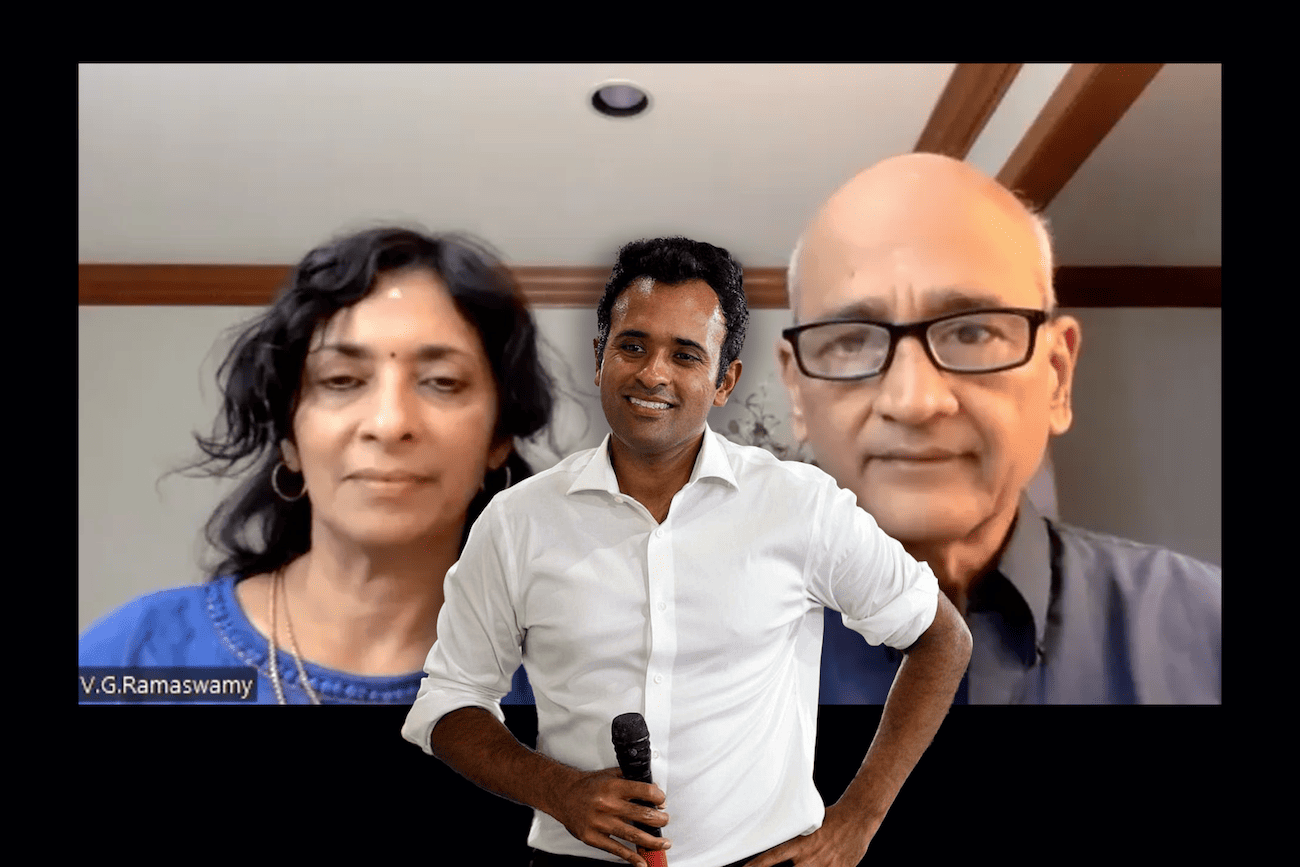

For more than three years — from his 2023 presidential campaign through the current Ohio gubernatorial race — Vivek Ramaswamy has returned again and again to the same story about his family to justify one of his most controversial policy proposals.
The proposal: require all Americans between the ages of 18 and 24 to pass the same civics test that immigrants must pass to become naturalized United States citizens — or complete six months of military or first-responder service — before being permitted to vote. He framed it as a constitutional amendment that would require citizens 18 to 24 to pass a civics test in order to vote — the same one immigrants take to become naturalized U.S. citizens.
The justification: his own immigrant parents had done it. They had come to the United States, committed to the country, passed the test, and become citizens. Why should American-born young people be exempt from demonstrating the same civic knowledge?
“I think there’s no reason why every high school student who graduated in this country should not have to pass the same civics test that an immigrant, like my parents, had to pass in order to become a citizen of this country,” he told Iowa Gov. Kim Reynolds at the Iowa State Fair in August 2023 — a statement that encapsulates the argument’s rhetorical core. “My parents.” The civics test. The commitment to citizenship as a demonstration of civic seriousness.
The problem, as NBC News reporter Dasha Burns discovered when she sat down with Ramaswamy for a one-on-one interview, is that the story he had been telling at campaign stop after campaign stop was false in a specific, material, and consequential way.
Burns revealed his father never took that test or naturalized, citing familial reasons. India bars dual citizenship, complicating Ramaswamy’s framing of naturalization as proof of civic commitment.
The Interview: A Quiet Acknowledgment, Three Years Into the Claim
When Burns pressed Ramaswamy on the family citizenship story during her sit-down interview, his answer was notably different from the rhetoric he had deployed at the Iowa State Fair and at dozens of other events.
In a sit-down interview, Ramaswamy noted that his father is not a U.S. citizen and never took the test. “He did not.”
“But my mother did,” he continued, explaining that she took the test and completed the process after he was born.
The distinction between what he acknowledged in the interview and what he had repeatedly told voters on the campaign trail is stark and documented. In the Iowa State Fair statement — one of dozens of similar formulations across public events — he referred to “my parents,” plural, as immigrants who had passed the civics test he was proposing to require of young Americans.
In the Burns interview, he confirmed that only one parent had done so. His father, Vivek Laxmikant Ramaswamy, a General Electric engineer who immigrated from Kerala, India, has remained a lawful permanent resident — a green card holder — without naturalizing, a choice complicated in part by India’s prohibition on dual citizenship, as Tiffin Ohio Net documented.
As Tiffin Ohio Net summarized the central factual finding, drawing on Burns’ investigation: Vivek Ramaswamy has repeatedly cited his immigrant parents to justify requiring young Americans to pass a citizenship civics test before voting. His father never took that test or naturalized.
If his father never took the test — if the man whose immigrant journey Ramaswamy invoked as the template for the civic standard he wants to impose on 18-to-24-year-olds did not himself meet that standard — the analogy loses its biographical grounding.
Why It Matters: The Policy Argument and Its Foundation
The false version of the family story matters because it was not incidental decoration on a policy argument. It was the policy argument.
Ramaswamy’s civics test proposal rests on an explicit analogy: naturalized citizens demonstrate their civic commitment by passing a test; American-born young voters should be held to the same standard. The moral force of the argument — the reason it resonates with audiences skeptical of youthful political engagement — depends on the premise that immigrants, as a class, have demonstrated a civic seriousness that entitled young Americans have not. And the personal force of the argument, as he deployed it, depended on his ability to say: my own parents did it. They are the example.
If his father never took the test — if the man whose immigrant journey Ramaswamy invoked as the template for the civic standard he wants to impose on 18-to-24-year-olds did not himself meet that standard — the analogy loses its biographical grounding. It becomes a policy argument in search of a different justification.
The story cuts to the center of a campaign full of off-the-cuff speaking and attention-grabbing, aggressive policy proposals that go further than past Republican presidential administrations have deemed possible — or even legal. The proposal that young voters should take a civics test first, for example, runs right into the 26th Amendment of the Constitution: “The right of citizens of the United States, who are 18 years of age or older, to vote shall not be denied or abridged by the United States or by any State on account of age.”
The Birthright Question: A Separate But Related Complication
The citizenship story carries a second wrinkle that Ramaswamy has also had to navigate carefully. Ramaswamy, 40, was born in the U.S. to two noncitizens, which means he gained citizenship through birthright, though he noted that his parents immigrated to the country legally.
He has been an outspoken advocate for ending birthright citizenship for children born in the United States to undocumented immigrants — a position he has maintained through his presidential campaign and his gubernatorial run. He has been careful to draw a consistent line: his parents came legally, so his birthright citizenship is legitimate; his proposal applies only to the children of those who came illegally.
“I want to be very clear about this. I think that birthright citizenship does not and should not apply to the kids of parents who entered this country illegally,” Ramaswamy said.

As Tiffin Ohio Net noted in its careful accounting of these distinctions: Ramaswamy himself became an American citizen before either parent had naturalized. His family therefore illustrates that citizenship at birth and parental naturalization are separate questions.
The India dual-citizenship prohibition adds a further layer of complexity. India does not permit its citizens to hold dual citizenship — meaning that for Ramaswamy’s father to have naturalized as an American, he would have had to formally renounce his Indian citizenship. That is a real and significant consideration. But it complicates rather than resolves the core factual problem: Ramaswamy told voters his parents passed a test that his father never took.
The Campaign’s Broader Pattern
The naturalization story is not the only occasion on which Ramaswamy’s gubernatorial campaign has generated factual controversy. During his unsuccessful run for president a few years ago, Ramaswamy floated raising the voting age to 25 for those who couldn’t pass a civics test or first complete six months of mandatory military service.
In the current Ohio campaign, as Signal Ohio documented, he has also proposed abolishing property taxes before backtracking, proposed ending summer break and adding an hour to the school day before deleting the video, and proposed closing multiple Ohio universities — a suggestion that, as Signal Ohio noted, prompted Cook Political Report to downgrade his race from “Likely Republican” to “Lean Republican,” with analyst Matthew Klein writing: “At this point, it’s clear that Ramaswamy has enough vulnerabilities to loosen his lock on this race.”
The Ohio Democratic Party has been explicit in its characterization of the pattern. “Vivek Ramaswamy can’t stop lying about his plans to close colleges, raise the voting age to 25, or even about how he called Medicaid and Medicare a mistake,” said Ohio Democratic Party spokeswoman Katie Seewer.
A Race That Was Supposed to Be Easy
Ramaswamy, a multimillionaire former biotech executive and erstwhile presidential hopeful, won the Republican primary for governor of Ohio on Tuesday and now faces a November general election contest against Democrat Amy Acton, a physician and former director of the Ohio Department of Health. The Midwestern state last elected a Democratic governor in 2006.
The state’s trajectory — decisively Republican in presidential elections, undefeated by Democrats in statewide races for twenty years — had made Ramaswamy’s race look, on paper, like a coronation. Trump’s early endorsement and enthusiastic personal support reinforced that impression. Trump wrote that Ramaswamy “will be a great Governor of Ohio, will never let you down, and has my complete and total endorsement.”
The accumulated weight of the factual controversies — the university closure proposal, the school-day extension video deletion, the Young Americans for Liberty debacle in Cincinnati, and now the documented false claim about his father’s naturalization — has transformed a presumed walkover into a genuine tossup. Cook Political Report’s shift of the race to tossup status reflects a simple and uncomfortable reality: Ramaswamy has given his opponent more ammunition than any Republican gubernatorial candidate in Ohio should need to provide in a state that last elected a Democratic governor twenty years ago.
Federal data on millions of permanent residents who haven’t naturalized suggests Ramaswamy’s father is far from alone — but the political problem is not what his father chose to do. It is what his son chose to say about it, repeatedly and inaccurately, to voters whose trust he is asking for.