




Anatomy of Hubris: ‘The Odyssey’ Proves That Men are the Primary Architects of Their Own Misery

- Christopher Nolan delivers a masterwork focused squarely on human struggles, trauma and human agency.

Watching Christopher Nolan’s “The Odyssey” in an IMAX theater in Atlanta was a soulful experience. As someone who has read and reread Homer’s foundational epic poem, I was thrilled by Nolan’s gritty, psychological, and practical-effects-heavy reconstruction. By stripping away the glossy fantasy of our collective imaginations and past Hollywood adaptations, Nolan delivers a masterwork focused squarely on human struggles, trauma and human agency.
Nolan pushes the boundaries of modern filmmaking, rejecting digital shortcuts in favor of pure cinematic obsession. The production’s grueling 150-day location shoot on volatile open waters and windswept coastlines across the globe pays off brilliantly; the actors look genuinely weathered, damp, war-worn, and sun-baked. Utilizing native IMAX cameras for the entire three-hour runtime elevates the film’s scale, turning the ocean into a terrifying, infinite character that swallows the frame and pushes Odysseus and his men to their absolute limits.
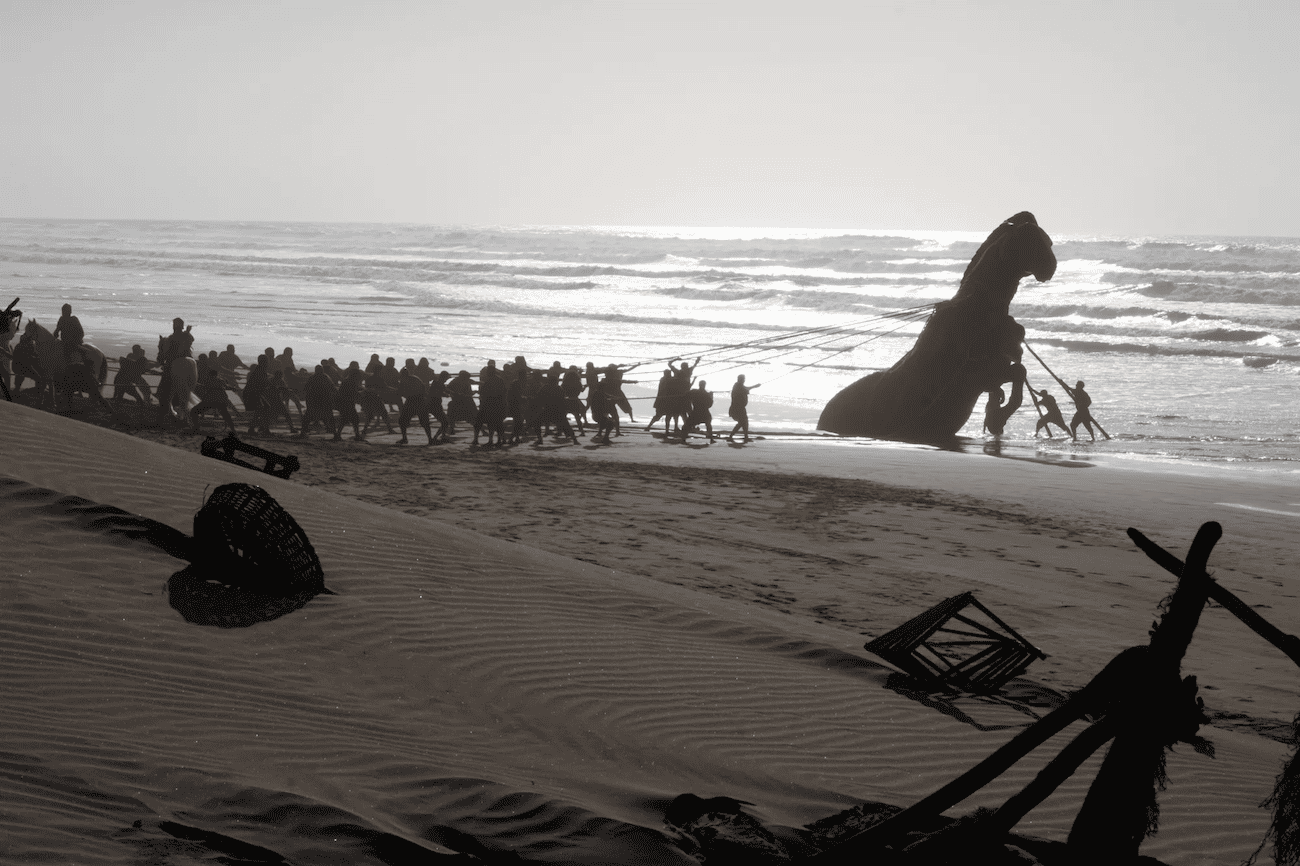
The film’s reliance on practical effects yields some of the most jaw-dropping imagery in recent memory. The art department constructed a massive, 35-foot practical Trojan Horse, half-buried in the shore sand; the subsequent interior scenes, filled with a claustrophobic tangle of desperate Greek soldiers, create masterful tension. Later, the 60-foot Cyclops, Polyphemus, is brought to life using a towering, visceral animatronic puppet. Trapped in a pitch-black cave, the monster looks genuinely ominous as the men attempt to escape by crawling alongside his flock of sheep. It was a blood curdling moment.
Matt Damon’s Odysseus is completely stripped of his classic, boastful resourceful perfection. He is a stoic survivor who views his cunning deceptions at Troy as an original sin.
Chris Nolan’s technical prowess is enhanced by a masterful ensemble cast. Matt Damon delivers a career-defining performance as a haunted veteran, while Tom Holland perfectly captures the painful coming-of-age journey of Telemachus. Back in Ithaca, Anne Hathaway shines as a weary Penelope fighting a war of attrition against the Suitors.Weaving a shroud by day, and unraveling it by night to buy time. Led by the villainous Antinous, these suitors represent a purely human domestic threat of political greed and decaying social order. They systematically abuse xenia, the ancient Greek law of hospitality to bleed the estate dry while gaslighting Penelope and plotting to assassinate Telemachus. Their parasitic cruelty ultimately leads to a brutal, morally complex climax where Odysseus descends into total violence to reclaim power.
Purists will note that Nolan heavily condenses, streamlines, and psychologizes Homer’s classic episodic trials. Calypso (Charlize Theron) is reframed as an enabling, ambiguous therapist supplying lotus petals to numb Odysseus’s severe wartime PTSD. Conversely, the sorceress Circe remains a dangerous antagonist and a crucial guide on her enchanted island of Aeaea, complete with predatory lions, tigers, and panthers. She transforms the crew into swine after luring them with a feast, leaving a desperate Eurylochus to escape and warn of her treachery.
Nolan’s most daring thematic shifts occur when dealing with the supernatural. The sequence with the Sirens is transformed into a silent psychological trap. The song is completely inaudible to the audience; instead, the camera focuses tightly on a lashed Odysseus screaming in raw existential agony as he confronts internal guilt and broken promises proving that unresolved regret is more terrifying than any external monster. Furthermore, Nolan intentionally removes the active interference of the Greek gods like Zeus, Poseidon, and Hera. Athena as Zendaya is stripped of divine superpower, operating instead as a silent observer. She functions as a tangible manifestation of faith and survival instinct, appearing almost as a living talisman gifted by Penelope to Odysseus. I long for home, I long for the sight of home. I used to keep this poignant quote from Homer’s Odyssey displayed at the entrance of my house in Alabama. It served as a constant, deeply personal reminder of the homeland I had left behind in India, making me wonder if I would ever truly be able to return at my own journey’s end.


These structural changes ultimately serve a deeper philosophical purpose. Matt Damon’s Odysseus is completely stripped of his classic, boastful resourceful perfection. He is a stoic survivor who views his cunning deceptions at Troy as an original sin. Even the iconic “Nobody” trick with the Cyclops is entirely cut, and replaced by a raw, desperate physical struggle to blind the giant. Through a physically and psychologically scarred Helen of Troy (Lupita Nyong’o), the film highlights the ultimate illusion of wartime glory, illustrating that conflict yields no true trophies.
By framing human hubris as the ultimate antagonist, “The Odyssey” proves that men are the primary architects of their own misery, frequently blaming external forces for the grief designed by their own cruelty. It stands as a brutal warning about the fragility of civilization, reminding us that society quickly collapses when we abandon mutual respect, empathy, and our sacred duty to the stranger. I can’t wait to watch it again with my children, and see how it resonates with their personal odyssey, and the odyssey of any mortal on this planet we call “home”.
With roots in Georgia and the Bay Area, and her heart still tethered to a childhood mango tree in Mumbai, India, Monita Soni approaches writing as a contemplative practice. A path to honor humanity. She has published hundreds of movie reviews, book critiques, poems, and essays, and contributed to combined literary works. Her two books are “My Light Reflections” and “Flow Through My Heart.” You can hear her commentaries on Sundial Writers Corner, WLRH 89.3 FM.