




Celebrated Ecological Activist’s Protest Fast Serves as a Profound Critique of the State of India’s Democracy

- Uniquely subcontinental in its pedigree of political protest, Sonum Wangchuk’s fast-unto-death not only reflects the apathy of the elite and the politics of attrition, but also our collective moral decline to stand up and speak up.
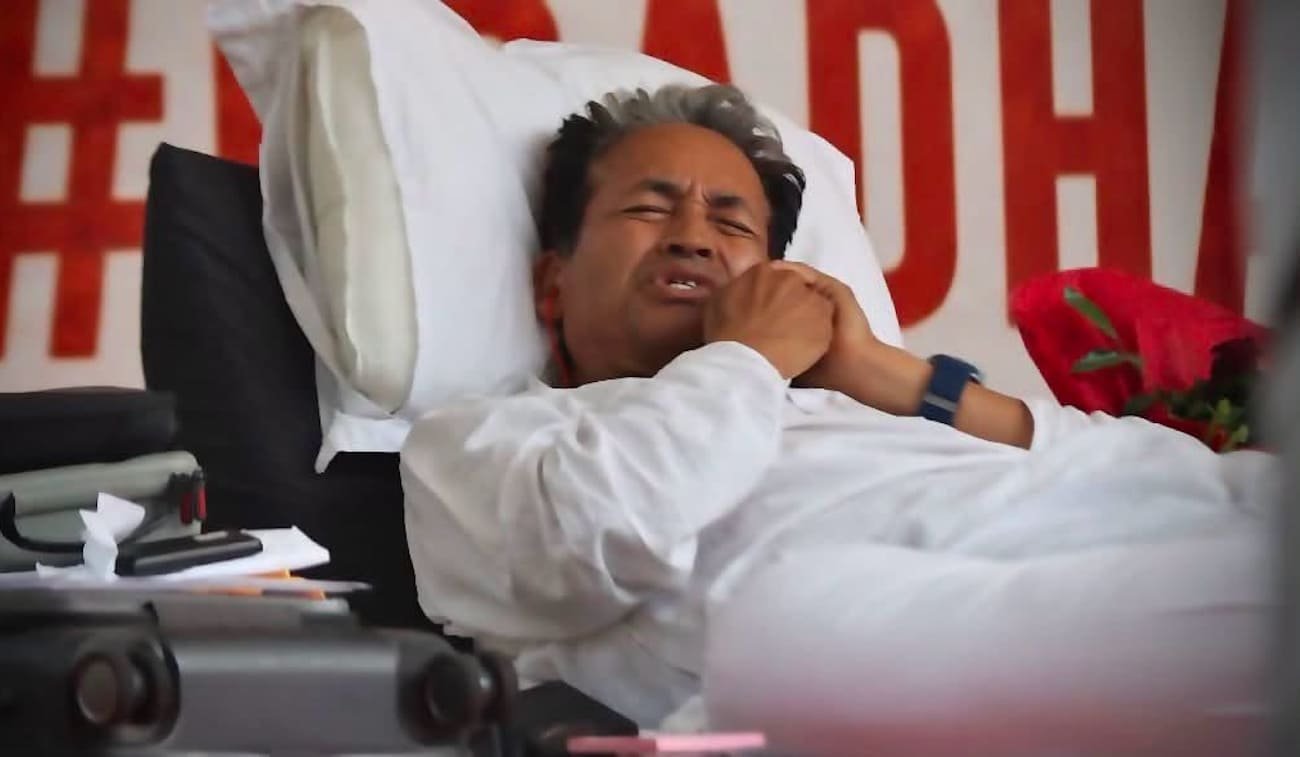

July in New Delhi is not for the faint of heart. At Delhi’s historic protest ground of Jantar Mantar, a profound political crisis is being quieted by the stifling mid-summer heat and occasional storm. Sonam Wangchuk, the 59-year-old activist innovator who has spent his life pioneering high-altitude ecological solutions and alternative pedagogy in Ladakh, is slowly fasting himself to death. Surrounded by his supporters, medical monitors and police barricades, his voice has reportedly been reduced to a raspy whisper after more than two weeks on a water-only fast.
As documented by independent news outlets and social media platforms, Wangchuk’s increasing physical deterioration sits at the intersection of two systemic national crises: the massive student outrage over compromised NEET-UG medical entrance examinations and India’s high-altitude region, Ladakh’s existential battle for ecological and political autonomy under the Sixth Schedule of India’s Constitution.
Yet, as the strike deepens, a heavy, calculated silence emanates from both the Union government and the nation’s socio-economic elite, as well as in its diasporic circles abroad. This standoff is not merely a policy dispute; it is an intellectual clash between the moral philosophy of protest and the modern state’s strategy of bureaucratic attrition – slow choke vs brute force, as reported during the widespread Citizen Amendment Act uprisings in 2019 and the 2020-2021 Farmers’ Protest.
Who is Sonam Wangchuk?
To understand the intellectual weight of Wangchuk’s fast, one must move past the simple label of “activist.” Wangchuk is fundamentally a pragmatist who views education, climate, and governance through the lens of systems engineering. Born in Uleytokpo—a remote Ladakhi village of just five households—he did not enter formal schooling until the age of nine. His early education was guided by his mother, whom he credits as being “never schooled but highly educated.” When he finally entered traditional Urdu-medium schooling in Srinagar, he was met with a rigid, alienating curriculum that relied on rote learning and physical discipline. He walked out.
This early rejection of institutional failure defined his life’s work. Instead of conforming, he co-founded SECMOL (Students’ Educational and Cultural Movement of Ladakh), a school specifically designed to nurture children failed by the state’s standardized systems. His engineering genius achieved global acclaim through the creation of “Ice Stupas”—artificial glaciers that trap winter waste-water to irrigate dry spring crops.
When a social thinker who has spent decades solving systemic problems through community-led science concludes that his only remaining option/tool is to stop eating on the asphalt of the capital to draw attention to the societal ills, it signals a deeper, structural failure: the complete breakdown of standard democratic channels – the state, judiciary and the media.
Wangchuk is fasting for the soul of a nation, its future and its democratic credibility, reportedly partnering with India’s youth-led Cockroach Janta Party (CJP). Wangchuk has championed the outrage of millions of students protesting widespread paper leaks and administrative corruption in the national medical entrance exam. For India’s aspiring middle class, these examinations are the sole mechanism of meritocratic mobility. A failure to secure their integrity represents a breach of the fundamental social contract between the youth and the state. It has been reported that several young people have died by suicide, arguably, a direct co-relation between their socio-economic inability to put their early years on hold and the leaks.
Concurrently, Wangchuk carries Ladakh’s fight for constitutional safeguards. Since its reorganization into a Union Territory without legislature in 2019, Ladakh has faced political disenfranchisement. The local demand for a Sixth Schedule Status is a bid for localized, indigenous sovereignty—allowing native communities, rather than distant bureaucrats, to protect their fragile Himalayan glaciers and cultural heritage from aggressive industrialization.
History of Political Dissent Through Fast-Unto-Death
Fasting holds a near-sacred place in the history of Indian political dissent. Grounded in Mahatma Gandhi’s philosophy of Satyagraha, the hunger strike is uniquely sub-continental, designed as an inward-directed suffering meant to weaponize vulnerability, appealing directly to the moral conscience of the powers that-be.
When a social thinker who has spent decades solving systemic problems through community-led science concludes that his only remaining option/tool is to stop eating on the asphalt of the capital to draw attention to the societal ills, it signals a deeper, structural failure.


This moral framework was spectacularly revived during Gandhian and political activist, Anna Hazare’s historic 2011 hunger strike at the same Jantar Mantar, where Wangchuk is now protesting. Hazare’s anti-corruption crusade instantly galvanized India’s urban middle class and media elite, creating a national flashpoint that forced the state to negotiate. With stark contrast to today’s India. Where Hazare’s fast shook the state, Wangchuk’s strike is met with profound apathy from India’s contemporary cultural and corporate elite as well as its diaspora – the very same diaspora that get highly voluble over the political and social construct of “Hinduphobia,” there is studied silence in this case, except for a few. This silence reflects a deeper intellectual shift since 2014 and beyond: the professional class, once vocal defenders of civic integrity, has largely retreated into comfortable, risk-averse compliance. When the target of protest is a highly consolidated central authority, the elite often prioritize institutional safety over moral solidarity, leaving localized and regional struggles to suffer in the shadows.
According to reports, the Union government’s absolute refusal to engage with the protesters is not a passive omission; it is an active administrative strategy. In contemporary statecraft, acknowledging or negotiating with a hunger striker is viewed by policy-makers as a structural vulnerability. To yield to a fast-unto-death suggests “vulnerability that policy can be dictated by physical self-sacrifice”, now or in future.
Thus, the state deploys the “politics of attrition.” By choosing silence, the administration bets on the limits of human endurance and media cycles. The calculated gamble is that public attention will eventually drift, student mobilization will fracture under academic pressure, and the physical exhaustion of the hunger strikers will quietly dissolve the movement without the state ever having to concede its authority.
Per sources, as the CJP and regional allies prepare for their march to Parliament, the stakes of Sonam Wangchuk’s fast transcend his immediate demands. The image of India’s most celebrated ecological inventor starving on a Delhi street serves as a profound critique of modern democratic health. Our collective moral health is on the decline as well!
When a state develops the capacity to look away from its most constructive citizens putting their lives on the line – and when its elite choose comfortable complicity over vocal dissent, the democratic contract itself begins to unravel. The silence at Jantar Mantar is a quiet, powerful testament to a system that has mastered the art of hearing only its own voice, and a populace that “doesn’t see nor care” because “it will not impact them!
Kuhu Singh is a writer with interest in social justice, cultural and political matters, in the U.S., India, and beyond. The opinions expressed in this article are my own. Biographical and Constitutional statements have been sourced via Wikipedia and other online sources.