




Visiting Iceland Where People Think They Will Be Cursed if They Don’t Believe in Fairies, Elves, and Trolls

- It is just as well that the conference of International Society for Folk Narrative Research (ISFNR) was held in Reykjavik in June, 2026.


On 19th June, 2026, the front desk manager at the hotel Reykjavik Natura greeted me with a smile. I was requesting a bill for the closing of 10 days of successful stay in the land of Ice and Fire. She printed out a bill and asked how our stay was. I asked her whether she was a local. Most of the staff in the service sector, including tour buses, lagoons, restaurants, and hotels, were either Polish or Portuguese, with a few Italians and Swedes as well. The European Union has made the cross-border movement of people very porous. She proudly said, I am from here. I am an Icelander. “What is your name?” as I could not see her name badge very well. She said “Glodis” and offered the meaning, too. Gold fairy.
I said, “Do you believe in it?” She said yes. I asked, why? Without a blink, she said, “If I do not, I will be cursed.” How? “These fairies, elves, and trolls protect us, otherwise, I may lose a near or dear one. Our land is full of these hidden people. Many rocks have tree houses where the fairies live. They are our guiding spirits. We are very careful with our land and protect it from any destruction. There are villages known as fairy villages. Huge rocks with tree houses are believed to be homes to elves, the hidden people.”
Glodis stated that during the 2008 earthquake, these rocks did not even move. I learned that Icelandic folklore is part of the school curriculum, which stretches their imagination, and that it must be contributing to the belief that nature is the most spiritual and precious, and that humans are at nature’s mercy.
I never imagined I would travel this far north to attend a conference. I always guessed it would be so cold! Reykjavík sits at a latitude of 64°08′ N, just south of the Arctic Circle, making it the world’s northernmost capital of a sovereign nation — a striking distinction in its own right, even without reaching for the North Pole as a point of comparison (which lies roughly 2,600 km further north).
This year, the International Society for Folk Narrative Research (ISFNR) conference was held in Reykjavík in June 2026. It was a new country, a new culture, and a new terrain, and I decided, why not? It has been magical to spend 10 days in Iceland.
Our hotel, Reykjavik Natura, lies near a small forest part of the state’s reforestation process at the bottom of a hill, where the world-famous Perlan museum is situated. This dome shaped museum combines exhibits on icebergs, volcanoes, and the expansive Atlantic and Arctic oceans surrounding this island.
Iceland has a population of about 395,000, and roughly 252,000 of them live in the capital region of Reykjavík. The rest of the country is mostly rural, and much of the interior remains uninhabited — shaped by ice and fire: glaciers, desert, mountains, volcanoes, lava fields, and the surrounding North Atlantic and Arctic oceans. Only 20-25% of the land on this island is habitable.
Iceland is geologically young by any measure — the island as a whole has been forming for roughly 16 to 18 million years through ongoing volcanic activity. However, the land we walk on today is, geologically speaking, still being made.The tectonic plates pull apart by about 2 cm per year, and the landmass is continually opening up, making volcanic eruptions a constant feature. Icebergs are melting, opening up new spaces.
First, the Norse settlers, the Vikings, came primarily from western Norway, with some arriving via the Norse settlements in the British Isles. Icelandic genetic studies have shown a notable Celtic component alongside the Norse, since many of the women who settled the island were Gaelic, brought from Ireland and Scotland during Viking voyages there — a more layered and complicated story than any single tale of Norsemen and their wives. Our tour guide offered his own version of the legend anyway: “Look at the Icelandic women. Since the Vikings married beautiful women, women in Iceland are beautiful.”
Reykjavík is not an ancient city by European standards. According to the medieval “Book of Settlements,” the Viking Ingólfur Arnarson was the first permanent Norse settler, arriving around 874 AD. As he approached the island, he and his crew found steam rising from hot springs along the coast, and so he named the place Reykjavík: reykja meaning “smoke” or “steam,” and vík meaning “bay.” Smoke Bay is named for the geothermal vapor that still defines the city’s character today.
After their arrival, the island’s ecosystem was drastically altered. The settlers introduced cattle, sheep, pigs, goats, dogs, mice, and horses to an island where no land mammals had previously roamed beyond the Arctic fox. When the Norse settlers arrived in the 9th century, they cleared a substantial share of the island’s original birch woodland, cutting trees for houses, furniture, and export to Norway, Sweden, and Denmark. Within a few centuries, much of the original forest was gone. As a result, much of the country became barren. It is heartening to know that Iceland now plants around two million trees every year to restore its greenery. Today, horses and sheep are the main farm animals, raised by farmers in farmhouses scattered all over the country. Sheep and horses roam freely in the summer and look very happy.
Folklore in the Streets
Reykjavik is rich in folklore — trolls, elves, hidden people, and other spirits. The uncanny nature of the land seems to invite them all. Walking the oldest streets near Aðalstræti, one encounters layers of the city’s founding story at every turn: the first settlers, Norse pagans who worshipped Odin, Thor, Freyr, Frigg, Freyja, and others, and who carried their own beliefs about the wonders of life and what came after death. Streets are named after them.
Norse mythology features a rich, complex pantheon divided into two main tribes of gods: the Æsir, the warriors and rulers, and the Vanir, associated with nature and fertility. Among the chief deities is Odin, the “All-Father” and supreme ruler of the gods, associated with wisdom, war, poetry, and magic. He is said to have traded an eye for infinite knowledge and to have hung on the World Tree, Yggdrasil, to learn the secrets of the runes. Thor, the thunder god and Odin’s son, is the strongest of the gods physically, protecting both mortals and deities from giants with his hammer, Mjölnir. Frigg, queen of the Æsir and Odin’s wife, is the goddess of marriage, motherhood, and prophecy, known for her protective nature.
Among the Vanir, the fertility gods, is Freyja, goddess of love, beauty, fertility, and war, and is highly skilled in seiðr, a form of magic. Her twin brother, Freyr, is the god of peace, fertility, rain, and sunshine, known for his magical ship and for riding a glowing golden boar.
Other prominent figures populate the pantheon as well: Loki, the infamous trickster god who causes chaos but sometimes aids the gods with his cunning; Heimdall, the ever-watchful guardian of the Bifröst, the rainbow bridge, who will sound the horn signaling Ragnarök; Baldr, the beloved, radiant god of light and purity whose death sets the events of Ragnarök into motion; Týr, the courageous god of law, justice, and single combat; and Njörðr, father to Freyr and Freyja, god of the sea, seafaring, and wealth. It sounds like the 330 million gods and goddesses Hindus claim.
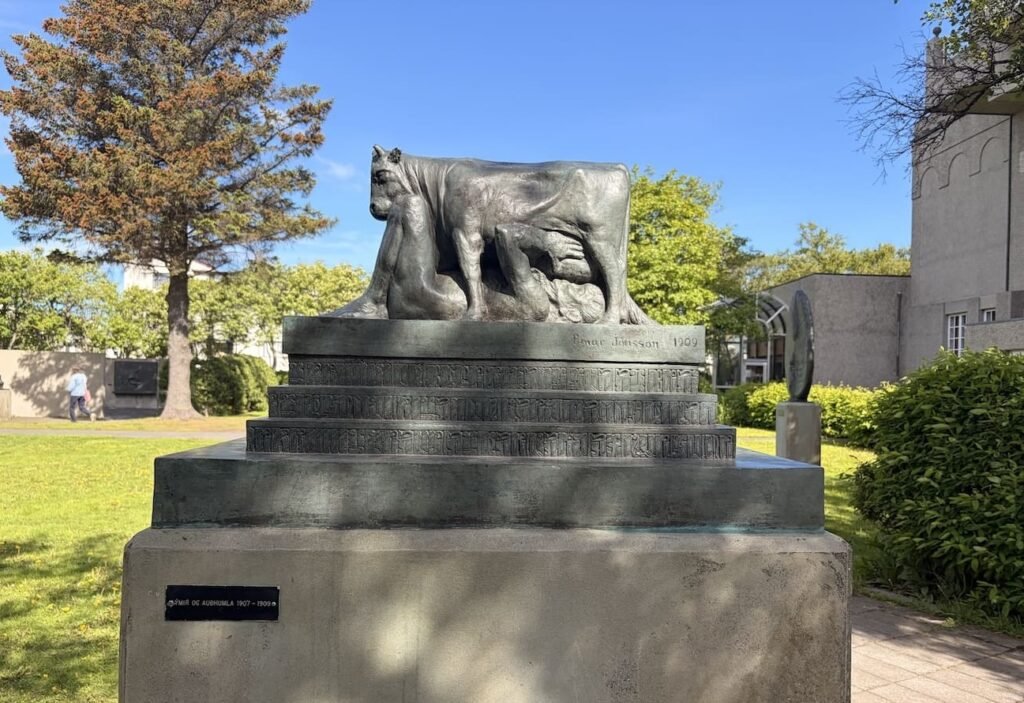
At the city center is the garden of the Einar Jónsson Museum, dedicated to Iceland’s first professional sculptor. The garden has bronze casts of his symbolist work, with figures drawn from Norse mythology and Christian allegory. One of the pieces is Ymir og Auðhumla: the primordial cow Auðhumla licking salt-laced ice for sustenance, while the giant Ymir fed on her milk. Over three days, her licking uncovered Búri, the first of the gods, from the ice. It reminded me of the cow as the life giving and sustaining divine being in the Hindu tradition.
In the 21st century, I felt these old presences very much alive in this land. You feel them in the ocean breeze, the black sand, pebbles, rocks with tree houses, majestic water falls, geo thermal pools in the wild nature, heavy wind, glaciers layering against the volcanoes, and the miles and miles of open sky.
The city buzzes with music, art, and culture. Reykjavík is a city of art, sculptures, and colorful houses.
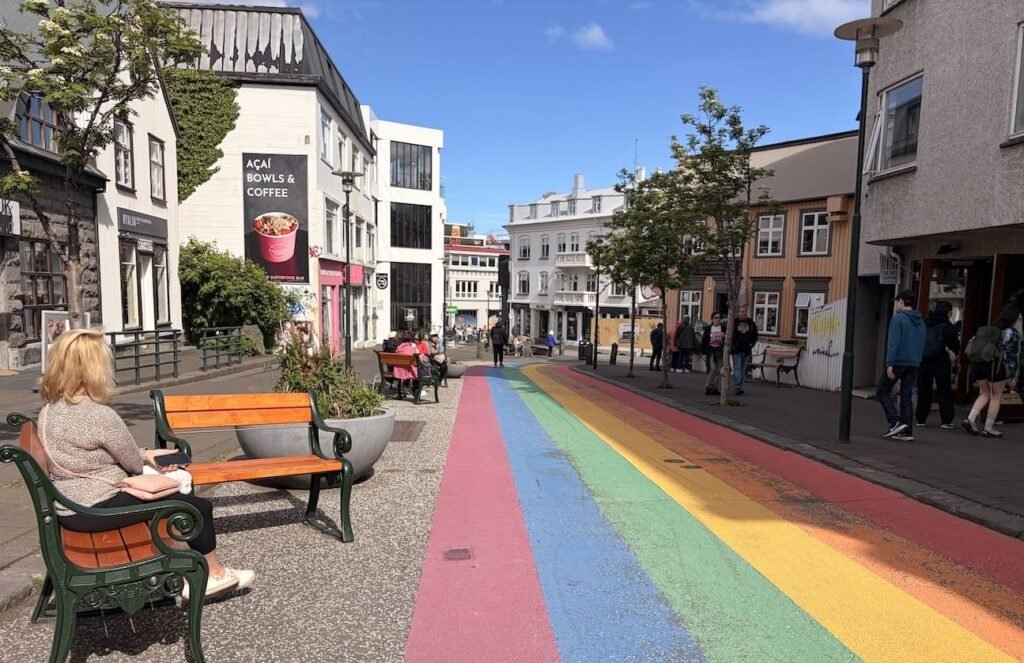
In the main city center, one street, Skólavörðustígur, is permanently painted in rainbow colors, originally to celebrate Pride Day in 2015 and now a great city attraction. What a beautiful idea. Nearby stands Harpa, the city’s modern glass concert hall.
Hallgrímskirkja Church: The Landmark of Reykjavik
You cannot miss the Hallgrímskirkja church. From almost anywhere in the city, its 74.5-meter tower is visible, its stepped concrete sides modeled on the basalt columns found in Icelandic lava formations. Designed by state architect Guðjón Samúelsson in 1937, the church took roughly four decades to complete, in 1976. The facade has rows of narrow concrete columns fanning out from the central tower, giving it both an angular, modern look and the shape of a natural rock formation.
The entrance is also worth a look: dark doors flanked by carved panels, with a tall, narrow window rising above them. Inside, the nave is long, white, and plain, leading the eye toward the large pipe organ on the west wall. The organ was built in 1992 by the German organ builder Johannes Klais and has 5,275 pipes.
Tourism, Rule, and Independence
Tourism is now the country’s main source of income, drawing roughly two million visitors a year, mainly from the United States, the United Kingdom, and Germany. Fishing has historically been the other major economic pillar. As a fish-loving Odia, I enjoyed Icelandic cod, Arctic char, and monkfish. Different species of whales, namely Orca, Mink, and Fin, among others, and puffins are both sensitive to ocean changes, including warming and rising acidity, which affect the food supply of krill and other small fish like capelin. Fin whales are mainly exported to Japan for huge profit and are listed as endangered.
Iceland’s fishing history, tied to its political history, runs through Norway and Denmark, with brief periods of British and American military presence during the Second World War rather than formal rule. Iceland came under Norwegian rule in 1262. When the Norwegian and Danish crowns were united in 1380, Iceland passed into the Danish realm along with Norway. The Lutheran Reformation reached Iceland in the 16th century, imposed by royal decree under the Danish crown; today, around 92 percent of Icelanders are nominally Lutheran.
The 15th century is sometimes called “the English Century” in Icelandic history, a period of English fishing fleets and coastal trade, followed by the growth of Hanseatic trade from Germany. Danish control tightened in the centuries that followed, including a long royal trade monopoly. During the Second World War, when Denmark itself was under Nazi occupation and unable to govern its distant territory, Iceland took the opportunity to move toward full independence.
June 17th is celebrated as Independence Day, marking the founding of the Republic of Iceland in 1944. I feel fortunate to be part of the celebration this year. U.S. military forces remained in Iceland until 1947, and later returned under a 1951 bilateral defense agreement that lasted until 2006. Icelanders credit the U.S. presence with several lasting contributions, including the country’s ring road and international airport, as well as other developments in communication and transportation.
An Expensive, Happy Country
Iceland is one of the most expensive countries one can imagine. Here, a small pizza can cost about $40. The cheapest thing, by contrast, is electricity, produced almost entirely from geothermal and hydropower. The water, drawn straight from glacial sources, tastes extraordinary. The country is well known for its swimming pool culture and the geothermal hot springs found all around it: nearly every town, however small, has its own heated public pool, and Icelanders of every age treat a soak as a daily ritual rather than an occasional indulgence — a social institution as much as a recreational one. People socialize in swimming pools the way others might at a café or a park; our guide mentioned that there are some 128 local pools with hot tubs in and around Reykjavík alone.
Wild and Unbothered
What struck me most, though, was how at ease the animals seemed everywhere I went. Sheep and the sturdy, relaxed Icelandic horses graze freely across the open countryside, loosely fenced if at all, and seem unbothered by passing traffic or tourists with cameras.
On a whale-watching and puffin-watching tour, I saw puffins guarding their eggs on the cliff side and humpback whales surfacing and diving in the open ocean nearby. I also learned that Arctic terns, which nest in the open on beaches and grassy fields rather than in trees, fiercely defend their eggs and chicks, diving at anyone, human or otherwise, who comes too close to their nest.
We missed the famous northern lights, since there is almost round-the-clock daylight in the summer — a different charm of its own, a memorable one all the same.
One asks why Iceland is consistently ranked among the world’s happiest countries. I would say: nature in abundance, a sense of equanimity among people, and a strong social fabric. Even the prime minister’s and the president’s offices have minimal visible security, and the person standing next to you in the grocery store could be a national leader. Our tour guide gave us a quiz, could we guess the only place in this country that has visible security? While we were still guessing, he answered it himself — the American Embassy.
A Conference Well Hosted
The ISFNR conference itself went well. Our hosts from the University of Iceland made sure we experienced the country’s cultural institutions alongside the academic program, organizing visits to the National Museum, the Art Museum, and The Edda, home to the Árni Magnússon Institute’s manuscript exhibition, among others, and hosting both a reception and a farewell party at these venues. It was a generous way to send us off — a job well done.
Annapurna Devi Pandey teaches Cultural Anthropology at the University of California, Santa Cruz.