




The Tortoise Factor: Nithya Raman Overtakes Spencer Pratt in LA Mayoral Primary — and What Comes Next Against Karen Bass

- The Tamil American councilmember who entered the LA mayor's race three hours before the filing deadline has pulled off the primary's most striking reversal — and now faces a November runoff that polling suggests she can win.
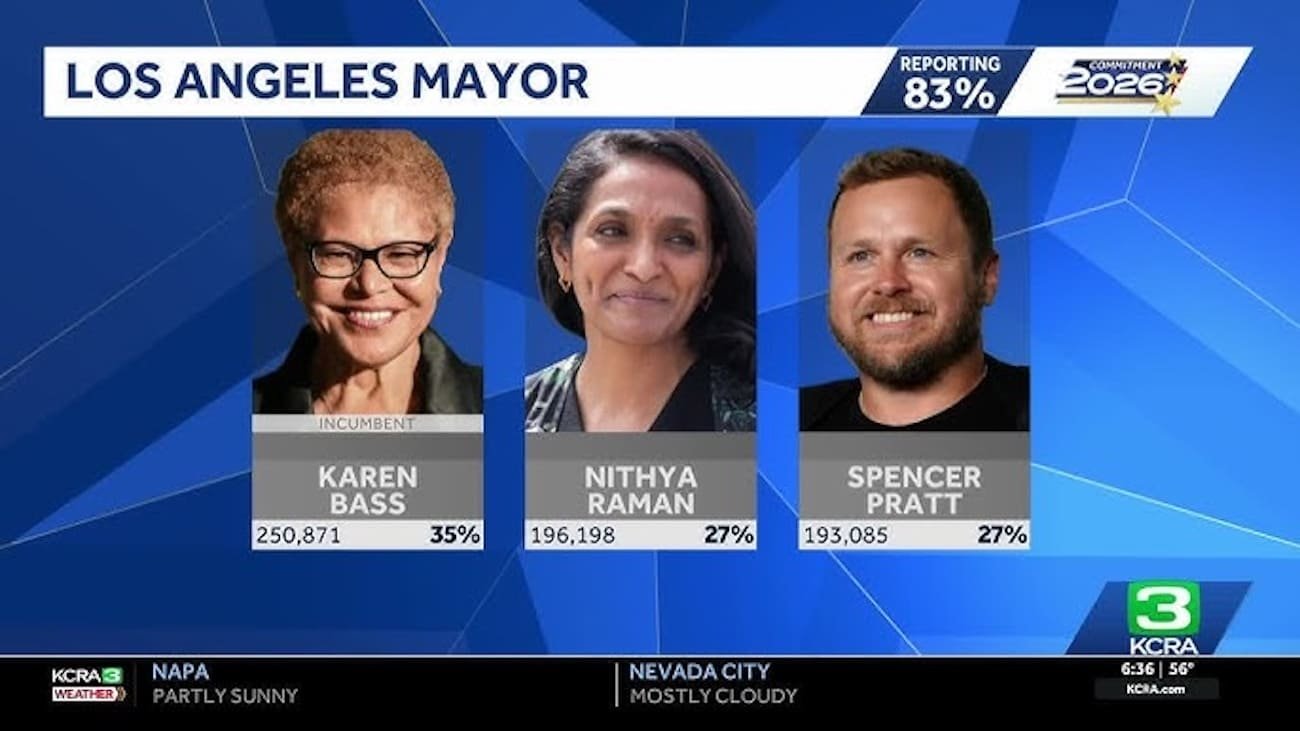

On election night, June 2, 2026, the numbers looked grim for Nithya Raman. With about half the votes counted, incumbent Mayor Karen Bass led the 14-candidate field at 35 percent, former reality television personality Spencer Pratt held second place at 30 percent, and Raman — the Harvard and MIT-educated Tamil American city councilmember who had entered the race three hours before the February filing deadline — was a distant third at 22 percent, according to ABC7 Los Angeles. Pratt’s supporters gathered at his election-night event with the confidence of a campaign that believed it had secured the second spot in November’s runoff.
Five days later, the race looked entirely different.
By Sunday, June 7, as Los Angeles County released new batches of late-arriving mail ballots, Raman had overtaken Pratt by approximately 3,000 votes. With 83 percent of the expected vote counted, Bass held 34.68 percent, Raman stood at 27.12 percent, and Pratt had fallen to 26.69 percent, according to ABC7. Decision Desk HQ projected Raman would advance to the November runoff, as The Hill reported. CNN, which had been tracking the count closely, noted that across all votes reported since election night, Raman had outperformed both Bass and Pratt, gaining 43,000 votes on Pratt and increasing her overall share by roughly five percentage points.
The reversal followed a pattern familiar to California election-watchers. Mail ballots — which in Los Angeles skew heavily toward liberal and progressive voters — arrive and are counted over days after election night, routinely shifting results in races with significant progressive candidates. The phenomenon is well-documented, but the scale of Raman’s surge still surprised observers who had written her off as a distant third.
The Road to the Runoff: An Unlikely Candidacy
Raman’s path to the June ballot was itself improbable. She announced her candidacy on February 7, 2026 — less than two weeks after she had publicly endorsed Bass for reelection and three hours before the filing deadline closed. The move was described by Bass allies as a betrayal. Bass campaign advisor Douglas Herman said in response that “the last thing Los Angeles needs is a politician who opposed cleaning up homeless encampments and efforts to make our city safer,” as Fox News reported.
Raman, 44, a former urban planner who had founded the Chennai-based urban infrastructure research organization Transparent Chennai before returning to Los Angeles in 2013, framed her decision in terms of institutional failure. “I do think Angelenos have really given us a lot of faith, voted for more taxes to address important housing issues, address homelessness, to address some of our biggest crises,” she told reporters after filing. “And if we don’t show results to them, I think we will lose them.”
The immediate catalyst for her break with Bass was an explosive Los Angeles Times report that Bass had directed a review of the Palisades Fire response — which had killed dozens and destroyed thousands of homes while Bass was in Ghana — to be watered down, as Politico documented. Bass had already been politically damaged by her absence at the time of the fire’s outbreak; the Times report deepened that damage in the final days before Raman’s announcement.
The LMU poll offered perhaps the most striking data point for Raman’s general election prospects: nearly 50 percent of Los Angeles voters said they preferred a Democratic Socialist as their next mayor.
She entered with no time to build a conventional organizing infrastructure. She raised $530,000 in direct contributions in recent campaign filings, largely from the entertainment industry, outpacing Bass in the most recent fundraising window according to Fox 11 Los Angeles, with support from Jon Favreau, Mindy Kaling, Adam Scott, and Michael Schur according to NBC Los Angeles. She received a recommendation — though not a full organizational endorsement — in the DSA-LA voter guide, a distinction that reflected the complicated relationship between Raman and the progressive left. The DSA-LA chapter had censured her in 2024 over her acceptance of an endorsement from Democrats for Israel-Los Angeles and disagreements over the war in Gaza, according to Fox News.
The November Matchup: Bass’s Vulnerabilities, Raman’s Opening
The central question now is whether Raman’s remarkable primary comeback can be converted into a mayoral victory against an incumbent who, as the data makes clear, is genuinely vulnerable.
A UC Berkeley Institute of Governmental Studies poll co-sponsored by the Los Angeles Times, released in late May, found Bass at 25 percent, Raman at 17 percent, and Pratt at 14 percent — with Bass’s unfavorable ratings exceeding 50 percent, as AOL reported. A late-May UC Berkeley-Los Angeles Times poll found Bass just one point ahead of Raman in a direct matchup, and four points ahead of Pratt, according to The Hill. A Loyola Marymount University poll, described as controversial due to its methodology, had shown Raman ahead of Bass outright in a head-to-head framing, as AOL reported.
Newsweek summarized the polling landscape clearly: which candidate ends up facing Bass matters because the data suggests she has different chances of winning depending on her opponent, with Raman appearing more likely to prevail in a head-to-head contest than Pratt would have been.

The structural case for Raman in November rests on several interlocking factors. Bass’s handling of the Palisades Fire — both her absence when the disaster began and the subsequent controversy over the watered-down review — has left a lasting impression on voters who feel she was not adequately prepared for the city’s most devastating crisis in recent memory. The nearly $1 billion budget gap the city is navigating adds a second layer of incumbent vulnerability. And Bass, who defeated billionaire developer Rick Caruso in 2022 with 43 percent of the primary vote before winning the runoff, is now entering a second general election campaign with higher unfavorables than she carried in her first.
Raman’s case to voters is built on accountability and urgency. “I love this city so much and I think it needs a fighter,” she said at her February press conference, as NBCLA reported. “And I hope the residents of Los Angeles will see that and cast their votes for me.”
The LMU poll offered perhaps the most striking data point for Raman’s general election prospects: nearly 50 percent of Los Angeles voters said they preferred a Democratic Socialist as their next mayor, while only 8 percent wanted an establishment Democrat. “Los Angeles is much more progressive than its elected leadership,” Fernando Guerra, the LMU pollster, said, as AOL reported.
The obstacles are real. Bass has the institutional endorsements — including the Los Angeles County Federation of Labor, AFL-CIO — the name recognition of a sitting mayor, and the organizational resources that incumbency provides. She also retains a base of loyal support, particularly among Black voters, where a UCLA Luskin poll found her with 53 percent support.
But Bass has not cleared 50 percent in any public poll of the general election landscape. In a city this Democratic, that means the November contest will be decided by which candidate can consolidate the progressive majority that Los Angeles’s demographics clearly contain.
That is exactly the argument Nithya Raman has been making since the day she filed. The primary results suggest more voters are listening than anyone expected.