




The Sound of Silence in Oslo: On Modi, Power, and the Oldest Question in Democracy

- The question is no longer whether Narendra Modi can dominate the political conversation in India. He plainly can. The question is what kind of democratic example India wishes to become at the precise moment history is inviting it to lead.
There is a tell that experienced diplomats develop, a slight recalibration of the body that happens the moment a press conference ends without questions. The shoulders drop a fraction. The eyes find the exit. The retinue moves. It lasts perhaps two seconds, and if you blink, you miss it.
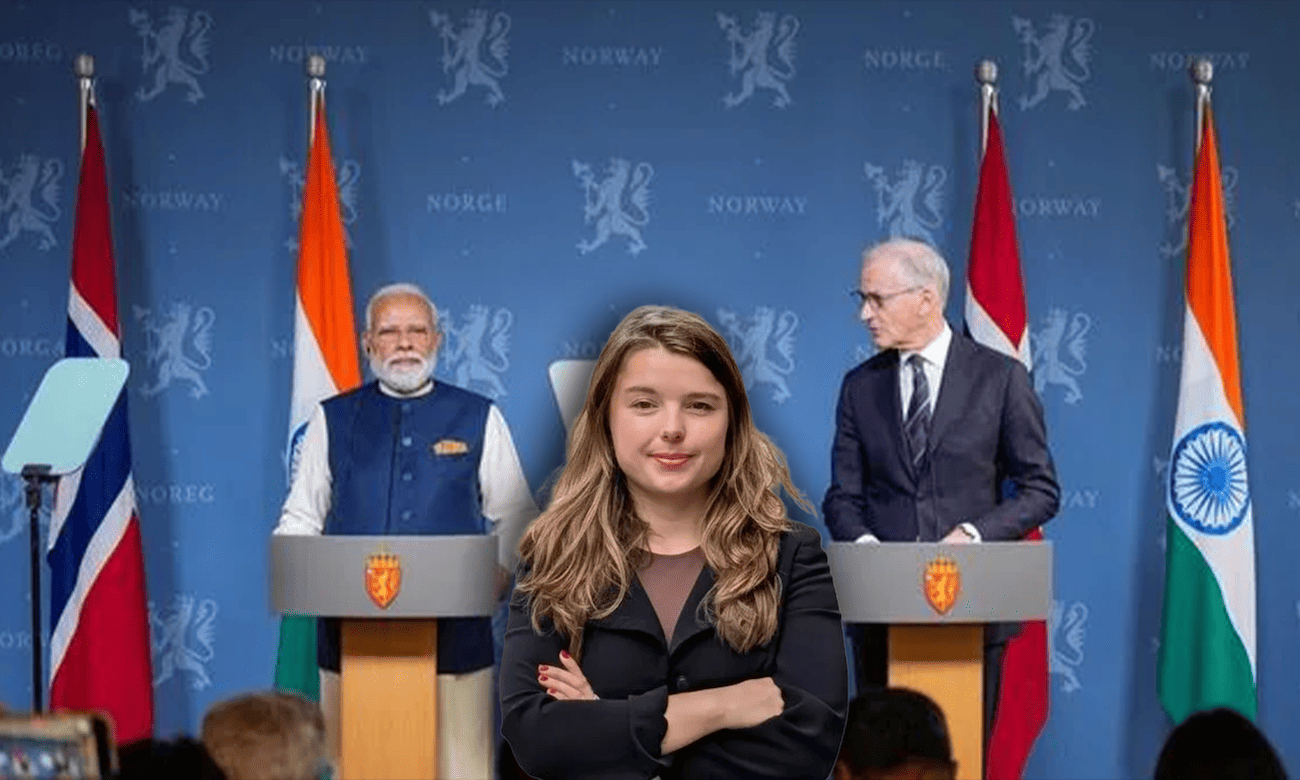
At a joint appearance in Oslo last month, the Norwegian hosts blinked. India’s delegation did not.
Helle Lyng Svendsen, a correspondent for Dagsavisen, did not blink either. As Narendra Modi turned to leave — another capital visited, another statement delivered, another floor never opened — she did what journalists are paid to do. She raised a question into the departing silence. Why, she asked, does the leader of the world’s largest democracy so rarely engage with the world’s freest press?
He kept walking.
Silence, in politics, is rarely empty. Often, it is strategy.
What followed transformed a moment of diplomatic awkwardness into something larger: a glimpse into how India increasingly explains itself to the world.
Sibi George is not a nervous man. Three decades in India’s Foreign Service have taken him from multilateral negotiations in Geneva to the upper reaches of South Block. He is, by any measure, a seasoned diplomat. But when Svendsen pressed him — citing India’s decline on global press freedom rankings and concerns raised by international observers — something shifted. George reached for the familiar vocabulary of civilizational reassurance: the invention of zero, the origins of chess, the inadequacies of foreign NGOs, the peculiar inability of outsiders to understand India.
The exchange spread quickly online, not because diplomats occasionally stumble — they do — but because it exposed a growing contradiction in how India presents itself abroad. A rising power confident of its democratic inheritance increasingly appears uncomfortable with democratic scrutiny.
To understand why Oslo resonated, one has to understand something larger about Narendra Modi’s political achievement — and why conventional criticism of it often misses the point.
His critics frequently explain Modi’s distance from unscripted press engagement through biography: a difficult television interview years ago, a preference for message discipline, an instinctive distrust of elite media. Perhaps there is truth in some of this. But explanations of temperament explain only so much.
The deeper answer is structural.
Modi has not merely managed the media differently. He has altered the relationship between political authority and journalistic mediation itself.
For most of modern democratic history, power moved through institutions of filtration. Politicians spoke; journalists interpreted; editors questioned; publics judged. The system was imperfect, frequently biased, often elitist. But it ensured one enduring principle: leaders could not entirely control the terms on which they were understood.
Modi’s defenders are not wrong to point out that this system had already begun to fray before he arrived. Across democracies, public trust in traditional media had weakened long before populist politics gained force. Newspapers lost authority. Television fragmented. Social media collapsed the distance between leader and citizen. Voters increasingly preferred authenticity — or the appearance of it — to mediated expertise.
Modi understood this transformation earlier, and more completely, than most democratic leaders.
With a digital following that reaches tens of millions, he has achieved something every modern politician has quietly desired: the ability to speak directly to citizens without journalistic intermediation. No editor determines emphasis. No headline reframes intention. No follow-up question interrupts narrative momentum. Communication arrives unfiltered, immediate, emotionally coherent.
The political advantages are obvious. The democratic implications are more complicated.
This is not censorship in its traditional form. India remains electorally competitive, politically noisy, and constitutionally argumentative. Yet something meaningful has changed.
This is not censorship in its traditional form. India remains electorally competitive, politically noisy, and constitutionally argumentative. Critical journalism exists. Opposition leaders campaign freely. Courts still intervene. Independent reporting continues to emerge despite growing pressures.
Yet something meaningful has changed.
The traditional press has not been defeated so much as rendered increasingly peripheral.
You do not need to silence a megaphone if you have built a louder one.
The sovereign speaks directly to the sovereign’s people, and the Fourth Estate increasingly watches from the parking lot.
What appears, at first glance, to be a furious democratic debate often functions differently in practice. Millions of voices surge daily through digital platforms in permanent political combat: one side elevating Modi to civilizational redeemer, the other warning of democratic erosion. Accountability appears omnipresent. Yet fragmentation can produce its own form of insulation. When every criticism is instantly reframed as ideological warfare — elite anxiety, foreign prejudice, partisan hostility, anti-nationalism — sustained institutional scrutiny struggles to accumulate authority.
In twelve years of government, remarkably few investigative revelations — however serious, however meticulously documented — have meaningfully altered the political standing of the prime minister. This may reflect public trust in Modi. It may reflect distrust of his critics. More likely, it reflects a communication architecture in which political legitimacy increasingly bypasses traditional arbiters altogether.
That architecture has worked extraordinarily well at home.
But systems designed for domestic politics sometimes behave differently abroad.
For decades, India possessed a geopolitical advantage that required little explanation: it was not China.
Chaotic, argumentative, frustrating, bureaucratic — yes. But open. Investors could criticize policy. Courts occasionally surprised governments. Journalists investigated power. Elections punished complacency. Democratic noise itself became strategic reassurance.
Global partners did not need India to resemble Western democracies. They needed confidence that institutions retained autonomy and that scrutiny remained possible. This was India’s democratic premium: intangible in moments of calm, invaluable in moments of uncertainty.
The premium matters more than many in New Delhi appear willing to admit.
In a century increasingly shaped by competition between authoritarian efficiency and democratic resilience, India’s greatest geopolitical strength is not simply scale. It is legitimacy. Washington, Brussels, Tokyo, and much of the democratic world invest hope in India not merely because of market size or military weight, but because India has long represented a rare proposition: pluralism at civilizational scale.
That reputation cannot be inherited indefinitely. It must be renewed.
Which is why moments like Oslo resonate beyond their immediate awkwardness.
When questions about jailed journalists, media pressures, or democratic practice are met primarily with references to ancient achievements, something subtle but consequential occurs. Civilizational confidence begins to resemble defensiveness. Pride in history begins to sound like evasion of the present.
A nation that answers questions about its institutions chiefly by invoking the greatness of its past risks suggesting uncertainty about its present.
The comparison some foreign observers increasingly make — quietly, cautiously — is not yet to authoritarian states themselves, but to the rhetorical habits that often accompany democratic insecurity: heightened sensitivity to criticism, suspicion of scrutiny, and a tendency to treat questions as hostile acts rather than democratic rituals.
The tragedy — and it is a tragedy, not a polemic — is that none of this is necessary.
India today occupies a position any strategist would envy: the fifth-largest economy, the world’s most populous nation, a decisive geopolitical swing power courted simultaneously by the United States, Europe, Japan, and the Global South. It possesses extraordinary demographic energy, technological ambition, and political stability.
A leader commanding such advantages does not need insulation from questions.
Indeed, confidence in a democracy is often measured precisely by a leader’s willingness to enter unscripted arenas, absorb criticism, answer difficult questions imperfectly, and emerge stronger for having done so.
The press conference is not a trap set by hostile elites. It is one of democracy’s oldest performances of confidence.
The world understands something democracies sometimes forget: strength is not demonstrated by avoiding vulnerability. It is demonstrated by surviving it in public.
This is why the unanswered microphone matters more than critics sometimes understand.
The question is no longer whether Narendra Modi can dominate the political conversation in India. He plainly can.
The question is what kind of democratic example India wishes to become at the precise moment history is inviting it to lead.
In Oslo, as the delegation swept away and Svendsen’s question dissolved into the corridor, a Norwegian photographer captured a single frame: the empty podium, two microphones, the Indian flag still visible at the edge of the shot.
It is, in its quiet way, an unexpectedly revealing image of contemporary India.
A stage prepared for conversation. Microphones waiting.
And a democracy powerful enough to speak to the world, yet increasingly uncertain whether it still needs to answer back.
Boston based strategic analyst Satish Jha is a former Editor of newsweekly Dinamaan of The Times of India Group.