




Tamil Nadu in Transition: The End of Half a Century of Duopoly and the Rise of a New Political Force

- What is particularly significant is the breadth of that support for actor Vijay’s Tamizhaga Vetri Kazhagam — across urban, semi-urban, and rural parts of the state.
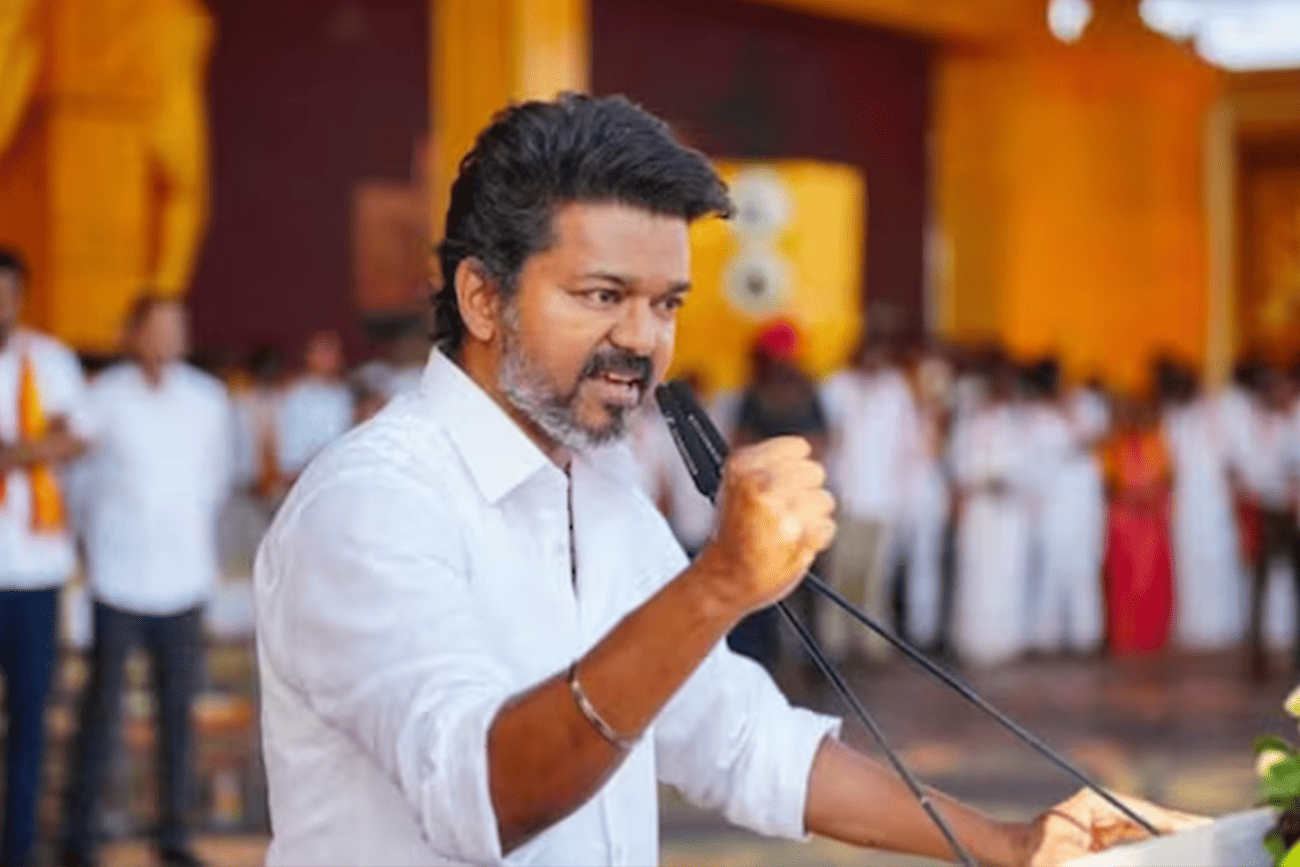

This month, a historic election has marked the end of a decades-old duopoly and the rise of a new political force in one of India’s most stable electoral states—Tamil Nadu.
As someone who follows electoral democracy in both India and the United States, I’ve often been struck by how voters periodically rewrite the rules of politics. Every so often, an election does more than decide a winner—it changes the structure of competition itself. This election appears to be one such moment.
For over half a century, Tamil Nadu has been defined by a remarkably stable binary political system. Since C. N. Annadurai led the Dravida Munnetra Kazhagam (DMK) to power in 1967, displacing the Congress establishment, politics in the state has revolved around two dominant Dravidian forces: the DMK and the All India Anna Dravida Munnetra Kazhagam (AIADMK).
Leaders like M. Karunanidhi and J. Jayalalithaa built durable political ecosystems grounded in welfare expansion, linguistic pride, and strong party organization. More recently, M. K. Stalin and Edappadi K. Palaniswami have carried forward these legacy structures, even as the political environment evolved.
Elections were fiercely contested but structurally predictable: each party would typically secure between 25% and 40% of the vote, with alliances pushing them into the winning range. In such a system, even a 2–3% swing could flip dozens of seats.
That equilibrium has now been disrupted.
The 2026 results point to a genuine three-way contest. Tamizhaga Vetri Kazhagam (TVK), led by actor-turned-politician Vijay, has not merely entered the fray—it has established itself as a statewide force, with seat tallies crossing or approaching the majority mark in early trends. This is not the familiar story of a third party nibbling at the margins; it is a structural breakthrough.
Welfare schemes, while still influential, may no longer be sufficient on their own to secure voter loyalty in a changing electorate.
What makes this moment particularly significant is the breadth of that support. Unlike earlier challengers that remained confined to urban pockets or issue-based constituencies, TVK has shown traction across regions—urban, semi-urban, and parts of rural Tamil Nadu. That kind of geographic spread is rare for a first-time entrant and signals something deeper than a protest vote.
It is tempting to attribute this entirely to charisma. But Tamil Nadu has seen film stars enter politics before, with mixed outcomes. Vijayakanth built a viable party that later declined, Kamal Haasan struggled to convert visibility into votes, and Rajinikanth ultimately chose not to enter electoral politics. What appears different this time is organizational depth.
TVK seems to have successfully converted fan networks into booth-level machinery—turning cultural capital into electoral capacity. In a first-past-the-post system, where margins are thin and contests are tight, that conversion is decisive.
There is also clear evidence of a shifting voter base. Younger GenZ voters, especially first-time participants, appear more willing to move beyond the traditional DMK–AIADMK binary. In urban and semi-urban constituencies, political preferences are increasingly shaped by peer networks and digital visibility—a bandwagon effect of sorts, where momentum itself becomes persuasive. This election also saw an unprecedented use of social media campaigns, acting as a force multiplier, which traditional door-to-door appearing weaker by comparison.
In a three-way contest, however, gains are never neutral. The key question throughout the campaign was whose votes TVK would cut into. The results now suggest an uneven redistribution.
The DMK appears to have faced pockets of urban erosion alongside the pressures of incumbency, compounded by criticism around leadership concentration and dynastic politics. Welfare schemes, while still influential, may no longer be sufficient on their own to secure voter loyalty in a changing electorate. The AIADMK, meanwhile, continues to grapple with leadership consolidation, leaving its base more vulnerable in closely contested seats.


The central lesson from 2026 is both simple and significant: in Tamil Nadu, elections are not decided by vote share alone, but by how efficiently those votes are distributed. A well-spread 35% can outperform a fragmented 40%. TVK’s performance reflects precisely this dynamic—reach and distribution matter as much as, if not more than, raw numbers.
What happens next remains open. Tamil Nadu could see a TVK-led government, a coalition arrangement, or a more competitive three-pole system. But whatever the immediate outcome, the longer-term shift is clear. For the first time in decades, the DMK–AIADMK duopoly has been meaningfully challenged—not rhetorically, but electorally.
If 1967 marked the rise of a new political order in Tamil Nadu, 2026 may mark the beginning of its transformation. Not necessarily its end—the core ideas of social justice and regional identity remain deeply embedded—but its evolution into a more competitive and fluid system.
For observers of democracy everywhere—from Chennai to California—this election offers a familiar reminder: no political order, however stable, is permanent. Given the right mix of leadership, organization, and voter sentiment, even the most entrenched systems can be reshaped.
Tamil Nadu may just have entered that phase.
Jayashree Srikanth lived in the United States for 16 years, then moved to Bangalore with her husband and two daughters. She is a proud homeschooler of a special needs kid, who has a successful art career and has won several awards including carrying the torch for the Rio Paralympics, in 2015. Her younger daughter graduated from UCLA and is now working for a healthcare startup in Chicago.