




‘The Devil Wears Prada 2’ is Grieving a World the South Asian Diaspora was Never Allowed to Fully Enter

- When the film casts Simone Ashley, a Tamil British actress as a supporting figure in a white editor’s last stand against the collapse of journalism, what it is really doing is rendering the present in 2006 grammar.
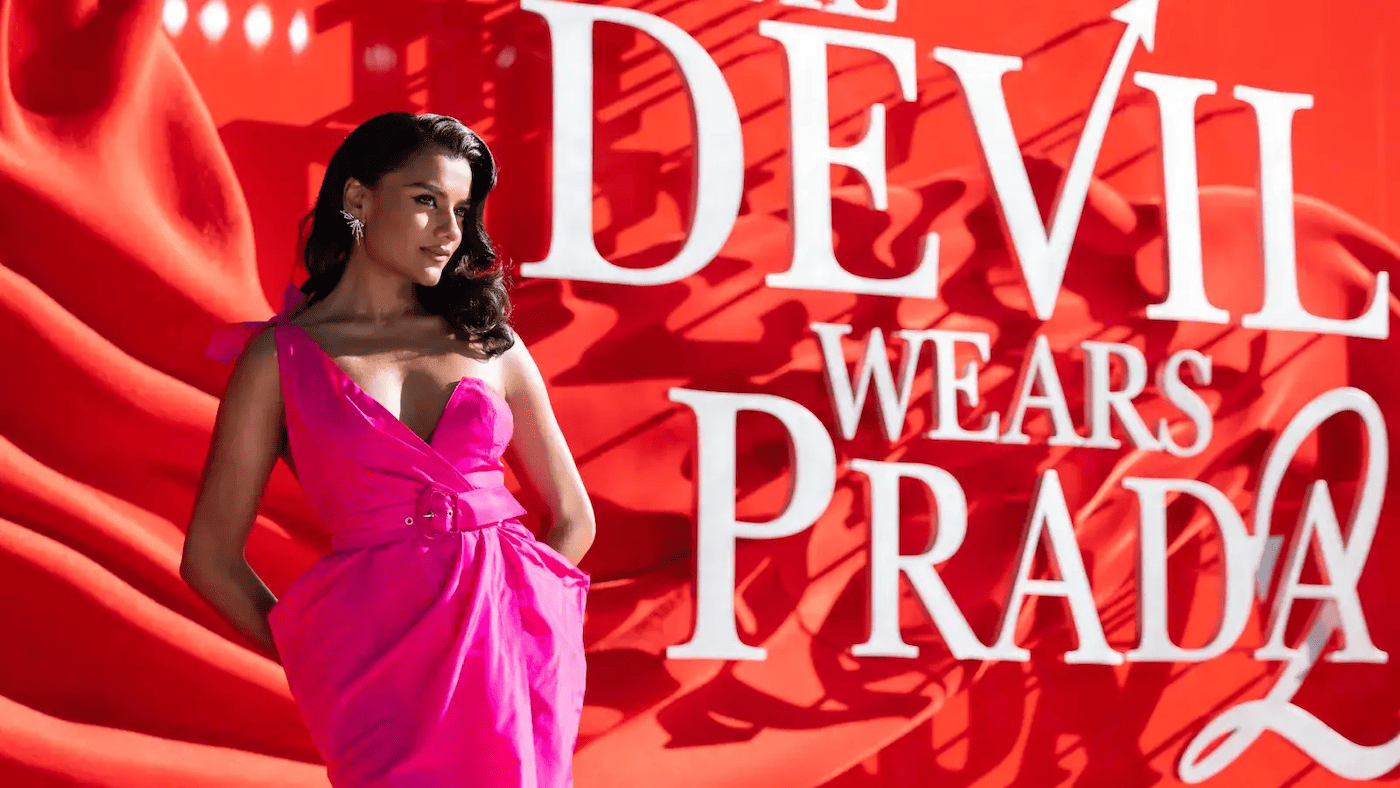

I went to see the sequel with my third grader and my sixth grader, which is its own form of cultural anthropology. The third grader gave it a 3 out of 5. The sixth grader gave it a 4. I split the difference at 3.5, and most of my half star is nostalgia.
Somewhere around the twenty-minute mark, my child leaned over and asked, in the carrying whisper that small children believe to be inaudible, why the main character’s name was Andy Sex. I told her it was Sachs. S-A-C-H-S. I spelled it out three times. She nodded gravely and went back to watching Anne Hathaway navigate the wreckage of American journalism. Reader, this question is the kind of focus group you cannot buy.
Andy Sachs (Anne Hathaway) loses her newsroom job in the kind of gala-text-message layoff that has become depressingly familiar in 2026 media. She lands back at Runway magazine under Miranda Priestly (Meryl Streep), who needs her to repair the masthead’s reputation after a sweatshop-adjacent puff piece embarrassed the brand. David Frankel directs again, Aline Brosh McKenna writes again, and the original quartet of Streep, Hathaway, Emily Blunt, and Stanley Tucci slip back into their roles with the practiced ease of women who have not forgotten how to wear an expensive coat.
The film has done well. It has earned $234 million worldwide against a $100 million production budget, and an 87% Rotten Tomatoes Verified Moviegoers score. Streep is the reason. Her Miranda has interiority now, partly because there is so little left in the magazine world for her to defend, and she plays the late-career fire perfectly. Tucci’s Nigel remains the film’s quiet heart. Blunt’s Emily has graduated into a kind of feral elegance. Kenneth Branagh as Miranda’s loving husband supplies a warmth this franchise has never quite had room for.
But this is American Kahani, and you and I both know what I actually want to talk about.
Simone Ashley is in this film. The British Tamil actress who carried half a season of Bridgerton on her sharp jawline and sharper line readings. She plays Amari, one of Runway’s new-generation staffers. Helen J. Shen plays Jin Chao, Andy’s Asian American assistant. This is, in 2026, what the franchise considers progress. South Asian and East Asian women are no longer absent from the Runway office. They are simply present as scenery, helpers, and heirs-in-waiting, with screen time but not arcs, presence but not power.
The Jin Chao introduction scene deserves its own paragraph, because it is wrong on two registers at once. The film has her elevator-pitch herself into the Runway job by leading with Yale, her GPA and ACT score. I want to say this gently, as someone who has spent significant time on that campus. Nobody I know at Yale would introduce themselves that way. If you have to say you are from Yale, you have already lost. Yale graduates are not hungry like that. They would rather starve than grovel. So the problem with Jin Chao is not just her portrayal as Asian American, scrambling and credentialed and pitching for table scraps. It is also her portrayal as a Yale graduate. The double mistake is revealing. The film thinks Yale plus ACT score plus East Asian striver equals a recognizable type.
South Asian women are running creative directions at major houses. They are founding the Substacks and platforms that displaced print Runway in the first place. They are editors-in-chief, stylists, founders, buyers.
What it has actually written is a ventriloquist’s dummy. Real Asian American Yale graduates I know lead with the work, never the pedigree, and would sooner walk out of the interview than recite their standardized test numbers to a white woman. The richest joke buried in the film is one I am fairly certain it did not intend. Meryl Streep herself went to Yale, which is why her character weekends in the Hamptons in the film, and Jin Chao does not. The actual Yale graduate in the room is at the head of the table. The fictional one is fetching coffee. The real Meryl Streep, Yale Masters of Fine Arts Class of 1975, laid into Trump at her Golden Globes speech. That is the entire problem of the film in a single casting choice.
More so, representation arguments in the diaspora can curdle quickly into demands that every brown character must be a hero. The argument is more specific. The film is supposedly about the collapse of a media world and the question of what comes next. In the actual 2026 New York fashion and media ecosystem, what comes next has been built in significant part by people who look like Simone Ashley and Helen J. Shen. South Asian women are running creative directions at major houses. They are founding the Substacks and platforms that displaced print Runway in the first place. They are editors-in-chief, stylists, founders, buyers. They are not waiting in the assistant chair for Miranda Priestly’s blessing. They got tired of waiting.
So when the film casts a Tamil British actress as a supporting figure in a white editor’s last stand against industry collapse, what it is really doing is rendering the present in 2006 grammar. It wants credit for diversity without ceding any narrative gravity. That is exactly the kind of conditional inclusion the script thinks it is critiquing when it points at the fashion industry. And I notice, with the particular tired patience that desi mothers know well, that nobody in the film says the words “sweatshop labor” with any specificity about who is in those sweatshops, or where, or under whose contracts. The garments that build the fortunes of the Mirandas of the world are sewn by women who look more like us than like the editors writing about them. The film raises the issue and then changes outfits.
The New York problem is connected. The cabs are still yellow. The bagels are still props. The fashion world still operates on the premise that a print masthead at Runway is a destination rather than a relic. This is the New York of 2006, lightly redecorated for 2026. The actual city has been remade by immigrant founders, by South Asian and East Asian and Latina creatives, by an entire post-print landscape the film treats as a vague threat rather than a fact. Runway in this universe is dying because the culture has moved on. The film cannot quite bring itself to imagine where it moved on to, because where it moved on to is full of us.

Streep is still wonderful. Tucci is still wonderful. Stay for the moment, late in the film, when Miranda chooses what kind of editor she wants to be at the end of her career, steering through corporate calculations to salvage the magazine on her own terms. It is a real piece of acting to handle the triple betrayals, and it lands. But understand that the film is grieving a world the South Asian diaspora was never allowed to fully enter, and asking us to grieve it alongside them. That’s why, inter alia, NYC Mayor Zohran is skipping the Met Gala.
The household panel knew this without articulating it. The third grader was bored in stretches because the film never quite imagines that someone like her, or someone with her last name, could be the protagonist. She was, however, deeply invested in figuring out what Andy was actually called, which is its own kind of media literacy. The sixth grader, at the age where power begins to come into focus, gave it the higher score because she could feel Miranda’s late-career fire without yet asking who got burned to keep it warm.
I gave it 3.5 for the same reason I keep watching films that flatten people who look like me. The performances are good. The clothes are spectacular. And every once in a while, even a film that misreads its present manages to say something true about endings.
The original earned its glamour. This one is renting it.
And the assistants, as ever, are still answering the phone.
Nadia B. Ahmad is an Associate Professor of Law at Barry University School of Law and a Ph.D. Student at the Yale School of the Environment. She is also a Fellow at the Center for Security, Race, and Rights at Rutgers University and affiliated faculty at Harvard Law School’s Institute for Global Law & Policy.