




Historian Audrey Truschke Expresses Frustration with How India and Pakistan Approach Their Shared Pre-1947 History

- This story is based on a recent interview with Audrey Truschke by Rana Saadullah Khan, a Pakistani writer and scholar and published in dunyadigital.
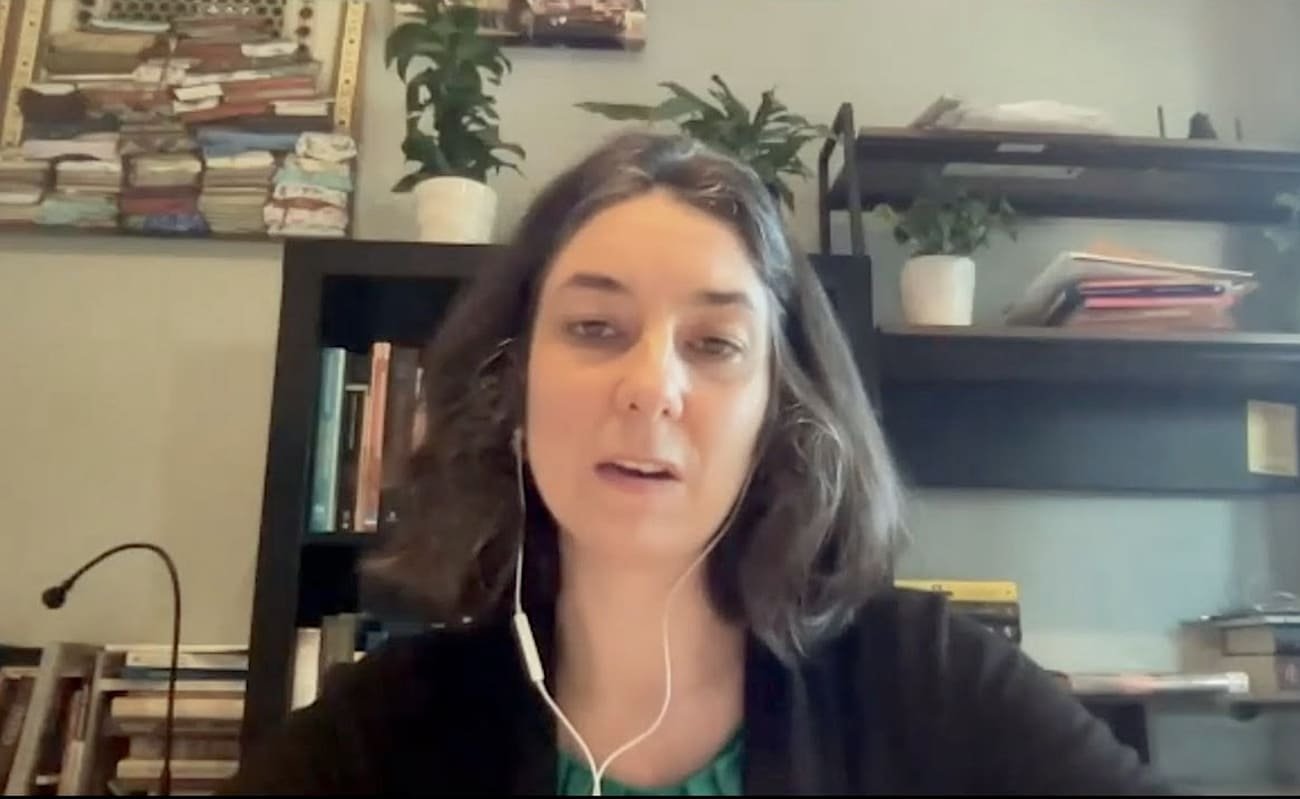

Audrey Truschke, the Rutgers University professor who has become one of the most eminent scholars of Sanskrit and Indo-Persian literature to emerge from the United States, recently discussed her scholarly work, the intense backlash she has faced from Hindu nationalist organizations, and the shared historical identity of India and Pakistan in an interview conducted in Lahore during a visit to promote her new book, “India: 5000 Years of History on the Subcontinent” (Princeton University Press, 2025).
Truschke, who holds a PhD from Columbia University where she trained under American Sanskritist Sheldon Pollock, spoke with interviewer Rana Saadullah Khan about her journey from studying religion in the American Midwest to becoming a target of what she describes as a smear campaign primarily originating from Hindu fundamentalist organizations.
“Not in my wildest dreams” did Truschke imagine the controversies that would engulf her work, she said in the interview. “Imagine: I’m in my mid to late 20s, in graduate school — I received my PhD at the age of 30 — and I’m spending most of my time in libraries, whether in the Indian subcontinent or somewhere in Europe or New York. My concern, if I had any about the reception of my eventual work, was that no one would care about it.”
The controversy began earlier than the publication of her 2017 book “Aurangzeb: The Life and Legacy of India’s Most Controversial King” (Stanford University Press), according to Truschke. In a 2015 interview with The Hindu about her first book, “Culture of Encounters: Sanskrit at the Mughal Court,” she made what she thought were edgy statements about Akbar, but “nobody has ever reacted to those ‘edgy’ comments,” she said.
Instead, she recalled, “in the same interview, I said two unobjectionable short sentences about Aurangzeb, and I felt like the world exploded at me after that. I essentially stated that Aurangzeb was a misunderstood figure: he was a pre-modern king. No historian would bat an eye at that, it is such a bland, obvious point.”
“What this made me realize was that what is obvious in the academy is not necessarily obvious outside of it,” Truschke said.
Escalating Attacks After 2019 Elections
The intimidation intensified after India’s general elections in 2019, when the BJP won by a landslide, according to Truschke. “Now that victory has absolutely nothing to do with me, and I am one very small casualty in a bigger set of trends here,” she said. “I honestly believe that the intensification of attacks on me is not a direct result of my scholarship; I had by then achieved a certain level of scholarship and notoriety, and when Hindu nationalists start to feel especially emboldened and fierce, they look around for academic targets.”
In 2021, a group of undergraduate Hindu students at Rutgers called for her to be removed from teaching anything related to Hinduism, citing how she had “conveniently decided to whitewash” Aurangzeb’s legacy in her book, according to the interview document.
The suit failed, and Truschke continues to be a teaching professor at Rutgers University in New Jersey.
South Asian History Understudied in U.S. Academia
Truschke discussed the structural challenges facing South Asian studies in American academia. “Especially outside of South Asia, South Asian history continues to be understudied and under-taught, simply as a consequence of bias and bigotry. There’s nothing complicated about that. Most people don’t think it’s the most important part of the world to study,” she said.
She described the imbalance at Rutgers: “I teach at a history department in New Jersey, arguably the most diverse state in the country. Still, our history department at Rutgers looks like almost every history department in the U.S., which is to say more than half of our professors focus on U.S. history. We’re talking about 250 years of history, with very specific specialists.”
When asked about texts she wishes would feature more in Pakistani curricula, Truschke pointed to Sanskrit literature. “Sanskrit is one of the great literary traditions of South Asia, and there are more texts in Sanskrit than in any other South Asian language.”
“For the rest of the world, we are the token representation,” she continued. “I’m expected to teach all of South Asian history from the Indus Valley Civilization to the present in two semesters! While I enjoy it, this is a completely insane way of teaching history. I am expected to teach 5,000 years of history for a quarter of the world’s population, while 20 of my colleagues have divided 250 years of American history between them.”
Jain Archives and Mughal Court Interactions
Truschke’s research revealed that much of the Sanskrit literature about the Mughal court was written by Jains. “I set out to find something that involved a level of interaction between Sanskrit and Persian, either as languages or through intellectuals of those languages. I discovered the Persian translations of the Sanskrit texts; then I found out about a bunch of the Jain-authored texts,” she said.
“In the end, I found that they wrote about their encounters with the Mughal court in a way that no one else did,” Truschke explained. “Now, of course, Brahminical communities were at the Mughal court in much larger numbers; though they should have had a lot more to say, they didn’t, at least not in Sanskrit.”
When Jains wrote about court encounters, their narrative was detailed: “so a guy went to the Mughal court in this year and he met with Akbar, here’s what they talked about — and it’s a 100 verses!” By contrast, Brahmin intellectuals wrote in more coded ways about sensitive topics like interreligious romances.
“The Jain archives are, on the surface, far richer; they lend themselves more easily to a historian’s interests and questions,” Truschke said. “But we do have to press on a couple of things: how accurate are they, and why are they creating these narratives in the first place?”
The Hamida Banu Ramayana in Doha
Truschke discussed her work on a Persian translation of the Ramayana owned by Hamida Banu Begum, now housed in Doha’s Museum of Islamic Art. The manuscript “was quite likely smuggled out of India after the Antiquities Act in the ’70s,” she said.
“Several years ago, I was brought into Doha to their Museum of Islamic Art to look at the manuscript and do a publication on it. When I got there, I was surprised that they weren’t displaying any of the pages, even though it has such lavish illustrations,” Truschke recalled.
“Upon inquiry I was told that it was taken down, after a couple of complaints regarding the displaying of Hindu deities’ images,” she said. “I thought it was striking that it only took one or two complaints for them to take it down, that there was no fighting back.”

Hindu Nationalism as Colonial Inheritor
Truschke characterized Hindu nationalists as “the major intellectual inheritors of British colonial thoughts” and said their use of decolonization language is “entirely in bad faith.”
“Hindu nationalism has fundamentally been saying the same thing for a hundred years,” she said. “Back then, they didn’t use the language of decolonization, but they maligned the Mughals and the Delhi Sultanates and old Muslim rulers of Indian history using other terms. The goal has always been consistently the same: you demonize Muslims in the past, in order to create a very quick and slippery slope to demonize Muslims in the present and use violence against them.”
“It’s one thing to say things when you don’t have much political power,” Truschke continued. “It is quite another thing to say those things in 2020, when the BJP is the major political party of India and Hindu nationalism is the defining political ideology in India… You can no longer ignore them as your crazy uncle’s idea anymore: your crazy uncle is running the country.”
Pakistan’s Relationship With South Asian History
Truschke expressed frustration with how both India and Pakistan approach their shared pre-1947 history. “Pakistani history as a nation-state starts in 1947; if you want to trace it any further back, it begins in 1930. That’s it. It doesn’t go any earlier than that,” she said.
“If you want to have an earlier history — and everybody wants an earlier history — Pakistanis and Indians in national terms share that history,” Truschke argued. “Especially among students in Pakistan, people say: I only want the Muslim part of history. Others: I want to geographically demarcate it to what actually happened on this soil. And you can do that in a light sense… But in terms of an actual framework for thinking about history, you can’t impose modern, artificial boundaries over 4,000 years of it.”
“From my perspective, Indian and Pakistani nationals today share a history before 1947, and I think Pakistanis might be more bold in seizing that,” she said. “Who cares that the Gupta kingdom didn’t extend into modern-day Pakistan, or that the Cholas were thousands of miles away? It’s your history as much as their history. To me, I would love to see a greater embrace of South Asian history here.”
Sanskrit Texts in Pakistani Curricula
When asked about texts she wishes would feature more in Pakistani curricula, Truschke pointed to Sanskrit literature. “Sanskrit is one of the great literary traditions of South Asia, and there are more texts in Sanskrit than in any other South Asian language,” she said.
“My guess would be that many people in Pakistan assume everything in Sanskrit is Hindu. That’s not true by a long shot. People could and did write anything under the sun in Sanskrit: cooking, raising horses, architecture,” Truschke explained.
She cited an example: “There are even translations of texts from Persian to Sanskrit, though they’re not as common as the other way around. One example of that is the Katha-kathuka, loosely: ‘strange story’. It’s a translation of Jami’s Yusuf-o-Zuleikha, i.e., the story of Joseph and Potiphar’s wife… including a Sanskrit translation produced in Kashmir.”
Colonialism came to broader India in various forms. Muslim and the European invaders are the same. They tried their very best to impose their faith , values and culture on Indians. To some degree they were successful. There were no good Mughals. No matter how one glorifies them either in literature, arts or movies, they were not friends of India. They were destroyers of India. Remember the Muslim faith began in 7th century. Before that they all were followers of either Sanatan Dharma or Lord Buddha. I am glad the India and Pakistan are two separate countries. Just imagine an undivided India with more than 450 million Pakistanis and Bangladeshis in it. Thank you Mahatma Gandhi.