




How Venture Capitalist Asha Jadeja Motwani Became Most Prominent Indian American Ally of President Trump

- She has written checks, walked the halls of Mar-a-Lago, and positioned herself as a bridge between Washington and New Delhi — whether Washington asked for one or not.
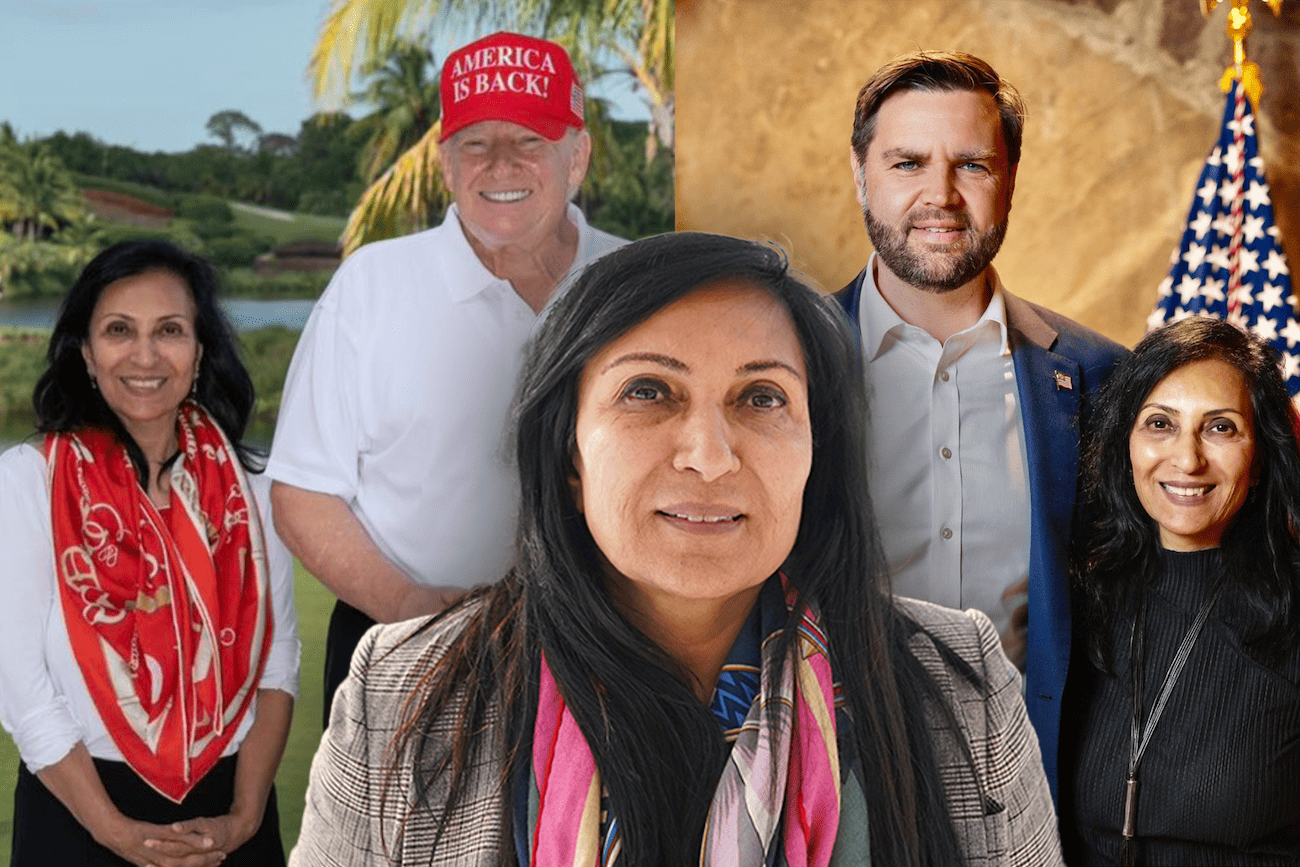

On a weekend in late 2025, Asha Jadeja Motwani drove through the gates of Mar-a-Lago in Palm Beach and spent time in proximity to the President of the United States. She came away convinced that most of her Indian American peers were making a serious strategic error.
“I spent the weekend in Mar-a-Lago in Palm Beach and got unusual access to the president with very little effort,” she wrote afterward in a post on X that circulated widely among Indian American political observers. “I wish there were more people doing this alongside me. Engaging with the current administration in Washington DC is easy and very, very doable. In fact, it is welcomed by everybody.”
The frustration in her words was genuine and characteristic. Motwani had spent months navigating an administration that many in the Indian American community — most of whom lean Democratic — viewed with wariness or outright alarm. She viewed the absence of her peers not as caution but as neglect. “Almost one year into batting for India in Washington DC, I am truly shocked that there is not a single other HNI Indian American helping India in DC,” she wrote, using the abbreviation for high-net-worth individual. “When I asked the usual Indian American billionaires why they are not helping our home country, most give the excuse that they know only the Democrats.”
In the landscape of Indian-American political engagement, Asha Jadeja Motwani occupies a position that is genuinely singular: a Silicon Valley venture capitalist of Indian origin who has backed Donald Trump with both her money and her presence, argued for India’s interests inside MAGA circles, and positioned herself as a behind-the-scenes power broker between two of the world’s largest democracies.
A Life Shaped by Tragedy and Technology
Asha Jadeja Motwani is not primarily defined by her politics. Before she became a recognizable name in Republican donor circles, she was known in Silicon Valley as the widow of Rajeev Motwani, the celebrated Stanford computer science professor who was an early adviser to the founders of Google and whose research shaped the theoretical foundations of modern search engines.
Rajeev Motwani, who won the Gödel Prize in 2001 for his work on the PCP theorem, died in 2009 at the age of 47 after accidentally drowning in his swimming pool, according to published accounts. His death left Asha Motwani, already an accomplished investor in her own right, to carry on a dual legacy: his commitment to education and her own to early-stage entrepreneurship.
According to Business Today, Motwani has invested in more than 200 technology startups in the Bay Area. Among her angel investments are companies including Google, Pinterest, and several education and health technology ventures. She is a limited partner in more than 20 Bay Area venture funds and maintains philanthropic investments in India through programs including MakerFest, a network she founded in 2013 connecting grassroots makers and innovators in India, Africa, and Brazil. With help from education researcher Professor Sugata Mitra, she established India’s first self-organizing School in the Cloud in Ahmedabad, which has since grown to more than 60 locally managed learning centers across South Asia, according to Business Today.
She is also a founding figure behind the Motwani Jadeja Family Foundation, which supports U.S.-India collaborative programs through institutions including the Hudson Institute, the Center for a New American Security, and the Hoover Institution, according to the South Asian Herald.
The $5 Million Check That Changed Her Profile
Whatever her standing in Bay Area philanthropy circles, it was federal campaign finance disclosures that brought Motwani to the attention of a much wider audience.
In January 2026, filings released by the Federal Election Commission revealed that the pro-Trump super PAC MAGA Inc. had raised $102.17 million in the period between July 1 and December 22, 2025. Among the donors listed in the filings — which detail contributions of $100,000 or more — was Asha Jadeja Motwani, who had given just over $5.1 million to the committee, according to Business Today.
She was the only donor of Indian origin at that tier.
The scale of the contribution made her, in the words of several Indian-American media outlets, the largest known political donor of Indian origin in the current election cycle — a distinction that carried particular weight given the community’s historical alignment with the Democratic Party and the simultaneous anti-Indian rhetoric rising in some corners of the MAGA movement itself.
The H-1B Whisperer — or at Least, She Says So
Motwani does not present herself merely as a donor. She presents herself as an interlocutor, someone with the access and the relationships to shape policy outcomes. And in late 2025, she publicly claimed a role in one of the most consequential shifts in the Trump administration’s immigration stance.
“I have spoken to both JD Vance and President Trump about the fact that people like Rajeev Motwani and I would not have come easily into the US if the current H1B drama had been playing out in the 1980s. This administration is refreshingly open to good ideas coming from either side of the aisle.”
In November 2025, after Trump gave an interview on Fox News in which he indicated that the United States needs highly skilled professionals and signaled a softer line on the H-1B program, Motwani published a thread on X saying she believed her conversations with Trump and Vice President JD Vance had contributed to the shift.
“I like to believe that some of this new position has something to do with me speaking nonstop in Washington DC about the value of bringing in top talent from India into the United States,” she wrote on X. “I have spoken to both JD Vance and President Trump about the fact that people like Rajeev Motwani and I would not have come easily into the US if the current H1B drama had been playing out in the 1980s. This administration is refreshingly open to good ideas coming from either side of the aisle.”
The claim drew significant attention. Whether Motwani’s advocacy actually shaped the administration’s position is impossible to verify independently; the White House issued no confirmation. The Trump administration itself walked back what had appeared to be a shift, clarifying that while it supports attracting skilled foreign workers for training purposes, the broader expectation is that they eventually contribute to their own countries after gaining U.S. experience, as American Bazaar reported.
Motwani’s position on H-1B is itself nuanced and, by her own admission, not simply pro-immigration. In a separate post on X in November 2025, she argued that the visa program had become a conduit for what she called mediocre engineering talent rather than the exceptional professionals it was designed to attract. “H1B visas must be reduced in number and reserved only for exceptional foreign talent,” she wrote.


Lobbying the Administration on India’s Behalf
Beyond the H-1B debate, Motwani has made herself a consistent voice urging the Trump administration to view India as a strategic partner and urging India’s government to respond in kind.
In an exclusive interview with the South Asian Herald published in August 2025, Motwani called on Prime Minister Narendra Modi to personally telephone President Trump to resolve ongoing tariff and trade tensions between the two countries. “India should recognize that the United States is an important friend and do what is necessary to keep President Trump happy,” she told the Herald. She urged India to pledge increased energy purchases from the United States, reduce its dependence on Russian crude oil, and consider exiting the BRICS bloc, which she described as offering “zero value” to India while potentially threatening the U.S. dollar — a concern she said the Trump administration held firmly. “We should reassure him that you’re right, that if BRICS hurts the dollar, this hurts India,” she told the Herald.
When the Trump administration imposed a 50 percent tariff on Indian imports, Motwani publicly laid out what she described as the administration’s expectations from New Delhi: a pledge of up to $500 billion in U.S. investments by Indian businesses, purchases of U.S. missile platforms including Spike and Javelin systems, and increased energy cooperation. She acknowledged that the figure came not from any official briefing but from her own reading of the relationship. “How do I know? It is up to you to guess,” she said, according to Business Today.
In photos shared on her X account, Motwani has been photographed alongside Vice President JD Vance, Second Lady Usha Vance, and Commerce Secretary Howard Lutnick — images that document her access to the upper echelons of the administration in ways that few Indian Americans outside of formal government appointees can claim.
Her foundation has also hosted panels at venues including Davos in 2025, where she convened discussions on U.S.-India relations featuring former U.S. Ambassador Eric Garcetti and executives from major Indian multinationals, and at the Stanford India Conference, where she participated in a panel on geopolitics and defense. She has launched India’s first Institute for American Studies at O.P. Jindal Global University in New Delhi, according to the South Asian Herald.
An Unconventional Broker
What Asha Jadeja Motwani has built, over the course of the Trump administration’s second term, is something unusual in American political life: a role as a self-appointed intermediary between a foreign government she has no formal connection to and an American administration she has paid significant sums to support. She does not hold a government title. She is not a registered lobbyist. She operates through the instruments of wealth and access — foundation events, donor breakfasts, weekends at the president’s private club — and translates that proximity into public commentary and private advocacy.
Whether her influence is as substantial as her public posts suggest is a question her interlocutors have not confirmed. The Trump administration has not credited her with any specific policy outcome. What is verifiable, through campaign finance filings, photographs, and her own detailed social media posts, is that she has invested considerably — in money and in time — in a bet that the Republican Party is not only navigable for Indian Americans but hospitable to them, and that the community’s interests are better served by engagement with power than by opposition to it.
It is a bet most of her peers have declined to make. She has made it loudly, expensively, and without apology.