




The Enduring Journey of Being Human: A Reflection on J.R. Sandadi’s ‘The Eleventh Kilometer’

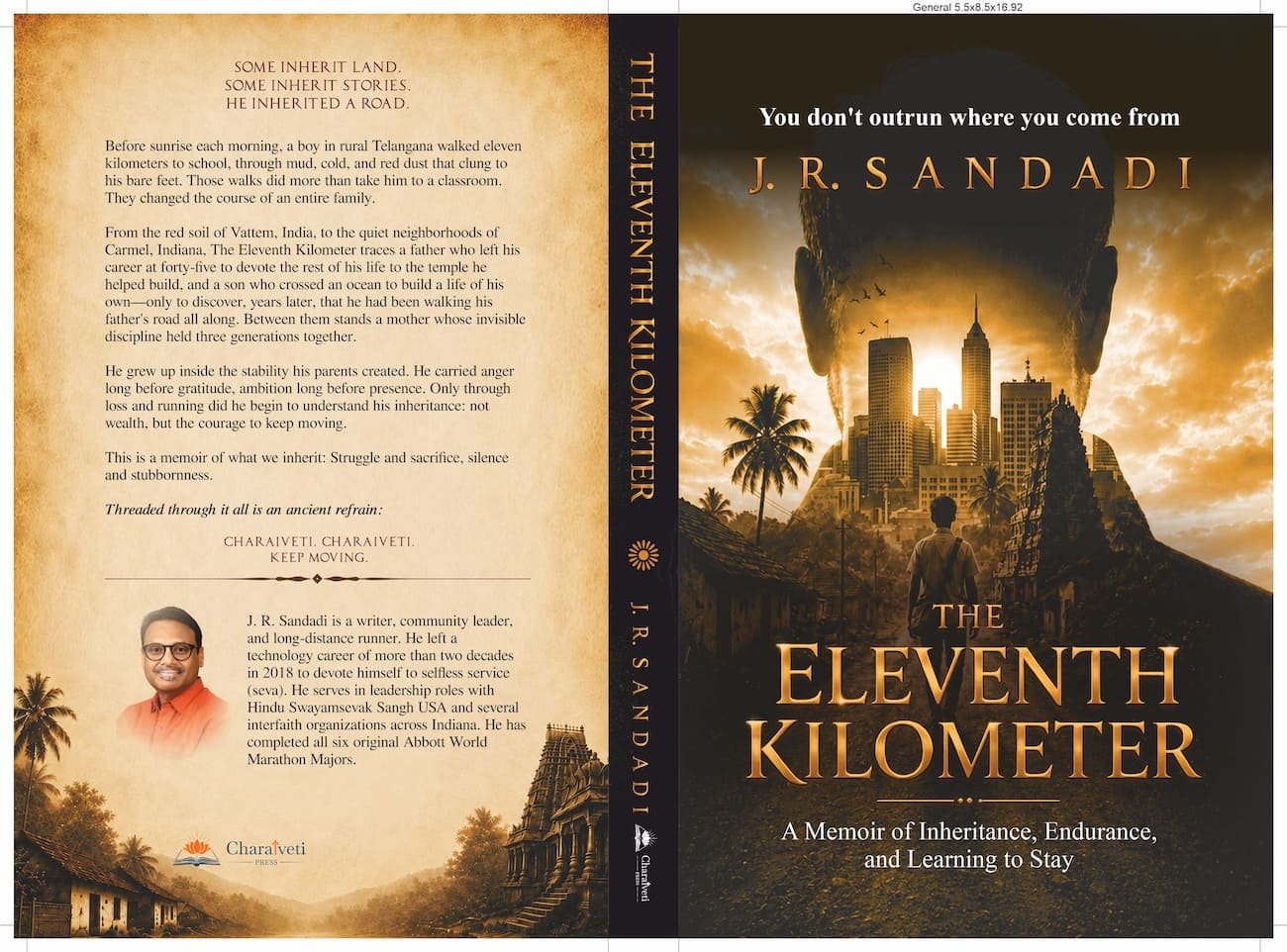
- Some memoirs tell us how a life was lived. “The Eleventh Kilometer” asks us to consider what makes a life worth examining—and what part of our journey began long before we took our first step.

For many immigrants, the journey to America begins long before the airplane leaves the runway.
It begins in the lives of parents and grandparents: in sacrifices seldom discussed, ambitions formed under constrained circumstances, and values transmitted more through conduct than conversation. It begins on village roads and in crowded classrooms, in disciplined households and deferred dreams. By the time an immigrant arrives in America, that person is already carrying the unfinished journeys of several generations.
J.R. Sandadi’s memoir, The Eleventh Kilometer: A Memoir of Inheritance, Endurance, and Learning to Stay, is rooted in this intergenerational continuum.
On the surface, it recounts the life of one man: a boy growing up in India, a student finding his way, an immigrant pursuing opportunity in America, a technology professional and entrepreneur, a husband and father, a marathon runner, and eventually a community leader committed to service and interfaith engagement.
Beneath that chronology, however, lies a more searching inquiry: What do we inherit from those who came before us, and what will we leave for those who follow?
Reading Someone Else’s Story—and Finding Our Own
I have known J.R. personally and have witnessed several dimensions of his journey. I therefore approached the memoir with both familiarity and curiosity. I expected to recognize people, places, and episodes. What I did not expect was how often his story would lead me back to my own.
That is among the book’s greatest strengths.
J.R. does not present himself as an extraordinary or flawless figure. He writes candidly about anger and fear, ambition and disappointment, illness and grief, achievement and insecurity. He allows readers to see not only what he accomplished, but also what those experiences demanded of him—and how they gradually changed him.
We encounter him as a son, brother, student, immigrant, employee, entrepreneur, husband, father, patient, runner, volunteer, interfaith advocate, and lifelong learner. These identities do not replace one another. They accumulate, overlap, and sometimes conflict, just as they do in our own lives.
The result is less a conventional success story than a record of becoming.
That distinction matters. Immigrant narratives are too often reduced to a familiar sequence: modest beginnings, education, migration, struggle, professional success, and social contribution. Such accounts can inspire, but they can also flatten a life by presenting achievement as its natural conclusion.
The Eleventh Kilometer is more interested in what happens after achievement—when outward success no longer answers the inward questions.
The Father Who Walked Before Him
At the center of the memoir stands J.R.’s father, Ranga Sandadi.
The title refers to the eleven kilometers his father walked each day in pursuit of an education. That daily journey becomes the book’s organizing image and emotional foundation.
The father walks eleven kilometers to school. Years later, the son travels approximately eleven hundred kilometers within India for higher education, crosses nearly eleven thousand kilometers to build a life in America, and eventually covers thousands more as a marathon runner.
The distances expand, but the deeper movement is not geographical.
What begins as a father’s walk toward opportunity becomes a son’s search for meaning.
Throughout the memoir, J.R.’s life feels less like a departure from his father’s and more like its continuation—not a repetition, but an evolution. Discipline, perseverance, humility, sacrifice, and responsibility pass quietly from one generation to another, assuming new forms in new circumstances.
This is one of the book’s most compelling insights.
We usually understand inheritance in material or biological terms. We inherit property, possessions, genes, and physical features. But families transmit far more than what can be documented in a will or detected in the body.
We inherit resilience and restlessness. We inherit habits, fears, loyalties, expectations, and ways of confronting adversity. We inherit dreams that were never named and sacrifices whose significance may not become clear until decades later.
Parents may leave their physical bodies, but portions of their lives continue through ours. Their struggles become the ground beneath our opportunities. Their unfinished aspirations sometimes find expression in choices they never lived to witness.
This continuity is particularly meaningful for immigrants. One generation may leave their motherland seeking education, dignity, or economic possibility. The next grows up amid opportunities its grandparents could scarcely have imagined.
Yet beneath that progress waits a vital question: What are we carrying forward besides success?
The Eleventh Kilometer returns repeatedly to that question.
The Immigrant Does Not Arrive Alone
Migration creates the impression that life begins anew upon arrival in another country. The language of immigration reinforces this idea: departure, arrival, reinvention, a fresh start.
But no immigrant arrives alone.
We carry our parents’ aspirations and our childhood experiences. We carry languages, memories, rituals, faith traditions, assumptions about success, and obligations that cannot always be explained to those outside our communities. We may also carry fears and burdens we do not recognize until much later.
America may offer the immigrant an opportunity to reinvent the self, but reinvention is never creation from nothing. The person who arrives is already inhabited by many lives.
At the center of the memoir stands J.R.’s father, Ranga Sandadi.
The title refers to the eleven kilometers his father walked each day in pursuit of an education. That daily journey becomes the book’s organizing image and emotional foundation.
J.R.’s story captures both the energy and the cost of that experience. Professional ambition and personal discipline help him establish himself, but the habits that enable achievement do not automatically produce contentment. Movement can become its own form of avoidance. One may keep advancing without asking what the race is for—or whether every race needs to be run.
The memoir’s later reflections therefore deepen its earlier account of ambition. Success is neither dismissed nor romanticized. It is placed in perspective. Accomplishment may provide security and recognition, but it does not relieve us of the responsibility to examine the life we are building.
The question eventually changes from “How far have I come?” to “What has this journey made of me?”
From Running Away to Running Toward
The Sanskrit exhortation Charaiveti—keep moving—quietly anchors the memoir.
Its meaning unfolds across several dimensions.
There is literal movement: from Bharat to America and from one marathon starting line to another. There is emotional movement through loss, disappointment, illness, ambition, and grief. And there is generational movement, as the unfinished journey of one generation becomes the starting point of the next.
Running eventually becomes much more than exercise for J.R. It is discipline, refuge, recovery, and self-confrontation. The marathon becomes a metaphor for the broader human journey: continuing when the destination feels distant, when certainty disappears, and when the body or mind urges us to stop.
Yet the book’s mature understanding of movement contains an important paradox. A meaningful life cannot consist only of going farther or faster. Sometimes growth requires us to stop escaping, remain present, accept responsibility, and learn to stay.
This tension gives the memoir much of its emotional depth. “Keep moving” does not mean perpetual restlessness. It means refusing stagnation while becoming steady enough to serve. Movement acquires meaning when it carries us toward deeper relationships, greater self-understanding, and a life useful to others.
Rootedness Without Isolation
The memoir also explores a question familiar to many Indian Americans: How can one remain grounded in a spiritual and cultural tradition while participating openly in the wider society?
J.R.’s outlook is shaped by Hindu thought, but faith does not appear in these pages as a boundary separating one community from another. It becomes a framework for responsibility, gratitude, self-discipline, service, and human connection.
His involvement in community and interfaith work emerges naturally from this foundation. The book suggests that rootedness and openness need not be opposites. A secure relationship with one’s own tradition can create the confidence required to explore and understand other traditions respectfully and without fear.
This is particularly relevant in a time when identity is often treated either as something to defend aggressively or something to dilute for social acceptance. J.R.’s journey points toward another possibility: an identity strong enough to serve, listen, collaborate, and evolve.
In that sense, the memoir is not only about preserving one’s roots. It is about allowing those roots to bear fruit in unfamiliar soil.
When Achievement Becomes Service
One of the most meaningful transitions in the book is the movement from personal achievement toward public responsibility.
Early in life, progress is measured through education, career, income, recognition, and eventually marathon medals. These accomplishments matter. They represent discipline, struggle, and the fulfillment of opportunities made possible by earlier sacrifices.
But over time, the measure begins to change.
Purpose appears increasingly through service: supporting young people, strengthening community institutions, building interfaith relationships, and being present for those whose lives are marked by instability or hardship.


The movement is subtle but profound. The question is no longer simply, “What can I accomplish?” It becomes, “Whose journey can I help make possible?”
This is where the title reaches its fullest meaning. The eleventh kilometer is not merely an additional distance beyond the expected ten. It represents the step taken after obligation has technically ended—the distance traveled not for recognition, but because someone else’s future may depend upon it.
Many people complete the first ten kilometers of life: education, employment, family, security, and social standing. The eleventh begins when success becomes stewardship.
Understanding Our Parents Too Late
Some of the memoir’s most affecting moments are not its most dramatic. They are moments of recognition—the realization that what once appeared ordinary was actually foundational.
Few of us understand our parents fully while growing up.
We see rules before we see sacrifice. We notice limitations before we understand circumstances. We resent discipline before recognizing the fear, love, and hope beneath it.
Only later—perhaps after becoming parents ourselves, confronting failure, living far from home, or losing those who raised us—do we begin to see the architecture supporting our own lives.
J.R.’s reflections on his parents capture this delayed understanding with honesty. His father’s walk was never merely a physical routine. His mother’s discipline was never simply severity. Their lives created the conditions from which his own life could emerge.
This realization invites readers to reconsider their own inheritance. What did our parents endure without telling us? Which of their qualities have quietly become ours? What opportunities do we treat as ordinary that once required extraordinary sacrifice?
A compelling memoir does not merely reveal the author. It reveals the reader to oneself. The Eleventh Kilometer succeeds because its particular story creates space for such personal reckoning.
A Book About the Road Beneath the Road
This is not a memoir that offers an easy formula for meaningful living. It does something more valuable: it leaves us with questions.
How do we distinguish achievement from purpose?
What do we owe those whose sacrifices made our opportunities possible?
Which values have we inherited without recognizing them?
How can we honor our origins without becoming imprisoned by them?
When does movement represent growth, and when does it become escape?
What kind of inheritance are we preparing for those who will come after us?
These questions extend far beyond J.R. Sandadi’s life. They belong to immigrants and their children, but also to anyone who has looked back at the lives of parents or grandparents and suddenly understood their struggles differently.
The book’s real subject is therefore not simply immigration, professional success, marathon running, faith, or service. It is the slow awakening to the invisible connections that shape a human life.
By the final pages, the eleven kilometers no longer belong only to J.R.’s father. They become a measure of the distance every generation travels so that the next may begin a little farther ahead.
And perhaps this is the deeper meaning of Charaiveti.
Keep moving—not merely across roads, finish lines, countries, or careers, but through generations. Carry forward the wisdom of those who walked before us. Transform the opportunities created by their sacrifices into opportunities for others. Leave the path a little clearer and the world a little kinder for those who will walk after us.
In that sense, The Eleventh Kilometer is more than the account of one Indian immigrant’s journey.
It is an invitation to recognize the roads beneath our own—and a moving reflection on the enduring journey of being human.
Dr. Tej Kumar Pareek is a biomedical scientist, entrepreneur, and community leader based in Cleveland, Ohio. He is co-founder and CEO of Celloram Inc., a biotechnology company developing therapies for cancer and immune disorders, and an adjunct faculty member at Case Western Reserve University’s School of Medicine.
Grateful to Dr. Tej Kumar Pareek for this brilliant reflection on The Eleventh Kilometer
He reads it as a book about what we inherit and what we leave behind — the road beneath the road. A generous and thoughtful piece, and one that saw exactly what I was reaching for.