




India at 80: I See the Evolution of the Country Through the Lens of My Village I Left 60 Years Ago

- India’s greatest asset may not be its wealth, technology, military strength, or economic size. It may be the resilience, adaptability, and optimism of its people.
India celebrated its 79th Independence Day on August 15, 2026—nearly eight decades after gaining independence in 1947. The journey has been remarkable, but never easy. From the beginning, India faced the extraordinary challenge of building a unified democratic nation across vast linguistic, religious, cultural, regional, and economic differences.
India inherited poverty, illiteracy, weak infrastructure, inadequate institutions, and deep social disparities. Since independence, it has endured wars with Pakistan and China, political assassinations, communal violence, youth movements, separatist and left-wing insurgencies, inter-state conflicts, political instability, and repeated economic crises. These were not isolated episodes; they were recurring tests of India’s unity, democracy, governance, and national resilience.
At various points, critics predicted that India would fragment, succumb to poverty, be overwhelmed by population growth, or fail to sustain democracy. Yet India endured. More importantly, it continued to evolve.
My Village Is My Backdrop
My understanding of India begins not with statistics, economic reports, or political debates, but with a tiny village in Odisha where I was born.
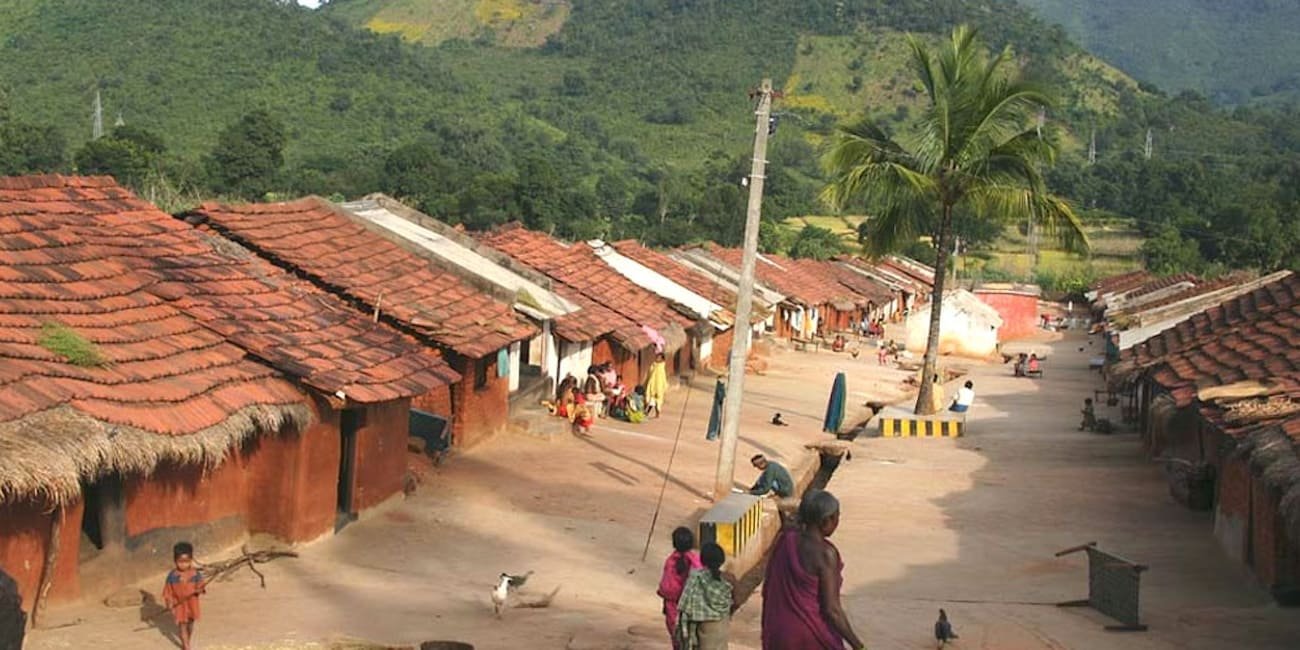
When I was growing up, the village had barely 300 people. Most were subsistence farmers or small entrepreneurs, and many were illiterate. There was no electricity, running water, paved road, or school, and virtually no electronic media. Our only connection to the outside world was father’s a battery-operated Philips radio. A few families owned bicycles or bullock carts.
My family lived in a distant town, where my father practiced law, but we frequently visited the village to oversee our agricultural land, cultivated by tenant farmers. Village children had to walk to a larger neighboring village for elementary education. Life was simple, difficult, and largely disconnected from the outside world.
On August 13, 1966, I left that village—and India—for the United States to pursue higher education. Since then, I have returned approximately every seven or eight years. With each visit, I have watched the village change. Its population has grown from roughly 300 to more than 1,000. The physical landscape, technology, education, and aspirations of its people have all changed dramatically.
Yet the village remains my personal window through which I observe India—its transformation, achievements, contradictions, disappointments, and failures.
Every visit has left me with the same powerful impression: beneath the visible poverty and enormous challenges lies extraordinary resilience and optimism.
For years, I wondered where that resilience came from. Then I remembered a conversation with my father, who has since passed away. I once asked him why people who possessed so little could remain so optimistic.
He quoted an ancient Indian philosophy: “Simple Living and High Thinking.”
He explained that it meant living modestly while pursuing higher moral, intellectual, and spiritual values. Material possessions, he said, were not the only measure of a meaningful life. Character, dignity, knowledge, responsibility, and hope mattered more.
The transformation is real—and extraordinary. But poverty and inequality persist. Caste and religious divisions remain sources of tension. Gender disparities continue. Outdated social practices survive alongside modern technology. Bureaucratic inertia, corruption, weak institutions, and uneven development remain obstacles.
Over the years, I have come to believe that this philosophy captures something important about India that statistics cannot fully measure. India has often progressed slowly, sometimes frustratingly so, but its people have possessed an extraordinary capacity to endure hardship without surrendering hope.
A Country That Refused to Give Up
India has changed enormously since I left in 1966.
Millions of Indians have escaped extreme poverty. Literacy and access to education have expanded dramatically. Electricity has reached villages that once depended on kerosene lamps. Roads, telecommunications, banking, healthcare, transportation, digital services, and technology have transformed everyday life.
India has also emerged as one of the world’s largest economies and an increasingly important global economic, technological, and geopolitical power. Its achievements in information technology, pharmaceuticals, space exploration, digital payments, telecommunications, and entrepreneurship have changed how the world views the country.
The agricultural transformation is equally remarkable.
A country that once faced chronic food shortages and depended heavily on imports has become broadly self-sufficient in food grains and a significant agricultural exporter. The transformation was not achieved by government alone. It resulted from farmers’ persistence, agricultural research, improved technology, irrigation, infrastructure, markets, and decades of institutional effort.
My village illustrates this transformation better than any economic statistic.
Today, it has electricity, running water, paved roads, an elementary school, concrete houses, motorcycles, televisions, mobile phones, internet connectivity, and a new generation of college graduates. Children who once had to walk to another village for elementary education now have opportunities their grandparents could hardly have imagined.
The transformation is real—and extraordinary.
But it is also incomplete.
Poverty and inequality persist. Caste and religious divisions remain sources of tension. Gender disparities continue. Outdated social practices survive alongside modern technology. Bureaucratic inertia, corruption, weak institutions, and uneven development remain obstacles. India’s economic growth has not benefited every region or every community equally.
India therefore remains a work in progress—slow, uneven, frustrating, and contradictory.
The Indian Tortoise
India reminds me of the proverbial tortoise.
The tortoise does not move quickly. It is not glamorous or spectacular. Its progress appears painfully slow compared with the speed of a hare. Yet the tortoise keeps moving.
The tortoise does not win because it is fast; it wins because it is persistent, focused and determined. India’s journey has been much the same.
It has survived crises that many believed would destroy it. It has absorbed enormous demographic pressures, economic shocks, political upheavals, wars, social conflicts, and competing regional aspirations. It has changed without completely abandoning its ancient civilizational identity.
India’s democracy itself is a remarkable experiment. Managing a country of more than a billion people—with hundreds of languages and dialects, numerous religions, enormous regional differences, and profound economic disparities—is an extraordinary undertaking. The system is imperfect and often contentious, but the democratic process has endured.
That endurance should not be taken for granted.
The Real Source of India’s Strength
More than six decades after leaving my tiny village, I understand my father’s quotation “simple living and high thinking” more deeply.


India’s greatest asset may not be its wealth, technology, military strength, or economic size. It may be the resilience, adaptability, and optimism of its people.
That resilience is visible everywhere.
It is visible in the farmer who cultivates uncertain land despite unpredictable weather and markets. It is visible in the entrepreneur who starts again after failure. It is visible in the student who travels long distances to obtain an education. It is visible in parents who sacrifice so their children can have a better life.
And it is visible in ordinary people who, despite setbacks, continue to believe that tomorrow can be better than today.
This optimism is perhaps one of India’s most underappreciated national assets.
Looking Toward the Next 80 Years
India’s first 79 years were largely about survival, institution-building, development, and transformation. The next 80 years will be about something even more difficult: converting its enormous potential into broad-based prosperity while preserving democracy, social cohesion, and human dignity.
The challenges will be formidable. Climate change, water scarcity, urbanization, technological disruption, artificial intelligence, demographic pressures, geopolitical competition, inequality, and global economic instability will test India in ways we cannot fully anticipate.
India will need to do better in many areas: governance, continued investment in education and skills, innovation, entrepreneurship, and more inclusive economic development. It will need to reduce the gap between its extraordinary technological achievements and the persistent problems faced by ordinary citizens.
Most importantly, India will need to preserve the qualities that have carried it this far: adaptability, tolerance, enterprise, perseverance, and hope.
My village is my backdrop, but India is the larger story.
When I look back at the tiny village I left on August 13, 1966, and compare it with the village I see today, I am reminded that national transformation is not always visible in a single moment. It happens gradually—in roads built, children educated, farms modernized, businesses created, families lifted from poverty, and dreams once considered impossible becoming ordinary realities.
After watching India change for more than six decades, I would make this declaration: India is strong and moving forward with greater confidence, slowly perhaps, unevenly certainly, but relentlessly.
The next 80 years will bring challenges we cannot foresee. But India’s greatest advantage is not certainty. It is the resilience to confront uncertainty.
That resilience was present in the humble villagers I knew as a child. It is present in the entrepreneurs, farmers, workers, students, scientists, teachers, and young people of today. And I believe it will remain at the heart of India’s journey into the future.
India is ready, able, and willing to meet the challenges of the next 80 years. That is India’s greatest strength—and its greatest promise.
Top photo: Representative image of a village in Odisha.
Pradeep Patnaik was a businessman for 35 years. He is now semi-retired and engaged in international development activities. He lives in Brentwood, Tennessee. He can be contacted at pkpatnaik022@gmail.com.