



Humanizing the Most Famous Monk of India Who Introduced Yoga and Spiritual Philosophy to the West

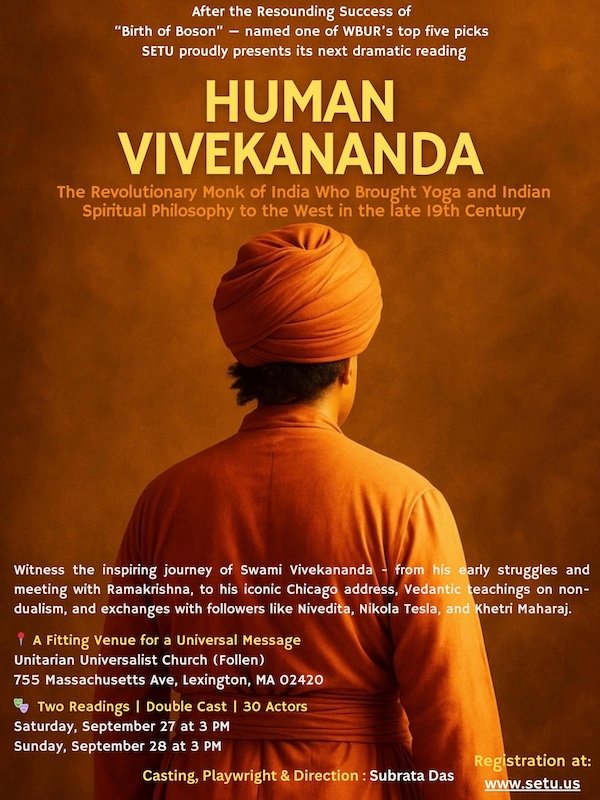
- SETU is staging “Human Vivekananda,” a dramatic reading of a script written and directed by the author, on September 27 & 28 at the Universal Unitarian Church in Lexington, MA.
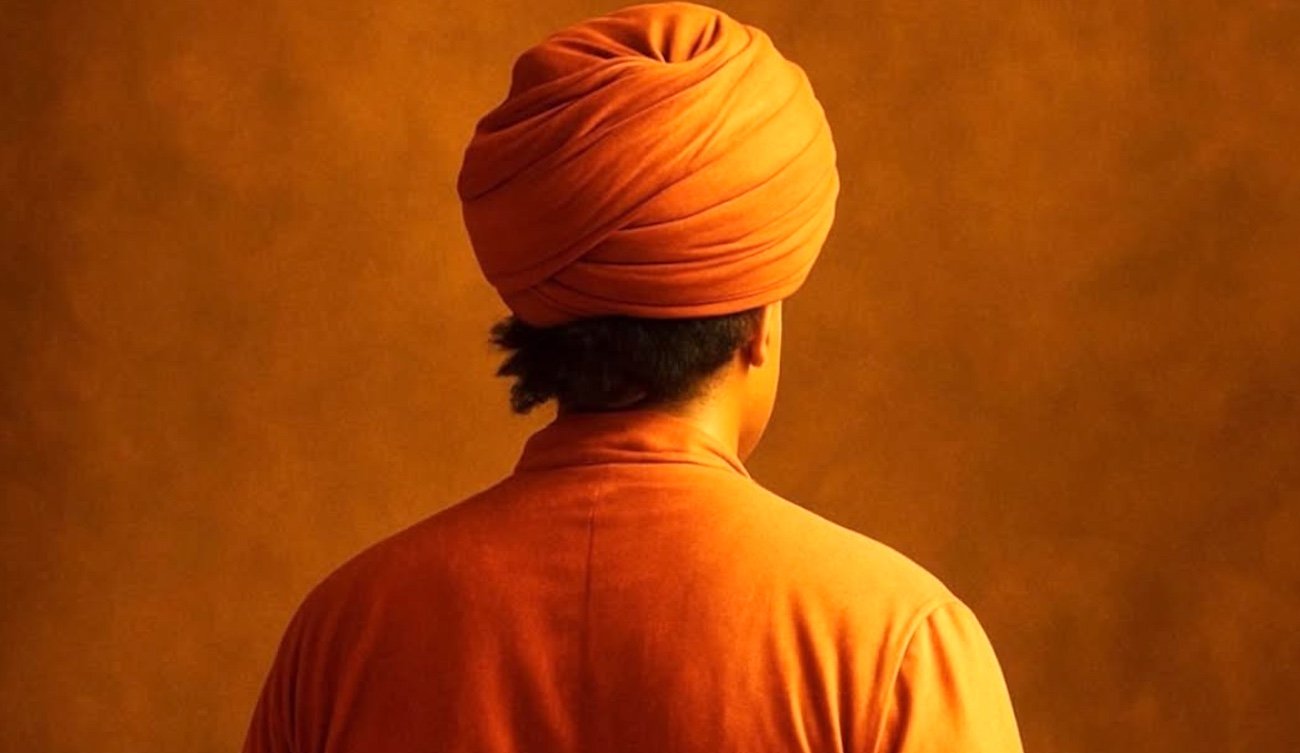
In India, we often deify spiritual figures once they attain a certain level of perceived enlightenment. We begin to ascribe supernatural powers to them, overlooking their human struggles, vulnerabilities, and the non-religious aspect of the philosophical depth of their teachings. To bring this forgotten side of Swami Vivekananda to a wider audience, SETU is staging “Human Vivekananda,” a dramatic reading of a script written and directed by the author, on September 27 & 28 at the Universal Unitarian Church in Lexington, MA.
The reading, with 30 actors in a double cast, primarily explores the most eventful phase of his life, spanning the years 1882 to 1902, especially focusing on his early struggles supporting his widowed mother and younger siblings, his transformative spiritual relationship with his Guru Sri Ramakrishna, the arduous journey to the World’s Parliament of Religions in Chicago, and his profound teachings on Advaita Vedanta. The play surfaces his very non-orthodox approach to religion, which, in turn, raises this question: Was he really a religious person in the traditional sense? Vivekananda’s Vedantic spiritual and practical messages of unity and tolerance transcend religion – culminating in the love of God through loving service to the poor and underprivileged.
Swami was a product of the great Bengal Renaissance, which saw the emergence of many intellectuals, including poet Rabindranath Tagore, Asia’s first Nobel laureate, and Raja Ram Mohan Roy, a founder of the Brahmo Samaj and a key figure in abolishing sati – the practice of burning widows on their husbands’ funeral pyres. These reformers were influenced by Western values under British rule, often clashing with ancient Indian practices. Initially, Vivekananda was fascinated by the Brahmo Samaj, whose doctrine rejects idol worship, casteism, and other orthodox practices. Brahmo Samaj was closely in line with the Vedantic non-dualistic approach to Hinduism. When asked by the Maharaja of Khetri, Ajit Singh, what he would say before the audience at the Parliament, Swami replied: “I am proud to belong to a religion that has taught the world tolerance and universal acceptance.” He intended to speak of the Upanishads – not as relics, but as living truths. Deeply aware of casteism and poverty in India, he told the Maharaja, “A person is judged not by caste or religion, but by character. Where temples and churches are built not only from stone, but from our hearts and minds – welcoming all, feeding the hungry.” These answers reflect the mind of Vivekananda, deeply ingrained with the early influences of the Brahmo Samaj.
With sponsorship from the Maharaja of Khetri, Vivekananda arrived in Chicago in July 1893 after a long sea voyage, only to discover that only individuals with credentials from a recognized organization would be accepted as delegates. He accidentally met Kate (Catherine) Sanborn, a Boston-based poet, teacher, and writer, while traveling by train from Vancouver to Winnipeg. Sanborn described Swami as “a magnificent specimen of manhood – as handsome as Salvini at his finest, with a lordly, imposing stride.” Upon her invitation, Vivekananda traveled to Boston to meet her. She then connected him to Prof. John Wright, a professor of Greek at Harvard. Prof. Wright had no hesitation in recommending him to Dr. Barrows, the chairman of the selection committee, calling Vivekananda “a man more learned than all our learned professors put together. To ask him for credentials is like asking the sun to state its right to shine in the heavens.”
Starting with Kate Sanborn, Vivekananda’s disciples and followers grew exponentially, especially among women, and that reveals his progressive views and respect for women, in contrast to more orthodox religious perspectives. Some were wealthy individuals and families who later followed him to India, including Josephine Macleod and Sara Bull (wife of Norwegian pianist Ole Bull, lived in Boston). His most well-known disciple, however, was Margaret Noble, an Irish teacher living in London, who later became Sister Nivedita in India. While Macleod, Bull, and others made monetary contributions to help him establish and run monasteries, Nivedita focused on empowering Indian women as per her master’s wish. She met Vivekananda in London in 1895 and followed him to India in 1897, where she settled and dedicated her life to social reform.
He was allocated only a handful of minutes to speak at the World Parliament of Religions at the Art Institute of Chicago in September 1893, but the delegates gave him a standing ovation that lasted over two minutes – immediately after his opening line, “Sisters and brothers of America … .” The very nature of this opening suggests his effort to reach out in a deeply personal way, giving women greater importance. The delegates were certainly curious about the 31-year-old monk (or sannyasi in Hindu tradition) in an orange robe, from a land known to most Westerners as the home of snake charmers and millions of gods. The monk, Swami Vivekananda, was representing the 300 million Hindus of India. His opening speech was so electrifying that the chairman saved it for the end of each session – just to ensure the audience would stay. Four thousand people, fanning themselves in the Hall of Columbus, sat patiently – smiling and expectant – enduring hours of other speakers just to hear Swamiji speak for fifteen minutes.
Meeting Tesla
While in New York, Vivekananda had a stimulating discussion with Nikola Tesla. Both were seekers of the ultimate truth – one through science, the other through spirituality. Tesla was fascinated by Vivekananda’s views on Prâna (vital life force), Âkâsha (the fundamental all-pervading substance), and Kalpas (cosmic cycles of time), which Tesla believed were among the few metaphysical ideas modern science could still consider. Both Akasha and Prana, according to Vivekananda, arise from Mahat (universal mind) or Brahman. Vivekananda noted that Tesla believed he could “mathematically demonstrate that both force and matter reduce to potential energy.”

The very nature of Advaita (non-dualism) philosophy and his interest in reconciling it with science make Vivekananda more a spiritual philosopher than a mystic. The realization of Brahman was his only imperative, and the Vedas and Upanishads his sole scriptural authority. Brahman is the ultimate reality and source of all existence; Atman is the individual self. Advaita Vedanta teaches that Atman and Brahman are ultimately one and the same, despite perceived differences. Regarding Yoga, Vivekananda explained that it is “the science” that teaches us to bring the chitta (mind-stuff) under control. The chitta is constantly churned by internal and external influences. Yoga teaches us to still the mind so that it remains balanced. Concentration is the source of all knowledge, and Yoga helps us master matter and align the soul with the Supreme Soul or God. There are four yogic paths: Jnana Yoga (knowledge), Bhakti Yoga (devotion), Karma Yoga (selfless action), and Raja Yoga (meditation and mental discipline).
Swami Vivekananda was born as Narendranath Datta into a well-to-do middle-class family in Calcutta on January 12, 1863. A reversal of fortune began after his father’s sudden death in 1884, which left the family in financial distress, burdened with debt, and entangled in a legal dispute over their ancestral home. Vivekananda struggled to find a job to support his mother and two younger brothers. Despite tremendous personal and institutional challenges, Vivekananda showed remarkable resilience in both India and abroad. He traveled widely despite the difficult transport systems of the late 19th century. His oratory held audiences spellbound, making complex Vedantic ideas accessible and moving. Known for his humility and hospitality, he often cooked meals for guests, proudly sharing his culinary skills. Despite being a monk, he never stopped visiting his mother.
He suffered from several health issues throughout his adult life and passed away on July 4, 1902, at the young age of 39. Yet in that short span, he left behind a legacy that transformed modern Hindu thought. He is remembered as the monk who revived the spiritual soul of Hinduism and gave it a global voice – much like the Buddha in his time. The legacy of Vivekananda and his Guru Ramakrishna extends far beyond sectarianism and intolerance. His birthday, January 12, is celebrated as National Youth Day in India. The National Portrait Gallery of the Smithsonian Institution included him among the 29 most eminent people to have visited America. Outside the Art Institute of Chicago, a section of Michigan Avenue is named in his honor, commemorating his impactful address.
Dr. Subrata Das teaches part-time AI at Northeastern University to pursue his passion for technology and works as an industrial data scientist. He is also the director, a playwright, an actor, and a co-founder at the nonprofit theater group SETU in the Boston area (www.setu.us). He is passionate about staging plays that explore deep-rooted Indian social issues with universal relevance. Since SETU’s inception in 2003, Subrata da has directed more than 25 plays, including several written by him. Subrata can be contacted at sjskdas@gmail.com or s.das@northeastern.edu, +1 617 797 1077, Addr: 2 York Road, Belmont, MA 02478, USA.