




Dronacharya’s Query Revisited: Why Critics Refused to Acknowledge That 16 Faiths Were Represented at the One Humanity Event

- Dr. Mohan Bhagwat’s visit was not sprung on the public. After the visit was confirmed, a press release issued three weeks in advance named him as keynote speaker.
Samantha Agarwal’s article in American Kahani, “RSS in America: World’s Largest Far Right Paramilitary Rallied in New York City. It Should Alarm Everyone,” uses strained and contradictory comparisons to disparage the Universal Oneness Celebration at the Infosys Theater at Madison Square Garden. In doing so, it also mischaracterizes more than 250 organizations and the 5,000-plus Hindu Americans who traveled from 39 states and 850-plus cities to attend.
The article opens with the 1939 German American Bund rally in New York—an explicitly pro-Nazi gathering marked by hakenkreuz (that is incorrectly called as swastikas) and a program of “white Gentile America.” Any reader applying even modest logic would ask how that racially exclusive event can be analogized to a Universal Oneness Celebration that officially invited leaders and followers of many faiths, races, and cultures and shared the stage with them. Later in the same piece, the author turns to Hindutva–Zionist relations. Hindutva is first framed as Nazi-like, then as allied with Jews—yet that alliance itself is treated as suspect. Friendship with Jews is cast in a negative light, as if association with Jews were itself incriminating.
The list of 66 organizations cited in support of the author’s position—and as having condemned RSS Sarsanghchalak Dr. Mohan Bhagwat’s visit—includes groups that have supported the breakup of India and opposed the integration of Jammu and Kashmir after the abrogation of Article 370 — a provision that had long been associated with violence, terrorism, and the targeting of minority Hindu and Sikh populations in the state. It illustrates the kind of endorsement protesters treated as a credential while opposing a message of global harmony.
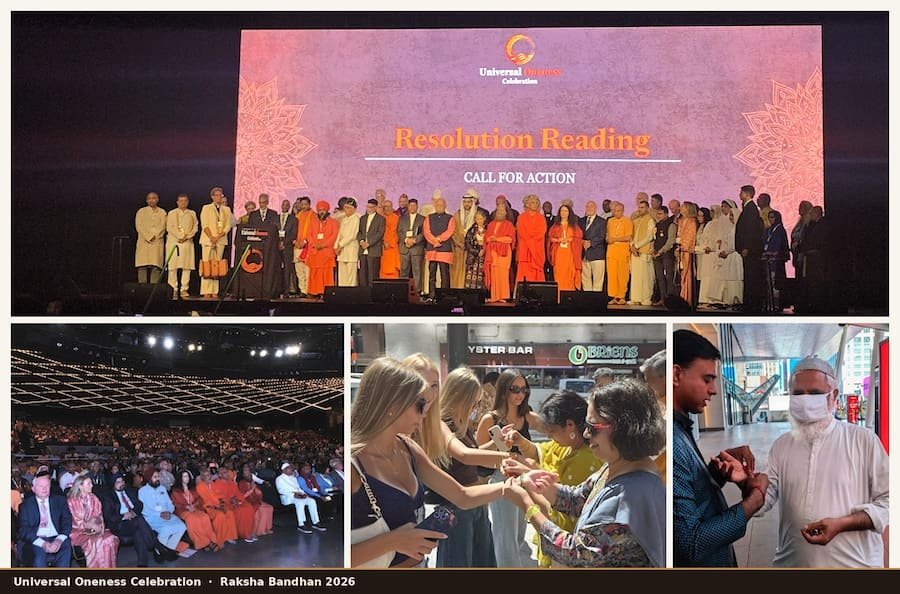
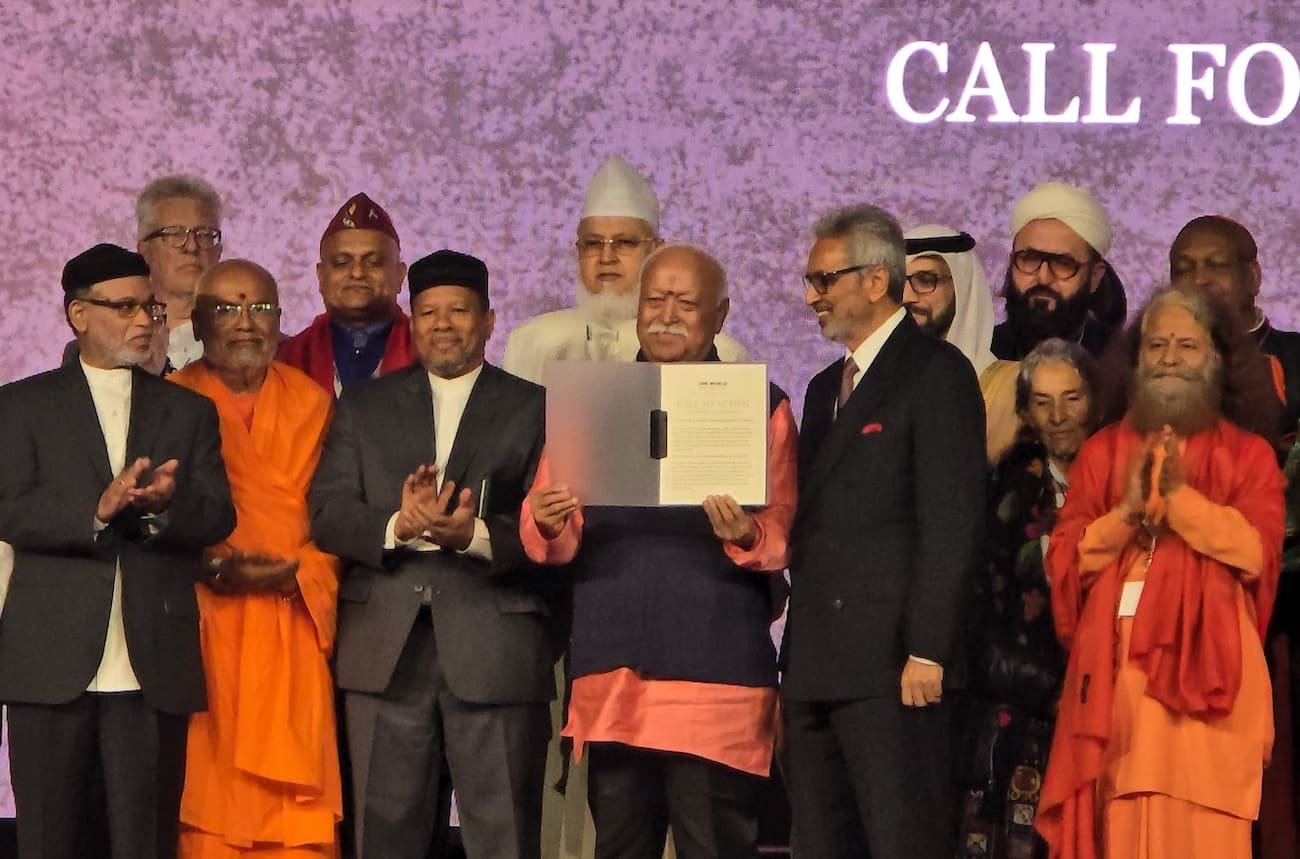
It is therefore necessary to understand with clarity what factually took place at the Universal Oneness Celebration:
- More than 5,000 people gathered around and celebrated the message of “One Humanity” and Vasudhaiva Kutumbakam—the world is one family.
- Hindu, Jewish, Christian, Muslim, Sikh, Jain and Indigenous voices shared the stage and spoke of human dignity, compassion, responsibility, and connection across differences.
- Dr. Mohan Bhagwat delivered the keynote, emphasizing oneness within diversity, service to society, responsibility toward nature, and giving back to America.
- Interfaith remarks were offered by Rabbi Jacob Blumenthal, Rev. Adrian Thorne, Imam Dr. Talib M. Shareef, and Indigenous elder Elizabeth Araujo.
- A collective Raksha Bandhan ceremony recast the rakhi as a symbol of responsibility, care, and connection extending beyond the family to the wider human community.
- An Interfaith Declaration, presented by His Excellency Bawa Jain of the World Council of Religious Leaders, called on faith communities to reject hatred, humiliation, dehumanization, and violence.
- Cultural presentations included dhol and tasha, an international dance mosaic, a Hindu-American youth a cappella performance, and Mahesh Kale leading thousands in “Sangachhadhwam,” a Sanskrit invocation of moving forward together in harmony.
The central message was that differences need not disappear for people to experience unity. Distinct identities and traditions can coexist with a shared sense of responsibility. The theater was filled with visible respect and sustained applause for speakers of many faiths and for the keynote.
Despite extensive commentary on Hindu organizations and Hindu public life, prominent critics devoted little attention to Raksha Bandhan itself or to greeting Hindus observing the festival.
It is worth noting that Dr. Bhagwat’s visit was not sprung on the public. After the visit was confirmed, a press release issued three weeks in advance named him as keynote speaker. Those interested in the gathering responded in large numbers from across the country. Ideological opponents mobilized just as quickly. The activists’ campaign to protest included calls for the U.S. government to cancel Dr. Bhagwat’s visa and Madison Square Garden to cancel the event, with a noisy circus around the Garden itself. They even called NY Mayor Zohran Mamdani to compel the venue to cancel the contract, however the mayor reminded them that it was a private venue beyond his jurisdiction.
Despite the media frenzy and the attempts to shut the program down, over 90 faith leaders took part in the Universal Oneness Celebration at the Infosys Theater at Madison Square Garden. Two of them who were present with others to welcome Dr. Bhagwat on the stage, later said they had not known who the keynote speaker would be and that they did not endorse him or the RSS in India. They did not withdraw their remarks. One may ask how, given weeks of publicity, two leaders out of 90+ only discovered the keynote afterward. Regardless, they have every right to say so. What matters is that their caveat did not dilute the event’s central claim: differences need not disappear for people to experience unity.
The protests outside the venue were the public face of that same campaign. They reflected concerns rooted largely in India’s political debates. Their relevance to an American gathering organized around interfaith dialogue, Raksha Bandhan, and civic belonging was and is questionable.
Organizers and participants of the Universal Oneness events did not contest the protesters’ right to assemble, even when demonstrations included the desecration of an Indian flag and the public display of a cardboard effigy of the chief guest. In a pluralistic society, the protection of dissent matters most when the expression is uncomfortable. That principle is strongest when applied consistently—including toward those with whom one disagrees.
Alongside the protest, a quieter scene unfolded. Volunteers offered rakhis to pedestrians of different racial, religious, and cultural backgrounds. Many accepted them; some tied rakhis in return. It was an unscripted expression of the festival’s core idea: bonds of care and responsibility can extend beyond family, faith, or community.

One omission was hard to miss. Despite extensive commentary on Hindu organizations and Hindu public life, prominent critics devoted little attention to Raksha Bandhan itself or to greeting Hindus observing the festival. That silence does not stop them from their right to protest, but it does raise a question: is a community best understood only through the perceived controversies, or also through the traditions and everyday practices by which its members understand themselves?
The article then returns to a familiar pattern of repeated allegations against Hindu Swayamsevak Sangh USA (HSS). It relies on material from “Savera United Against Supremacy,” which describes itself as “a new platform bringing together a multiracial, interfaith, anticaste coalition of organizations and activists to build a new world where all people are able to live in harmony, dignity, and liberation.” In practice, its reports focus only on Hindus: first by constructing a narrative of collective guilt, then by extending that guilt by association to Hindu Americans. What it “exposes” about HSS is in fact, public information already published by HSS through official channels.
HSS has often been the visible target of this campaign—through reports, conferences, and social-media bullying. The relative silence of the same networks toward the broader 0.9% of American population — Hindu-American community, a micro-minority that contributes through innovation, taxes, charity, hard work, and intellectual work, suggests that the real object of attack is Hindus in America, whether first-generation or later.
There is a traditional didactic legend (ākhyāyikā) in the Itihāsa — Mahabharata. Guru Dronacharya asked Yudhishthira to find a wicked person and Duryodhana to find a virtuous one. Yudhishthira could not find the wicked; Duryodhana could not find the virtuous. Duryodhana is long gone. The blindness that could see no virtue remains.
Vikas Deshpande is a member of the Hindu Swayamsevak Sangh USA.