




Inside and Outside Madison Square Garden: How Mohan Bhagwat’s ‘Universal Oneness’ Rally Divided a City and a Diaspora

- The RSS chief drew 6,000 supporters to Madison Square Garden with a message of Hindu civilizational mission and interfaith unity — while hundreds of protesters outside called it a repackaging of supremacy.
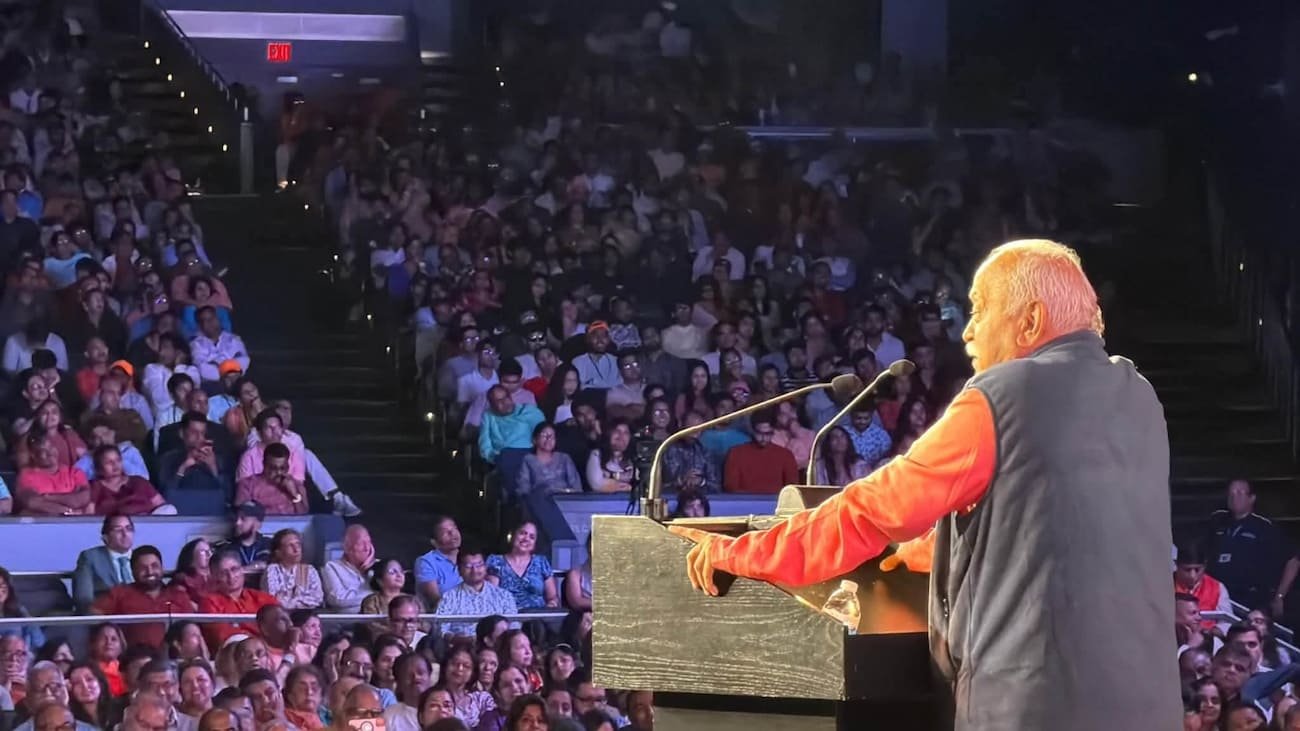

By the time Mohan Bhagwat took the stage at Madison Square Garden’s Infosys Theater on the afternoon of Saturday, August 29, 2026, the evening had already been days in the making — and not only in the sense that its organizers had spent months planning it. The protests, the mayoral denunciation, the federal sanctions recommendation, and the sustained controversy over what the event represented had given the gathering a charge that no amount of cultural programming could fully absorb.
Outside on Seventh Avenue, hundreds of protesters filled the entrance to Madison Square Garden on Saturday, according to the Indian American Muslim Council’s official account of the day’s events. Inside, more than 6,000 members of the Indian American community and interfaith leaders settled into their seats in a theater decorated for the occasion of Raksha Bandhan, according to Indian media reports.
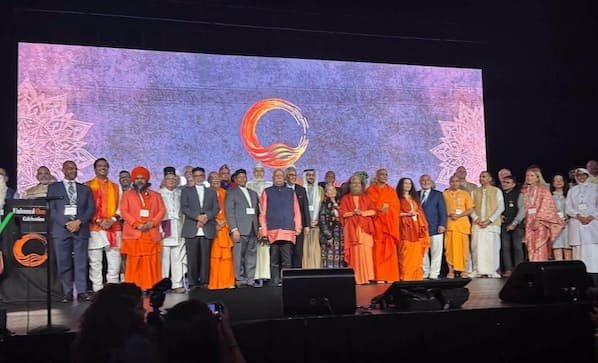
The “Universal Oneness Celebration,” organized by American Hindus for Engagement and Dialogue and supported, its organizers said, by 135 Hindu American organizations, had been billed as an interfaith gathering extending the idea of mutual responsibility “from family to communities, nations, humanity and the natural world,” as Indiablooms documented. By the time Bhagwat took the microphone, it had become something considerably more complicated.
What Bhagwat Said: A Message of Oneness, Dharma, and Civilizational Mission
The RSS chief’s address, as documented in detail by the Organiser — the RSS’s own official publication, was organized around several interlocking themes that together constituted a carefully constructed public argument.
His central rhetorical move was a contrast between two words: the American concept of pluralism and the Indian concept of “unity in diversity.”
“In America one word is discussed — pluralism,” Bhagwat told the audience. “For Bharat it is unity in diversity, which is in our DNA. Every nation has a destiny to fulfill. What is the destiny given to Bharat? Bharat is there to realize, and from time to time make the world realize this unity in diversity. We are one, and due to diversity, that oneness is decorated. So, diversity has to be celebrated, has to be respected, has to be accepted. And at the same time, we must keep in mind this feeling of oneness,” as the Organiser documented verbatim.
He grounded the argument in the Hindu philosophical concept of Vasudhaiva Kutumbakam — the world is one family — describing it as Bharat’s specific civilizational contribution to global thought, as the Organiser’s key highlights account confirmed. “Nations are not merely geographical entities,” he said, invoking what he described as the moral obligation carried by human intelligence to sustain the world through right thinking and selfless service.
He called directly on the Bharatiya diaspora in the room to maintain dual loyalty — to their Karmabhoomi, or land of work, and to the values of their Janmabhoomi, or land of birth — urging them to remain steadfastly committed to both without contradiction, as the Organiser documented.
On the RSS’s own centenary journey, Bhagwat offered a passage notable for its candor about the organization’s historical marginality. “Sangh started in 1925, and during the course of hundred years, we have created a place, a prestige for us in our own society,” he said. “Today when I am talking this, even Baba may ask, where were you all these years? You are talking these things today. We were there, but we were so minuscule, so neglected, that even if I would have come here to participate, I would have been rejected outside. Now we have some say in our own society,” as the Organiser documented.
On diversity specifically, he said: “Diversity is a decoration for our unity. It has to be accepted. It has to be respected. It has to be protected. As I protect my own specific nature, I have to protect others also,” in remarks at a parallel interfaith dialogue event — “One World, One Humanity” — held at 1345 Avenue of the Americas on the same day, as the Organiser’s separate account of that event confirmed.
The booking of Madison Square Garden is, from the RSS’s perspective, itself a statement about how far the organization has traveled in global legitimacy and diaspora mobilization.
He told the audience that Hindu thought did not support excluding Muslims, as IPA Newspack documented from the event. He described Dharma as “the essential middle path and sustaining force,” as the Organiser’s key highlights account confirmed.
Inside the Arena: The Atmosphere
The audience in the Infosys Theater received Bhagwat warmly. The 6,000 attendees represented temple organizations, yoga groups, cultural associations, and community leaders from across the Indian American community in New York and beyond, as NY1 reported. The event was supported by 135 Hindu American organizations, as Religion News Service noted.
Photographs and video distributed by PTI, the Indian state news agency, showed a full theater and an attentive audience. The occasion of Raksha Bandhan — the Hindu festival celebrating the bond between siblings — gave the cultural programming a festive dimension alongside the political one.
American singer Mary Millben — a public supporter of Prime Minister Modi who had previously performed at events connected to Indian American conservative organizations — publicly welcomed Bhagwat’s arrival. “Welcome to the United States, Mohan Bhagwat! My warmth to all those gathering at Madison Square Garden this weekend. There is power in unity,” she wrote on X.
The event also included a parallel interfaith gathering, “One World, One Humanity,” organized by the World Council of Religious Leaders at a separate venue at 1345 Avenue of the Americas on the same day, at which Bhagwat delivered remarks, as the Organiser reported.
Bhagwat is then expected to attend two more private events in New York before heading to Canada.
Outside MSG: The Protest
The scene outside Madison Square Garden was, as the IAMC’s press release described it, a “massive show of opposition” — though the IAMC is a party to the controversy and its characterization of its own protest as the “largest and most humiliating public rejection” the RSS has ever faced on American soil reflects its advocacy position rather than an independent assessment.
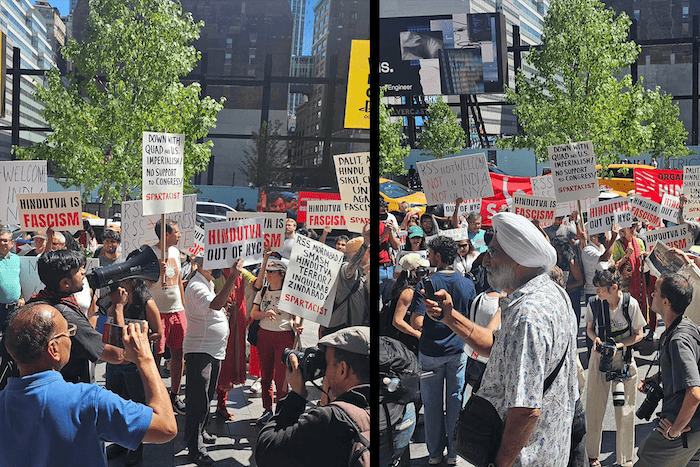
What is confirmed across multiple independent sources is that hundreds of protesters assembled outside the arena on Saturday, as NY1 confirmed. The demonstration brought together Muslim, Sikh, Christian, Dalit, Hindu, and Jewish New Yorkers. Congressional nominee and former New York City Comptroller Brad Lander stood with the protesters outside the arena.
The protest was organized by Hindus for Human Rights alongside the Indian American Muslim Council and affiliated organizations — the same coalition that had held a City Hall press conference on August 25.
Anuraag Khandelwal, speaking for Hindus for Human Rights from outside the arena, offered a line that encapsulated the opposition’s framing: “Packaging 100 years of Hindu supremacy and minority vilification as a Universal Oneness is some top-tier PR gymnastics.”
Inside the opposition coalition itself, speakers from multiple faith traditions made the same argument in different registers. Danielle Williams of the Interfaith Center of New York invoked the 1939 pro-Nazi Bund rally at Madison Square Garden as a historical reference point, saying it was “not the first time that Madison Square Garden has hosted fascists, hate and supremacy,” as Religion News Service reported

The Scholars: What the Venue Choice Signals
Edward Anderson, a scholar of Hindu nationalism and the Indian diaspora, offered the most analytically precise commentary on the event’s significance, speaking to Middle East Eye before the rally.
While it may be surprising to see the RSS leader headline a major event in New York, he said, the organization has sought to cultivate support among the Indian diaspora around the world since the early years of Indian independence. The choice of venue carried a specific purpose: “It reflects a strength and success that is connected to their narrative of pride and assertiveness,” he told Middle East Eye.
The observation is consistent with Bhagwat’s own remarks inside the arena about the RSS’s journey from marginality to institutional presence — his comment that decades ago, he would have “been rejected outside” such a venue. The booking of Madison Square Garden is, from the RSS’s perspective, itself a statement about how far the organization has traveled in global legitimacy and diaspora mobilization.
The Federal Dimension: USCIRF and the Visa Question
The rally took place three days after the U.S. Commission on International Religious Freedom — USCIRF — urged the U.S. government to consider sanctions against RSS members and to revoke Bhagwat’s visa over alleged religious freedom violations in India. The bipartisan federal body’s recommendation, made in the days before the event, represented an unusually direct intervention by an American government-connected institution into an Indian diaspora event.
India’s Ministry of External Affairs quickly rejected the commission’s remarks, calling the body biased and lacking in credibility. The IAMC, in its post-event press statement, called on the State Department to revoke Bhagwat’s visa and impose the targeted sanctions USCIRF had already recommended.
The visa was not revoked. The event proceeded. Bhagwat spoke.
A City — and a Diaspora — Divided
The debate that played out across New York’s sidewalks, social media platforms, op-ed pages, and the arena floor on Saturday is not a debate that will be resolved by a single event. It is a debate about what the Indian American community is, who speaks for it, and what values it wants to project onto the stage of American public life.
The 6,000 who filled the Infosys Theater heard a message of civilizational pride, interfaith oneness, and diasporic duty. The hundreds outside heard, in that same message, a repackaging of an ideology they associate with violence and exclusion. Mayor Mamdani — the first Indian American mayor of New York, the son of a family rooted in the same subcontinent Bhagwat was speaking about — said before the event that he does not support the rally. He also said the city cannot cancel a private event at a private venue.
The RSS chief returned the favor by not mentioning him.