




‘2000 Mules’ Come Home to Roost: Pardoned Felon Dinesh D’Souza Settles Defamation Case on Eve of Trial

- The resolution brings to an end one of the most closely watched legal challenges arising from “2000 Mules,” a film that became a major vehicle for claims that the 2020 presidential election had been stolen through organized ballot fraud.
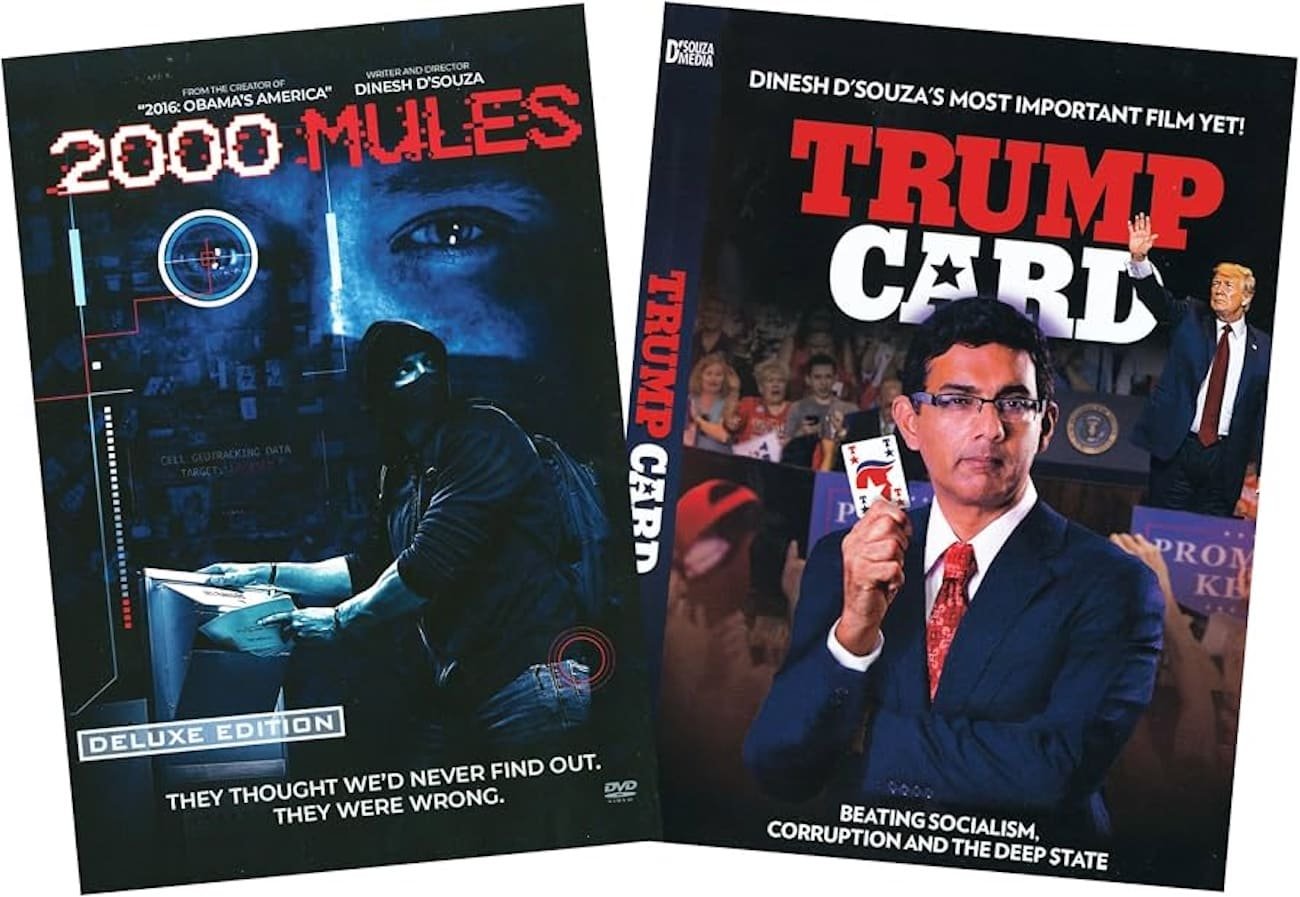

Conservative filmmaker and political commentator Dinesh D’Souza has settled a defamation lawsuit brought by a Georgia man who was falsely portrayed in his 2022 documentary “2000 Mules” as part of an illegal ballot-harvesting operation.
The settlement with Mark Andrews came just days before a federal jury trial was scheduled to begin in Atlanta. The terms were not disclosed, and the public court record does not indicate whether D’Souza made any financial payment or other concessions to Andrews. The case was dismissed with prejudice after the parties notified the court that they had reached a settlement.
The resolution brings to an end one of the most closely watched legal challenges arising from “2000 Mules,” a film that became a major vehicle for claims that the 2020 presidential election had been stolen through organized ballot fraud.
At the center of the lawsuit was a brief surveillance video showing Andrews depositing absentee ballots into a ballot drop box in Gwinnett County, Georgia. The film presented the footage as evidence of criminal activity. D’Souza’s narration stated: “What you are seeing is a crime. These are fraudulent votes.”
But Georgia investigators determined that Andrews had been legally returning ballots for himself, his wife and their three adult children. The state investigation cleared him of wrongdoing.
A Case That Survived Dismissal
Andrews filed the lawsuit in October 2022 against D’Souza, D’Souza Media, True the Vote and other parties involved in producing and promoting the film. He alleged defamation, voter intimidation and invasion of privacy, arguing that “2000 Mules” falsely portrayed him as a criminal participant in a nationwide ballot-trafficking scheme.
The case survived an attempt by the defendants to have it dismissed. In October 2023, U.S. District Judge Steven D. Grimberg allowed the core defamation and voter-intimidation claims to proceed.
The case took a more consequential turn in October 2025. In ruling on motions for summary judgment, Judge Grimberg found that the statements accusing Andrews of criminal conduct were false as a matter of law and allowed the defamation claims to proceed to trial.
According to Protect Democracy, which represented Andrews, the judge found that the defendants acknowledged they had no evidence that Andrews had been paid to deposit ballots, had visited a drop box more than once, had picked up ballots from a nonprofit or had participated in a violent riot. The court also found that True the Vote had not geotracked Andrews’ cellphone or another device belonging to him.
Those findings were potentially significant because geolocation data was central to the film’s broader argument. “2000 Mules” asserted that cellphone-location information could be correlated with surveillance footage to identify people who repeatedly visited nonprofit organizations and ballot drop boxes, which the film characterized as evidence of organized ballot trafficking.
The judge’s 2025 ruling said there was sufficient evidence for a jury to conclude that the defendants knew Andrews’ surveillance footage had never been geotracked and that there was no video evidence supporting the specific “mules” theory as applied to him.
D’Souza Later Apologized
The legal case was also complicated by a significant retreat from the film’s original presentation. In December 2024, D’Souza publicly apologized to Andrews and acknowledged that inaccurate information had been supplied to him and his team concerning the surveillance footage. He said he had learned that the videos used in the film might not have been correlated with the geolocation information as he had understood. The Associated Press reported that D’Souza said he would have presented and edited the film differently had he known that at the time.
That admission followed an earlier and broader repudiation by Salem Media Group, which had published and distributed “2000 Mules.”
In May 2024, Salem apologized to Andrews, saying it had relied on representations from D’Souza and True the Vote that people depicted in the videos, including Andrews, had illegally deposited ballots. Salem also said it had learned that the Georgia Bureau of Investigation had cleared Andrews of illegal voting activity. The company withdrew the film and its companion book from distribution.
The case had been scheduled for trial beginning August 17, 2026. According to WSB-TV, the trial was canceled July 30 after the parties informed the court that they had reached a settlement. The federal court subsequently dismissed the case with prejudice.
Salem separately settled Andrews’ claims against the company for what it described as a “significant” confidential amount. That settlement did not resolve Andrews’ claims against D’Souza and the other remaining defendants, which continued toward the trial that was ultimately canceled this summer.
From Election Blockbuster to Legal Liability
Released in May 2022, “2000 Mules” became one of the most prominent films advancing allegations of widespread fraud in the 2020 election. It argued that thousands of people had been paid to collect ballots and deposit them in drop boxes across several battleground states.
The documentary attracted substantial attention among conservative audiences and was promoted by former President Donald Trump, who hosted a screening at Mar-a-Lago. According to a federal court order cited by The Atlanta Journal-Constitution, the film generated more than $9 million.
Its central claims, however, came under sustained scrutiny from election officials, fact-checkers and journalists. The specific case involving Andrews became particularly damaging because the person identified in the film as evidence of criminal ballot trafficking had in fact been performing an activity permitted under Georgia law.
The case also exposed a dispute among the film’s principal participants over responsibility for the information underlying its allegations. D’Souza’s lawyers argued that research supplied by True the Vote had led him to believe Andrews was a “ballot mule.” True the Vote, in turn, argued that it should not be held responsible for statements D’Souza made in the documentary. True the Vote was removed as a defendant in November, according to The Atlanta Journal-Constitution.
Settlement Closes a Chapter
The settlement means that the factual and legal questions surrounding D’Souza’s treatment of Andrews will not be decided by a jury.

The case had been scheduled for trial beginning August 17, 2026. According to WSB-TV, the trial was canceled July 30 after the parties informed the court that they had reached a settlement. The federal court subsequently dismissed the case with prejudice. The settlement terms were not included in the publicly available court records.
Neither side publicly disclosed the financial or other terms of the agreement. An attorney for D’Souza declined to comment to The Atlanta Journal-Constitution, while Andrews’ lawyers did not respond to the newspaper’s request for comment.
The settlement therefore stops short of a jury verdict on damages or on the remaining allegations against D’Souza. But it follows a sequence of developments that substantially altered the legal and factual landscape surrounding 2000 Mules: Salem Media withdrew the film and apologized; D’Souza apologized to Andrews and acknowledged that inaccurate information had been used; and a federal judge subsequently ruled that the accusations against Andrews were false as a matter of law and allowed the defamation case to proceed toward trial.
For Andrews, the settlement ends a nearly four-year legal battle over his brief appearance in a film watched by millions and promoted as evidence of a vast conspiracy surrounding the 2020 election. For D’Souza, it closes the case without the courtroom test that was poised to examine in detail how the film’s central allegations were assembled, verified and presented to the public.
A Controversial Legal History
The “2000 Mules” litigation is not Dinesh D’Souza’s first significant encounter with the courts. His most consequential criminal case came nearly a decade before the film was released.
In 2014, D’Souza pleaded guilty in federal court in New York to making illegal campaign contributions through a so-called straw-donor arrangement. Prosecutors said he caused contributions to be made in the names of others to the 2012 Senate campaign of his friend Wendy Long, a Republican who was running against Democratic Sen. Kirsten Gillibrand.
D’Souza admitted that he reimbursed donors for contributions they made in their own names. The Justice Department described the offense as campaign contribution fraud. He was sentenced in September 2014 to five years’ probation, including eight months of community confinement, one day a week of community service and a $30,000 fine.
D’Souza maintained that the prosecution was politically motivated. Federal prosecutors rejected that characterization, and the case ended with his guilty plea and conviction.
Four years later, President Donald Trump intervened. On May 31, 2018, Trump granted D’Souza a full and unconditional pardon. The formal pardon document, published by the Justice Department’s Office of the Pardon Attorney, specifically identified D’Souza’s conviction in the Southern District of New York and the sentence imposed in 2014.
Trump announced the pardon on Twitter, saying D’Souza had been “treated very unfairly by our government.” D’Souza had been a prominent conservative critic of Barack Obama and had produced the 2016 film “Hillary’s America,” among other politically charged documentaries.
The pardon did not establish that D’Souza had been innocent of the offense to which he had pleaded guilty. Rather, it was an exercise of the president’s constitutional clemency power that removed the federal conviction’s legal consequences. The Justice Department’s official clemency records list the action as a pardon for “Campaign contribution fraud.”