




Indian American Thanksgiving: It’s Not Assimilation in the Traditional Sense. It’s a New Way of Being American

- Even as this Thanksgiving arrives amid a darker national conversation, we realize that long before we encountered American traditions, we came from cultures where hospitality carried moral weight.
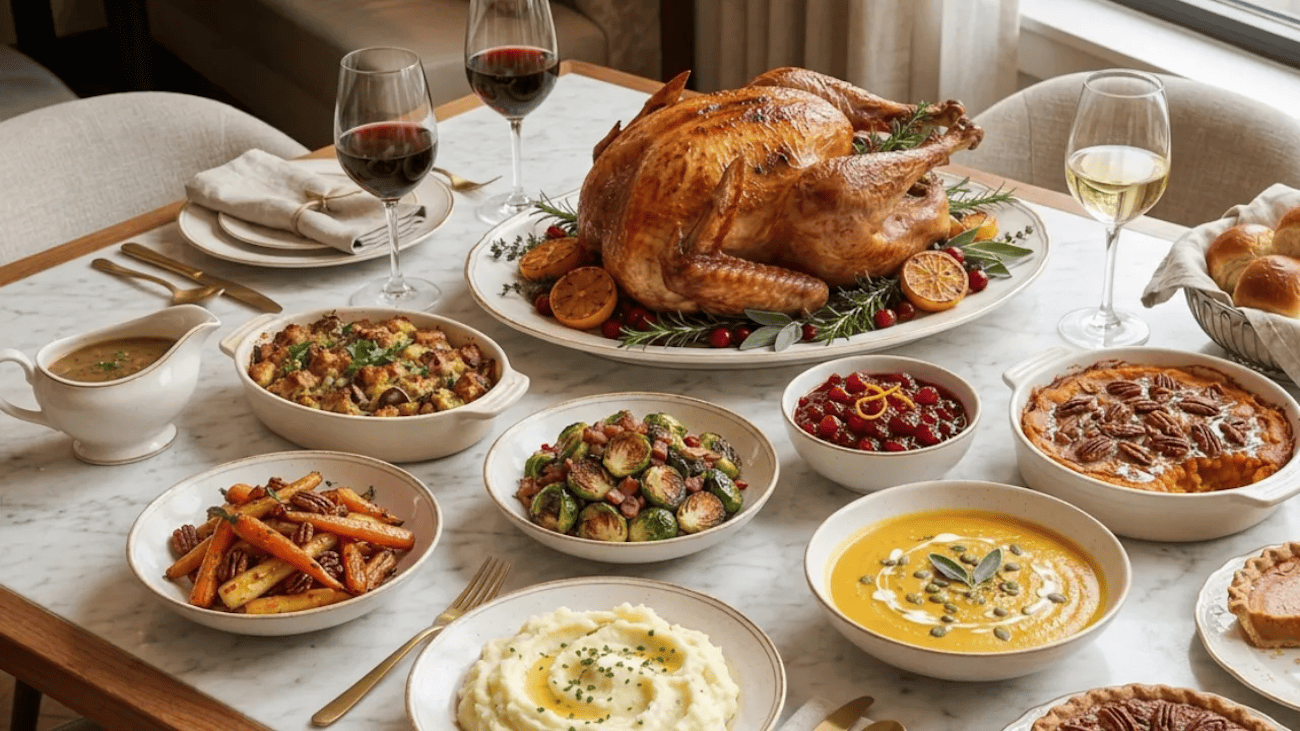

Every November, I participate in a distinctly South Asian form of American assimilation. There is the Big Bird — a turkey, of course. There is also Murgh Mussalam, or a Cajun chicken joins the proceedings because, apparently, one bird is insufficient. Soon the table fills with pulao, dal, vegetables, chutneys, and desserts. The turkey, intended as the centerpiece of the meal, finds itself competing for attention.
Poor host!
For many South Asian immigrants, Thanksgiving and the Fourth of July became our unofficial lessons in belonging. We embraced them enthusiastically, convinced that participating in America’s civic rituals would help us become part of its story. We learned the customs, hosted the dinners, attended the parades, and recited the narratives.
Yet something unexpected happened along the way. We never really assimilated. Instead, we improvised. The turkey remained, but so did the garam masala. Pumpkin pie shared space with kheer. America did not replace India. India simply pulled up a chair. That Thanksgiving table has always felt like a metaphor for immigrant life in America: not a completed transformation but an ongoing negotiation.
This year, however, Thanksgiving arrives amid a darker national conversation.
Across the country, immigrant families are living with uncertainty as immigration enforcement intensifies and political rhetoric increasingly portrays newcomers as threats rather than neighbors. For many immigrants, especially those with mixed-status families, temporary visas, green card applications, or relatives still navigating the system, the anxiety is not theoretical. It is woven into everyday life.
The timing feels especially striking.
Every Thanksgiving, Americans gather to commemorate a story rooted, however imperfectly and mythologized, in an act of hospitality. Historians continue to debate the details. Native Americans rightly remind us of the devastating consequences that followed those early encounters. Yet the story Americans return to each November contains a remarkably persistent theme: vulnerable newcomers survived because people already living on this land shared food, knowledge, and shelter.
Whether one sees that story as history, myth, or a combination of both, its symbolic lesson remains difficult to miss. Hospitality came before belonging. Assistance preceded assimilation. Strangers were welcomed before they became neighbors. And yet, centuries later, the descendants of successive immigrant waves continue to debate whether today’s newcomers deserve that same grace.
South Asians should recognize this contradiction. Most of our families have their own migration story. A father arriving with two suitcases and an engineering degree. A physician beginning residency in an unfamiliar city. A graduate student surviving on scholarships and determination. An aunt working nights. An uncle taking jobs far below his qualifications. The details differ. The pattern does not. Someone crossed an ocean. Someone started over. Someone arrived as a stranger.
America’s greatest strength has never been its ability to preserve a fixed identity. Its strength has been its capacity, however unevenly and imperfectly, to expand the circle of belonging.
Perhaps that is why Thanksgiving never felt entirely foreign to us. Long before we encountered American traditions, we came from cultures where hospitality carried moral weight. In South Asian homes, guests are rarely offered a meal. They are fed until resistance becomes futile. No celebration is considered complete unless there is enough food for unexpected visitors, and then some. Abundance is not measured by what is consumed but by what can still be shared. That instinct survives migration.
The South Asian Thanksgiving table reflects it beautifully. The official menu serves merely as a suggestion. The turkey arrives, but so do dishes from home. Family recipes travel across oceans. Culinary traditions merge without asking permission from either culture. What emerges is not assimilation in the traditional sense. It is something more interesting: a new way of being American. Like every immigrant community before us, South Asians learned that belonging is not simply a legal status. It is a social and cultural process. It requires participation in a collective story.
But collective stories can be fragile. America has spent much of its history arguing about who belongs. The Irish were once viewed with suspicion. Italians were considered outsiders. Jews faced exclusion. Chinese immigrants were barred by law. South Asians, too, were once regarded as permanently foreign. The categories change. The anxieties remain. History’s recurring lesson is not that America eventually stops fearing immigrants. It is that yesterday’s immigrants often forget they were once feared themselves. That amnesia feels especially poignant during Thanksgiving.

For all its contradictions, Thanksgiving remains America’s annual exercise in imagining itself as a community. On that day, millions of people who will never know one another sit around tables and participate in the same ritual. They share food, repeat familiar stories, and reaffirm a common identity. For immigrants, the holiday carries an additional meaning. It reminds us that belonging is not a fixed condition. It is a relationship. It requires both newcomers willing to participate and a society willing to make room for them.
That truth is visible around immigrant Thanksgiving tables across the country. Children move effortlessly between cultures. Parents balance inherited traditions with adopted ones. Conversations drift from cricket to football, from Diwali to Christmas, from rising grocery prices to immigration worries. The menu itself becomes an archive of multiple histories occupying the same space.
These are ordinary scenes. They are also profoundly American scenes. Which is why the language surrounding immigrants feels so jarring at this time of year. Thanksgiving asks Americans to honor a story about receiving strangers. Much of contemporary politics asks Americans to fear them. One story is told around the dinner table. The other dominates campaign rallies and policy debates.
As I look at a turkey surrounded by Murgh Mussalam, Cajun chicken, pulao, cranberry sauce, and enough side dishes to bewilder both Pilgrims and nutritionists, I find myself returning to a simple thought. America’s greatest strength has never been its ability to preserve a fixed identity. Its strength has been its capacity, however unevenly and imperfectly, to expand the circle of belonging.
The South Asian Thanksgiving table understands this instinctively. It is crowded. It is noisy. It contains multiple histories, layered loyalties, and competing memories. Nobody entirely agrees on what belongs there. Yet somehow another chair is always found. Another guest arrives. Another dish appears. The menu changes. The gathering survives. Perhaps that, more than anything else, is the American story.
Top image, courtesy of www.localsamosa.com.
Kuhu Singh is a writer with interest in social justice, cultural and political matters, in the U.S., India, and beyond.