




Pakistan’s First Astronaut: Muhammad Zeeshan Ali Reaches Orbit in China’s Crewed Space Program

- A fighter pilot from Pakistan's air force has become the first Pakistani in orbit and the first foreign national aboard China's Tiangong space station. At home the reaction was jubilant and almost unanimous. In India it was respectful but pointed.
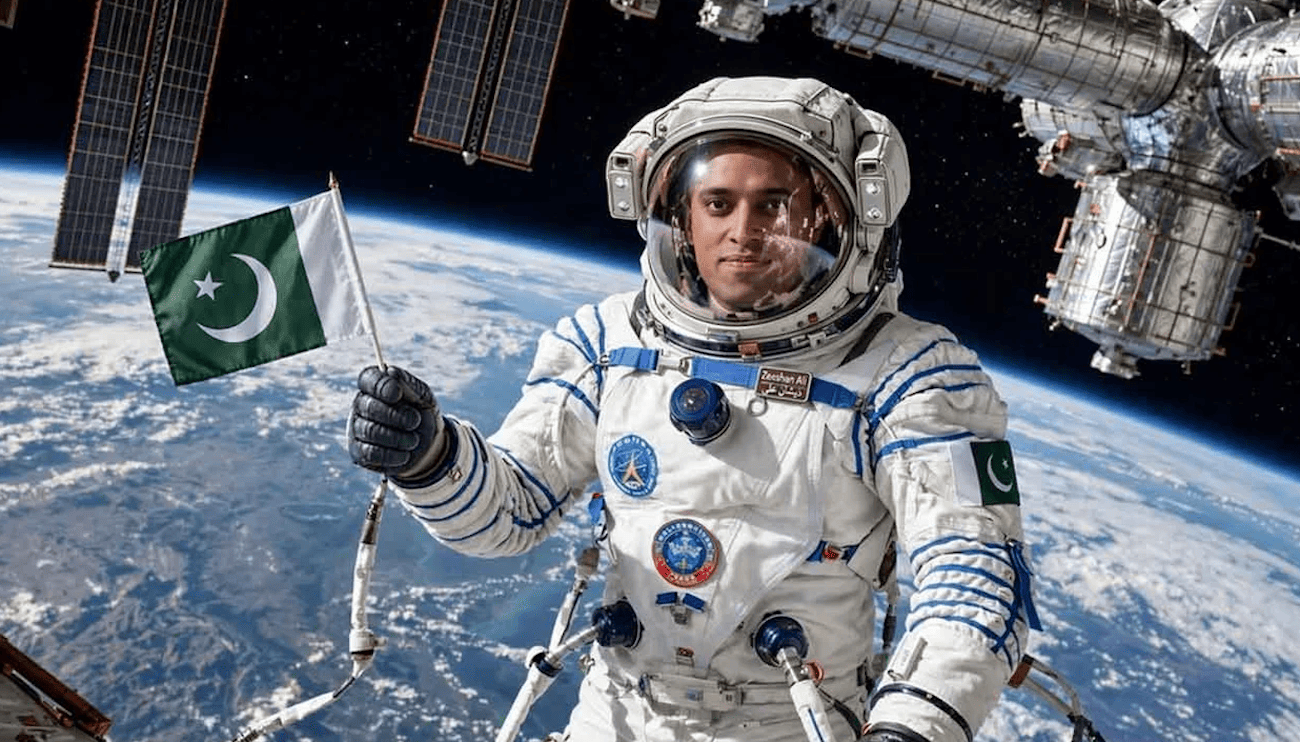

Before dawn on Wednesday, in a chilly Islamabad, people packed the auditorium at the headquarters of SUPARCO, Pakistan’s space agency, to watch a launch more than 2,000 miles away. When the rocket lifted off, the room rose and sang the national anthem, Al Jazeera reported from the hall. Then it went quiet for several minutes, until a host announced that the launch had succeeded.
On board was Muhammad Zeeshan Ali, 40. China’s Shenzhou-24 spacecraft lifted off on a Long March-2F rocket from the Jiuquan Satellite Launch Center in the Gobi Desert at 8:18 a.m. Beijing time (5:18 a.m. in Pakistan). It docked with Tiangong 3 hours and 38 minutes later, according to Dawn. Ali flew with two Chinese astronauts: commander Tang Hongbo, 51, and Wu Yi, 39, The Associated Press reported. The AP said the flight is the first in the history of China’s crewed space program to carry both Chinese and foreign astronauts.
Who Zeeshan Ali Is
Ali served as a wing commander in Pakistan Air Force. His road to orbit began with an agreement signed in February 2025 between SUPARCO and the China Manned Space Agency (CMSA), the Express Tribune reported. Amer Gilani, who oversees human spaceflight cooperation at SUPARCO, told Reuters the two countries first conceived the mission in 2019.
The selection had three phases: preliminary, secondary and final. It produced two male Pakistani pilots, Ali and Khurram Daud, according to China Daily. Space.com reported that the two were chosen from about 20 finalists, with the candidate not selected to fly serving as backup. Prime Minister Shehbaz Sharif met both men in Islamabad in April before they left for China. He said he hoped the voyage would “usher in a new era of space research in Pakistan,” Dawn reported.
The training in Beijing was compressed. Dawn reported that a planned one-year program was squeezed into seven months, and that Ali said learning Chinese had been his biggest challenge. The Week said the training also included centrifuge runs and rescue, survival and emergency drills. It added, as a lighter note, that he practised Chinese calligraphy and played table tennis with his crewmates. At a press event before the flight, Ali spoke in Mandarin and cited a classical Chinese poem about climbing higher to see farther, the AP reported.
Ali is not the first person of Pakistani birth to cross into space. Namira Salim flew on a suborbital Virgin Galactic flight in October 2023. Her flight reached about 87 km, below the 100 km Kármán line, and did not go into orbit. Ali is therefore the first Pakistani to reach orbit, and the first astronaut trained and flown under Pakistan’s national program.
The Mission
Ali is flying as a payload specialist. That means his job is to run Pakistan’s science experiments, not to fly the spacecraft. He is expected to stay about a week, according to Dawn.
He will return to Earth on the Shenzhou-23 spacecraft, not the one he launched on. Shenzhou-23 brought the previous crew to the station in May. Its commander, Zhu Yangzhu, will stay on Tiangong for a full year so that researchers can study how the human body copes with long stays in space, Dawn reported. That year-long stay is what freed a short-visit seat for Ali.
Ali described the flight as a beginning, not an end. “This mission is not a finish line; it is a launch pad,” he said at the pre-flight press conference, as reported by Dawn. The AP quoted him from a separate statement: “The sky is no longer our limit, it is our launching pad.” He has said he hopes the cooperation will grow from one astronaut on one flight to joint missions to the Moon, Mars and beyond, according to the AP.
Ali is flying as a payload specialist. That means his job is to run Pakistan’s science experiments, not to fly the spacecraft. He is expected to stay about a week.
How Pakistan Received It
The response in Pakistan cut across the government, the military and the opposition, which is unusual in the country’s polarized politics.
Prime Minister Shehbaz Sharif wrote on X: “This is not just one astronaut’s journey, but the journey of 240 million Pakistanis,” the AP reported. He also suggested that a Pakistani on a space station today could mean a Pakistani on the Moon tomorrow, and credited the armed forces, SUPARCO and the country’s scientists.
President Asif Ali Zardari exchanged congratulatory letters with Chinese President Xi Jinping. Zardari wrote that “Pakistan takes immense pride in this historic achievement,” according to Dawn. Deputy Prime Minister and Foreign Minister Ishaq Dar called the mission a “significant milestone” in what Pakistan calls its all-weather partnership with China. He noted that the flight falls in the 75th year of diplomatic relations between the two countries.
The military’s media wing, Inter-Services Public Relations, issued a statement on behalf of Field Marshal Asim Munir and the heads of the navy, the air force and the National Strategic Command. It said the Pakistan-China friendship had now reached “beyond the frontiers of Earth into outer space,” the Express Tribune reported.
Barrister Gohar Ali Khan, chairman of Imran Khan’s Pakistan Tehreek-e-Insaf (PTI), joined in. “Zeeshan, you’ve made all of us in Pakistan proud,” he wrote on X, wishing the astronaut a safe journey and return.
As the spacecraft climbed, crowds in Pakistan shouted “God is great!” and “Long live Pakistan-China friendship!” the AP reported. The AP added that customers in restaurants followed the launch on television. In the SUPARCO auditorium, Al Jazeera found students holding cards with Ali’s portrait among paper flags and green-and-white balloons. Ahzam Farooq, a physics undergraduate at the National University of Sciences and Technology (NUST), recalled his parents’ early doubts about his interest in space: “My parents used to ask, ‘What is there in this?’ like it will never be us.” SUPARCO chairman Muhammad Yousaf Khan told Al Jazeera: “Our commitment is to reach the moon by 2035.”


How China Framed It
For Beijing, the flight is a milestone of its own: the first time Tiangong has hosted anyone who is not Chinese. In his letter to Zardari, Xi called the station “an ark of peace, friendship and cooperation,” according to Dawn. At the pre-flight briefing, CMSA spokesperson Zhang Jingbo said Ali “is the first foreign national to visit Tiangong,” Dawn reported.
Commander Tang Hongbo told reporters that differences in language, culture and psychology had made teamwork harder, but that efforts on both sides were paying off, the AP reported. The flight comes as China steps up its space diplomacy in competition with the United States, CNN reported. Beijing is aiming for a crewed Moon landing by 2030, and NASA for one in 2028, according to the AP.
How India Responded
There has been no official statement from the Indian government on the launch as of Wednesday. Indian media covered it closely, and much of the coverage made the same comparison: Pakistan’s flight against India’s own history in human spaceflight.
The parallel is close. India’s first astronaut, Rakesh Sharma, was also an air force pilot who flew on a partner’s spacecraft, the Soviet Soyuz T-11, in 1984. Group Captain Shubhanshu Shukla visited the International Space Station on the commercial Axiom-4 mission in 2025. India is now building Gaganyaan, a program to fly its own astronauts on an Indian rocket and spacecraft.
The Week framed the flight as a marker of the difference between reaching space through partners and mastering the technology yourself. It noted that Pakistan relies on China for training, launch, accommodation in orbit and the ride home. Earlier in November, the magazine had quoted space analyst Girish Linganna as saying the flight showed the region’s space race was now about international relations, not only technology. Linganna also cautioned against dismissing a short trip: “Launch, docking and re-entry carry the same dangers whether an astronaut stays a week or six months.”
Other commentary was sharper. In an opinion piece, the right-leaning TFI Post called the flight a real milestone “worth acknowledging.” It then argued that “a seat does not make a space power.” The piece contrasted India’s decades of building its own launchers and planetary missions after 1984 with Pakistan’s lack of a homegrown orbital rocket, while conceding that Gaganyaan is behind schedule. RNA Media’s conclusion was more measured. It said the flight’s long-term value depends on whether Pakistan can turn the experience into research at home.
China’s state-run Global Times has been watching the Indian coverage. Before the launch, it quoted Qian Feng, a researcher at Tsinghua University’s National Strategy Institute, as saying that “India has long regarded itself as a leading space power in South Asia.” He also argued that space cooperation should not be overshadowed by “narrow political considerations.”