




The Geography of Loss: Refugees, Memory, and an Indian American’s Unfinished Search for Home

- Reflections on displacement and belonging through my short-story collection, “Refugee-ing/Skinning.”
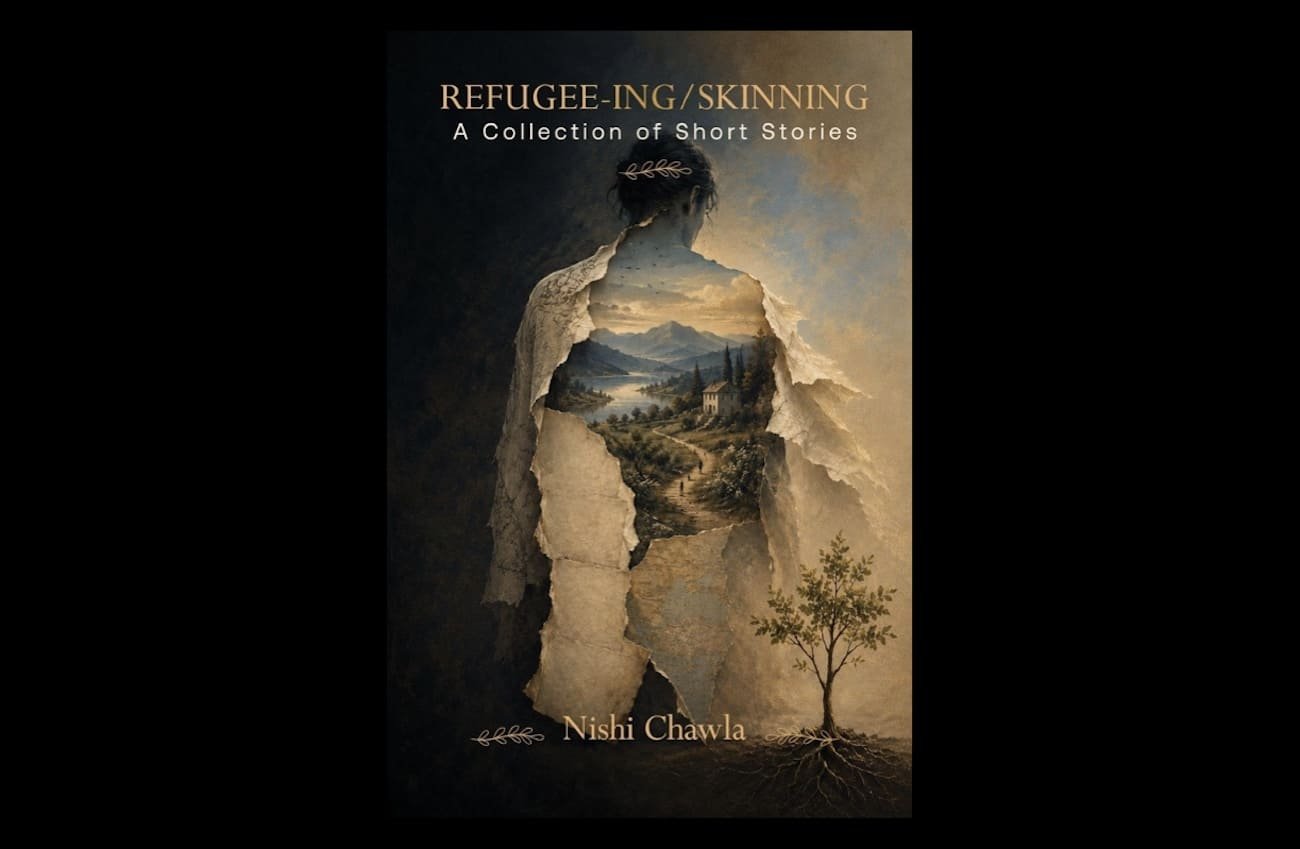
What does it mean to lose a home? Not simply a house, a familiar street, or a geographical location, but an entire world of associations, memories, languages, relationships, and cultural inheritances that have shaped one’s sense of self? What happens when the landscape that once gave meaning to one’s existence becomes inaccessible, and the individual is compelled to construct a new life in a place that may offer refuge but cannot necessarily offer belonging?
These are some of the questions that animate my short-story collection, “Refugee-ing/Skinning,” published by Shawmut Peninsula Press, Boston. The collection emerged from my continuing engagement with the intersections of history, identity, culture, and the individual human experience. Through its stories, I explore displacement not merely as a geographical movement across borders, but as a profound psychological and existential rupture: the experience of being separated from the familiar world and having to negotiate one’s existence in an unfamiliar one.
We live in an age in which the refugee has become an increasingly visible figure in political discourse, international news, and humanitarian debates. Wars, religious persecution, ethnic conflicts, authoritarian regimes, economic inequalities, and environmental catastrophes have forced millions to abandon their homes. Yet the language through which we discuss refugees often remains inadequate to the complexity of their experiences. They become statistics, political controversies, security concerns, or anonymous recipients of humanitarian assistance. Their individual histories, emotional lives, intellectual worlds, and personal aspirations frequently disappear behind the terminology of crisis.
Literature can challenge this reduction. Fiction allows us to enter the interior worlds of those whose experiences are otherwise mediated through headlines and official narratives. It restores individuality to people who have too often been rendered anonymous. It asks us to look beyond the circumstances that forced someone to flee and consider the human being who must continue living after that departure.
In “Refugee/ing/Skinning,” I am particularly interested in the less visible dimensions of displacement. The moment of departure, however traumatic, is only the beginning. What follows is often a prolonged process of psychological adjustment, cultural negotiation, and emotional reconstruction. The refugee must learn to inhabit a new geography while carrying the psychological weight of another. Familiar languages become distant, inherited traditions become difficult to sustain, and ordinary cultural practices acquire an unexpected poignancy. Even the simplest recollections can become acts of preservation.
Memory, in this context, is both an inheritance and a burden. It preserves what has been lost, but it can also prevent the individual from fully inhabiting the present. The refugee lives in two temporal worlds: the remembered past and the uncertain future. Between them lies an often uncomfortable present in which the individual must negotiate a new identity without entirely surrendering the old one.
This tension raises a fundamental question: can one ever truly leave home?
Perhaps the answer depends on how we define home. Is it the place of one’s birth, the landscape of childhood, the language in which one first learned to express affection, or the community within which one’s identity was formed? Is home something that can be recreated through relationships and shared experiences, or does it remain an irreplaceable emotional geography? For many displaced people, home becomes less a physical location than an accumulation of memories, fragments, and attachments carried across borders.
The collection also examines the complicated relationship between adaptation and assimilation. Host societies often celebrate multiculturalism while simultaneously expecting newcomers to conform to established cultural norms. The immigrant or refugee is encouraged to integrate, but the terms of that integration are not always clearly defined. How much of one’s cultural identity must be modified to gain acceptance? When does adaptation become erasure? And can belonging be authentic when it requires the suppression of parts of oneself?
In “Refugee/ing/Skinning,” I am particularly interested in the less visible dimensions of displacement. The moment of departure, however traumatic, is only the beginning. What follows is often a prolonged process of psychological adjustment, cultural negotiation, and emotional reconstruction.
These questions become particularly significant for subsequent generations. Children of displaced families often inherit histories they have not personally experienced but which nevertheless shape their identities. They may feel connected to a homeland they know primarily through parental memories, stories, photographs, and cultural practices. At the same time, the country in which they grow up may regard them as outsiders because of their ancestry. They inhabit a complicated cultural space in which belonging is neither entirely inherited nor entirely acquired.
The title Refugee/ing/Skinning gestures towards this process of transformation. The experience of becoming a refugee is not a singular event with a clearly defined beginning and end. It is an ongoing process of shedding, acquiring, adapting, and negotiating identities. One may acquire a new language, citizenship, profession, and social identity, but the psychological traces of displacement do not necessarily disappear. The old self and the new self coexist, sometimes harmoniously, sometimes in conflict. The process of rebuilding a life can involve both extraordinary resilience and profound vulnerability.
I am also interested in the ethical responsibility of storytelling. To write about refugees is not simply to reproduce narratives of suffering or to solicit sympathy. Such an approach risks reducing complex human beings to their victimhood. The people who inhabit these stories possess ambitions, contradictions, desires, prejudices, humour, emotional attachments, and the capacity to make choices. They are not defined exclusively by what has happened to them. They are also defined by what they continue to imagine and aspire to become.
This distinction matters. Refugees are not merely people who have lost something; they are people attempting to create something under circumstances they did not choose. Their stories involve survival, certainly, but also dignity, reinvention, resistance, and the determination to recover agency over their lives.
For me, the literary exploration of displacement is inseparable from a larger concern with the relationship between individual lives and historical forces. Across my work in fiction, poetry, drama, and cinema, I have returned repeatedly to questions of identity, cultural memory, historical inheritance, and the human consequences of political and social transformations. I have been interested in the ways in which seemingly private experiences are shaped by larger histories, and how individuals negotiate the demands of their societies while attempting to preserve their own sense of self.


The concerns of “Refugee/ing/Skinning” are particularly resonant in contemporary America, a nation whose history and cultural imagination are deeply intertwined with migration. The American experience has been shaped by successive generations of immigrants, refugees, exiles, and displaced populations. Yet the promise of belonging has never been equally available to everyone. The country continues to grapple with questions of immigration, citizenship, racial and cultural difference, national identity, and the obligations of a society towards those seeking refuge within its borders.
It is tempting to approach these questions exclusively through the language of politics. But politics alone cannot adequately convey what displacement does to a human life. Laws can determine entry, residency, and citizenship; they cannot restore a lost childhood, recover a vanished landscape, or resolve the emotional dislocation of someone who no longer knows where they belong.
That is where literature assumes its importance. It can create an imaginative space in which readers encounter lives beyond their immediate experiences. It can make unfamiliar histories emotionally accessible and challenge the assumptions through which we view people different from ourselves. Above all, it can remind us that the refugee is not an abstraction but a human being whose longing for security, dignity, recognition, and belonging is fundamentally no different from our own.
Ultimately, Refugee/ing/Skinning is an exploration of what remains when the familiar structures of belonging have been disrupted. It asks whether identity can survive geographical separation, whether memory can become a substitute for home, and whether a new society can offer more than physical shelter. The answers are neither simple nor final. Perhaps that is precisely the point.
Home may be lost, remembered, reconstructed, or imagined. It may exist in a language, a relationship, a remembered landscape, or a story passed from one generation to another. For those who have been displaced, the search for home is rarely completed. It continues across borders, generations, and changing identities.
And perhaps the most important lesson of the refugee experience is that belonging should never be treated as a privilege reserved for those who have always lived within a particular geography. It is a fundamental human need. To recognize that need in another person is not an act of charity; it is an affirmation of our shared humanity.
Dr. Nishi Chawla is an academic and a writer with eleven plays, three novels, and eight poetry collections. She has directed four award-winning films, co-edited poetry anthologies with Penguin, and taught English Literature for more than forty years. Her plays have been staged Off-Broadway, and she has read her poetry at the U.S. Library of Congress.