




The Many Sides of Nithya Raman: Nerd. Activist. Backstabber. Socialist. Malayali. Tamilian

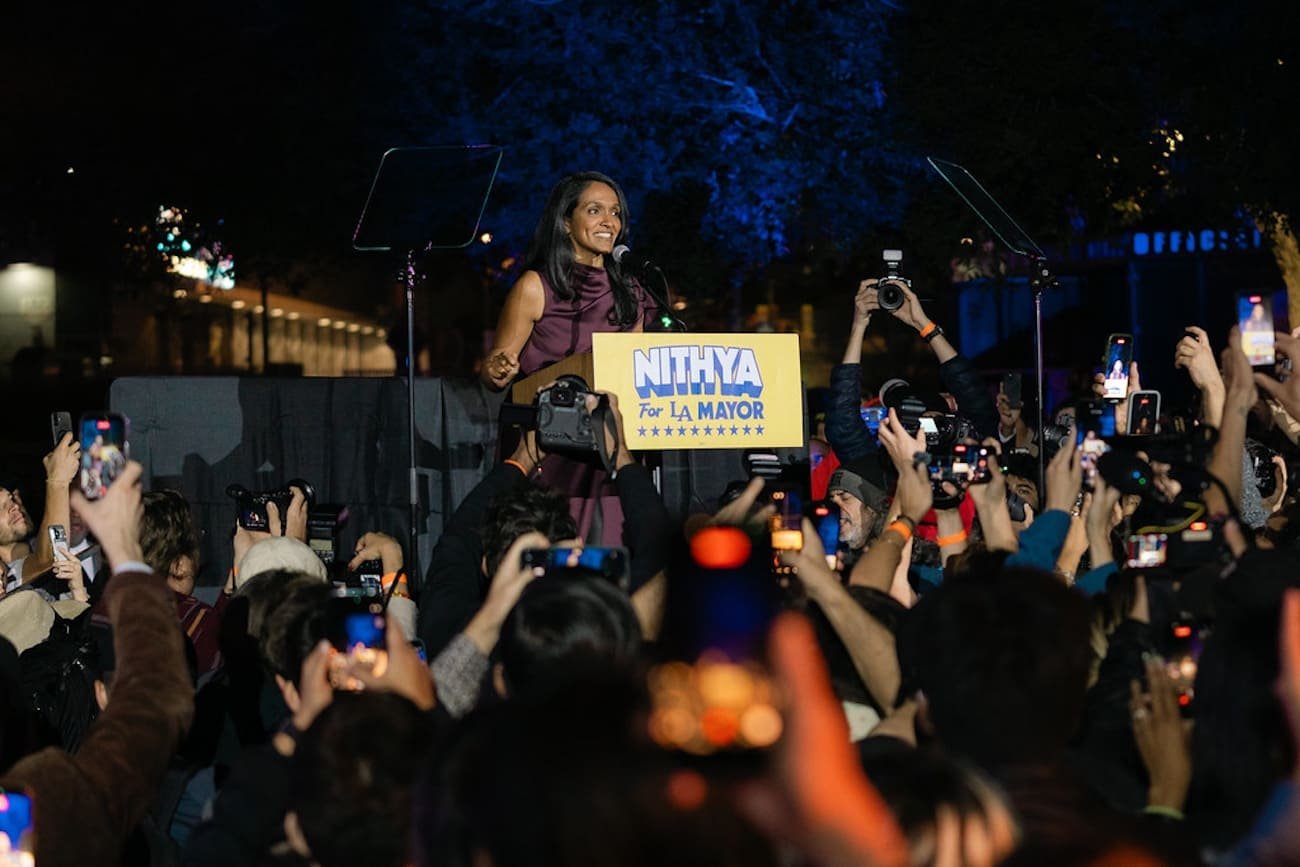
- On Thursday evening, however, she spoke of another side that made her Mayor-elect — she said she was moved that at this moment in history Angelenos chose to elect an immigrant.
Most incumbents keep an eye on their opponents. Karen Bass should have kept an eye on her endorsers.
At the start of this year, Los Angeles City Councilmember Nithya Raman endorsed the mayor for a second term. On February 7, a few hours before the filing deadline, she filed to run against her. On Thursday, Bass called her to concede.
As of Friday morning, with roughly three-quarters of the vote counted, Raman leads 460,772 to 413,519–52.7 percent to 47.3 — and every new batch of ballots has widened the gap. She is the first challenger to unseat a sitting Los Angeles mayor in more than twenty years, the first Indian American to run the city, and, alongside Zohran Mamdani in New York, the second democratic socialist of South Asian descent to take one of America’s two largest cities in as many Novembers.
The Backstab Nobody Saw Coming
Bass said she was “flabbergasted.” The Los Angeles Police Protective League, which had backed the mayor, put it more colorfully: if political backstabbing were a crime, Raman would be a wanted fugitive.
The council closed ranks. Nearly every member endorsed Bass, including Raman’s three fellow democratic socialists — Eunisses Hernandez, Ysabel Jurado and Hugo Soto-Martínez. Even the local chapter of the Democratic Socialists of America, which had carried her into office twice, declined to endorse her in the primary.
The sense of betrayal was not just political theater. When the council redrew district lines, Raman’s district was thoroughly mangled — many of her renters were carved out and replaced with San Fernando Valley homeowners, a map widely read as an attempt to end her career. She survived it, won reelection, and it was Bass who gave her a second life at City Hall, including the chair of the housing committee.
Raman’s explanation was that the city had reached a “breaking point.” Whether that was principle or ambition depends on whom you ask. It was probably some of both, which is true of most political decisions worth writing about.
She made the decision the night before the deadline. The next day, volunteers were in her backyard ADU setting up the campaign — a fitting headquarters for a candidate whose platform was, in large part, letting Angelenos build more housing.
Behind on Election Night, Twice
On the night of the June 2 primary, Raman stood before supporters at a downtown brewery in third place. Bass led with about 35 percent; Spencer Pratt, the reality-TV villain turned mayoral candidate, held second with 30. Raman had 22. She thanked everyone for her “little campaign” and sounded like someone drafting a concession.
Then Los Angeles did what Los Angeles does, which is count slowly. Mail ballots kept arriving, and every update moved her closer to Pratt. Six days later she passed him. The final primary numbers: Bass 34.3, Raman 28.6, Pratt 25.8.
November was a rerun. At 9 p.m. on Tuesday, Bass led by about 10,000 votes. Shortly after midnight, Raman edged ahead by a tenth of a point. By morning the lead was two points, and the Associated Press called the race Thursday afternoon.
These comebacks are partly an artifact of how Los Angeles counts. Early mail ballots tend to skew older and more conservative; ballots cast on and around Election Day lean younger and more progressive. Anyone who knew the pattern could have predicted the direction of the drift. But a drift only helps you if the votes are actually in the pile, and twice this year, hers were.
Why Bass Lost
Karen Bass is a former six-term congresswoman, was on Joe Biden’s vice-presidential shortlist in 2020, and in 2022 became the first Black woman elected mayor of Los Angeles. Gavin Newsom, Kamala Harris and Nancy Pelosi all backed her this year. Even Rick Caruso, the billionaire developer she beat four years ago, said he was voting for her.
What undid her was January 2025. When the Palisades Fire broke out, Bass was in Ghana for a presidential inauguration. The fire became the most destructive in the city’s history, killing 12 people and destroying thousands of homes, and many voters never stopped holding her to account for it. Homelessness, the centerpiece of her first campaign, showed early progress, but the most recent count had the numbers climbing again.
Dan Schnur, who teaches political science at USC, said Bass ran a very successful campaign “to be mayor of 20th-century Los Angeles.” Raman went after younger voters who usually don’t turn out, and got just enough of them.
Raman swept the youth vote across the city; Bass did better with voters over 50. Mike Trujillo, a Democratic consultant who supported Bass, said this was not a geographic coalition or a racial one, but “a when-you-were-born coalition.”
Bass called her rival “not ready for primetime.” She may yet turn out to be right. Her concession, though, was gracious. “Serving as your mayor,” she said, “has been the honor of my life.”
Her husband, Vali Chandrasekaran, is a veteran television writer and producer, and through him she has watched Hollywood’s contraction squeeze friends and neighbors.
The Woman Who Counted Toilets
Nithya Raman was born in 1981 in Kerala, to a Tamil family, and moved to Louisiana at six. The family later settled near Boston. She studied political theory at Harvard, then went back to India — and only afterward earned a master’s in urban planning at MIT.
In Chennai, she started a research project called Transparent Chennai, which collected data the city either didn’t have or didn’t share, mostly about the urban poor. One of its first questions was disarmingly simple. Raman phoned the Chennai Corporation and asked which department looked after the public toilets.
Nobody could quite say. So she sent a colleague to each of the city’s ten zonal offices to get a count. One office produced a map. The others handed over lists of addresses. It took India’s Right to Information Act to pry loose the rest, and when the counting was done, Chennai had 714 public toilets for some 4.7 million people.
The toilet count was a preview of the politician Los Angeles just elected. She moved to the city in 2013, got involved in homelessness work in her Silver Lake neighborhood, founded a homeless services nonprofit, and in 2020 knocked off a well-funded incumbent council member with an army of volunteers. Courthouse News describes her as an introvert and a policy wonk, which is roughly what you would expect from someone who once audited a city’s public lavatories.
Her mayoral campaign ran on the same unglamorous material: potholes, buckled sidewalks, broken streetlights, a city government “actually capable of delivering on its promises.” Its most effective ad showed an empty lectern at the site of a warehouse fire, then on Skid Row, then in front of shuttered storefronts. “Where is our mayor?” she asked.
She also had an unusual window into the city’s signature industry. Her husband, Vali Chandrasekaran, is a veteran television writer and producer, and through him she has watched Hollywood’s contraction squeeze friends and neighbors. On election night she said Los Angeles had stopped being a place where people could build things, open things, create things — and film things.
The Socialist Nobody Noticed
The Associated Press, in its story on her win, noted almost in passing that Raman “never attracted the same level of national attention” as Mamdani. The second-largest city in the country elected a democratic socialist, and it registered as a regional story.
A year ago I wrote about Mamdani’s final weekend in New York: biryani with cab drivers, Tai Chi with seniors, runners stopping mid-marathon for selfies. His campaign was a festival. Raman’s was a spreadsheet with good production values. There are a few reasons the second one didn’t travel.
The first is temperament. Mamdani performs; Raman audits. She did shimmy to Michael Jackson’s “Remember the Time” at her election-night party, but only after the polls had closed. The second is that she kept her own label at arm’s length. She stressed her “independence” from the DSA, and the relationship has been rocky for a while — the Los Angeles chapter censured her in 2024 after she accepted an endorsement from Democrats for Israel, and a day before this election it narrowly voted against rescinding its support. It is hard to become the face of a movement that keeps debating whether to have you.
The third is novelty. Mamdani was the first. By this November, democratic socialist mayors are a trend line: Katie Wilson already runs Seattle, and Janeese Lewis George won in Washington, D.C., on the same night as Raman. And that night was a midterm, with Democrats retaking Congress. A mayor’s race in California was never going to lead the broadcast.
The fourth reason has nothing to do with America.
Kerala Calls

When Mamdani won last November, the Indian lawmaker Milind Deora mocked his country’s “self-proclaimed urban intelligentsia” for obsessing over New York’s mayor while having no clue who ran their own cities. He needn’t have worried this time around. The woman who actually phoned the Chennai Corporation to ask about its toilets has just been elected to run Los Angeles, and the obsession has been manageable.
Not nonexistent.
On Friday, Kerala’s chief minister, V. D. Satheesan of the Congress party, posted his congratulations: “A Daughter of Keralam Shines at Los Angeles City Hall,” calling her journey an inspiration to the global Malayali community. It was a warm note, and a slightly creative one, since the daughter in question was born to Tamil parents and did her civic work in Chennai. Everyone claims the part of a diaspora success they can use.
As I write this, a day after the race was called, I have found no word from New Delhi. That may change by the time you read this. As far as I can find, Mamdani never got one either — not after his win, and not after his swearing-in. It fits a pattern.
With Mamdani last year, Congress leaders like Shashi Tharoor cheered; voices from the ruling BJP ranged from silence to open hostility, with the actor-turned-MP Kangana Ranaut declaring that he “sounds more Pakistani than Indian.” India’s response to Mamdani was markedly cooler than its celebrations for Kamala Harris or Usha Vance.
In his case, the coolness was easy to explain away. He is Muslim, and he had been sharply critical of Narendra Modi.
Raman offers no such alibi. She is a practicing Hindu who hosted Diwali celebrations at City Hall. She has engaged with BAPS temples in Los Angeles closely enough to draw criticism from Hindus for Human Rights. If the issue were faith or loyalty to the motherland, she would be a poster child.
What she is, instead, is a democratic socialist who said at a September forum co-hosted by the Jewish Federation of Los Angeles that she agreed Israel had committed genocide in Gaza. That makes her very hard to claim for a political establishment that prefers its diaspora heroes to be CEOs, astronauts and vice presidents, ideally the kind who post photos of themselves with the prime minister.
That is the pattern. Congress leaders in India cheer; the BJP looks away. Meanwhile, in the actual race, Kamala Harris — whose mother came from Chennai — endorsed Bass.
The Hard Part
Los Angeles has a relatively weak mayor and a strong City Council, and not one of Raman’s council colleagues endorsed her. The most effective mayors, Schnur says, use public pressure to pull the council their way; Raman will have to govern “from the outside in.”
She has also made some durable enemies. The police union spent more than $6 million trying to beat her, and she has promised to replace LAPD Chief Jim McDonnell, something a mayor cannot do alone. She has pledged to cut the number of people sleeping in tents and encampments by at least half by 2028, when the Olympics arrive and the whole world shows up to look at the sidewalks. Her campaign slogan was “A City That Works,” which is a fine slogan right up until the first pothole that doesn’t get fixed.
And she has very little time. Her term begins December 8, giving her one of the shortest transitions in the country for a city of nearly four million people.
On Thursday evening, at the Original Farmers Market, she didn’t talk about Kerala or Chennai or Delhi. She talked about the city in front of her. “The idea that Angelenos voted for an immigrant to be their next mayor at this moment in American history,” she said, “is so deeply moving to me.”
She said immigrant. Not Indian, not Malayali, not Tamil.
Top image, courtesy of Raman’s campaign.
Ganpy Nataraj is an entrepreneur, author of “TEXIT – A Star Alone” (thriller) and short stories. He is a moody writer writing “stuff” — Politics, Movies, Music, Sports, Satire, Food, etc.