




Indian American Candidates Prepare for a High-Stakes Election: From Congress to Statehouses and City Hall

- Vivek Ramaswamy’s bid for Ohio governor, competitive congressional contests involving Amish Shah and Pia Dandiya, and Nithya Raman’s challenge to Los Angeles Mayor Karen Bass are among the races drawing attention as voters prepare to go to the polls on November 3.
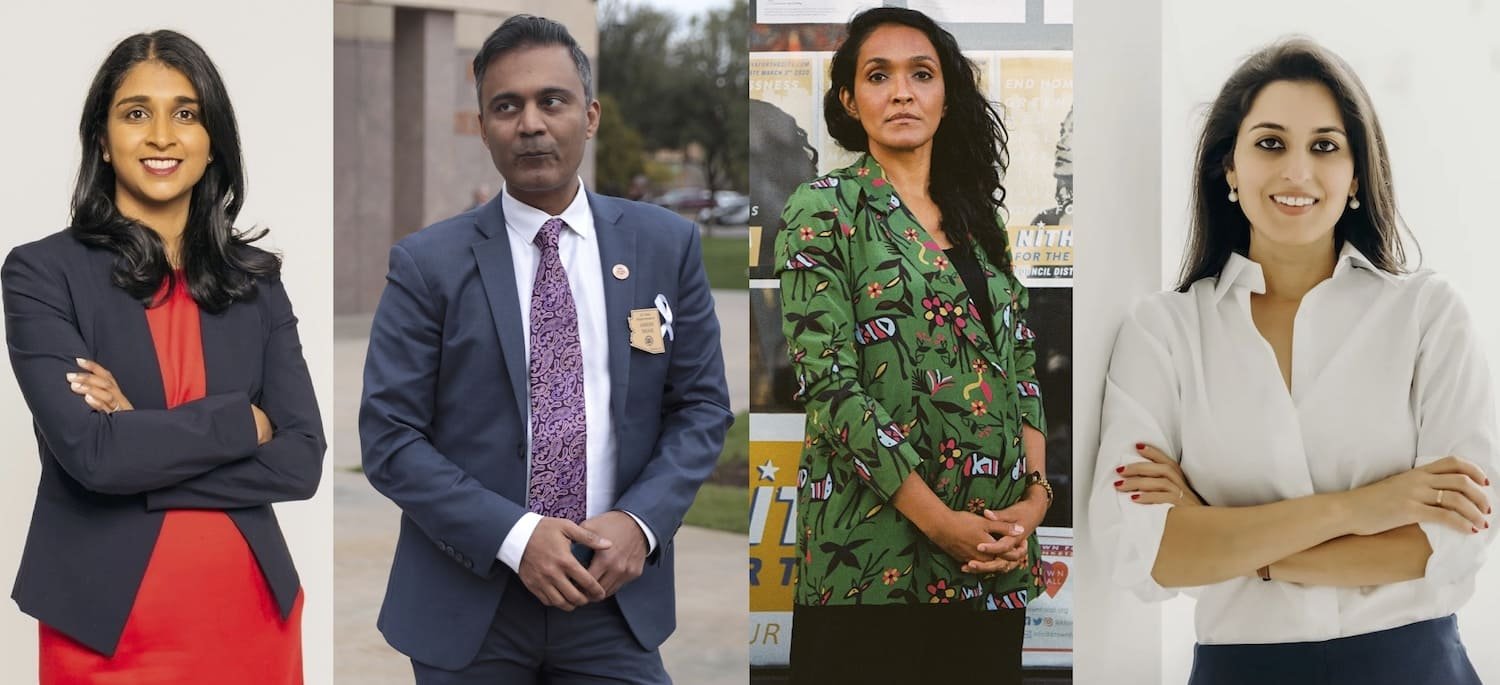

Indian Americans are seeking elected office across the United States in the November 3, 2026, midterm elections, competing for seats in Congress, state legislatures and executive offices, as well as city hall. Their campaigns range from high-profile statewide contests to local races whose outcomes could reshape representation in rapidly growing South Asian communities.
The elections will also determine which party controls Congress for the final two years of President Donald Trump’s second term. All 435 seats in the House of Representatives, 35 Senate seats and 36 governorships are being contested, alongside thousands of state and local offices.
For Indian American candidates, the election presents two distinct challenges: holding seats already won by members of the community and expanding representation into offices where they have historically been less visible. The contests also cross party lines. Democrats and Republicans of Indian origin are competing against one another in some districts, while others are seeking to become the first Indian American or South Asian elected to a particular office.
The races below focus on prominent contests for which recent reporting, polling or other election information is available. The assessment of each race draws on published polling and documented electoral circumstances rather than assuming that a candidate’s ethnicity, party or profile determines the result.
Congress: Four Incumbents Seek to Retain Indian American Representation
Four Indian American Democrats are seeking reelection to the House: Ro Khanna, Pramila Jayapal, Ami Bera and Suhas Subramanyam. Their races are part of the broader contest for control of the House, where Republicans entered the campaign with a narrow majority.
Khanna, who represents California’s 17th Congressional District in Silicon Valley, faces Republican Ritesh Tandon, an Indian-origin challenger. Jayapal, representing Washington’s 7th District, faces Republican Nirav Sheth, also of Indian origin. Bera is running in California’s 3rd District, while Subramanyam is seeking another term in Virginia’s 10th District.
The incumbents’ records, party affiliations and district-level political conditions are more useful measures of their prospects than their shared ancestry. Because the available reporting reviewed for this article does not provide comparable, recent polls for all four races, it would be misleading to assign numerical chances or suggest that the contests are equally competitive.
Two other Indian American politicians who currently serve in the House will not be returning through the same route. Raja Krishnamoorthi of Illinois lost the Democratic primary for the U.S. Senate, while Shri Thanedar of Michigan failed to win his party’s primary for reelection to the House. Their departures mean the number of Indian-origin House members could decline unless challengers such as Amish Shah or Pia Dandiya win their contests.
Arizona: Amish Shah and a Race That Could Affect House Control
Amish Shah — Arizona’s 1st Congressional District
Democrat · Challenging Republican Jay Feely

Shah, an emergency-room physician and former Arizona state legislator, is attempting to win a seat that could help determine control of the House. His opponent, former NFL kicker Jay Feely, received President Trump’s endorsement in the Republican primary.
Shah narrowly lost to Republican David Schweikert in 2024. The seat became open when Schweikert decided to run for governor rather than seek reelection.
The contest is among the more closely watched congressional races involving an Indian American. On October 7, Shah and Feely debated issues including data centers, healthcare, immigration and the economy. KJZZ, Arizona’s public radio station, reported that their disagreement over data-center development reflected broader differences in their approaches to economic growth and regulation.
A recent reporting from Arizona television station ABC15 said final polling showed Shah with a slight edge. The station cautioned that Republicans have historically outperformed polls in some of Arizona’s competitive districts.
The race’s importance extends beyond representation. A close contest in a competitive district could influence the balance of power in the House. The available polling suggests a contest in which undecided voters, turnout and the district’s political history remain relevant, rather than one in which the outcome can be treated as settled.
Florida: Pia Dandiya Faces Casey Askar
Pia Dandiya — Florida’s 22nd Congressional District
Democrat · Opponent: Republican Casey Askar

Dandiya, who grew up in Palm Beach County and worked as a teacher and school principal, is contesting an open House seat against Republican businessman Casey Askar.
Dandiya’s race has attracted national attention because the seat is competitive and outside groups have spent heavily. The Cook Political Report and Sabato’s Crystal Ball classified the race as a toss-up, while Inside Elections described it as tilting Republican.
A poll commissioned by House Majority PAC and conducted by Impact Research between August 24 and 31 showed Dandiya leading 46% to 44%. After respondents heard both candidates’ biographies, her lead widened to 49% to 44%. Because the poll was commissioned by a Democratic-aligned organization and was conducted weeks before early voting, it should not be treated as a definitive picture of the race.
The contest illustrates how an Indian American candidate’s campaign can become part of a national fight over House control, with spending by outside groups and the composition of an open district shaping the contest alongside the candidate’s personal background.
Ohio: Vivek Ramaswamy’s Bid for Governor
Vivek Ramaswamy — Ohio governor
Republican · Opponent: Democrat Amy Acton
Ramaswamy, the biotech entrepreneur and former Republican presidential candidate, is seeking to succeed term-limited Gov. Mike DeWine. His Democratic opponent, Amy Acton, is a physician who previously directed the Ohio Department of Health.
Ramaswamy’s campaign is among the most nationally visible Indian American candidacies of the year. His contest also provides a test of whether his national political profile and support from Trump can translate into a statewide victory in a state that has leaned Republican in recent presidential elections.
The polling picture is mixed. Marist University’s October 15–18 survey of 1,176 likely voters found Acton leading Ramaswamy 50% to 43%, with a margin of error of 4.5 percentage points. But a survey by co/efficient conducted October 5–6 showed Ramaswamy ahead 45% to 43%.
More recent polling reported by Cleveland.com on October 27 found Acton leading 48.2% to 43.8% in a RedBox Research survey conducted October 20–23. The result was within the poll’s margin of error of 4.6 percentage points, so it did not establish a statistically clear leader.
Ramaswamy has also faced scrutiny over a controversial attack ad featuring Acton’s estranged mother. The video’s origin and funding have not been established, and the campaign has not acknowledged producing it. The episode has added a personal dimension to a contest already shaped by policy disagreements and a dispute over a debate.
Taken together, the polling shows a close race with results varying by pollster and survey dates. The margin between the candidates, the state’s political leanings and the national attention surrounding Ramaswamy make the contest significant beyond Ohio.
New York: Saritha Komatireddy Challenges Letitia James
Saritha Komatireddy — New York attorney general
Republican · Challenging Democratic incumbent Letitia James

Komatireddy, a former federal prosecutor and Harvard Law School graduate, is challenging James, who is seeking another term as the state’s attorney general.
The contest is notable because it pits an Indian American Republican against a prominent Democratic incumbent in a state where Democrats have a substantial electoral advantage. Komatireddy has criticized James over her handling of Medicaid fraud and other enforcement issues.
An October 12–14 poll commissioned by Komatireddy’s campaign and conducted by OnMessage Inc. showed James leading 50.7% to 44.7% among likely voters. The survey of 1,000 voters had a margin of error of 2.8 percentage points. Because it was commissioned by the challenger’s campaign, its results deserve to be read with that sponsorship in mind. The same report cited a September Siena poll that put James ahead 52% to 39%.
The newer survey indicates a closer contest than the September poll, but the two surveys were conducted by different organizations and should not be treated as a precise measure of movement. The available evidence documents a challenge to James, not a settled result.
The November 3 results will show not only whether individual candidates succeed, but also whether the community’s growing presence in American public life translates into greater representation in Congress, state governments and city halls.
Texas: Two Democrats Seek State House Seats

Texas has two Indian American Democratic candidates seeking seats in the state House, where the outcome of individual races can influence debates over education, taxes, immigration and other policy issues.
Pooja Sethi — Texas House District 47
Sethi, an immigration lawyer and chair of the Travis County Democratic Party, is running against Republican Jennifer Mushtaler for an open seat. She previously served as chief of staff to state Representative Vikki Goodwin. A general-election victory would make her the first Indian American and first Hindu elected to the Texas Legislature.
Sandeep Srivastava — Texas House District 66
Srivastava, a Plano-based small-business owner with experience in technology and real estate, is challenging Republican incumbent Matt Shaheen. Shaheen chairs the Texas House Elections Committee and won 61.1% of the vote in 2024. Srivastava previously lost a congressional race to Republican Keith Self by 62.5% to 37.5%.
Maryland: Aruna Miller Seeks Another Term as Lieutenant Governor
Aruna Miller is seeking reelection as Maryland’s lieutenant governor alongside Democratic Gov. Wes Moore. Born in Hyderabad, India, Miller is among the Indian-origin politicians already serving in statewide executive office.
Her race is part of the larger Maryland gubernatorial contest rather than a separate statewide election for lieutenant governor.
Los Angeles: Nithya Raman Challenges Karen Bass
Nithya Raman — Los Angeles mayor
Raman, a member of the Los Angeles City Council, is challenging Mayor Karen Bass in a November 3 runoff. If elected, Raman would become the first South Asian woman to serve as mayor of Los Angeles.
The race has become a contest over homelessness, housing costs, public safety, city services and confidence in City Hall. Bass has faced criticism over her first term, including the city’s response to the deadly Palisades Fire and persistent homelessness. Raman presents herself as a generational change candidate, while Bass argues that Raman’s approach to policing and homelessness poses risks.
The Associated Press reported on October 21 that Bass won only 34% of the vote in the June primary, while Raman advanced to the runoff. Bass has endorsements from prominent Democrats including Gov. Gavin Newsom, former Vice President Kamala Harris and former House Speaker Nancy Pelosi. Raman has received backing from progressive groups, including Our Revolution and the Sierra Club.
A Manhattan Institute poll published October 9 put Raman at 38% and Bass at 32%, with a margin of error of 4.6 percentage points. An earlier Berkeley IGS/Los Angeles Times poll in September had Raman at 39% and Bass at 28%, with roughly one-third of voters undecided. Those results point to a competitive race, but undecided voters, turnout and the return of ballots will be crucial in interpreting the numbers.
The AP also reported that only 5% of ballots had been returned nearly three weeks into mail voting at the time of its report. That low early return rate left substantial uncertainty about who would ultimately participate. The mayoral contest is one of the most prominent local races involving an Indian American candidate and could make history, but the outcome remains dependent on voter turnout and local issues rather than identity alone.
What These Races Mean for Indian American Representation
The 2026 election offers Indian Americans opportunities at multiple levels of government. Shah and Dandiya are contesting congressional districts where the results could affect control of the House. Ramaswamy is seeking a governorship with national implications. Komatireddy is challenging an incumbent attorney general, while Sethi and Srivastava are competing for seats in a state legislature. Raman’s mayoral campaign has placed South Asian representation at the center of a major city election.
The candidates’ prospects vary considerably. Some are incumbents with established records; others are challenging officeholders or competing in open seats. The available polling shows close contests in Arizona, Florida, Ohio, New York and Los Angeles, while the sources reviewed did not provide reliable, comparable polling for every congressional and state legislative race.
The candidates also differ politically. Their shared Indian ancestry does not imply a common platform or constituency: they range from progressive Democrats to Republicans such as Ramaswamy and Komatireddy. Their campaigns reflect differing views on economic policy, immigration, public safety, healthcare, government regulation and the role of the federal government.
The November 3 results will show not only whether individual candidates succeed, but also whether the community’s growing presence in American public life translates into greater representation in Congress, state governments and city halls. Until the votes are counted, polling and campaign conditions can illuminate the stakes—but cannot settle the outcomes.