




Nilima Sheikh’s MoMA Debut Turns Kashmir’s Beauty and Suffering Into an Unforgettable Visual Narrative

- In “Fractured Skies,” the Indian artist brings decades of work on Kashmir, displacement and collective memory to New York’s Museum of Modern Art. Her painstakingly painted scrolls challenge viewers to look beyond the region’s spectacular landscape and confront the lives shaped by conflict.
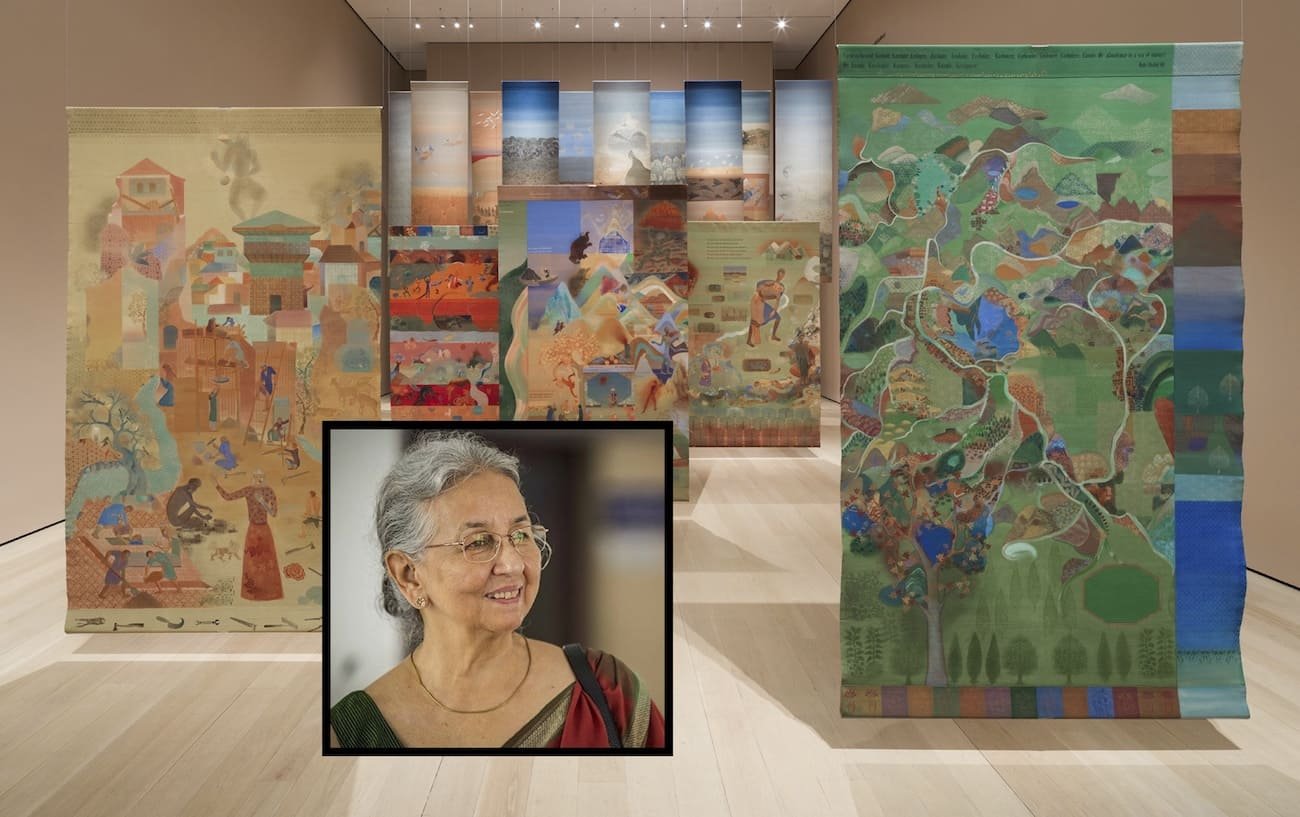

The first thing that strikes a visitor to Nilima Sheikh’s exhibition at New York’s Museum of Modern Art is the sense that these paintings ask to be read as much as they ask to be seen.
Suspended scrolls, delicate figures, intricate patterns and landscapes draw the eye into a world that appears, at first, almost dreamlike. But beneath the richly layered surfaces lie stories of violence, displacement, loss and the fragile persistence of human relationships.
Kashmir is the emotional and political centre of much of this work. Its mountains, valleys and cultural traditions have long inspired romantic visions of paradise. Sheikh, one of India’s leading contemporary artists, refuses to let that image obscure the history of a region marked by competing national claims, militarization and unrest.
Her exhibition, “Nilima Sheikh: Fractured Skies,” opened at MoMA on September 27, 2026, and runs through June 13, 2027. According to the museum’s official exhibition announcement, the show is organized in collaboration with New Delhi’s Kiran Nadar Museum of Art (KNMA) and marks Sheikh’s first solo presentation in New York. It brings together work from three major series, including a new group of monumental paintings commissioned by KNMA.
The result is a significant introduction to an artist whose work combines South Asian visual traditions with a sustained engagement with political history. Rather than illustrate a news report about Kashmir, Sheikh builds a visual language in which history, memory, poetry and personal testimony coexist.
Kashmir Beyond the Postcard
At the heart of the exhibition is Each Night Put Kashmir in Your Dreams, a series created between 2003 and 2014. MoMA describes its works as suspended, double-sided painted scrolls that reflect Sheikh’s sustained engagement with the Kashmir Valley and its contested history.
The paintings draw on Kashmir’s cultural richness while acknowledging the political forces that have shaped its modern history. Sheikh’s treatment of the region resists two familiar representations: Kashmir as an idyllic tourist destination and Kashmir as nothing more than a theatre of violence.
Instead, her paintings suggest that the two realities cannot be separated. The beauty of the landscape is inseparable from the lives of the people who inhabit it, and the history of conflict cannot erase the region’s cultural memory.
The choice of the scroll is crucial. In an audio guide published by MoMA, Sheikh explains that she chose the format partly because it can be viewed from both sides and allows her to tell stories unfolding in different places and at different times. She says the viewer must participate actively, moving back and forth between looking and reading.
This is not art that delivers its message in a single dramatic image. Its meaning accumulates through details that may initially seem incidental: a figure in a landscape, a pattern recalling a textile, a written fragment or a shift in color. The process of looking becomes a form of attention to people and histories that conventional political narratives often reduce to abstractions.
The Displaced and the Dispossessed
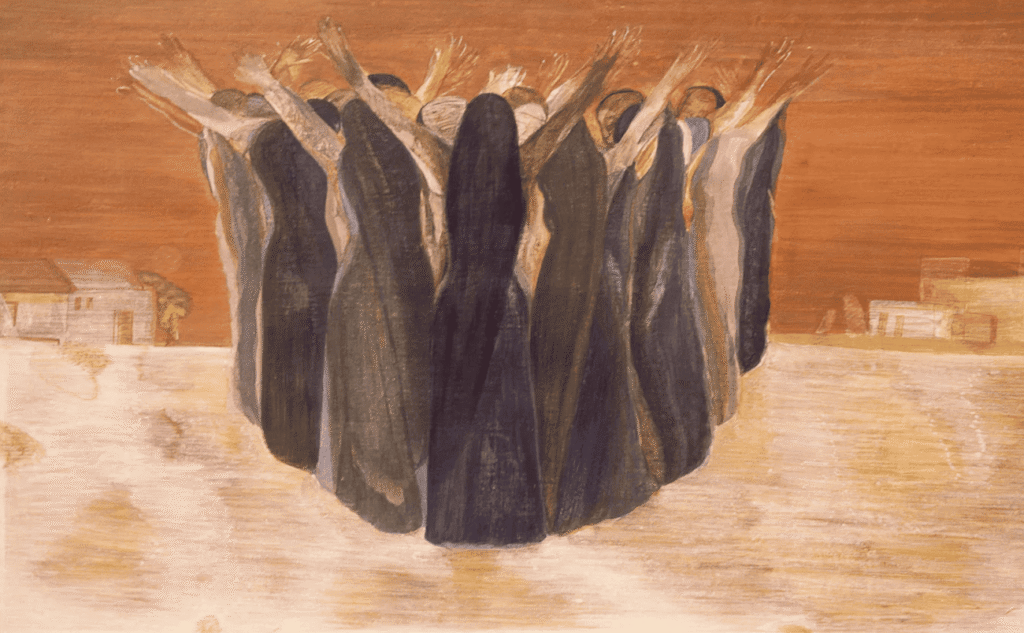
The exhibition extends beyond Kashmir’s political boundaries in Home, Land (2023–25), a series of paintings on paper focusing on the precarious lives of the Bakarwals, a nomadic pastoral community in Jammu and Kashmir.
She does not simply reproduce the appearance of a particular news event. Instead, she places historical references, poetic associations, landscapes and human figures in conversation, allowing meaning to emerge through their relationships.
MoMA and KNMA identify the series as an exploration of displacement and the uncertainty faced by Bakarwal communities. Their seasonal movements with livestock are tied to inherited routes, livelihood and access to land. Sheikh’s paintings draw attention to a way of life vulnerable to restrictions on movement and broader environmental and political pressures.
By placing Home, Land alongside the earlier Kashmir scrolls, the exhibition broadens its inquiry. Displacement is not only the dramatic consequence of war or forced migration; it can also emerge through the gradual erosion of a community’s ability to inhabit and move through its traditional landscape.
The paintings ask what happens when home itself becomes precarious. The Indian Express, in its October 2026 examination of Sheikh’s work at MoMA, similarly highlighted the exhibition’s exploration of displacement, memory, cultural identity and the threat to a sense of home.
Shahid/Witness: From Regional History to a Fractured World
The newest work, Shahid/Witness (2025–26), makes its debut at MoMA. According to the museum and KNMA, the installation consists of ten monumental suspended painted scrolls commissioned by KNMA and designed in response to the architecture and scale of MoMA’s gallery.
The title carries an important double meaning. Shahid can mean a witness and, in particular contexts, a martyr. The pairing draws attention to the relationship between witnessing suffering and remembering those who have endured or died through violence.
The work expands Sheikh’s inquiry beyond Kashmir to war and unrest around the world. Its placement alongside the earlier series suggests that the region’s history should not be treated as an isolated tragedy, but as part of a wider landscape of conflict, forced movement and contested memory.


The exhibition’s title, Fractured Skies, evokes a world in which familiar divisions between beauty and devastation, home and exile, memory and history no longer hold. The sky remains vast, but the human world beneath it has been broken by forces that individuals cannot easily control.
A Distinctive Visual Language
Sheikh’s paintings combine painstaking technique with political seriousness. MoMA’s exhibition materials explain that she draws on historical accounts, archival material and literary sources, adapting the traditional scroll format and working primarily with casein and gum tempera. Text, imagery and stenciled patterns combine to form narratives that unfold through interconnected episodes.
Her method differs from the visual immediacy of photojournalism. She does not simply reproduce the appearance of a particular news event. Instead, she places historical references, poetic associations, landscapes and human figures in conversation, allowing meaning to emerge through their relationships.
That approach has its demands. The paintings reward patient attention, but their density may make the experience challenging for visitors unfamiliar with Kashmir’s history or the literary and artistic traditions informing Sheikh’s work. Additional historical context can help viewers understand the political references without reducing the paintings to illustrations of a conflict.
Yet the slowness is also part of the achievement. In a media environment that often compresses complex histories into competing images and slogans, Sheikh insists on the time needed to look carefully.
An Overdue Recognition
Born in New Delhi in 1945, Sheikh studied history at Delhi University from 1962 to 1965 before earning a master’s degree in painting from the Faculty of Fine Arts at the Maharaja Sayajirao University of Baroda in 1971. According to KNMA’s artist biography, she has been based in Baroda, now Vadodara, and has played an important role in shaping contemporary Indian art. Her work is held in collections including the Metropolitan Museum of Art in New York and the Art Institute of Chicago.
Her MoMA exhibition is more than an introduction to an unfamiliar artist. It brings a major South Asian artistic voice into a prominent international institution, giving viewers an opportunity to engage with work in which regional histories speak to universal questions of violence, loss and belonging.
The exhibition’s greatest strength is that it does not ask viewers to choose between the aesthetic and the political. The paintings are beautiful, but their beauty is not an escape from history. It is the means through which history becomes visible—and through which lives too often obscured by political argument regain their human presence.