




The Growing Hatred for Indian Americans: The Ladder History Climbs When a Minority Becomes a Convenient Target

- I called the memes about Indians “stealing tech jobs” the first rung. A teenager with a rifle in a temple parking lot is the top one.

On October 11, according to police in Palatine, Illinois, a 19-year-old named Alexandros Paporakis drove from his mother’s house to a Hindu temple in Aurora, west of Chicago, armed and ready. Investigators believe his target was the largest Hindu temple in Aurora, though they say the exact location is still being confirmed. People familiar with the case told NBC Chicago that he tried to open fire and the rifle jammed. So he drove home.
He worked as a cashier at a Taco Bell. A coworker had heard him call himself a white supremacist and say he “couldn’t wait” to kill Indian people. That coworker went to the police, and officers arrested him before he could go back. In his home they found a rifle, loaded magazines, hundreds of rounds of ammunition, and a tactical vest with body armor and a patch tied to white supremacist extremism. They also found a manifesto in which he called himself the “Aurora Shooter” and wrote about a superior race and the mass shooting of Indian people. Palatine police announced the arrest this week, and he now faces multiple felony charges.
A jammed rifle and a coworker who took him at his word. That is the entire distance between this essay and a candlelight vigil.
Aurora is what finally gave shape to thoughts that had been brewing in me since last fall. In first part, I described a ladder that history climbs whenever a visible minority becomes a convenient target: ridicule, resentment, rhetoric, policy, violence. I called the memes about Indians “stealing tech jobs” the first rung. A teenager with a rifle in a temple parking lot is the top one. To understand how he got there, you have to start at the bottom, and the bottom is older than any of us.
We Have Been Here Before
Earlier this year, I wrote about the history of South Asians in America that most of us were never taught. I won’t repeat all of it here, but two pieces of it belong in this essay.
On September 4, 1907, roughly 500 white workingmen in Bellingham, Washington, set out to drive the town’s South Asian mill workers out of the city. Most of those workers were young Sikh farmers from Punjab who had come to work in the lumber mills, and local papers had spent the previous year warning about a “dusky peril” that would drag down wages.
Two days earlier, on Labor Day, about a thousand union members had paraded through town demanding that no South Asians be employed after the holiday. The workers showed up for their shifts anyway. So the mob pulled them out of the mills, ransacked their bunkhouses, stole their belongings, and drove them to the city limits or to the jail. The police held about two hundred of them overnight in the basement of City Hall, for their “protection,” on the understanding that they would leave town. Within ten days the entire community was gone, and one local paper approvingly described them as “wiped off the map.”
The law followed the mob, as it usually does. The Asiatic Barred Zone came in 1917. In 1923, in United States v. Bhagat Singh Thind, a unanimous Supreme Court ruled that Indians were not “white” and therefore could not become citizens, and dozens who had already naturalized were stripped of their citizenship. Thind had trained with the U.S. Army in World War I. It did not matter.
Two details from that history keep nudging me. The newspapers called the Bellingham workers “Hindoos,” even though most of them were Sikh. The mob never checked which god anyone prayed to, and the people sending death threats today do not check either. And Thind wore the uniform. Loyalty, service, and good behavior did not save him. Remember that when we get to the people in Washington who think proximity to power will protect them.
Now, let us talk about the ladder.
Rung One: Ridicule
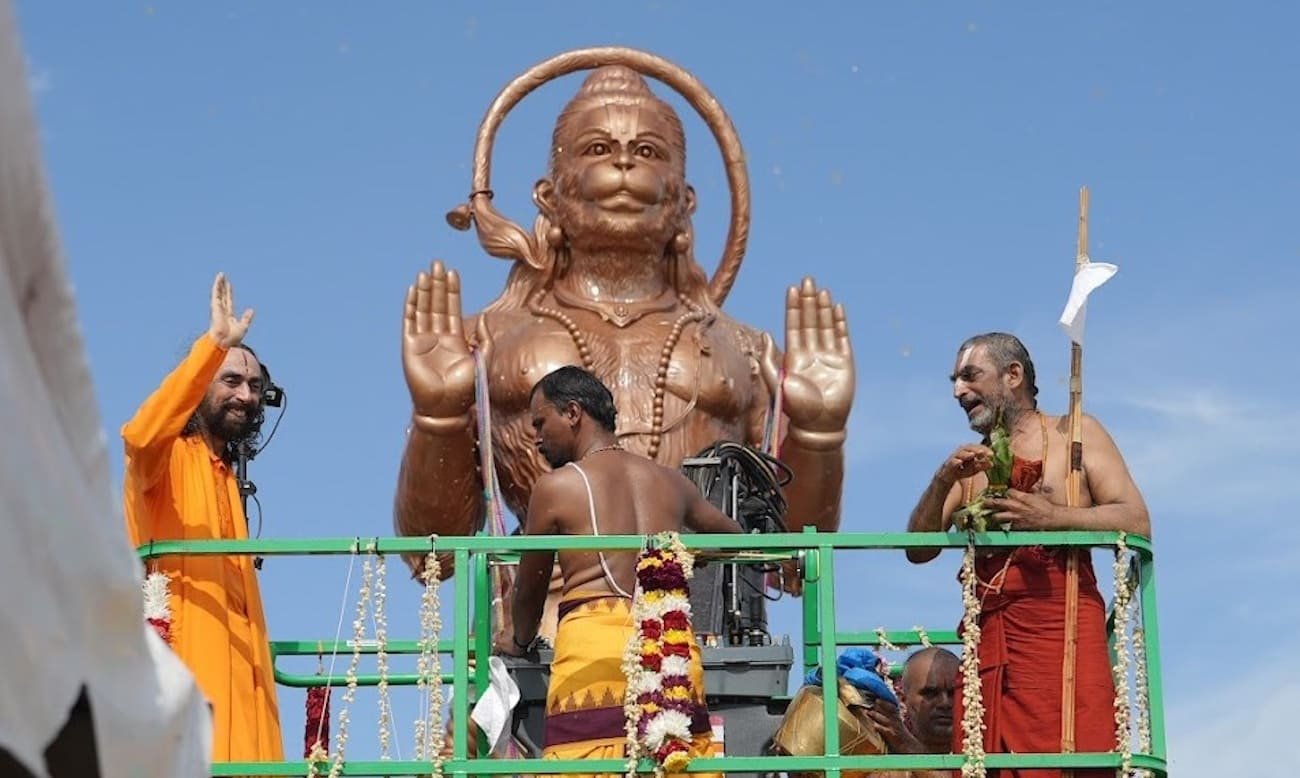
On March 31, 2026, Savanah Hernandez, a correspondent for Turning Point USA, went to North Texas to see its Indian population for herself. She filmed outside a Hindu temple (Karya Siddhi Hanuman Temple in Frisco), described it as a 72-foot temple to a “monkey-god,” and told her followers that people inside were praying for blessings for “job visas.” The post drew 1.7 million views. Hanuman is one of the most beloved deities in Hinduism, a figure of devotion, strength, and selfless service. And praying for work is not a scandal; Christians pray for employment, Catholics have a patron saint of workers, and every faith I know of asks God for help with the rent. In Hyderabad there is even a temple, Chilkur Balaji, that locals affectionately call “Visa Balaji.” I find that charming. She found it sinister.
When FBI Director Kash Patel posted a Diwali greeting last October, the replies filled with demands that he go back and calls to deport him — a man born in New York. Researchers at the Center for the Study of Organized Hate counted nearly 2,700 posts promoting racism against Indians and Indian Americans on X in that month alone. In August, a video of Ganesh Visarjan in India was posted on X with a caption claiming it showed Indians dumping truckloads of plastic trash into rivers, and it had to be fact-checked as false.
The Mirror We Avoid
This is the rung where we sometimes hand our critics the material, and I think we have to say so. In March, a video went viral of an Indian man and a woman performing a choreographed dance to a Telugu song at the National World War II Memorial on the Mall. That memorial honors the 16 million Americans who served and the more than 400,000 who died. Plenty of Americans who are not remotely racist found it disrespectful, and frankly, so did I. A memorial is not a backdrop for a reel. Around the same time, Indian tourists were filmed dancing to “Chaiyya Chaiyya” on Hanoi’s Train Street and doing garba on an airport tarmac, clips that drew as much scorn from Indians back home as from anyone else.
In September, during Ganesh Chaturthi, a video of an idol being immersed in Lake Ontario circulated online, framed even by the channel that posted it as a sacred tradition colliding with environmental concerns. It was not the first time this year. In June, a clip of two Indian children lowering a small Ganesha idol into a clear Canadian lake had gone viral on X under a caption mocking Hindu parents for teaching their kids to litter. Defenders pointed out that many idols are made of clay that dissolves.
Critics pointed at the flowers floating on the surface. Some of the sharpest criticism came from Hindus themselves, who said nothing in the faith requires dumping offerings into someone else’s lake. Anyone who grew up in India knows this debate is real at home too; cities like Bengaluru have spent years trying to keep plaster-of-Paris idols out of their lakes. Anyone who lives in an Indian American suburb or subdivision knows the Diwali firecrackers that go on well past midnight, and the processions, dhol and all, that hold up a city street for hours while people in colorful garb dance. We find it joyful. Our neighbors often do not.
I am not going to pretend any of this is fine. Civic sense is not a Western imposition, and respect for a war memorial is not assimilation. We should say so, loudly, and before our critics do.
But notice what happens next. The man who danced at the World War II Memorial was doxxed. People dug up that he ran a dance studio in Dallas, pressured his employers, and demanded his deportation. He deleted every account he had. Under the Canadian lake clip, commenters demanded that the family be identified from the video and fined. One dance becomes a referendum on five million people. A white tourist filming a reel at the Taj Mahal is a travel influencer. A brown one at a memorial is an invasion.
The Punjabi mill workers in Bellingham were not all saints either. Some of them, like some of us, were probably loud, clannish, or careless with local customs. That was never the reason for the riot. It was the excuse. Fixing our own manners is worth doing for its own sake. It will not buy us safety. The young man who drove to Aurora with a rifle was not upset about a reel.
Rung Two: Resentment
Resentment is ridicule with a grievance attached, and the grievance is almost always jobs.
I hoped, in a naive corner of my mind, that once the administration “did something” about H-1B, the resentment would ease. It went the other way. The broad public still mostly supports the program; a Rasmussen survey this summer found most voters approve of it, even as many are angry about how many foreign workers get hired. But the anger has concentrated, and concentrated anger is louder than diffuse support.
In a Blind survey last September, 56 percent of American tech professionals said they see H-1B holders as direct competitors. Gov. Ron DeSantis of Florida ran an informal poll on X in which 62 percent of roughly 49,000 respondents voted to eliminate the program outright. An X poll is not science, but it is a good measure of what plays to the base.
The resentment also has a real grain in it, and we should not pretend otherwise. In 2013, Infosys paid $34 million, then the largest payment ever in an immigration case, to resolve allegations that it used business-visitor visas for jobs that required H-1Bs. Infosys now discloses another Justice Department investigation into how it classified certain H-1B employees.
In 2024, a federal jury found that Cognizant had engaged in a pattern of discrimination against its non-Indian employees, a verdict the company is appealing. This year alone, the Justice Department has settled with a string of IT staffing firms in New Jersey, Virginia, and Texas over hiring practices that shut out U.S. workers, including one whose AI-written job ads limited applicants to people on H-1B, OPT, or H-4 status.
The EEOC has sued another staffing agency for national origin discrimination tied to H-1B hiring. Anyone who has worked in IT consulting, as I have, knows the corner of the industry where “C2C only” postings and tight ethnic hiring networks are the norm. Many of those firms are run by people who look like me. A staffing firm that tells Americans not to apply is breaking the law and making life harder for every Indian engineer who got a job fairly.
But resentment never stays aimed at the guilty. It spreads to anyone who looks the part. In Frisco, Texas, a local activist warned that “soon your entire City Council could be Indian,” as if an election were an invasion. A council meeting on February 3 turned into a confrontation that the Indian American Advocacy Council later documented as a case study. The 2026 Indian American Attitudes Survey by the Carnegie Endowment and YouGov found that 48 percent of Indian Americans had encountered racist posts targeting Indians very or somewhat often since the start of 2025.
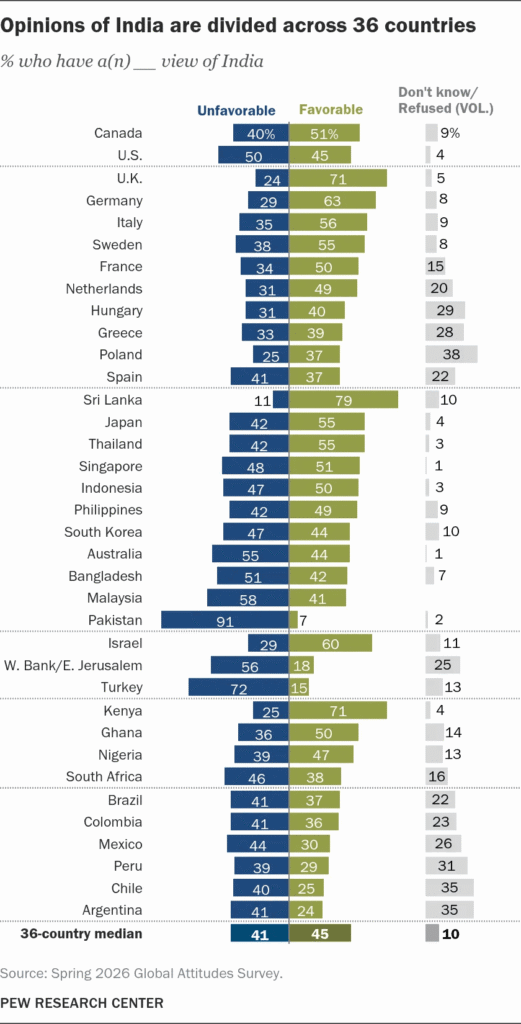
The mood shows up in the polling too. In Pew’s spring 2026 survey, only 45 percent of Americans had a favorable view of India and 50 percent an unfavorable one, among the lowest ratings since Pew began asking in 2008 and down from 51 percent favorable in 2023. Republicans were less favorable than Democrats, 42 percent to 50 percent. The number that worries me most is the age gap: only 42 percent of Americans under 30 view India favorably, compared with half of those 65 and older. I suspect that is the generation that meets India mostly through reels, memes, and H-1B arguments. Pew was asking about India the country, not Indian Americans, and some of that slide surely reflects trade fights and a rocky year between Washington and Delhi. But the people telling Kash Patel to go back do not draw that distinction, and I am not sure the rest of us can afford to either.
The resentment also has a real grain in it, and we should not pretend otherwise. In 2013, Infosys paid $34 million, then the largest payment ever in an immigration case, to resolve allegations that it used business-visitor visas for jobs that required H-1Bs.
Rung Three: Rhetoric
Rhetoric is the rung where the fringe gets a microphone and the mainstream decides whether to take it away. This year, mostly, it did not.
Nick Fuentes used a slur for Usha Vance on Piers Morgan’s show. Leaked Telegram chats from more than 350 Young Republican operatives, people who held real jobs in campaigns, government offices, and conservative organizations, were full of racist messages, including some aimed at Vivek Ramaswamy. Laura Loomer, one of the President’s most influential online allies, attacked Kash Patel with the line “You are an Indian.” And in Ohio, a Republican candidate for governor, Casey Putsch, posted a video in which he asked Vivek whether he wanted to play “Cowboys versus Indians” and then fired a gun three times. The Ohio Republican chairman waved it off as typical of a primary.
The Three Who Could Have Spoken
A year ago, I wrote that Indian Americans with influence inside the MAGA movement, naming Vivek Ramaswamy and Usha Vance, had to understand that their silence was complicity. A year later, I want to add Kash Patel to that list and give an honest report card on all three.
Vivek Ramaswamy did eventually speak. At Turning Point USA’s AmericaFest last December, he told the crowd that no American is more American than another, and he defended Usha Vance against slurs. It was a good line. Three months later, a Turning Point correspondent was filming a Hindu temple in North Texas like a zoo exhibit. And Vivek found his voice only after months of racist attacks aimed at him. This is the same man whose post about American culture favoring mediocrity over excellence, in December 2024, helped ignite the H-1B fight in the first place. He still supports ending birthright citizenship for the U.S.-born children of undocumented immigrants. He is now the Republican nominee for governor of Ohio, running on the ticket of a party whose state chairman shrugged at a candidate firing a rifle at his name. His campaign declined to comment on the video.
Kash Patel runs the FBI, the agency responsible for investigating hate crimes and domestic terrorism. He has been on the receiving end of this hatred more publicly than almost anyone. He has complained in the past that Indian Americans vilified him for his politics and failed to stand by one of their own. Fine. Then stand by us. Aurora is a textbook case for the federal government to call anti-Indian terrorism by its name. I will be watching to see whether the Director, of all people, says the word “Indian” out loud.
Usha Vance has said nothing that I can find. When Fuentes used that slur, her husband, the Vice President, talked about party unity and free speech and shifted the conversation to what he called systemic discrimination elsewhere. Nobody is owed a press release about her family. But she is also the Second Lady of the United States, a Yale-trained lawyer who clerked for a federal appeals judge, and she knows exactly what a pattern looks like.
I understand the argument for staying inside. Change comes from within, a seat at the table is worth something, and walking out hands the room to the worst people in it. But a seat at the table is only worth something if you use it. What I see instead is three people whose faces have become the movement’s alibi. Every time someone points out the hate, the answer is ready: How can we be anti-Indian? Look at Usha. Look at Kash. Look at Vivek. Bhagat Singh Thind had a uniform, and the Supreme Court took his citizenship anyway. Proximity to power is not protection. Staying is a choice. Staying silent while staying is a second choice. Neither is neutral.
Rung Four: Policy
This year, the words turned into paperwork.
On September 19, 2025, President Trump signed a proclamation imposing a $100,000 fee on new H-1B petitions for workers outside the country. The fee spent the next year bouncing through the courts. In June, a federal judge in Boston ruled it unlawful, reasoning that a charge that large was effectively a tax, and only Congress can levy one. In July, an appeals court refused to revive it while the government appeals. The administration did not give up. DHS has since proposed a separate fee of $103,265 on certain cap-subject petitions, and the lottery itself has been reworked into a wage-weighted selection.
And this week, the target moved from people trying to come in to people who are already here. On October 13, DHS released a proposed rule to end what immigration lawyers call “deference.” Since 2004, with a detour during Trump’s first term, an officer reviewing an H-1B extension would generally approve it if the employer, the worker, and the job had not changed since the last approval. Under the proposal, every extension would be reviewed as if it were a brand-new petition. DHS’s own analysis projects about 6,000 additional evidence requests a year, and, tellingly, no change in denials. That tells you what the rule is for. It is not designed to reject people. It is designed to make them wait, to eat into the 240 days they can keep working while an extension is pending, and to turn every renewal into an audit. The people hit hardest are those on their third or fourth extension, already approved for a green card and stuck in a backlog that, for Indians, can run for decades. The next day, DHS finalized a rule ending the automatic extension of work permits for people whose renewals are pending, which lands squarely on H-4 spouses and green card applicants.

Because Indians receive roughly three-quarters of all H-1B visas, any rule written for H-1B is, in practice, a rule written for Indians. Nobody in Washington has to say the word “Indian” for the policy to know whom it is about. The Asiatic Barred Zone did not need to say it either.
If you hold one of these visas, or employ someone who does, the deference rule is open for public comment until November 13 at regulations.gov, under docket USCIS-2026-0529. Comments are not a magic wand, but agencies are required to respond to them, and a thin record makes a rule easier to defend in court.
Rung Five: Violence
Nine days before Aurora, someone threw bricks through the windows of the Shree Swaminarayan Vadtal Dham Hindu Mandir in Richmond Heights, Ohio, just outside Cleveland, while priests and devotees were inside. No suspect has been named, and police have not established a motive. The Hindu American Foundation called it a possible hate crime. A community already on edge did not need the motive spelled out to feel it. Carnegie’s survey found that 9 percent of Indian Americans reported physical threats since the start of 2025, and 4 percent reported physical assault.
Then Aurora, where the ladder reached its top rung and was stopped only by a mechanical failure and one person’s conscience. Temples are not only places of worship for us in this country. They are where visiting grandparents get taken on their first weekend, where kids learn a shloka for the annual cultural program, where you eat puliyogare (tamarind rice) off a paper plate in the basement cafeteria after darshan. Someone who brings a rifle to that parking lot knows exactly what he is aiming at.
One more thing belongs on this rung.
Last September, I named Charlie Kirk as one of the loudest voices recycling the line about cheap foreign tech workers. Six days after that essay was published, he was shot and killed while speaking at Utah Valley University. I stand by what I wrote about his rhetoric. His killing was also an atrocity, and anyone who celebrated it was feeding the same disease I was writing about. The ladder does not check party registration. A country that grows numb to political murder will not keep a temple in Aurora safe either.
Who Actually Pays
A friend of mine, a senior executive at a tech company in a big city, told me recently that he has never personally experienced any of this. I believe him. I suspect many of you reading this would say the same.
He has a point, and I want to be fair to it. These incidents are still few and far between. America is a vast country, and most Indian Americans go to work, drop the kids at school, and walk into a temple on Saturday without anything happening to them. If I can stereotype my readers a little, many of you are white-collar professionals who are well settled in your communities. You have already earned a measure of respect, and a good part of that respect comes from economic privilege. The neighbor who might sneer at a stranger tends to be polite to the cardiologist next door.
That is exactly the point. I had loosely predicted we might see calls for Sundar Pichai or Satya Nadella to be pushed out because of what they symbolize. That has not happened in any serious way, and I was wrong about where the anger would land. It has mostly bypassed the people at the top and landed on the people who have not made it yet: the H-1B engineer on his fourth extension, the H-4 spouse whose work permit lapses, the Uber driver, the Indian American woman in Texas who was at work when a customer started throwing things at her and shouting about deportation, the young dance teacher whose reel cost him his livelihood, the family at the temple on a Sunday morning. Those are the people still building their base, with the least cushion when something goes wrong. The Bellingham mob did not go after the mill owners either. It went after the men in the bunkhouses.
If you have never felt any of this, that is good news. It is not evidence that it is not happening.
What I Am Asking For
To Indian Americans: report what happens to you. Stop AAPI Hate and the Indian American Advocacy Council both maintain reporting tools and know-your-rights guides, and incidents that go unreported do not exist in the data that policymakers read. If you are affected by the H-1B deference rule, file a comment before November 13. Hold our own institutions to a standard: temples and community groups that encourage clay idols and offer immersion at the temple or at home instead of in public lakes and rivers, staffing firms that follow the law, and families who know the difference between a celebration and a disturbance.
If you are one of the comfortable ones, use that comfort on behalf of the people who do not have it yet. And stop treating politicians who share our heritage as a source of pride regardless of what they do with their power. An Indian American congressman or a governor is not automatically a cause for celebration; what they stand for is. Representation is not the same as protection.
To everyone else: when the hatred is aimed at us, say something. You do not need to agree with Indian Americans about anything else to agree that nobody should be shot at in a temple.
The People Who Refused
A year ago, I closed by celebrating what Indian Americans have contributed to this country. This time, what I want to celebrate is the people who refused to go along.
They have always been there. In 1907, even as the Bellingham mob had the town’s sympathy, the Industrial Workers of the World put out a statement denouncing the riot as bad for every worker. This year, fact-checkers debunked the fake Visarjan video. The Aurora alderwoman spoke up for the right of every resident to worship in safety, and police in two suburbs moved fast. None of them were Indian Americans with influence in Washington. They did it anyway.
The coworker in Palatine has not been named, and maybe that is for the best. What we know is that this person stood behind a fast-food counter next to a teenager who said he could not wait to kill Indian people, and instead of laughing it off as edgy talk, took him at his word and called the police. In a year when the most powerful Indian Americans in Washington could not bring themselves to treat this hatred as real, a Taco Bell employee did.
Ganpy Nataraj is an entrepreneur, author of “TEXIT – A Star Alone” (thriller) and short stories. He is a moody writer writing “stuff” — Politics, Movies, Music, Sports, Satire, Food, etc.