




‘Love Chaos Kin’: The Revolutionary Story of an Indian American Family Who Adopted White-Navajo Twins

- Eight years in the making, Chithra Jeyaram's documentary challenges every fixed idea about what American families can look like — and arrives at a moment when the story it tells has never been more necessary.
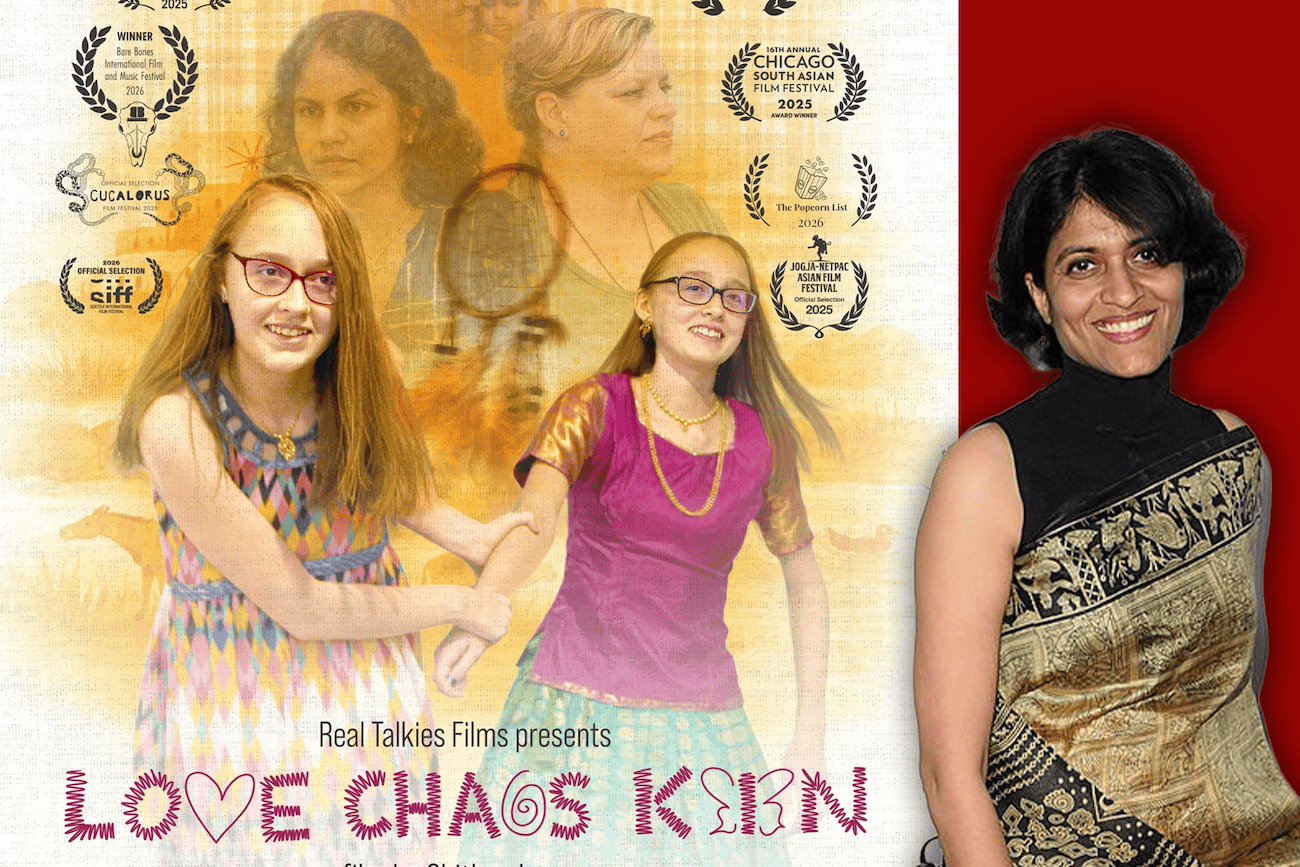

The film that became “Love Chaos Kin” began, in a sense, with a personal question that its director could not stop asking herself.
Indian American filmmaker Chithra Jeyaram had considered adoption. Living in the United States as a Tamil immigrant — frequently the only Tamil or Indian person in a room — she found herself preoccupied with questions about cultural transmission. “I was always wondering, right? Like, what is going to happen to my language? What is going to happen to my culture?” she told Eastern Eye in a recent interview. The question of how parents pass on their heritage to children from entirely different backgrounds was one she experienced as a personal and philosophical puzzle. Then she found the Iyer family of Philadelphia, and the puzzle became a film.
“Love Chaos Kin, a documentary screened at the recently concluded 52nd Seattle International Film Festival, tells the story of a South Indian couple in Philadelphia who adopted white-presenting Navajo twins. Produced, directed, shot and edited by Jeyaram, the 97-minute film follows the life of an interracial family where the adoptive parents sought to maintain real relationships with the twins’ birth parents, deliberately exposing the girls to both worlds,” as eShe Magazine’s Shailaja Rao documented from the SIFF 2026 screening and the filmmaker’s pre-screening discussion.
The film premiered at CAAMFest in May 2025 — the San Francisco-based festival of the Center for Asian American Media — and has since traveled to the Brooklyn Film Festival, the Beloit International Film Festival, and the 52nd Seattle International Film Festival in May 2026. Its IMDb score of 9.6 from 17 ratings, while based on a small sample, reflects the documentary’s capacity to move audiences who encounter it.
The Family at the Film’s Center
Lakshmi and Narayanan Iyer are a South Indian couple settled in Philadelphia. Their adopted twin daughters, Anjali and Meghna — named with Indian names by their adoptive parents — were adopted at ten months old. The girls are white and of Navajo descent, raised in a family rooted in Indian and Hindu traditions while remaining connected to their white birth mother, Brandy, now known as Katherine Faye, as Eastern Eye reported from the film’s content.
The decision to maintain that connection — to keep the birth family present rather than to seal the adoption in the manner that characterized most American adoptions of earlier generations — is the fulcrum on which the film’s entire drama rests. An unexpected pregnancy compels an Indian immigrant mother to help her adopted twin daughters reconnect with their White birth mother — grappling with life’s challenges — and estranged Native American father, exposing raw class divides while transforming their understanding of identity and belonging, as the CAAMFest official description documented.
Lakshmi Iyer has been featured on NPR’s “The Takeaway” and on the BBC Asian Network’s Big Debate program — recognition that situates her not merely as a documentary subject but as a public voice on the questions her family’s life raises.
The film documents what happens over nearly a decade when two children born of a white mother and a Navajo father are raised by Tamil Indian parents who cook South Indian food, practice Hindu traditions, celebrate Indian holidays — and simultaneously drive the girls to visit birth family members navigating poverty, addiction, and the compounded difficulties of a life lived at the intersection of class disadvantage and indigenous dispossession.
Eight Years, One Camera, Many Questions
Chithra Jeyaram is a filmmaker whose body of work reflects, as eShe’s Rao writes, “a consistent preoccupation with stories left out of mainstream narratives.” Her earlier films include “Rags to Pads” (2012), which reframes menstruation as a societal issue through the story of a husband who worked to destigmatize it; “Foreign Puzzle” (2019), which contrasts the brutality of cancer with the resilience of dance; and “Amma’s Pride” (2024), for which she served as lead producer, which champions unwavering parental love.
For “Love Chaos Kin,” she served simultaneously as producer, director, director of photography, editor, and writer — a level of creative control that is both an artistic choice and a practical necessity for an independent documentary requiring eight years of sustained access to an intimate family story, as the Brooklyn Film Festival crew listing confirmed. The CAAM-funded film emerged from Jeyaram’s own desire to adopt, as the CAAMFest official listing documented — making the documentary simultaneously a journalistic undertaking and a deeply personal exploration of questions she was living alongside her subjects.
The film weaves together observational scenes, animated sequences, and reflective thoughts — a formal choice that allows it to hold the complexity of its subject without reducing it to a single narrative register, as CAAMFest confirmed.
What the Critics Said: “Outstanding” and “Clear-Eyed”
The critical reception to “Love Chaos Kin” at the festivals where it has screened has been genuinely distinguished.
The SIFF official description quoted Panos Kotzathanasis of Asian Movie Pulse calling it “outstanding” — “marked by an extraordinary story, nuanced and realistic perspectives, and thoughtful commentary.”
Mediaversity Reviews, in its April 2026 assessment, described the documentary as exploring “an intriguing premise of transracial adoption” and praised Jeyaram for cutting “right to the quick of why documentary storytelling is so powerful” — even while noting that the film “doesn’t tout many bells and whistles” and would not be called experimental. The review credited the film with a specific achievement: “Jeyaram tracks the family over the course of years” in a way that generates genuine emotional investment.
The SIFF’s own curatorial description called it “a clear-eyed look at what belonging to more than one world actually means” — a formulation that captures both the film’s emotional register and its intellectual ambition.
The Beloit International Film Festival’s listing placed the film’s significance in the landscape of American adoption narratives: “By showcasing the experiences of an Indian immigrant family and their adopted White-passing, Navajo-descent twins, it provides a counter-narrative and visibility to diverse American family dynamics.”
Jeyaram’s Own Conclusions
In her interviews around the film’s festival run, Jeyaram has spoken with a directness about adoption that goes well beyond the feel-good framing that adoption narratives often receive.
“No matter how different we are, if we choose to trust, if we choose to have friendships, there is a lot to be learned from each other,” she told Eastern Eye. But she was equally pointed about what adoptive parents often prefer not to consider: “Whoever is choosing to adopt is coming from a place of ‘I can’t have a child’, but in the process of getting a child, another mother or another family is losing a child. So therefore, whoever is adopting has to think of this as, yes, you are getting something, but you also need to make sure you are caring for that family that gave you a child, and for the child who’s lost a family.”
“Whoever is choosing to adopt is coming from a place of ‘I can’t have a child’, but in the process of getting a child, another mother or another family is losing a child. So therefore, whoever is adopting has to think of this as, yes, you are getting something, but you also need to make sure you are caring for that family that gave you a child, and for the child who’s lost a family.”
The film’s impact campaign, stewarded by associate and impact producer Emilia Toledo, has targeted exactly those conversations — among adoptive families, adoption agencies, social workers, and communities navigating the specific complexities of transracial adoption.
Indian Americans Who Have Adopted Across Racial Lines

The Iyer family’s story is unusual but not singular. The phenomenon of South Asian American families adopting children of different racial backgrounds — while rare and underrepresented in mainstream media — is a documented if sparsely quantified reality of American family life.
The statistical context is instructive. According to data from the Department of Health and Human Services Administration for Children and Families and the National Council for Adoption, approximately 28 percent of all foster care adoptions in the United States between 2017 and 2019 were transracial — an increase from 23 percent a decade earlier, reflecting a 58 percent growth in transracial adoptions over that period, compared to a 24 percent growth in same-race adoptions, as the ASPE/HHS transracial adoption fact sheet documented. Among the children available for adoption, the vast majority are not of Asian descent — meaning that Asian American families who adopt from the domestic foster care system are, by the simple arithmetic of availability, disproportionately likely to adopt children of other racial backgrounds.
American Kahani published a significant account in January 2023 — “My Mom is a Blonde With Blue Eyes: Identity Crisis and Other Struggles of Indian Children Raised in White American Families” — which documented the experience of Indian-origin children adopted by white American families. The piece cited the academic study “Reclaiming Culture: Reculturation of Transracial and International Adoptees” by Amanda L. Baden, Lisa M. Treweeke, and Muninder K. Ahluwalia, which found that going to college is a significant life event that may trigger transracial adoptees to doubt their sense of self, create a desire to learn about their birth culture, or inspire a search for their birth family. The study’s findings — about the particular identity pressures on transracial adoptees at moments of developmental transition — apply with equal force to the Iyer twins, whose story “Love Chaos Kin” tracks through precisely those years.
The Indian Child Welfare Act of 1978, as NPR documented in its December 2018 investigation and Wikipedia confirmed in its Indian Adoption Project entry, was enacted specifically to make it harder for Native American children to be adopted by non-Native parents — a response to the federally organized Indian Adoption Project of 1958-1967, which had placed hundreds of Native American children with white families in an explicitly assimilationist project. The Iyer adoption of their Navajo-descent twins sits within this fraught legal and historical context — a history the film acknowledges through its attention to the twins’ Native American paternal heritage and the estranged Native American father whose presence in the story is felt even in his absence.
Among documented cases, the Iyer family represents a specific variation that the Beloit International Film Festival described as providing “counter-narrative” visibility: not the dominant flow of majority-white adoptive parents taking children of color, but its inversion — parents of Indian origin, themselves immigrants navigating American racial categories from the outside, choosing children whose own racial complexity does not map onto any simple framework of similarity or difference.
Jeyaram has specifically noted the gap her film addresses: “Love Chaos Kin fills a critical gap in mainstream adoption narratives by highlighting multicultural and multiracial families through the lens of immigrants and people of color,” as the Brooklyn Film Festival listing documented from the film’s own impact statement.
What the Film Ultimately Asks
“Love Chaos Kin” is, at its core, a film about the making and sustaining of family under conditions of maximum difference — racial, cultural, economic, geographical. The Iyers are Tamil South Indians steeped in Hindu tradition. Their daughters are white-presenting children of Navajo descent, given Tamil Indian names, raised in Philadelphia, knowing and being known by a white birth mother whose life circumstances are dramatically different from those of the family that adopted them.
What Jeyaram films across eight years of access is not the resolution of those differences but their management — the daily, un-heroic, sometimes painful, sometimes joyful work of choosing, repeatedly and without guarantee, to remain in relationship across every line that American society draws between people.
The film does not argue that the Iyers got everything right. It does not argue that open adoption is easy or that cultural transmission across such radical difference is ever fully successful. What it argues, with the patient authority of eight years of observation, is that the choice to try — to trust, to stay connected, to hold more than one story at once — is itself a form of love worth documenting.
“Whoever is adopting has to think of this as, yes, you are getting something, but you also need to make sure you are caring for that family that gave you a child,” Jeyaram told Eastern Eye.
The Iyers, over eight years, tried to do exactly that. The film is the record of what that trying looked like — and of what it cost, and what it gave, to everyone in its unfolding.