




‘Self-Deport or Find Out’: DHS Pulls ‘Mr. Singh’ Post After Backlash — But Only After 4.2 Million Views

- The Department of Homeland Security published — then deleted — an AI-generated image telling a brown-bearded, turbaned man to "get off our roads." The Sikh Coalition called it a textbook example of anti-Sikh profiling. A Democratic congressman said his own middle name is Singh. DHS had initially defended the post.
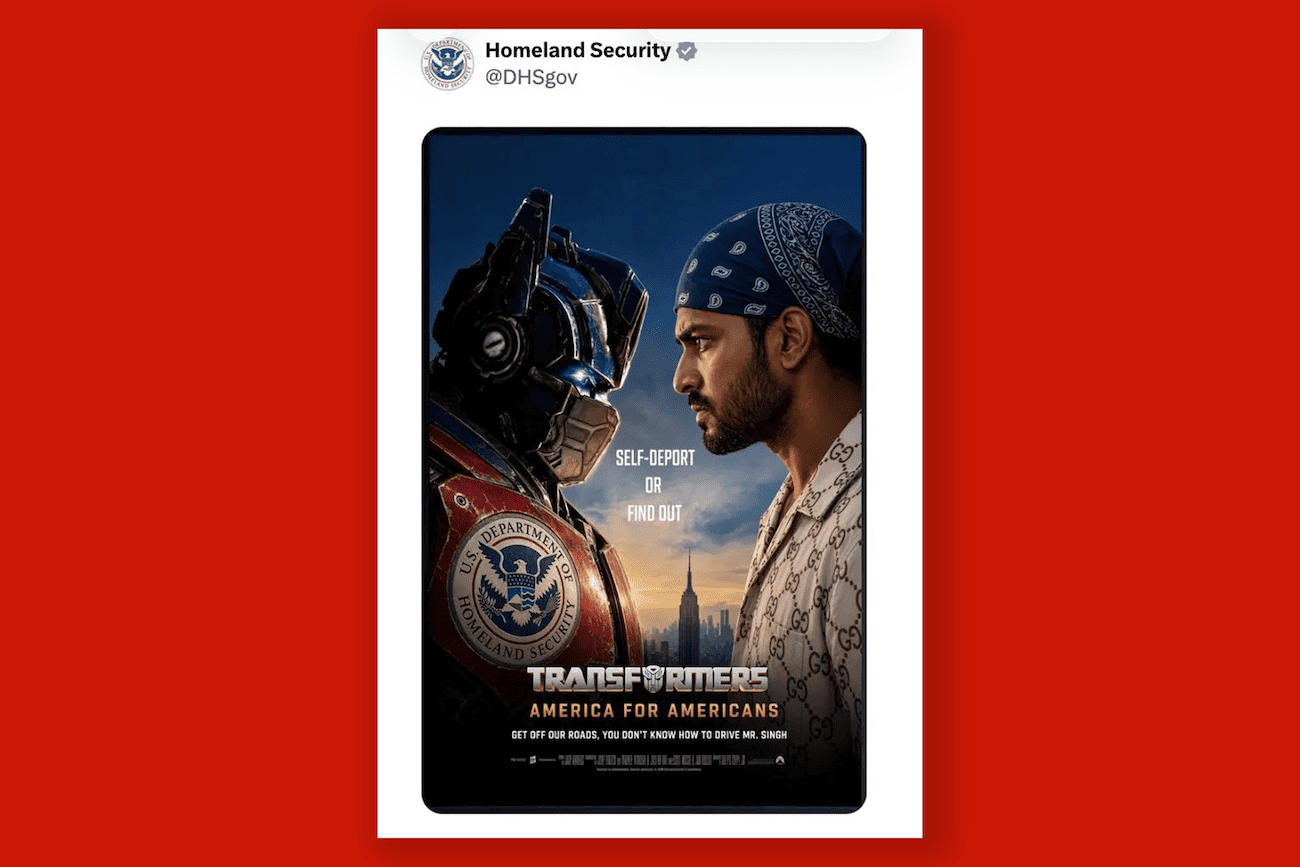

On Wednesday, September 9, 2026, the official X account of the United States Department of Homeland Security published an AI-generated poster that would, by Thursday morning, have been viewed more than 4.2 million times, provoked condemnation from Sikh and Indian American advocacy groups, drawn sharp responses from Democratic members of Congress, and been quietly deleted by the department that posted it.
The image depicted two figures facing each other: on one side, Optimus Prime — the heroic protagonist of the Transformers franchise — wearing a DHS insignia on his arm; on the other, a brown-skinned, bearded man wearing a head covering whose appearance was similar to that of an Indian-origin truck driver who had been arrested in Florida in August 2025 following a fatal crash. Between the two figures, the text read: “America for Americans. Get off our roads, you don’t know how to drive Mr. Singh. Self-deport or find out.”
The post was published as a reply to a separate DHS video urging people to self-deport, according to Scroll.in, which both reviewed the post before its deletion. A related DHS video featured Megatron — Optimus Prime’s adversary in the Transformers franchise — being used to represent truck drivers the department said were in the country illegally and involved in accidents and crimes. In the video, Megatron appeared to negotiate for the release of the named drivers, as India Weekly documented from the clip.
The surname “Singh” — used in the post as a personal epithet directed at the image’s central figure — is one of the most common surnames in the Sikh community, shared by millions of Sikhs and people of Punjabi heritage worldwide. It is not the surname only of Harjinder Singh, the 28-year-old Indian-origin truck driver whose Florida crash case DHS subsequently cited as the post’s justification. It is, as the Sikh Coalition would later note, the surname of millions of Americans who had nothing to do with any immigration violation or traffic accident.
DHS Initially Defends the Post
When the storm of protests broke on Wednesday evening and into Thursday morning, the Department of Homeland Security did not immediately take the post down. It defended it.
DHS initially stood by the message, saying it referred to Harjinder Singh — an Indian man accused of causing a fatal Florida crash last year that killed three people in a minivan — and the department also tied the post to its broader campaign against undocumented commercial drivers, as India West documented.
Harjinder Singh, 28, was an Indian-American truck driver who had obtained his commercial driver’s license in California. Investigators alleged he had attempted an illegal U-turn on a Florida road, causing a minivan to slam into his trailer, killing three people instantly. He was taken into custody in August 2025, as part of a broader pattern of arrests involving commercial drivers of Indian origin whose cases DHS had highlighted in its enforcement campaign.
DHS framed the post and associated campaign materials in the language of national security and immigration enforcement. “If you approach this nation with hostile intent, know this. We will defend ourselves. We will defend Americanism. We will defend our home,” the department had written in a separate X post tied to the same campaign.
The Backlash: Communities, Advocates, and Lawmakers
The response to the DHS post was swift, coordinated, and, by the standards of Indian American community political mobilization, unusually unified across organizations with different political orientations.
The Sikh Coalition — the largest Sikh civil rights organization in the United States — said the message was particularly troubling because Sikhs have faced decades of profiling based on their appearance, including violence and harassment following the September 11 attacks, the Coalition’s statement said. The organization said the campaign reinforced long-standing profiling of Sikhs and called the messaging discriminatory and anti-American, as India Weekly confirmed from its review of the Coalition’s public response.
The Hindu American Foundation — which occupies a different place on the Indian American political spectrum from the Sikh Coalition, having generally maintained closer ties to Republican political networks — also expressed opposition to the post, describing it as discriminatory and saying it extended beyond typical political messaging.
DHS did not publish a formal apology, a retraction, or an explanation of why the post was removed. The department’s initial defense — that the post referred specifically to Harjinder Singh and the broader undocumented commercial driver campaign — was not formally withdrawn.
Social media users on X drew immediate comparisons between the DHS post and the broader pattern of anti-Indian rhetoric that the Center for the Study of Organized Hate had documented generating hundreds of millions of views through 2025 — observing that when a federal department of the United States government adopts the visual and rhetorical grammar of anti-immigrant social media campaigns, the distinction between official policy and online harassment collapses in a specific and alarming way. One user called for people to “stand up for Sikhs” against what they described as the blatant misuse of the Singh surname as a target for attack, as Scroll.in documented from the social media response.
The criticism was not confined to community organizations. Representative Raja Krishnamoorthi — the Illinois Democrat who represents a district encompassing significant Indian American and Sikh American constituencies — responded with a statement that was simultaneously personal and institutional.
“As a proud Sikh-American, my middle name is Singh,” Krishnamoorthi wrote on X. He said the federal government should not use its authority to single out people because of their names, faith, or heritage, and warned that portraying “Mr. Singh” as a villain could direct suspicion toward the many Sikh Americans who share the surname.
His statement — “my middle name is Singh” — was the single most widely shared individual response to the post, combining biographical claim, community solidarity, and institutional rebuke in a form that X’s platform amplified rapidly.


The Deletion and What It Did Not Include
By Thursday morning, the DHS post had been removed from the department’s official X account. The deletion came after the post had accumulated more than 4.2 million views, more than a thousand reposts, and sustained critical attention from media organizations in both the United States and India, as Scroll.in reported.
DHS did not publish a formal apology, a retraction, or an explanation of why the post was removed. The department’s initial defense — that the post referred specifically to Harjinder Singh and the broader undocumented commercial driver campaign — was not formally withdrawn.
The Context: Indian Truck Drivers and a Broader Campaign
The DHS post was not produced in isolation. It was part of a sustained enforcement and public communications campaign that the Trump administration has mounted around commercial drivers of Indian and South Asian origin.
The controversy comes amid several incidents in recent months involving truck drivers of Indian origin in the United States who were arrested or charged in connection with fatal crashes involving commercial vehicles. The broader deportation context is significant. More than 3,500 Indian citizens were deported from the United States in 2025, while more than 1,100 had been deported in 2026 as of June, according to information provided by the Indian Union government to Parliament.
It is within that context that the choice to use the name “Mr. Singh” — rather than “Mr. Harjinder Singh,” the specific individual’s name, or a generic description of undocumented commercial drivers — acquired its particular charge. The use of a surname shared by an entire religious community, in an AI-generated image whose visual representation evoked not a specific individual but a type — brown-skinned, bearded, turbaned — collapsed the distinction between law enforcement targeting and community profiling in a way that even the department’s defenders found difficult to explain.
The post is gone. The 4.2 million views are not.