




Inquilab Zindabad: How Ashik Siddique and Young South Asian Muslims Turned to Democratic Socialism After Their Post-9/11 Struggles

- The attraction of DSA for politically active South Asian Muslims, however, appears to come from several overlapping sources rather than from a single ideological cause.
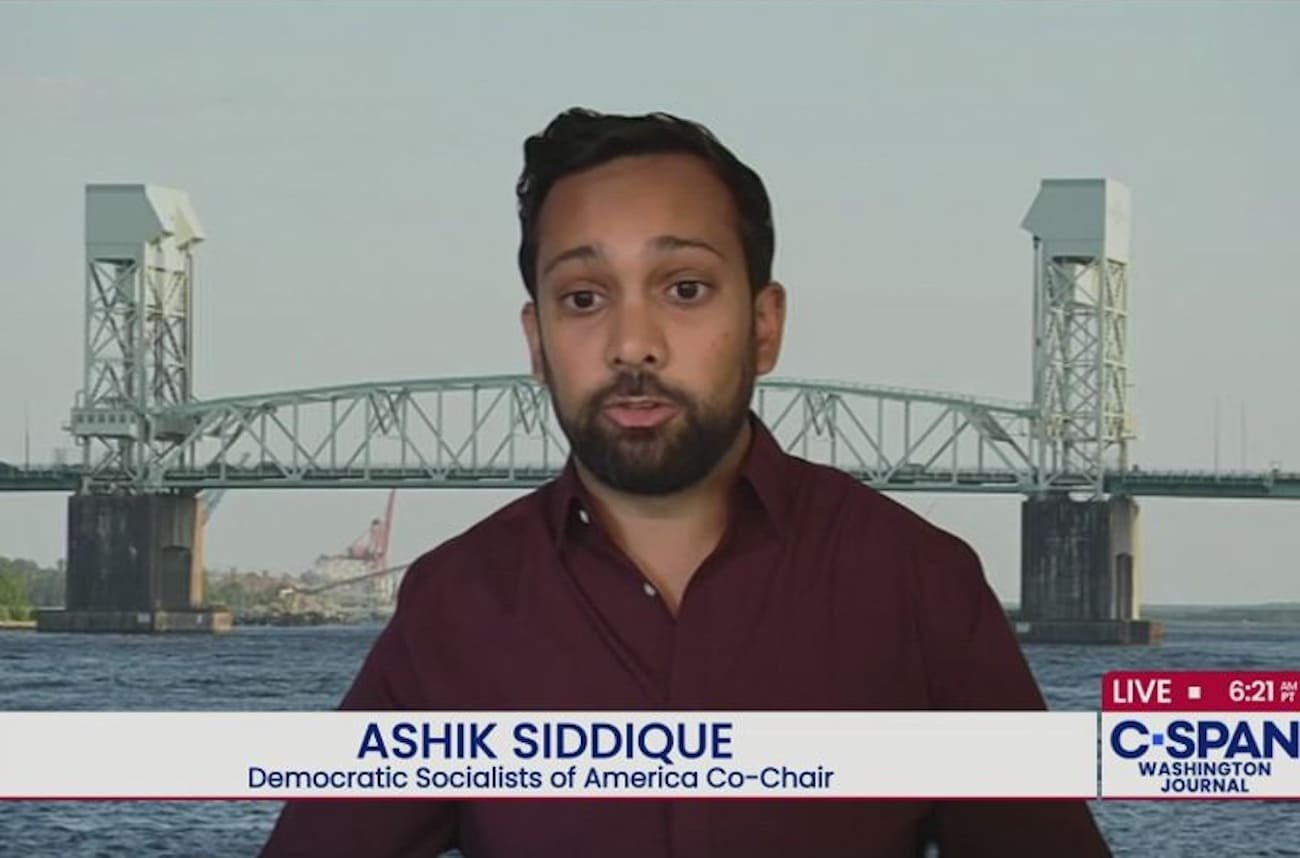

Ashik Siddique has emerged as one of the most visible South Asian Muslim figures in the American socialist movement, helping lead an organization that has moved from the political margins toward the center of Democratic primary politics.
Siddique, a Brooklyn native whose parents immigrated to the United States from Bangladesh, is national co-chair of the Democratic Socialists of America (DSA), the country’s largest socialist organization. He was first elected to its National Political Committee in 2021 and became national co-chair in 2023. At the DSA’s 2025 convention, delegates reelected him to the expanded 2025–27 National Political Committee and he remained one of its two national co-chairs, alongside Megan Romer.
His rise is significant not simply because of his position within DSA, but because it illustrates a broader development on the American left: the growing participation and leadership of Muslim and South Asian Americans in an organization whose political agenda combines economic populism, labor organizing, racial justice, immigration reform and Palestinian solidarity.
Yet it would be misleading to describe DSA as a predominantly South Asian Muslim organization. There is no reliable public demographic data establishing that South Asian Muslims constitute a majority—or even a specific percentage—of DSA’s membership.
What can be documented is that South Asian, Arab and Muslim activists have become conspicuous in parts of its leadership and in some of its most politically active chapters.
From Brooklyn to the socialist movement.
Siddique’s own political evolution is closely tied to his experience as the child of Bangladeshi immigrants.
At DSA’s 2021 national convention, he described himself as having been politicized as a Muslim after the September 11 attacks. The convention’s official notes say that his parents had immigrated from Bangladesh and that his political trajectory was shaped by becoming politically conscious in the post-9/11 environment.
That background helps explain an important element of Siddique’s politics. His socialism is not presented simply as an economic theory. It is tied to questions of race, immigration, policing, American foreign policy and the experience of Muslim Americans.
In a 2024 essay published by DSA, Siddique recalled joining the organization seven years earlier and finding what he described as a political home, fellowship and a sense of collective agency.
His professional background has also been oriented toward economic policy. He has worked as a research analyst at the Institute for Policy Studies’ National Priorities Project, which focuses on federal budget priorities and military spending.
By the middle of the 2020s, Siddique had become part of a younger generation of socialist organizers trying to turn DSA from a protest organization into an institution capable of winning elections, organizing workplaces and building durable political power.
That effort has coincided with an extraordinary expansion of DSA. Siddique told Democracy Now! in July 2026 that the organization had more than 120,000 members. The Washington Post reported this month that DSA had grown to more than 100,000 members and more than 200 local chapters.
A Leadership Increasingly Reflective of America’s Immigrant Left
The composition of DSA’s national leadership provides a window into the organization’s changing political constituency. The 2025–27 National Political Committee has 25 members. Alongside Siddique are figures including Abdullah Farooq, Ahmed Husain and Kareem Elrefai, while the Young Democratic Socialists of America is represented by co-chairs Daniel Salup-Cid and Sara Almosawi.
Several of these leaders have backgrounds that connect them to immigrant, Muslim or internationalist political organizing.
Ahmed Husain, for example, is an immigrant who says he began organizing during the Arab Spring. His DSA biography describes his work in Palestine solidarity, mutual aid, immigrant organizing and abolition in Denver and New York. He has also worked on DSA’s national boycott, divestment and sanctions campaigns.
Siddique has been closely associated with the broader DSA effort behind Mamdani’s rise. By 2026, DSA’s New York chapter had become one of the largest and most politically influential chapters in the organization.
Kareem Elrefai has been described by DSA and outside sources as an Egyptian American organizer and union negotiator active in New York City DSA. He was elected to the 2025–27 National Political Committee.
Abdullah Farooq, another NPC member, became involved in DSA through student organizing at Caltech and subsequently worked on Medicare-for-All and other socialist organizing. DSA Los Angeles identifies him as a former co-founder of Caltech YDSA.
It is important, however, not to turn names into assumptions about ethnicity or religion. Public information does not establish the religious or ethnic identity of every member of DSA’s leadership. The strongest evidence concerns individuals who have themselves publicly discussed their immigrant, Muslim or Arab backgrounds.
Siddique is the clearest example.
Why DSA Resonates With Some South Asian Muslims
The attraction of DSA for politically active South Asian Muslims appears to come from several overlapping sources rather than from a single ideological cause. First is economic politics. DSA advocates universal health care, affordable housing, free college and expanded labor rights. Siddique told Democracy Now! that the organization’s central argument is that workers should have greater control over the country’s wealth and that DSA seeks universal health care, free college, affordable child care and higher taxes on the wealthy.
Those issues have obvious appeal beyond any particular ethnic or religious community, particularly among younger Americans confronting high housing costs, student debt and precarious employment.
Second is immigration. Many South Asian American communities have direct experience with immigration systems, family separation, visa restrictions and the challenges faced by immigrant workers. DSA’s platform has emphasized immigrant rights and opposition to racial profiling. Its 2021 platform, for example, explicitly called for ending racial and religious profiling of South Asian, Arab and Muslim people by law enforcement.
Third is the post-9/11 experience. For Muslim Americans who came of political age after 2001, opposition to surveillance, profiling, war and U.S. military intervention can be an important part of political identity. Siddique’s own account of becoming politically conscious as a Muslim after 9/11 is illustrative of that pathway into socialist politics.
And fourth is Palestine.
For a younger generation of Muslim and South Asian Americans, Palestine has become a particularly powerful political issue. DSA has made Palestinian rights and opposition to U.S. military and economic support for Israel central components of its international politics.
Siddique has explicitly acknowledged the importance of the issue. In a July 2026 interview, he argued that DSA’s opposition to Israeli policies and its emphasis on Palestinian rights have helped distinguish the organization from more centrist Democrats. The Guardian likewise reported that Palestine had become an increasingly important mobilizing issue for DSA activists and candidates.
For some Muslim Americans, that stance offers something they have not always found in mainstream Democratic politics: a political organization that treats Palestinian rights as a central rather than peripheral issue.
The Mamdani Connection


The rise of New York Mayor Zohran Mamdani has made this connection especially visible. Mamdani, a South Asian Muslim immigrant and DSA member, became the organization’s most consequential electoral success when he won the New York City mayoral election in 2025. His campaign combined socialist economics—particularly housing affordability—with an explicitly pro-Palestinian foreign-policy position.
Siddique has been closely associated with the broader DSA effort behind Mamdani’s rise. By 2026, DSA’s New York chapter had become one of the largest and most politically influential chapters in the organization.
The significance of Mamdani for Siddique and DSA extends beyond one mayoral election. It demonstrated that a candidate who is Muslim, South Asian, immigrant and openly socialist could win a major American city’s highest elected office while campaigning on issues that once would have been considered politically dangerous.
Siddique has argued that Mamdani’s victory was not an isolated event but the product of years of organizing. The same strategy is now being exported elsewhere. DSA-backed candidates have scored victories in Democratic primaries in New York, Colorado and other states during 2026, giving the organization substantially greater influence over the Democratic Party’s activist base.
Beyond Identity Politics
There is a danger in explaining Siddique’s rise principally through his Muslim or South Asian identity. His politics are fundamentally rooted in an older socialist tradition: organized labor, class politics, redistribution of wealth and building institutions capable of challenging corporate power. He has repeatedly emphasized that DSA’s appeal is not simply cultural or identity-based.
In his Democratic Left essay, Siddique described his political journey in terms of learning how organized people could create power and sustain hope rather than simply reacting to political events.
That distinction matters. DSA’s South Asian and Muslim members are not necessarily drawn to socialism because they are South Asian or Muslim. Rather, for some activists, economic inequality, immigrant rights, racial profiling, American foreign policy and Palestine intersect with their experiences in ways that make DSA’s politics particularly attractive.
The organization itself has increasingly provided a political home for that intersection.
A Changing American Left
Siddique’s prominence therefore represents something larger than the career of one activist. The American socialist movement of the 21st century is more racially and religiously diverse than the stereotype of the predominantly white, industrial-era socialist movement. South Asian Americans, Arab Americans, Black Americans, Latinos, immigrants and Muslims are increasingly visible in its organizing networks and electoral campaigns.
The DSA leadership roster does not support the claim that South Asian Muslims dominate the organization. It does, however, demonstrate that people from immigrant and Muslim backgrounds occupy meaningful positions within its national leadership.
And Siddique is arguably the clearest symbol of that change.
A son of Bangladeshi immigrants who became politically conscious in the aftermath of 9/11, he now sits at the top of an organization with more than 100,000 members and a growing electoral footprint. His ascent coincides with the rise of a new generation of Muslim and South Asian politicians and activists—including Mamdani—who are testing whether socialism, immigrant identity and Muslim political consciousness can coexist within mainstream American electoral politics.
For DSA, that experiment is no longer theoretical. It is becoming an increasingly visible part of the American political landscape.