




A Mango by Any Other Name Would Taste as Sweet: How India Came to Name the King of Fruits

- India didn’t name its mangoes the way a company names a product, from the top down, for a market. People named them the way the things they love are named — locally, stubbornly, in their own languages, for their own reasons.
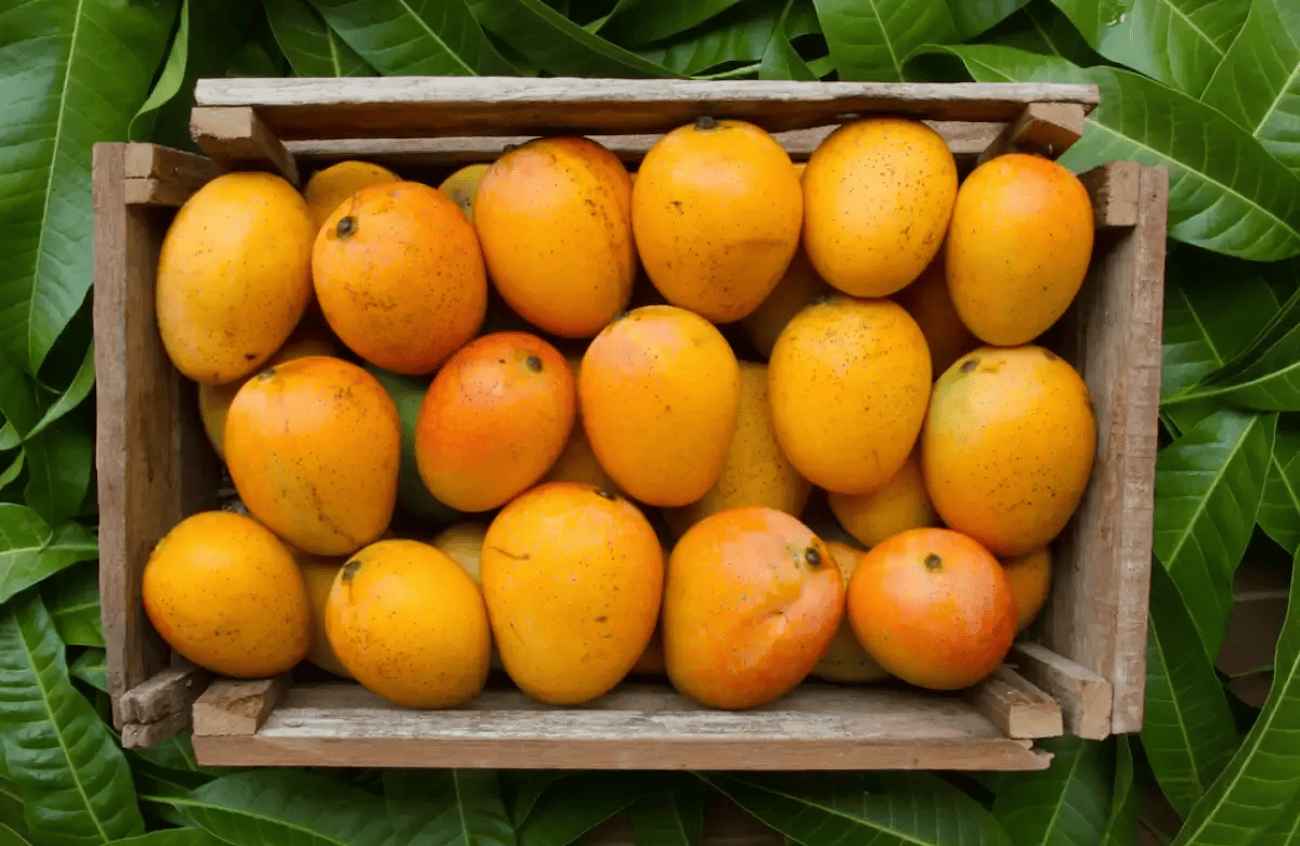

There is a mango in Costco right now called Tommy Atkins.
Tommy Atkins. It sounds like a man who does your taxes. It is, in fact, named after a Florida property owner whose backyard tree happened to produce a fruit that ships well and bruises late — which is to say, it was named after exactly the qualities that have nothing to do with how a mango tastes. (Tommy Atkins is also, historically, British army slang for a generic foot soldier, the Anglophone equivalent of “some guy.” A more honest name for this mango, I have decided, does not exist.)
I bring this up because the Tommy Atkins, bland and rectangular and reliable, is the product of a system. Someone bred it, named it, trademarked it, and put it on a truck. It has a paper trail. And holding one in a Michigan parking lot, I found myself thinking about the mangoes I grew up with in Tamil Nadu, which have no paper trail at all — which were, as far as I can tell, named by several hundred people across a subcontinent who never once spoke to each other and would have come to blows if they had.
Consider the two most famous Indian mangoes, side by side.
The Alphonso is named after Afonso de Albuquerque, the Portuguese general who conquered Goa in the sixteenth century. A nobleman. A colonizer with a coat of arms. The mango carries his name like a title.
The Langda is named after a man with a limp. Langda means “lame.” The legend — and it is only a legend, because nobody wrote any of this down — is that the variety came from the orchard of some farmer in Varanasi who walked with a limp, and the name that stuck, forever, across centuries and international borders, was essentially “that gimpy fellow’s mango.”
One fruit got a conquistador. And its neighbor? I guess, it got a note about a stranger’s gait. These two mangoes are roughly equals in quality and reputation, and they were named by what appear to be completely different civilizations operating on completely different principles. And once you notice this, you cannot stop noticing it, because the entire mango catalog is like this.
Here is what I have pieced together about how Indians named their mangoes, region by region, with — I want to stress — no central authority, no committee, no standards body, and no apparent communication between any of the parties involved.
Some people named the mango after where it grew. This is the sensible camp, and you can feel their relief. The Dasheri is named after Dasheri village near Lucknow, where the original tree still allegedly stands, roughly two hundred years old.
The Banganapalle — the pride of Andhra, the one that costs $200 a dozen if you want it shipped to America, as I once did and will not discuss further — is named after the town of Banganapalle.
Gujarat’s Kesar is named for kesar, saffron, after the color of its pulp. Gir Kesar is the same Kesar with a regional tag. These are the work of adults. You read these names and you think: yes, fine, a reasonable person was briefly in charge.
The reasonable person did not stay in charge.
Some people named the mango after what it vaguely resembled, having looked at it for approximately one second. In Tamil Nadu we have the Kilimookku — kili meaning parrot, mookku meaning nose or beak — because the fruit has a little hooked tip. Reasonable enough, except that the exact same mango is called Totapuri elsewhere, tota being parrot in Hindi: two regions, no contact, both squinted at the same fruit and independently saw the same bird.
Meanwhile Karnataka’s Badami is named after the almond (badam) it supposedly tastes like, and there exists another variety (Gadhemar) whose folk name I will not translate in full but which compares the fruit, with great confidence and zero shame, to a donkey’s anatomy. I did not invent this and I take no responsibility for it.
Some people gave up on description entirely and just told you it was sweet. The Telugu-speaking regions are the great offenders here, and I say this with love. The Cheruku Rasalu translates to “sugarcane juice.” The Panchadara Kalasa translates, and I want you to sit with this, to “pot of sugar.” Do they sound like mere names? Not to me. These are a man tasting a mango, being overwhelmed, and submitting his immediate emotional reaction as the official record. Somewhere there is a varietal whose name is functionally just the word “delicious,” and honestly, fair enough.
There is a cultivar called Malgova (Malgoa) which is a native of Salem, Tamil Nadu. The name is a derivative of paal (milk) and khova (solidified sweetened milk dessert), for the fruit’s very rich, thick, and fiberless texture and taste.
Some people gave up on description entirely and just told you it was sweet. The Telugu-speaking regions are the great offenders here, and I say this with love. The Cheruku Rasalu translates to “sugarcane juice.”
Some people named the mango after beautiful things it does not resemble in the slightest. The Mallika — a modern hybrid — is named after jasmine. The Neelum is named after neelam, the blue sapphire, which is a curious choice for a yellow fruit and tells you exactly how long anyone spent looking at it. And then there is the Amrapali, another hybrid, named after the legendary courtesan of ancient Vaishali who later became a disciple of the Buddha. Amrapali’s own name means “mango” — she was supposedly found as a baby under a mango tree. So the Amrapali is a mango named after a woman who was named after a mango. Nobody stopped to think this all the way through, and I am glad.
Some people named the mango after the people they were trying to flatter. Bengal is the spiritual home of this approach. A whole family of varieties carries the suffix bhog — food offered to a deity — so you get Gopalbhog and Lakshmanbhog and Mohanbhog, mangoes whose chief listed accomplishment is being good enough for a god. And then there is the Imam Pasand, “the Imam’s favorite,” which is not a description of the fruit at all but a customer review. No shape, no place, no color — just the testimony that an important man enjoyed it once. It is the only mango I know of that got famous on the strength of a letter of recommendation.
Some people, in the north, named the mango after a war. The Chausa — large, golden, outrageously sweet — is popularly said to have been named by Sher Shah Suri to mark his victory at the Battle of Chausa in 1539, where he routed the Mughal emperor Humayun. A military triumph, commemorated not with a monument or a coin but with a fruit. Somewhere a man is eating a battlefield and finding it pleasant.


And some people named the mango after whoever happened to be standing nearby. This is the wildest wing of the operation. The Langda, as established, is the limping farmer. Bengal’s Fazli is, by most accounts, named after a woman called Fazli — a Mrs. Fazli Bibi, of a village in the Malda region, whose entire claim to historical immortality is having owned a very good tree. Bengal’s Gopalbhog, depending on who you ask, is named after a farmer named Gopal. Across the border, the celebrated Anwar Ratol is named after a grafter’s father. There was no method. People simply looked around the orchard, noted who was present, and committed.
Now, the consequence of all this — of hundreds of regions naming fruit with the coordination of a dropped tray of marbles — is that the same mango often has three or four names, and the country has never fully sorted out which is which.
The Alphonso is Hapus in Maharashtra, which is just “Alphonso” worn down by a few hundred years of being said quickly, the way the English gave up on pronouncing “Worcestershire.” The lovely juicy Raspuri of Karnataka is the Pairi of Maharashtra — same fruit, different state, new identity, like a man in witness protection. The Andhra Banganapalle is also sold as Safeda and as Benishan. And the result is that India does not so much have a list of mango cultivars as a vast, contradictory, regionally-litigated rumor about them.
I mean litigated almost literally. The Fazli — the one named after Mrs. Fazli Bibi’s tree — became the subject of a formal Geographical Indication dispute between India and Bangladesh, two nation-states arguing before international bodies over the rightful ownership of a mango named after somebody’s grandmother. This is the natural endpoint of a naming system with no adults in it: eventually the lack of a convention becomes a matter of international law.
(I’ve written before, in a more sentimental mood, about what these mangoes actually meant to me growing up — the sacks of two hundred fruit, the smell that took over the house, the particular Tamil Nadu summer they belonged to. This is not that essay. This is me, years later, finally looking at the names instead of eating the fruit, and realizing the whole nomenclature is held together with spit and regional pride.)
And here, finally, is the thing I keep circling back to, standing in the parking lot with my honest, boring, well-documented Tommy Atkins.
The chaos is not a failure. It only looks like one if you assume there was ever supposed to be a system. There wasn’t. India didn’t name its mangoes the way a company names a product, from the top down, for a market. It named them the way a thousand separate places name the things they love — locally, stubbornly, in their own languages, for their own reasons, with no thought whatsoever for the village three hundred miles away doing the same thing to a different fruit and arriving at the same parrot. The naming convention is the history: dozens of languages, hundreds of orchards, centuries before anyone thought to draw a single border around the whole thing and call it one country with one list.
So no, nobody was in charge of naming the mangoes. That is precisely why the names are so much more interesting than the fruit in my hand. Though I’ll admit — and I want to be fair to the man — Tommy Atkins does ship beautifully.
Ganpy Nataraj is an entrepreneur, author of “TEXIT – A Star Alone” (thriller) and short stories. He is a moody writer writing “stuff” — Politics, Movies, Music, Sports, Satire, Food, etc.