




Son of India: Sir Mark Tully, BBC’s ‘Voice of India’ Who Chronicled a Nation’s Defining Moments, Dies at 90

- The Sunday Telegraph called the journalist, who covered the subcontinent for a quarter of century, "India's best-loved Englishman.”
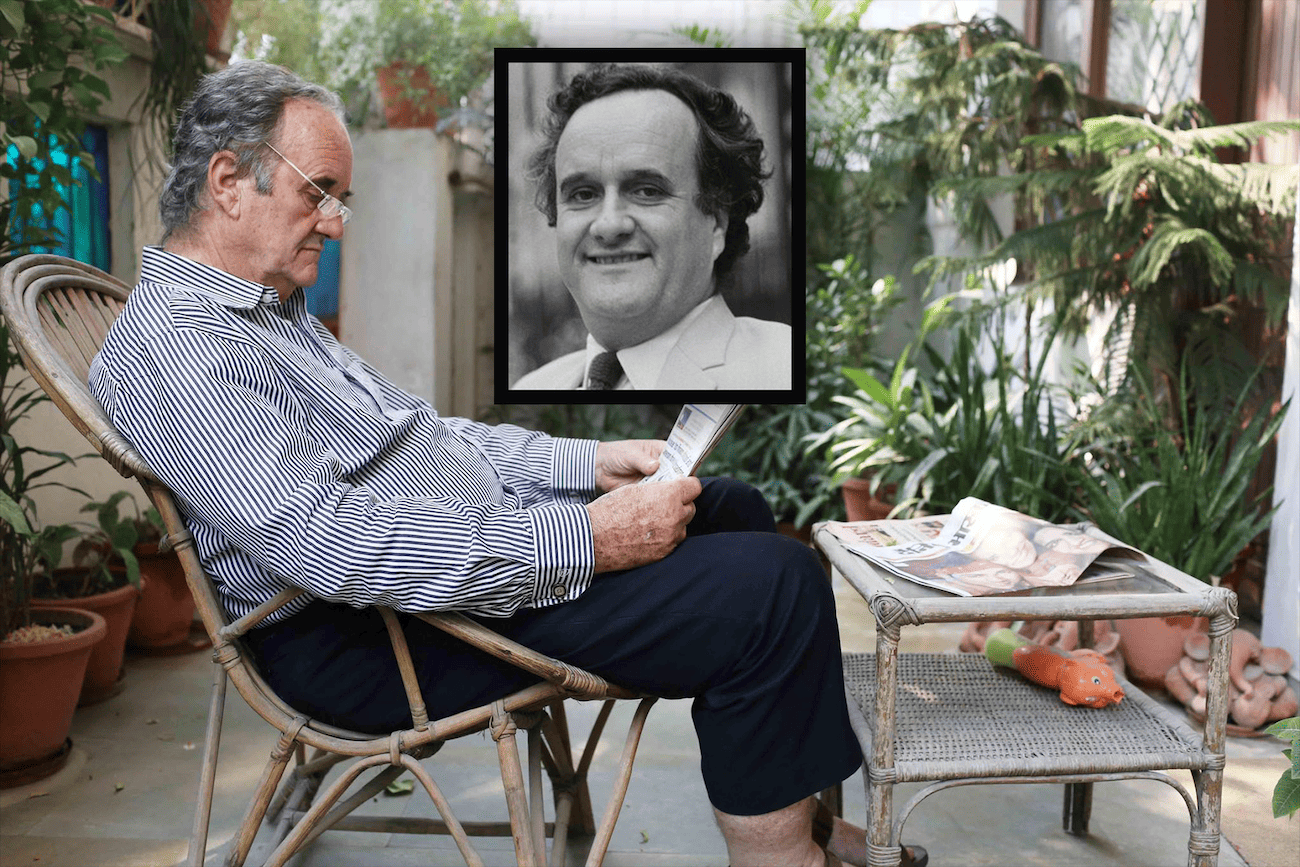

Sir William Mark Tully, the legendary BBC correspondent whose calm, authoritative voice became synonymous with news across the Indian subcontinent for more than a quarter century, died on Sunday, January 25, 2026, at Max Super Speciality Hospital in New Delhi. He was 90.
According to hospital officials, Tully passed away due to multi-organ failure following a stroke. He had been admitted on January 21 under the nephrology department. Veteran journalist Satish Jacob, who co-authored Tully’s first book and remained a close friend throughout his life, confirmed his death to PTI.
A Son of India
Tully was born in Tollygunge, Calcutta, Bengal Presidency, British India on 24 October 1935. His father was a wealthy British businessman who was a partner in one of the leading managing agencies of the British Raj.
Tully spent the first decade of his childhood in India, although without being allowed to socialize with Indian people; at the age of four, he was sent to a “British boarding school” in Darjeeling, before going to England for further schooling from the age of nine. There he was educated at Twyford School (Hampshire), Marlborough College and at Trinity Hall, Cambridge, where he studied Theology.
This colonial childhood would profoundly shape his life. In an interview with Business Standard in 2016, he reflected on his early years and the friendships that defined his career.
Tully joined the BBC in 1964 and moved back to India in 1965 to work as the corporation’s India Correspondent. Tully returned to London in 1969 to head the Hindi service and then the West Asia service, for which he covered the Bangladesh War of Independence in 1971 and the execution of Zulfikar Ali Bhutto.
It was in 1972 that Tully made the decisive shift from administrator to journalist. A lot was happening in India then. He made some of his best friends, both in bureaucracy and in politics, in those years. “Devi Lal, VP Singh, Sant Bux Singh… I loved them all,” he told Business Standard in an interview in 2016.
Twenty Years at the Helm
Tully served as BBC’s New Delhi Bureau Chief for two decades, a tenure during which he became arguably the most recognizable foreign correspondent in India. He covered all the major incidents in South Asia during his tenure, ranging from Indo-Pakistan conflicts, Bhopal gas tragedy, Operation Blue Star (and the subsequent assassination of Indira Gandhi, anti-Sikh riots), Assassination of Rajiv Gandhi to the Demolition of Babri Masjid.
His independence came with costs. He was barred from entering India during Emergency in 1975–77 when Prime Minister Indira Gandhi had imposed censorship curbs on the media. He was even expelled from the country in 1975 at 24 hours notice for refusing to sign a censorship agreement. But he returned to the country after the end of the Emergency and has been in the national capital ever since.
The Voice That Shaped Understanding
What distinguished Tully was not just his presence at history’s turning points, but how he reported them. Andrew Whitehead, a former BBC India correspondent who worked alongside Tully in the 1990s, told Business Standard via email: “Mark had such a profound understanding of India, which was, of course, the land of his birth as well as of his death… He loved India, and lived two-thirds of his life here.”
Whitehead continued: “I was struck that so many movers and shakers in Delhi regarded Mark not as a foreign correspondent but as one of their own.” An exemplary correspondent is how Whitehead described him – “probing, vivid, impartial, and with his own wonderful, idiosyncratic, broadcasting style.
Business Standard’s Aditi Phadnis captured his personal style: In that sense, Tully sa’ab, as he was known in India, lived up to an image often associated with journalists back then. Reporters were required to be hard drinking, capable of working under great pressure, and always on the side of the underdog. He was a beer drinker, but would never say no to a drop – or two, or three – of Jameson, the Irish whisky (earlier in life, he smoked smelly South Indian cheroots).
Whitehead recalled the convivial atmosphere: “Quite often Mark would say at the end of the day: ‘Why don’t you pop down for a beer.’ He enjoyed having a circle of people for a chat and gossip. He was one of the most convivial people I have met.
A Principled Departure
Tully’s BBC career ended dramatically in 1994. He resigned from the BBC in July 1994, after an argument with John Birt, the then Director General. He accused Birt of “running the corporation by fear” and “turning the BBC into a secretive monolith with poor ratings and a demoralized staff.”
Yet Tully continued his association with the broadcaster.
A Literary Legacy
Tully authored nine books that explored India with the same depth and nuance that characterized his journalism. Tully’s first book on India “Amritsar: Mrs Gandhi’s Last Battle” (1985) was co-authored with his colleague at BBC Delhi, Satish Jacob; the book dealt with the events leading up to Operation Blue Star, Indian military action carried out in June 1984.
His most celebrated work was “No Full Stops in India” (1988), a collection of journalistic essays published in the United States as “The Defeat of a Congressman.” The Independent wrote that “Tully’s profound knowledge and sympathy .. unravels a few of the more bewilding and enchanting mysteries of the subcontinent.”
Other notable works included “The Heart of India” (1995), his only work of fiction; “India in Slow Motion” (2002), written in collaboration with Gillian Wright; “India’s Unending Journey” (2008); and “India: The Road Ahead” (2011), published in India as “Non-Stop India.”
In reviewing “India in Slow Motion,” The Observer’s Michael Holland wrote: “Few foreigners manage to get under the skin of the world’s biggest democracy the way he does, and fewer still can write about it with the clarity and insight he brings to all his work.”

Honors From Two Nations
Tully’s unique position—British by citizenship but Indian in spirit—was reflected in the honors he received from both countries. Tully was made an Officer of the Order of the British Empire in 1985 and was awarded the Padma Shri in 1992. He was knighted in the New Year Honors 2002, receiving a KBE, and in 2005 he received the Padma Bhushan. He also received a BAFTA in 1985 for lifelong achievement.
The Padma Shri and Padma Bhushan are among India’s highest civilian honors and are rarely bestowed on foreigners, underscoring how deeply India embraced Tully as one of its own.
Tributes Pour In
Prime Minister Narendra Modi led the tributes to Tully. Describing Tully as “a towering voice of journalism” Prime Minister Modi said his “deep engagement with India helped shape public understanding of the country. “His reporting and insights have left an enduring mark on public discourse,” the Prime Minister said in a post on X.
Jonathan Munro, BBC News interim chief, said in a statement: “Sir Mark opened India to the world through his reporting, bringing the vibrancy and diversity of the country to audiences in the UK and around the world.”
The Sunday Telegraph had called him “India’s best-loved Englishman,” a description that Business Standard noted was exactly what Mark Tully was.
More Than a Correspondent
UNESCO’s tribute to Tully said, “For over a quarter of a century, one of the most recognized and trusted radio voices in India was that of Mark Tully. This British correspondent for the BBC has covered all the momentous events that marked the country’s recent history, until the mid-1990s. He is a living witness of the time when radio was the main medium to reach the masses, telephone communications were unreliable, and radio recordings were made on magnetic tapes that had to be physically sent to the editorial offices.”
Business Standard’s Aditi Phadnis summed up his significance: Mark Tully represented the one quality that all journalists aspire to: Credibility. He died at 90, still a British citizen but in his soul and spirit, an Indian.”
She continued: The man who got awards from the Queen (a knighthood in 2002) as well as the President of India – Padma Shri (1992) and Padma Bhushan (2005) – will always be a part of the India story. The Sunday Telegraph called him “India’s best-loved Englishman.” That is exactly what Mark Tully was.”
This story was aggregated by AI from several news reports and edited by American Kahani’s News Desk.