


Will Someone Tell Divia Thani Why Wearing a Sari is Not an Act of Resistance

- Her Vogue essay seems to suggest that the greatest challenge is choosing how to accessorize heritage while attending social events, then asks readers to treat that choice as bravery.
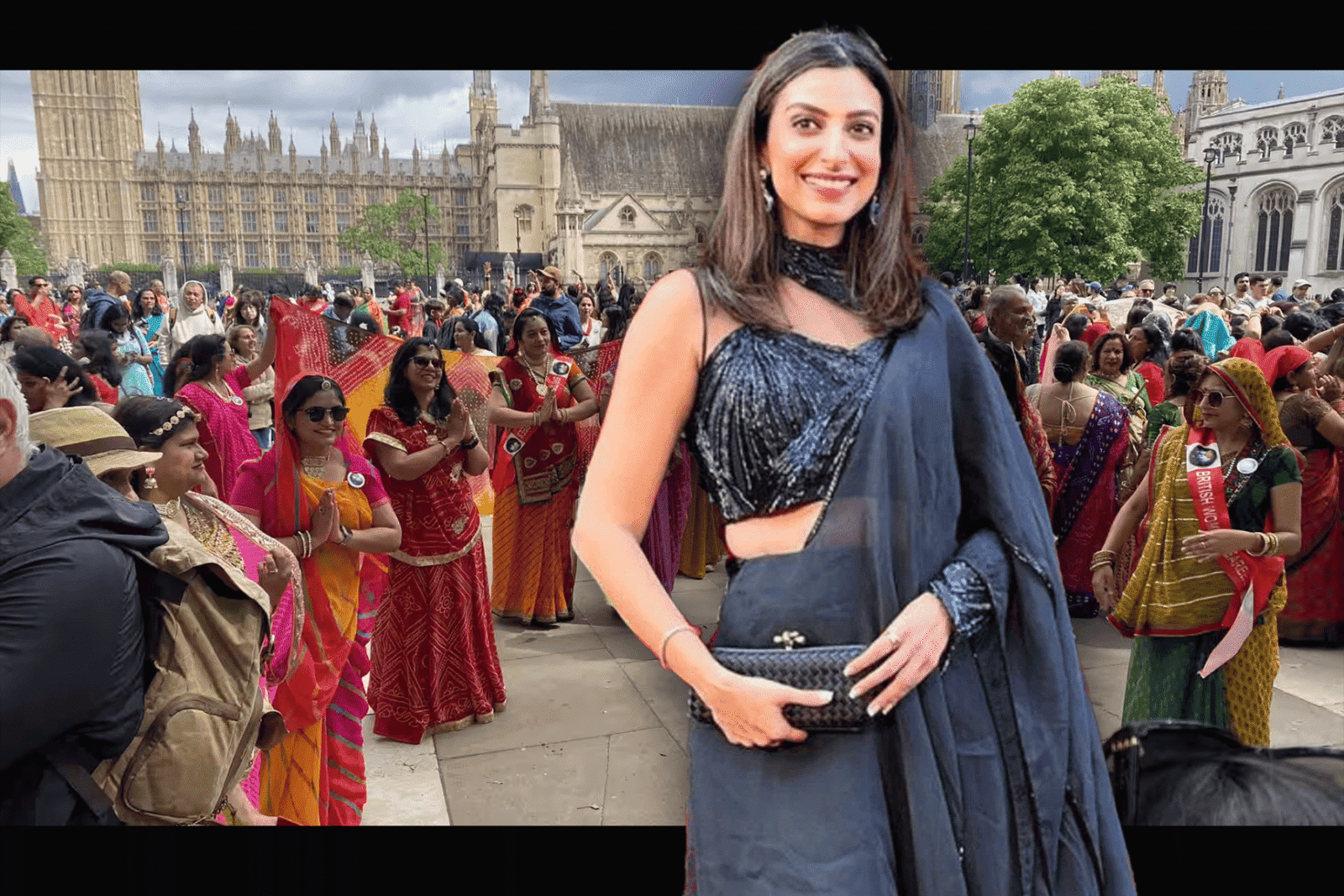

Every so often a piece of writing comes along that is so spectacularly tone deaf it almost feels like performance art. Divia Thani’s Vogue essay about wearing saris in London and discovering that this, somehow, is now a political act belongs squarely in that category. Published under the grandiose title “Wearing My Sari in London Is No Longer Just a Matter of Personal Style – It’s Political, Too,” the piece insists that an editor’s luxury fashion choices now amount to an act of resistance in an age of rising anti-immigrant sentiment (Thani is Global Editorial Director for Condé Nast Traveller). It reads less like journalism than like an Onion parody of elite media solipsism, except for the small problem that the author appears to be entirely earnest.
Here is where the disconnect becomes unintentionally hilarious. Thani recounts that she once packed “two suitcases with DKNY sweaters, blue jeans and a Michael Kors backpack with gold buckles” in order to fit in when she went to an American university decades ago, and now she fills suitcase after suitcase with saris so she can express her identity in London. Wearing an ivory hand-woven Chanderi with a Zara crop top at Wimbledon or a navy and silver number under a blazer with a black Chanel bag at lunch is transformed into a political act. Only in the fashion pages could such a scene be framed as defiance.
She writes with breathless earnestness about how a sari makes her “stand a bit straighter, a bit taller, to walk with a little swagger,” and then insists that her sartorial choices are a meaningful contribution to the fight against xenophobia. There is something almost surreal about reading a luxury fashion writer describe her sequined Manish Malhotra sari paired with Cartier jewellery and then shifting into commentary about anti-immigration marches. This would be funny if there weren’t real people suffering real consequences from the politics she gestures toward.
There is something particularly rich about someone from Mumbai, a city whose extremes of wealth and poverty are impossible to ignore, posturing in London as though she were a besieged aristocrat bravely asserting her place in society. She is not British royalty, nor is she a hunted outsider. She is a globally mobile, well connected editor whose public persona is carefully constructed, photographed and monetized. The performance of vulnerability, delivered from within a cocoon of comfort, is where the piece collapses into farce.
As one Facebook commenter bluntly put it, “An Indian woman wearing a blingy sari to an event in London is not a political statement and it doesn’t exactly make her a suffragette. Better journalism, Vogue.”
The farce is completed by the fact that in 2023, the British Society of Magazine Editors (BSME) awarded Thani a DEI honor, a designation once meant to acknowledge people who face actual structural disadvantage. Thani plainly does not. She is not marginalized, underrepresented, or excluded from opportunity in any meaningful sense. That she can be repackaged as a “diversity” figure at all exposes how emptied of substance that language has become. When institutions start handing out inclusion awards to people whose lives are defined by comfort rather than constraint, DEI stops naming injustice and becomes just another exercise in corporate self-congratulation.
What Thani is doing belongs to a wider class of writing that has become depressingly common in Western lifestyle and DEI circles, where people who are perfectly comfortable insist on being read as embattled. Editors, brand consultants, and corporate professionals now produce earnest essays about the “bravery” of visibility while enjoying secure jobs, social approval, and institutional protection. Choosing what to wear, feeling awkward in elite rooms, or being mildly scrutinized is dressed up as hardship. The language is heavy with borrowed pain, the tone grave, the risks imaginary. Like Thani’s piece, this genre works by shrinking the definition of suffering until it can comfortably include people who are doing just fine. Words once meant to describe exclusion and deprivation are repurposed to flatter those who have neither, turning inequality into a vibe and victimhood into a career accessory.
What makes this more than merely silly is the timing. There are people in Britain right now living with real fear and real deprivation. Migrants trapped in the hostile environment, asylum seekers housed in unsafe accommodation, workers denied legal status and basic protections, families facing deportation, refugees demonized daily in the press and by politicians. These people do not get to turn identity into a fashion statement. They do not get applause for “walking with swagger.” Their lives are constrained by policy, prejudice and poverty in ways that no amount of couture can approximate.


Against that reality, the Vogue essay feels like a slap in the face. It recenters attention on someone whose greatest challenge is choosing how to accessorize heritage while attending social events, then asks readers to treat that choice as bravery. As one Facebook commenter bluntly put it, “An Indian woman wearing a blingy sari to an event in London is not a political statement and it doesn’t exactly make her a suffragette. Better journalism, Vogue.”
That comment resonates because it punctures the fantasy at the heart of the piece. Loving saris, celebrating Indian fashion and feeling pride in cultural identity are not problems. Recasting those pleasures as political resistance while ignoring the scale of actual suffering is. If Vogue wants to engage seriously with immigration, racism and belonging, it should stop mistaking privilege for persecution and stop flattering writers who confuse a designer wardrobe with courage.
Vikram Zutshi is an American journalist and filmmaker specializing in religion, art, history, politics and culture.