


When the Bombs Have American Flags: On Why Liberal Democracies Keep Funding Wars They Publicly Oppose

- The violence needed to maintain Western capital’s access to markets, resources, and geopolitical control is performed in other places, on other people, in other time zones.

“It is not because they are somehow intrinsically given to violence… it is because capitalism requires violence. By contrast, the core states can have nice human rights at home because they externalize the violence that capitalism requires.”
— Jason Hickel, economist and anthropologist
This is Part 2 of a two part series. Here is the link to Part 1 .
Part 1 of this essay documented something that should not need documenting: that an active ICC arrest warrant has been issued against a sitting head of government, that the UN has found his military’s actions meet the legal definition of genocide, that UNESCO has verified damage to some of humanity’s oldest and most irreplaceable cultural sites — and that the governments most loudly committed to international law have responded with continued arms shipments, diplomatic cover, and, in the case of the United States, withdrawal from the very agencies doing the documenting.
This post is about why.
Not in the conspiratorial sense — not who planned what in which room. In the structural sense. The question is not why individual politicians are corrupt or cowardly, though some are both. The question is why this outcome is so consistent, so durable, so resistant to elections, public opinion shifts, and moral argument. Why the same result keeps emerging from administrations as different as Biden and Trump, from parties that agree on almost nothing else, across decades and scandals and wars.
When a pattern is that consistent, it is not an accident. It is a feature of a system. And to understand the system, we have to go somewhere most political commentary refuses to go.
The Contradiction at the Heart of Liberal Democracy
The economist and anthropologist Jason Hickel, a professor at the Autonomous University of Barcelona, has spent his career studying a question that most Western academics find too uncomfortable to ask directly: why do liberal democracies — governments that genuinely hold elections, protect civil liberties at home, and profess commitment to human rights — so reliably produce violence abroad? His answer is structural, not conspiratorial, which is what makes it useful.
Hickel argues that liberalism rests on a contradiction it cannot resolve. Liberal governments hold two simultaneous commitments: to the principles of democracy, rights, and equality on one hand, and to capitalism — to the protection and expansion of private capital accumulation — on the other. Most of the time, these commitments coexist comfortably enough. But when they come into conflict — when protecting human rights abroad would require constraining the profits of weapons manufacturers, or when supporting democratic sovereignty in the global South would mean accepting lower returns on Western capital — the liberal state consistently chooses capital.
Every single time.
This is why the same government that funds school lunches also funds bombs. It is not hypocrisy in the personal moral sense. It is the predictable, reliable output of a system in which, as Hickel observes, production and investment are controlled not by democratic decision but by the financial interests of those who own capital. Defense contractors like Lockheed Martin, Boeing, and Raytheon (to name a few popular ones) do not merely manufacture weapons. They shape foreign policy through lobbying expenditure, campaign contributions, revolving-door careers between the Pentagon and the private sector, and concentrated ownership of media. The decision to keep arming a government that holds an ICC arrest warrant is not made at a ballot box. It is made in a system where, as Hickel puts it, wealth confers not just power over consumption but command over what gets produced, what gets invested in, and ultimately what gets destroyed.
Hickel also offers a colder structural insight that is worth sitting with: wealthy democracies can afford to be humane at home partly because they externalize the violence their economic system requires elsewhere. The welfare state, the civil rights protections, the relatively high quality of life in Western cities — these are not contradictions of the imperial project. They are, in part, its dividend. The violence needed to maintain Western capital’s access to markets, resources, and geopolitical control is performed in other places, on other people, in other time zones. On people who will not appear in Western news cycles unless their historical monuments are damaged — and sometimes not even then.
This is not an argument against markets, or democracy, or any particular form of economic organization. It is a precise argument about what happens when economic power is sufficiently concentrated that it can reliably override political will. Most Americans support(ed) a ceasefire in Gaza. Most Americans do not support the war in Iran. Most Americans support universal healthcare. Most Americans, when polled, express more sympathy for the Palestinian people than for the Israeli government. None of this has translated into policy. Hickel’s framework explains why: because in a system where capital rather than citizens controls the direction of investment, majority opinion is a factor that can be managed, not a force that determines outcomes.
Here is a number worth sitting with: adjusted for inflation, the United States has given Israel $317.9 billion since 1951 — more than any other recipient of American foreign aid in the entire postwar era.
This is also why the “but we have elections” response falls short. Elections matter — oh! they absolutely matter for shaping many domestic policies—but they operate inside a system that has already constrained what candidates can credibly promise and what governments can practically deliver without triggering capital flight, defense-industry lobbying, and the orchestrated media campaigns that reliably follow any serious challenge to existing power. The center, as Hickel puts it, cannot hold — it will always, eventually, abandon its stated principles in favor of the one commitment it cannot abandon: capital accumulation.
A Straight Line from 1953 to Isfahan
The most clarifying example of this mechanism — and the one most conspicuously absent from American public education — is Iran.
In 1953, the governments of the United States and United Kingdom, in a CIA-confirmed and declassified covert operation called Operation Ajax, orchestrated the coup that removed Mohammad Mosaddegh, Iran’s democratically elected Prime Minister. Mosaddegh was not a communist. He was not a theocrat. He was a constitutional democrat who believed that Iran’s oil — discovered and extracted under a British monopoly (BP) that returned almost nothing to Iranians — should benefit the Iranian people. He nationalized the Anglo-Iranian Oil Company, the precursor to BP.
He was removed. Mohammad Reza Shah was installed in his place. The Shah’s secret police, SAVAK — trained and equipped with American assistance — suppressed democratic opposition for 26 years. That repression eventually generated the conditions for the 1979 revolution. That revolution produced the Islamic Republic. The Islamic Republic produced the geopolitical architecture — the regional proxy networks, the nuclear program, the axis of resistance — that American politicians now describe as an existential threat requiring military force.
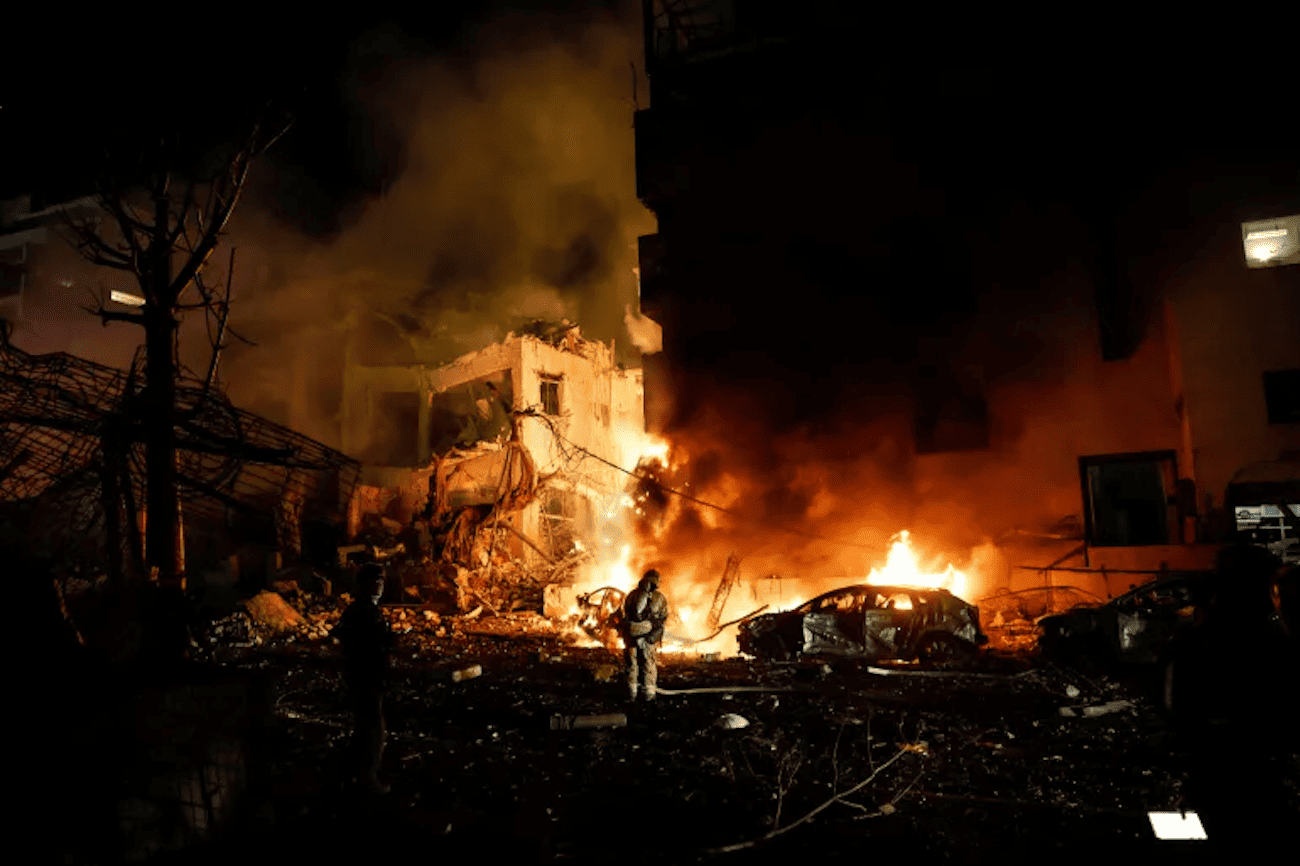
The bombs falling on Isfahan in 2026 have a direct line back to a boardroom decision made in 1953 to protect oil revenues.
That is not ideology. It is documented, declassified history. And it illustrates the mechanism precisely: a democratic government, expressing democratic values, removed a democratic leader because his democratic decisions threatened capital accumulation. Seventy-three years later, the consequences of that choice are being felt in the shattered mirrors of a 17th-century palace and in the bodies of children who never heard of Mosaddegh.
The Money and the Will
Here is a number worth sitting with: adjusted for inflation, the United States has given Israel $317.9 billion since 1951 — more than any other recipient of American foreign aid in the entire postwar era. Since October 7, 2023 alone, Congress has authorized at least $16.3 billion in additional direct military aid (and this doesn’t include the current cost of the Iran war). The baseline commitment under the current Memorandum of Understanding is $3.8 billion per year — roughly $10 million every single day — through 2028.
The United States does not have universal healthcare. It does not have free public university education. It has the highest maternal mortality rate in the wealthy world, the highest rate of medical bankruptcy, an opioid crisis that has killed hundreds of thousands of people, and a housing affordability crisis that has made home ownership functionally impossible for an entire generation.
The standard response to this comparison is that these are separate budget lines, separate political failures, and that the arms money would not automatically flow to healthcare even if the arms stopped. That is technically true, and worth saying. But it misses the point entirely. The argument is not about line items. It is about political will. The political will to fund one thing at enormous scale — consistently, across every administration, in defiance of public opinion, international law, and the findings of the world’s foremost legal institutions — while simultaneously declaring that funding anything else is simply unaffordable, reveals a hierarchy of priorities. That hierarchy was not set by voters. It was set by the same concentrated interests Hickel describes: the defense contractors, the financial institutions, the political donors for whom this arrangement is extraordinarily profitable and for whom it must therefore continue.
The American public is not stupid, and it is not confused. A majority now favors an arms embargo on Israel. A majority favors universal healthcare. A majority expresses more sympathy for Palestinians than for the Israeli government. And yet the money flows, the bombs fall on ancient palaces, and the politicians from both parties continue to insist, with straight faces, that American interests require it.
Whose interests, exactly?
Netanyahu Is Not Israel
This is the part of the argument that requires the most care — because the conflation of a government with its people, of a political project with an entire ethnicity or religion, is exactly the rhetorical trap that has been used, successfully, to silence legitimate criticism for decades. The accusation of antisemitism is wielded not only against genuine bigots but against anyone who applies to Israel the same legal and moral standards applied to every other government on earth. That weaponization of a serious word is itself a moral failure, and it has caused enormous harm — to genuine victims of antisemitism, whose claims are cheapened, and to the millions of people who have stayed silent about documented atrocities out of fear of the label.
So let me be precise: the Holocaust happened. The systematic murder of six million Jewish people by the Nazi state was one of history’s greatest crimes. The trauma of that history is real, legitimate, and demands ongoing moral seriousness. The existence of a Jewish homeland, and the right of Jewish people to live in safety and dignity, are not in question here.
What is in question is a specific political leader, running a specific government, operating under a specific ICC arrest warrant.

The silence around Gaza, around Isfahan, around the children without hospitals and the priests shot while running toward the wounded — it is not a failure of the system. It is the system working exactly as designed.
Benjamin Netanyahu is not the Jewish people. He is not Israel. He is a politician — one facing domestic corruption charges, one whose government has been the subject of sustained mass protest within Israel itself, one whose judicial power grab triggered a constitutional crisis in his own country, one who political analysts across the ideological spectrum have described as willing to prolong and expand military conflict in part to delay the domestic legal reckoning that awaits him. Many of the most searing criticisms of his government’s conduct come from within Israel — from former generals, from intelligence officials, from tens of thousands of Israelis who have marched in the streets.
The ICC did not issue a warrant for Netanyahu for being Jewish. It issued a warrant for him for the war crime of using starvation as a method of warfare, and for crimes against humanity — with the unanimous agreement of its Pre-Trial Chamber, after reviewing evidence compiled by its prosecutor.
Thousands of Jewish scholars, rabbis, activists, and public intellectuals have said what many Western politicians will not: that the actions of this specific government, in Gaza and beyond, are a betrayal of the moral principles that ‘Never Again’ was supposed to encode. The intellectual honesty to say so is not antisemitism. The refusal to say so, out of political convenience or fear of the label, is its own kind of moral failure.
What “Never Again” Was Always Supposed to Mean
The honest version of “Never Again” has no asterisks. It was not a conditional promise — that never again would Jews be subjected to such treatment. It was a universal one: that never again would any people be subjected to systematic dehumanization, collective punishment, and deliberate destruction. The institutions the world built to enforce that universal promise have now found it violated. The intellectual honesty to say so is not antisemitism. The refusal to say so, out of political convenience or fear of the label, is its own kind of moral failure.
But Hickel’s framework forces a harder question than hypocrisy. Hypocrisy implies that the right values exist somewhere, frustrated by weak or corrupt individuals who fail to live up to them. What Hickel describes is something more troubling: a system in which the “right values” are structurally subordinate to capital accumulation — not occasionally, not in edge cases, but reliably, predictably, every single time the two come into conflict.
The bombs have American flags on them not because American voters chose this, but because in a system where capital controls the direction of production, investment, and ultimately foreign policy, majority opinion is a variable to be managed, not a mandate to be followed.
Which brings us to the only question that actually matters: what changes it?
Not outrage alone — outrage is easily metabolized by a system this practiced at absorbing it. Not elections alone — elections operate inside the constraints the system has already set. What Hickel points toward, and what history suggests, is that the only force that has ever meaningfully constrained the violence capitalism requires is organized, sustained, popular pressure that makes the political cost of continuation higher than the economic cost of restraint. Every arms embargo ever imposed. Every apartheid regime ever dismantled. Every war ever ended before its architects were ready.
None of that happened because the right people were eventually elected. It happened because enough people refused to be quiet, refused to be managed, and refused to accept that the way things are is the way things have to be.
And a system that works as designed cannot be fixed by better intentions or better leaders alone. It requires something more fundamental: the willingness to see clearly, and to say plainly what we see.
The silence around Gaza, around Isfahan, around the children without hospitals and the priests shot while running toward the wounded — it is not a failure of the system. It is the system working exactly as designed.
The silence is a choice. So is breaking it.
The standard has to be the same. Or it was never a standard at all. It was always just a mirror — reflecting back only the faces we had already decided were worth seeing.
Ganpy Nataraj is an entrepreneur, author of “TEXIT – A Star Alone” (thriller) and short stories. He is a moody writer writing “stuff” — Politics, Movies, Music, Sports, Satire, Food, etc.