


The Trap of Imagined Victimhood: Indian Americans Must Learn to Laugh At Themselves and Get a Life

- Healing power of comedy can help reduce intergroup hostility and toxic tribalism in the diaspora. Here are some factors leading to religion-based grievance culture that disengages us from America’s joyful and messy mosaic.
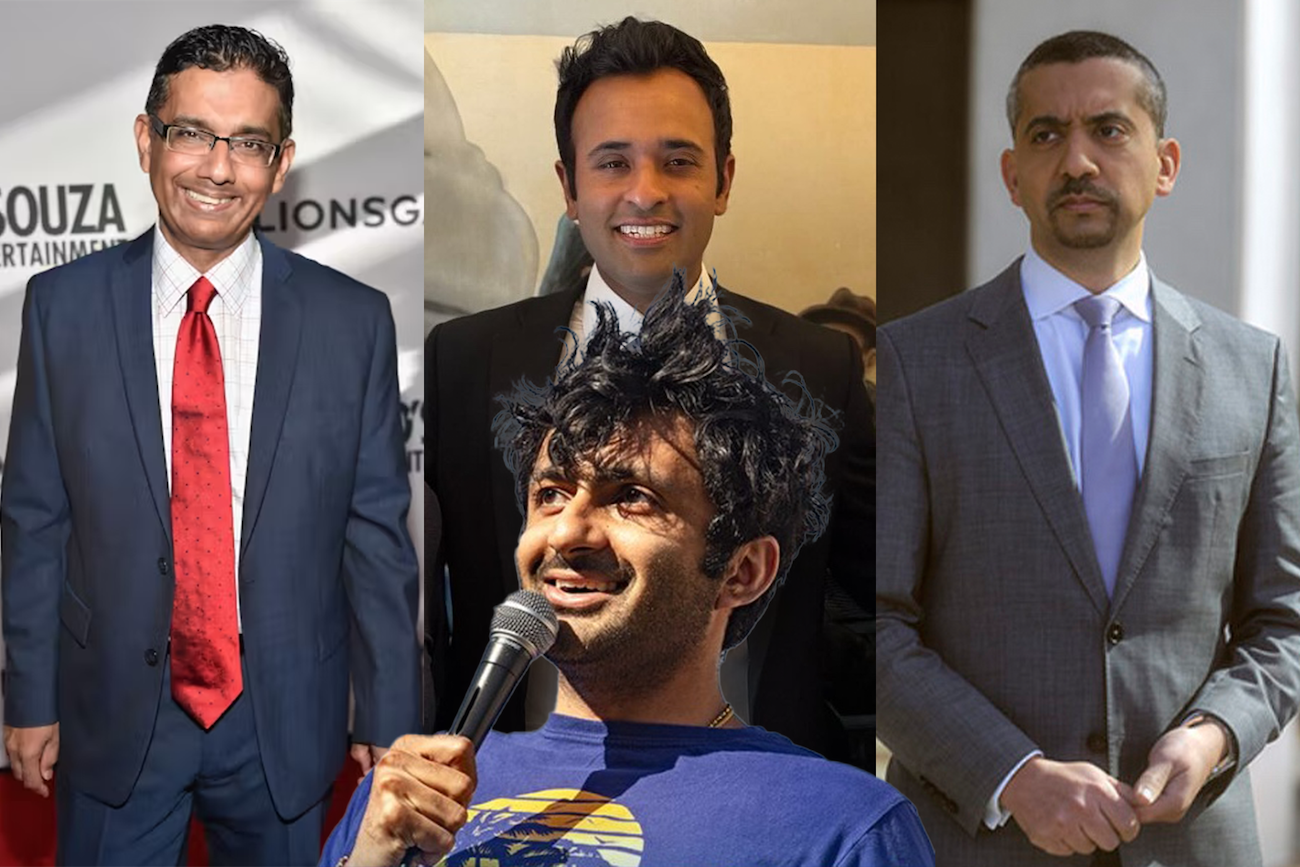

America buzzes with taco stands, jazz bars, and comedy clubs where diverse crowds eat, drink and roar with laughter, forging bonds that transcend cultural divides. Comedians like Nimesh Patel capture this in his 2020 special “Lucky Lefty,” poking fun at his Indian-Hindu upbringing with a bit on Ganesha and temple visits: “My parents dragged me to the temple every weekend, and I’m staring at Ganesha, the elephant-headed god, thinking, ‘This dude ate all the modaks and got stuck in the door.’ I’m supposed to pray for good grades, but I’m wondering if his trunk is for vacuuming crumbs or just a bad barber day. And the temple’s all smoky from incense, everyone’s squinting, and I’m thinking, ‘If Ganesha removes obstacles, why am I still failing algebra?’” YouTube.
Russell Peters, in his 2008 special “Red, White, and Brown,” roasts Indian frugality: “Indian people, we are proud of our cheapness. You are never gonna insult us by calling us cheap. … You walk up to an Indian guy ‘You guys are cheap’ … ‘Thank you for noticing, thank you.’ We’re proud to be cheap, we don’t care who knows it!” He mimics an uncle haggling at a flea market: “Five dollars? I’ll give you fifty cents, take it or leave it!” YouTube.
Dave Chappelle, in his 2003 Chappelle’s Show skit from Season 1 Episode 1, plays Clayton Bigsby, a blind Black KKK leader unaware of his race, ranting: “The message of my books is very simple: Niggers, Jews, homo-sexuals, Mexican, A-rabs, and all different sorts of chinks stink, and I hate ‘em!” The absurdity peaks when his hood is removed at a rally, revealing his Blackness to a stunned crowd, exposing racism’s lunacy YouTube. These raw, self-mocking bits turn cultural quirks into universal laughs, inviting everyone to connect.
Self-appointed Spokesperson for Hindus
This shared humanity stands in sharp contrast to X posts that spin minor critiques into epic battles, feeding an imagined victimhood. Taking oneself too seriously fuels a toxic tribal mindset that obscures common ground. Comedy’s therapeutic power, alongside actual therapy, offers a healthier path for diaspora members struggling to integrate into the culture they were born into. Vishal Ganesan, a self-appointed spokesperson for Hindus in America, exemplifies this trap, stewing in imagined victimhood on X. In one post, he writes: “Caste has been the primary lens through which the west has interpreted India for hundreds of years, mostly b/c it provided missionaries with a simple foil against which they could elevate the supremacy of Protestantism. Hindu civilization, which is defined by caste, is hierarchical, repressive, and stagnant, whereas Protestant Christianity is democratic, egalitarian, and progressive, etc.”
He adds: “Interestingly, elements of the global left have similarly engaged in the same reductivism, but for a different reasons. … The effect is a great flattening which facilitates the spread of crackpot sociological and political theories that bear no reference to actual reality.” He concludes: “In either case, it is a reductive mode of analysis that has proved disastrous for furthering actual understanding.”
His point about oversimplification has some merit, but like many of his ilk, he mirrors it by framing every critique as an attack on Hinduism, ignoring that caste has been tackled head-on by spiritual reformers like Narayana Guru, Sant Ravidas and others. His relentless victimhood narrative casting missionaries, colonial powers, and now the “elite left” as conspirators builds a tribal identity. It’s ridiculous to feel like a victim when Indian Americans, with median incomes topping $100,000, sit atop the economic food chain. While temple vandalism by hate groups and anti-Indian racism is real, they’re pinpricks compared to the centuries of slavery, genocide, or segregation endured by African Americans, Native Americans, or other minorities. Hate crimes and destruction of property are best handled by law enforcement and NGO’s, and as for alleged academic bias, this is best addressed by qualified academics and journalists, not basement-dwelling keyboard warriors.
Hasan shows zero interest in anything Western beyond mining it for relentless victimhood narratives and an unnatural fixation on religious identity.
Tribalism isn’t unique to Hindus; it’s the defining condition of our polarized era, mirroring patterns among some Muslims, Christians, and Jews. Mehdi Hasan, a UK-born journalist of Indian descent, fixates obsessively on Islam-based victimhood, framing Muslims as perpetually targeted by Western societies. In a 2009 sermon, he mocked non-Muslims as “kuffar, the disbelievers, the atheists who remain deaf and stubborn to the teachings of Islam,” comparing them to “animals, bending any rule to fulfill any desire,” and linking homosexuals to “pedophiles” and “sexual deviants” TheWrap.
He apologized in 2019, calling the remarks “stupid” and “offensive” Yahoo. Some of his complaints, such as negative media portrayals may have merit, but basing his entire career on tribal grievances is pathological, sidelining broader societal dialogue. Besides, other communities, including Hindus, have expressed similar concerns about unflattering media stereotypes. Similarly, some Jewish commentators in the West, like certain voices on X, amplify narratives of antisemitism as an omnipresent threat, framing every critique of Israel or Jewish institutions as an attack on their identity. This mirrors Hindu and Muslim hyper-vigilance, where group loyalty overshadows pluralistic engagement, fostering a defensive mindset that isolates them from broader cultural connection.
Hasan shows zero interest in anything Western beyond mining it for relentless victimhood narratives and an unnatural fixation on religious identity. His career as a journalist has been largely focused on Islam—nothing else on planet Earth seems to interest him.
Ganesan and Hasan are emblematic of a larger neurosis afflicting swaths of the diaspora, where second-generation immigrants, born and raised in the West yet strangely estranged from its everyday rhythms, retreat into religion-based identities that feel more urgent and “authentic” than the fluid, hybrid lives they actually inhabit. We’re not attacking them personally but spotlighting a malady: the reflexive urge to armor one’s heritage against imagined assaults, morphing cultural pride into a perpetual siege mentality that demands constant vigilance.
Dinesh D’Souza embodies this on the right, his militant Christianity and far-right crusades paralleling Mehdi Hasan’s unyielding Islamic fixation, while Vivek Ramaswamy offers a subtler variant, repackaging Hinduism into a palatable, muscular conservatism tailored for Christian nationalists, stripping away its philosophical nuance to fit neatly into America’s culture-war playbook.
Growing up Indian American, many balance their parents’ heritage with America’s melting pot. Some lean into their roots for stability, especially if teased for their culture, like a classmate mocking their lunch or religious customs, or girls making fun of their dorkiness. Being a dweeb or nerd, retreating into niche online spaces or academic bubbles, can heighten social isolation, fueling religious tribalism. How else does one explain someone born in the West adopting a worldview more tribalistic than their counterparts in Mumbai or Delhi, where cultural blending is often more fluid?

A 2019 study in British Journal of Social Psychology found that “group-based victimhood” fosters a cognitive bias where individuals perceive their group as uniquely persecuted, reducing their ability to empathize with others’ struggles and reinforcing divisive identities Wiley. For those glued to X with little social life, slights become crusades. A 2020 study in Personality and Individual Differences found that “perceived victimhood” creates a self-reinforcing cycle, where individuals exaggerate threats to their group, leading to heightened defensiveness, social withdrawal, and reduced willingness to engage with out-groups ScienceDirect. A 2021 study in Frontiers in Psychology adds that this mindset diminishes empathy for others’ suffering, as individuals become fixated on their own group’s grievances, often ignoring broader societal contexts Scientific American.
Never at Home in the West
For Ganesan, Hasan, and D’Souza, religious identity functions as a trauma response to the subtle disorientation of diaspora life. Raised in the West yet never fully at home, they clutch faith like a life raft, transforming childhood alienation—schoolyard taunts, parental nostalgia, the quiet ache of not belonging—into a grand narrative of eternal persecution. Ganesan recasts every caste mention as colonial assault; Hasan turns airport pat-downs into civilizational jihad; D’Souza spins liberal secularism into a war on Christianity. The louder they proclaim their tribe, the more they drown out the inner whisper of rootlessness, mistaking volume for belonging.
America thrives on blended identities. Patel’s Ganesha bit resonates with anyone navigating family piety. Peters’ cheapness roast connects with immigrant denial. Chappelle’s Bigsby skit exposes racism’s absurdity for all to laugh and reflect. Their laughter is therapeutic, reframing pain as human, not tribal, inviting connection. A healthier approach is American first, Indian second, Hindu/Muslim/Christian/Sikh third. American means embracing a diverse nation. Indian roots ground you. Religion becomes a quest for spiritual truth, not an endless crusade. Comedy offers a stage where cultural quirks become shared jokes, letting everyone from temple-goers to Punk rock-lovers find common ground. Laughter slices through the fog of grievance, drawing Indian Americans and everyone else into the joyful comedy of America’s messy, mosaic culture.
It would also help to abandon the binary lens of “the West and the Rest,” which fuels the neurosis at its core, and instead view the world as a vast mosaic of races, religions, ethnicities, and wildly divergent modes of being and relating to the universe—shedding the U.S.-centric frame for a planetary one where borders blur and humanity shares a single, fragile home that is increasingly threatened by environmental destruction, climate change, rampant inequality, wars and genocide.
To protect themselves from the pernicious forces of toxic tribalism and political or religious demagoguery, Indian Americans need to internalize a couple of Sanskrit expressions : Vasudhaiva Kutumbakam (the world is one family) and Aham Brahmasmi (I am the Universe). That combined with yoga, meditation, an attitude of gratitude, and plenty of sunshine and laughter can lay the foundation for a real frontier dharma – one that can help them accept the inherent messiness of modern life and ride out the choppy waves of the historical moment they are passing through.
Vikram Zutshi is an American journalist and filmmaker specializing in religion, art, history, politics and culture.