



The Settler Complex and Unrequited Embrace: How Israelis Look Down on Indians

- In the Zionist worldview — as in the reality of Israeli behavior across India’s hills and beaches — Indians are useful. They are not equals.
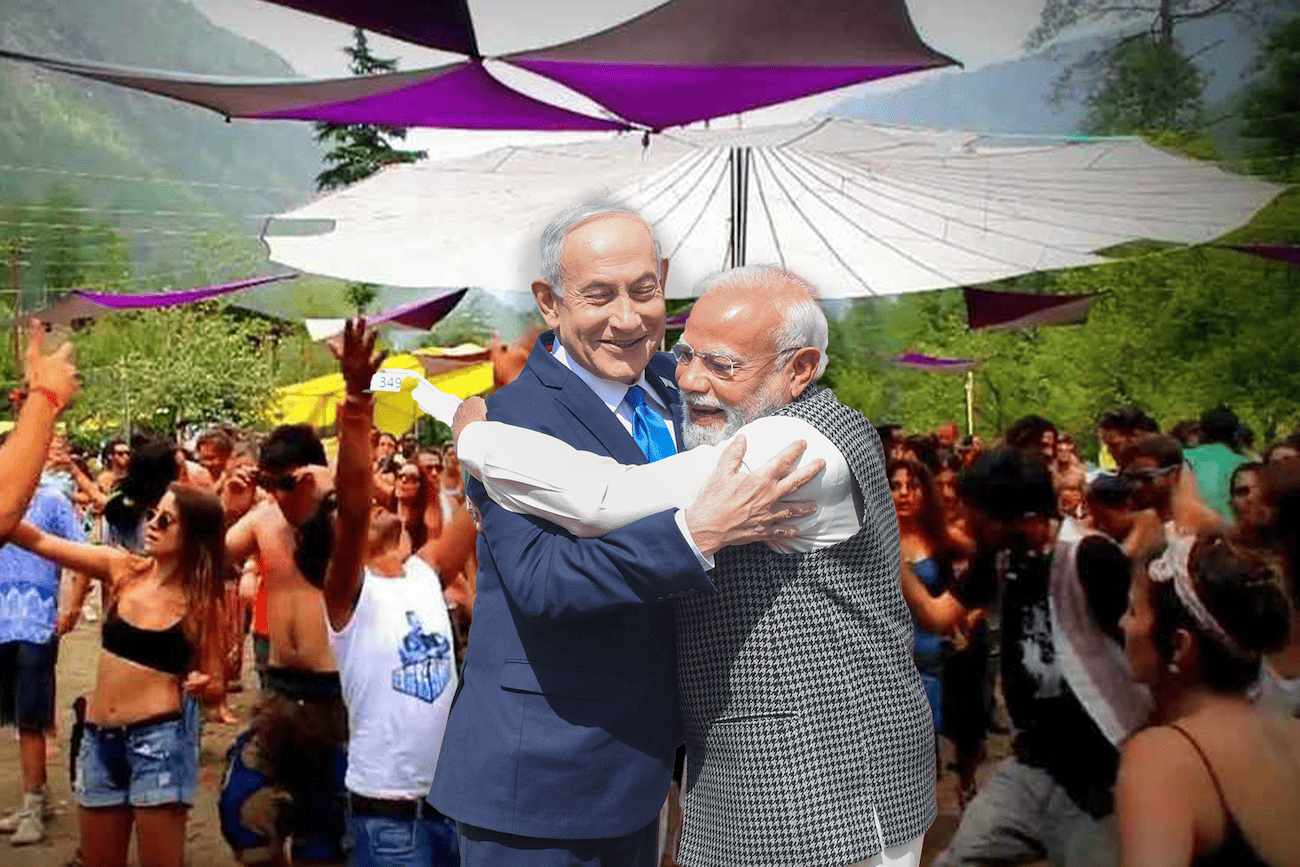

In 2015, a young Indian woman walked into theFreekasol café in Kasol, Himachal Pradesh, and sat down. She asked for a menu. Nothing came. The staff walked past her. Her British companion, seated beside her, was served promptly. The café, Israeli-themed, run by those with deep Israeli connections, operating on Indian soil — had an unspoken but apparently firm policy: Indians need not apply. A video of the incident went viral. An Israeli patron, interviewed on camera, explained without embarrassment that Indians “can’t be trusted” to pay.
This happened in India. In Himachal Pradesh. In a district whose economy depends significantly on Indian domestic tourism. In a café operating under Indian law, on Indian land.
It was not an isolated incident. It was a glimpse of something larger.
Mini Israel, Himachal Pradesh
Kasol is called “Mini Israel.” So is Dharamkot, a few hours north near Dharamsala. The names are affectionate…a tribute to the overwhelming Israeli tourist presence that has shaped both villages over the past two decades. Walls painted in Hebrew. Menus in Hebrew. Guesthouses catering exclusively to Israeli tourists. Cafés where the music, the food, and the clientele are almost entirely Israeli. Businesses that have quietly made clear, through policy or atmosphere, that Indian locals are not the intended audience.
This is not simply a story about tourists who prefer their own company. What has developed in Kasol, Dharamkot, and along Goa’s Arambol beach is a pattern of cultural enclosure, spaces where a foreign community has embedded itself so thoroughly that local Indians experience their own land as foreign territory. A retired diplomat might call it a sphere of influence. An investigative piece by Vashtimedia called it something sharper: a pattern eerily reminiscent of settlement behavior.
The communities are predominantly made up of young Israelis completing mandatory military service — men and women in their early twenties who come to India specifically to decompress after years in one of the world’s most heavily armed and psychologically demanding militaries. They arrive in numbers, they arrive with money relative to local incomes, and they arrive with a strong collective identity that makes integration with local communities not just unlikely but apparently undesired.
The Rishikesh Kirtan Fest controversy of early 2026 — where Indians were reportedly denied entry to a spiritual festival held on Indian soil while foreigners moved freely through the gates, is merely the most recent episode in a pattern that stretches back a decade. Even in sacred spaces, even in one of Hinduism’s holiest cities, the hierarchy asserts itself.
Back Home: The Hierarchy Confirmed
If the enclaves in India made the hierarchy implicit, what happened in Ashkelon in late 2025 made it explicit.
Two Indian construction workers from Uttar Pradesh were beaten in a public park in Ashkelon, Israel. This was not a random assault. Israeli public broadcaster Kan described it as premeditated and racially motivated — coordinated in advance through WhatsApp, the attackers deliberately targeting Indian workers in the neighborhood. The attackers were arrested. Israel’s government condemned the violence. But the condemnation could not obscure the context.
These men were in Israel because India sent them. Specifically, India signed a bilateral labor agreement in 2023 to supply construction workers to Israel, primarily to replace Palestinian workers whose permits had been revoked en masse in the weeks after October 7. Hindu men from UP and Bihar, recruited through agencies that reportedly advertised positions for “Hindu workers only,” refusing to process Muslim applicants. They were not there as tourists. They were not there as pilgrims. They were there as bodies — as a solution to a labor shortage created by the dispossession of another people.
Welcome to Israel. Know your place.
NGO FairSquare called on the Indian government to refuse the labor agreement, citing exploitative recruitment conditions and the ethical implications of sending workers to fill roles vacated by Palestinians living under military occupation. The Indian government proceeded anyway. Today there are approximately 32,000 Indian workers in Israel, building homes in a country at active war.
Also in 2025, an Indian-Hindu man was kicked by an Israeli Rabbi during a prayer gathering. Filmed. Circulated. Briefly noted — then forgotten by the governments of both countries.
These are not diplomatic incidents. They are data points in a pattern.
What has developed in Kasol, Dharamkot, and along Goa’s Arambol beach is a pattern of cultural enclosure, spaces where a foreign community has embedded itself so thoroughly that local Indians experience their own land as foreign territory.
The Handshake: February 25, 2026
On February 25, 2026, the Indian Navy concluded its biennial MILAN naval exercises in the Bay of Bengal. Among the participating vessels was the IRIS Dena, a Mowj-class frigate of the Iranian Navy. Iran and India, friends, naval partners, exercising together in Indian waters — an expression of a relationship that has been warm, stable, and strategically significant for decades.
On the same day, Narendra Modi landed in Tel Aviv.
Over the next two days, Modi became the first Indian Prime Minister to address the Knesset. He declared that India stands with Israel “firmly, with full conviction, in this moment and beyond.” And went onto say, “Israel is the Fatherland and India is the Motherland.” He called Benjamin Netanyahu — a man the International Criminal Court has issued an arrest warrant for — his brother. Twenty-seven bilateral agreements were signed. The relationship was elevated to a “Special Strategic Partnership.”
Among the beneficiaries: Gautam Adani. Adani Defence & Aerospace, which already holds a 70% stake in Haifa Port and operates a joint venture with Israeli defense firm Elbit Systems producing drones used by the IDF, walked away with a ₹2,770 crore contract to supply carbines to the Indian Army, co-produced with Israel Weapon Industries. Defense deals announced alongside or in the wake of the visit are estimated at $8–10 billion in total. The optics of a Prime Minister whose closest industrial ally profits directly from the relationship being “elevated” did not appear to trouble anyone in South Block.

Modi flew home. Less than 48 hours later, U.S.-Israel strikes on Iran began.
Multiple credible outlets — Bloomberg, Nikkei Asia, Sunday Guardian — have since asked openly whether Modi was briefed on the planned strikes before he departed Tel Aviv. Whether he knew or not, the effect is the same: India’s Prime Minister embraced the architect of an attack on India’s long-standing partner at the precise moment that attack was being prepared. A retired Indian diplomat told reporters the visit had “diminished India’s stature in the eyes of the world.” The Deccan Herald called it “a diplomatic embrace that will cost India dear.”
Cost India dear. The phrase would prove more literal than anyone anticipated.
The Unrequited Embrace
There is an ideological kinship between Hindutva and Zionism that its practitioners make little effort to conceal. Both movements draw from a template of religious-ethnic nationalism — a vision of the state as the expression of a civilizational identity, shaped by the logic of a threatened majority. Both have made the Muslim the primary figure of internal threat. Both have found in each other a mirror that flatters.
Hindutva circles have admired Israel for years. They see in its military assertiveness, its settler project, its unapologetic ethnic character, a model for what Hindu nationalism might become. The admiration is genuine, vocal, and largely one-directional.
The people who will not serve Indians in cafés in Kasol are not confused about the hierarchy. The young men who coordinated an attack on Indian workers in Ashkelon via WhatsApp are not confused. And Netanyahu, standing beside Modi in Jerusalem, calling him “more than a friend” — Netanyahu is not confused about it either. He knows precisely what India represents to Israel: a large democratic market, a source of relatively cheap skilled labor, a useful bilateral partner, and now, apparently, a government willing to provide the political legitimacy of a Knesset address as cover for military action that India’s own diplomatic tradition should have made unthinkable.
Modi called Netanyahu a brother. Note carefully what Netanyahu called Modi: a friend. Not a brother. A friend.
In the Zionist worldview — as in the practical reality of Israeli behavior across India’s hills and beaches — Indians are useful. They are not equals. The Hindutva dream of brotherhood with Israel is a dream Israel has never shared and has no interest in sharing. The ideology that connects these two movements is not mutual respect or civilizational kinship. It is a shared enemy. And shared enemies make temporary allies — never brothers.
The hierarchy is clear. Indians are excluded from cafés in their own country. Indian workers are beaten in Israeli streets. And India’s Prime Minister, having handed Israel the political legitimacy of a Knesset address and handed Adani a billion-dollar arms contract, has nothing to say.
Ganpy Nataraj is an entrepreneur, author of “TEXIT – A Star Alone” (thriller) and short stories. He is a moody writer writing “stuff” — Politics, Movies, Music, Sports, Satire, Food, etc.
I think Mr. Ganpy Nataraj’s article does not promote a positive image of India. It reminds me that when I was working in Dubai, a delegation of Indian businessmen was allowed to express their dissatisfaction to the Ruler Shk Mo, that Indian labor was enslaved and not treated well. Shk Mo in his endless wisdom simply said “You can take all the Indian labor back home and for every one there are two in India who will want to work in Dubai. India has a problem. India needs to improve its image including their behavior. Indians need to get smart. They are a handsome race but wrap their faces with towels!!!!