



Chile geographically is fascinating. I’d call it the Land of Fire and Ice, as it’s a total mix of extremes with scorching Atacama desert in the north and icy Patagonia in the South. It is also one long and narrow country with Pacific ocean and Andes mountain ranges in the east and west respectively, running through its entire longitudinal stretch of 2,500 miles. With its width averaging a mere 112 miles, I was wondering how Chileans might have more neighbors in bordering countries than their own countrymen. It shares borders with Peru and Bolivia in the North and Andes with Argentina in the East, and Antarctica’s basically just a hop away.
We stayed in San Pedro de Atacama, this super chill town, to explore the Atacama Desert. Very rustic, but the town suddenly lights up at night when the tourists come back from their day trips. Our hotel rooms were tiny (guess our luggage didn’t get the memo), but we loved how the hotel blended in with the desert. I am not complaining about our “exfoliating” towels either, probably rough from how they get washed in the desert but I’m pretty easy to please on vacation, though.
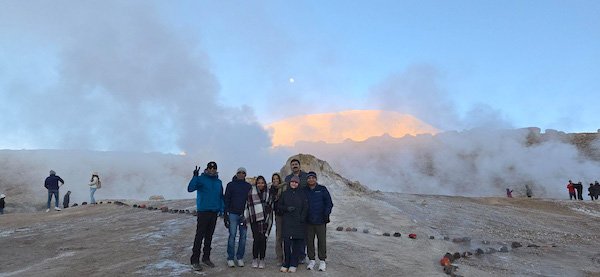
The stargazing experience we signed up for started a mere hours after we checked in. Since the temperatures are expected to drop at nights in the deserts, we bundled up for the activity. The moon was in the spotlight that day (the day after the full moon), stealing the show from the stars, but as I am not in the habit of complaining, I was happy to gaze at the moon (that too rising, my net new experience) — bonus when the guide snapped pics through her telescope.
The next couple of days were jam-packed with adventures. We had to drive long distances in rugged and windy roads in high altitudes of over 14,000 feet and some of us felt the impact — “motion + altitude sickness = double the fun.” We were given very little time to get acclimated and the coca leaves helped only a little with our headaches, dizziness, and nausea. But we pushed on, heads held high!
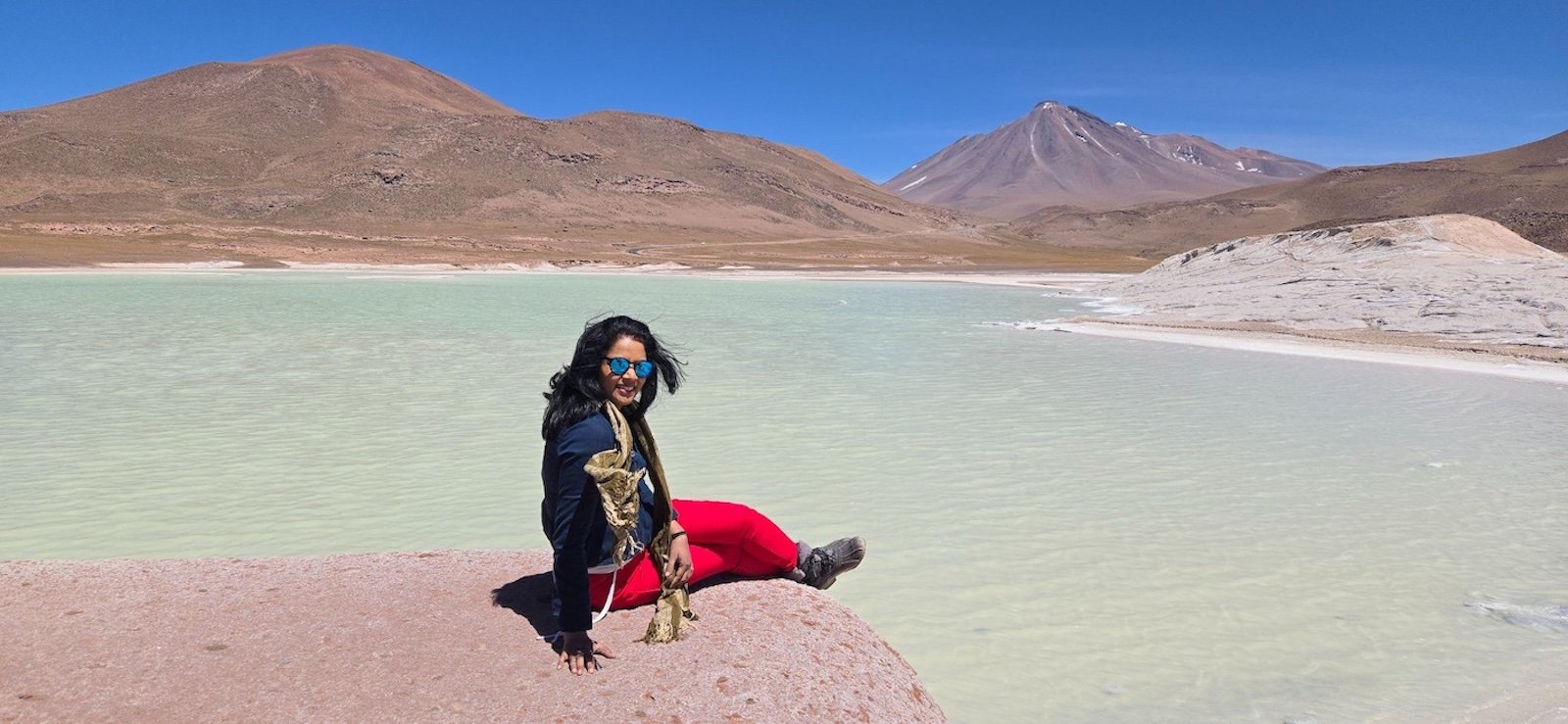
Altiplanic lagoons, a series of high-altitude lakes in the Andean plateau, are on the agenda that day. As we marveled at these remote oases like water bodies set against vibrant volcanic landscapes, I kept wishing for saris in those jade green lake colors.
A bonus that day was a trip to the stunning Flamingo reserve with black and white flamingos, a striking contrast to their typically pink counterparts. Knowing that the pink ones get their colors from eating shrimp, I wondered what the black and white ones ate. My silly yet curious mind also wondered how much shrimp one, one human that is, has to eat to start showing colors. We passed through the Tropic of Capricorn on our way to the hotel.
Chile’s culinary offerings were satisfying, but it was the beverages that truly impressed. The Pisco Sour, and its tastier cousin, the Calafate Sour, popular in Patagonia, were delightful indulgences that required accommodation within my daily caloric allowances. In fact, Chileans are so good at mixology, they even created a recipe for this cocktail called “Terremoto” which is reserved to be enjoyed during these frequent earthquakes they experience. My thoughts at this point were drifting to what Nero was doing when Rome was burning.
From the local cuisine, we got to try sopaipillas and empanadas in the street food category but their national dish, pastel de choclo — a corn cake stuffed with, get ready, meats and boiled eggs, topped with, get ready once again, caramelized sugar, felt like a combination of main course and dessert, but interestingly it works. The popular “Chilean bass” (or simply bass since we were in Chile) was MIA from the menus, but their juicy shrimp made up for it.
We opted for two optional tours the next day, I am not sure why they were optional, they should both be made mandatory to all Atacama visitors — they were amazing experiences. Geysers in the El Tatio region reminded me of Yellowstone but we got to get much closer to the geothermal activity making it a more immersive experience however, the sobering reminder from our guide about a tragic incident involving some tourists that fell into a mud pot and died acted as a caution and we took pictures from a safe distance.
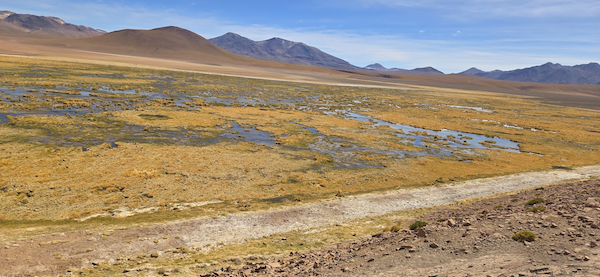
On the way back, we stopped for breakfast in the serene Machuca wetlands, a beautiful and greener contrast to the desert landscape. As our guides were setting up breakfast, we took pictures of various birds inhabiting this picturesque haven. When our guide introduced us to yareta, the blood-sugar-regulating plant, my inner diabetic wanted to try some but its endangered status – thanks to over-harvesting and slow growth rate – meant it was strictly off-limits, leaving me to manage my diabetes in other ways. The lime green cushion-like plant was photogenic however.
Since Chile is in the Southern Hemisphere, their seasons are the exact opposite to ours in the U.S. December-January being Summer, we packed more clothes for warm weather which only worked in Santiago. Patagonia was expected to be cold anyway but we ended up dressing like onions each day in the North, peeling layers as the day progressed.
Spanish is a Global language widely spoken in Latin America, making it a self-sufficient landscape that reduces pressure on native speakers to learn English. Even with the number of tourists they serve, I am surprised that even basic English phrases like ‘yes’ and ‘no’ seem elusive to some locals.
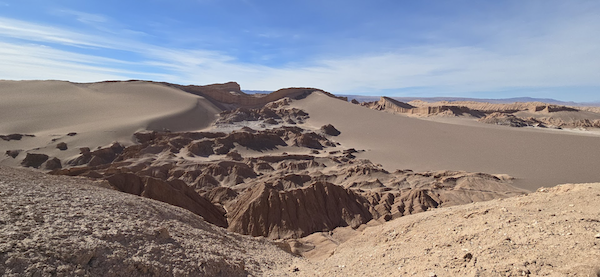
50 shades of brown is how I would describe Valley of the moon, which was our post lunch activity that day. It felt like we had Utah’s hoodos, South Dakota’s badlands, and towering Namibian sand dunes all in place and it was confusing and overwhelming to us. Like that’s not enough, the Valley of the Moon, part of the Cordillera de la Sal range, offers a staggering panorama with the Andes on one side and the Domeyko range on the other, making it a complete geological mashup. Sunset that day with a glass of Pisco sour was a beautiful end to the day!
Spanish is a Global language widely spoken in Latin America, making it a self-sufficient landscape that reduces pressure on native speakers to learn English. Even with the number of tourists they serve, I am surprised that even basic English phrases like ‘yes’ and ‘no’ seem elusive to some locals. Despite some of us having a few Spanish words under our belts, it was difficult to understand as Spanish requires more syllables, more words, and longer sentences to convey the same meaning as English and is also spoken fast to catch up I guess.
Although Google translate came to our rescue, we also ended up in a few funny situations, one of which was at the airport in Calama. We were scheduled to board the plane as group 2 and stood in line as group 1 was wrapping up. As the counter lady refused to let us board, we thought they weren’t ready for group 2, so went back in line and joined when it was clearly our turn. When she refused again and we began arguing in our respective languages, the manager stepped in and clarified that we were trying to board the wrong flight.
Nothing to do with Spanish, but more to do with our luck, our flight that day just happened to be carrying the winning soccer team from Concepcion. Along with the team, we also waved at the fans who came to welcome them in Santiago.
Santiago, the capital city of Chile is situated in the Central valley, this fertile region in the middle of the country. Enclosed by mountains, this sprawling, flat basin is a gorgeous and practical place to live – no wonder roughly 50% of Chile’s 20 million people call it home. Public transportation is good with Subway covering much of the city, and buses taking care of areas that Metro doesn’t reach.
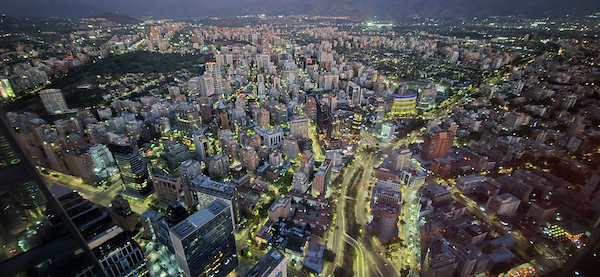
With the evening free in Santiago, we set out to eat and shop, only to find most restaurants and shops had already closed for the day. We learned later that Dec 8th is a major Catholic holiday in Chile. We spent the rest of the day at Castanera Center mall, which also happens to have a skyscraper, Gran Torre, which is 300 meters tall.
Views of sprawling Santiago from the observation deck, with mountains on all sides and Mapucho river, the city’s main water source, dividing the city were breathtaking. That day and almost everyday of the trip in Santiago, we got multiple reminders from our guides, waiters, and merchants, to be careful with our purses and phones. Having lost my passport in Portugal, I tried to be extra vigilant.
Mining contributes significantly to Chile’s GDP, especially Copper and Lithium making up nearly 60% of its exports. Thanks to its long coastline, the country’s fishing industry’s a big export player. With wineries spread all over the country, this South American nation is also one of the top exporters of wine. Chile’s unique landscapes from Atacama desert to Patagonia, make tourism a key source of revenue. May not be significant, but Chile also produces and exports lapis lazuli, this blue stone you see everywhere in Santiago markets.
We had a guided city tour the next day. Like quintessential tourists, we wandered Lastarria’s cobblestone streets, admiring colonial mansions, enjoyed views of the city from Santa Lucia hill, posed among the sculpture garden’s art pieces by the Mapocho River, and snapped photos of historic buildings. Highlight however was Alejandro, our 76 year old guide who walked with a spring in his step sharing insights about his home town enthusiastically.
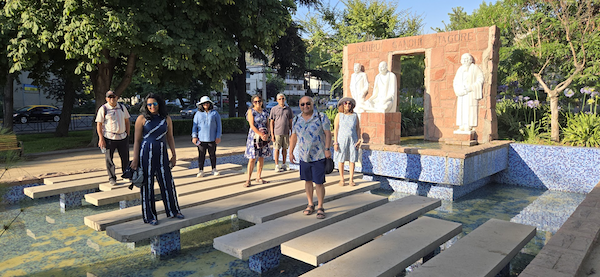
Post lunch, after making a failed attempt to take the cable car, we decided to go to Plaza de la India, a charming park featuring statues of Gandhi, Nehru, and Tagore with a fluttering Indian flag. The India connection was unclear, but we couldn’t help feeling a sense of pride – captured it all in pictures.
Most Chileans are Mestizo (mixed European/Native American) although you see more indigenous people especially Mapuche living in Patagonia. Spanish dominates, but you’ll stumble upon Native American words sprinkled throughout. Historically Catholicism is dominant but Protestants are growing in number.
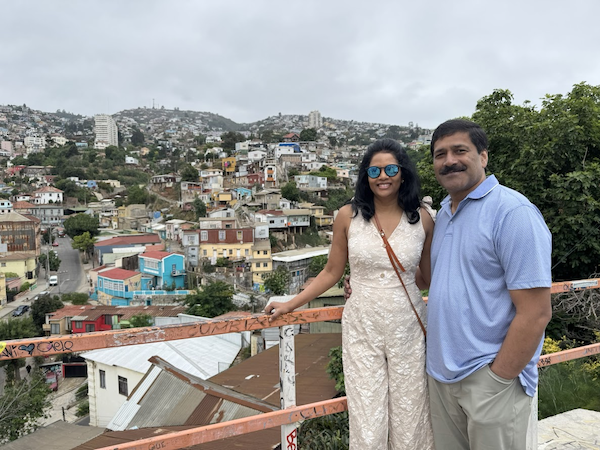
A highlight of our trip was the next day’s trip to the picturesque coastal towns of Valparaíso and Viña del Mar. Valparaiso, a UNESCO World heritage site enchants with its Hilly landscape, vibrant street art, and historic funiculars. Immigrants from Italy, French, and other European nations significantly influenced its architecture and culture that they now have a hill named after each country, with its own church. Post lunch, we enjoyed beach time at Vina del Mar.
Chileans seem highly engaged politically and socially; during our short visit, we stumbled upon protests in multiple areas, a testament to the country’s vibrant activism. Probing deeper, we learned the protests centered on civil rights, social equality and fairness, immigration policies, and more. One consistent thing, however, was the loud music complete with drums – initially, we mistook it for festivities and started grooving, but it was actually part of the protests.
Chileans seem highly engaged politically and socially; during our short visit, we stumbled upon protests in multiple areas, a testament to the country’s vibrant activism.


Anticipation was peaking as we geared up to head to Patagonia for the next three days. Travel however reminded me of Steve Martin’s movie “Planes, Trains and Automobiles,” with segments involving dropoff at the airport in Santiago, flight to Punta Arenas with a stopover in Puerto Montt, drop off at the bus station, a three hour bus ride to Puerto Natales, and a final dropoff at our hotel. As I often say, my travel pics don’t show the behind-the-scenes chaos.
Whatever was left of the day, we spent roaming around the streets of Puerto Natales, this Port city in Southern Patagonia. The onion layer tactic to dress up that worked so well in Atacama didn’t work in Patagonia, as it was cold, windy, and raining, all at the same time; we had our own personal cloud over our heads the next three days. We did not let anything dampen our spirits and indulged in Patagonia’s best: exceptional coffee, a sublime meal, and post-dinner gelato.
It’s funny how when you travel, every locale boasts the “world’s best”, and after experiencing it, you are thinking “I will settle for mediocre next time.” Best coffee or not, I see Americans’ faces lighting up when they see a Starbucks in other countries; almost like stumbling upon a US consulate after losing your passport. I think with their familiar settings they act as cultural oases, but I strongly feel it is mostly about their clean bathrooms which are difficult to find when traveling.
Patagonia is often referred to as the “End of the World”, but I agree with our guide when he said it’s the “Beginning of Heaven.” The crowning jewel of Patagonia, Torres del Paine (TDP) is in the books today. TDP is a panorama of turquoise lakes, snow-capped granite peaks disappearing into the clouds, and thundering cascades. We got to see all these “heavenly” elements in a “less heavenly” condition, being rained upon, but in our excitement totally ignored the discomfort.
The park’s landscape was a striking contrast of lush greenery, mostly black bush and calafate shrubs, against long stretches of rugged terrain. Trees were a rare sight, and those few that did thrive appeared stunted, almost like bonsai specimens. It reminded me of Iceland and sitting in my temperature controlled vehicle, I wondered how indigenous who lived here survived without modern amenities.
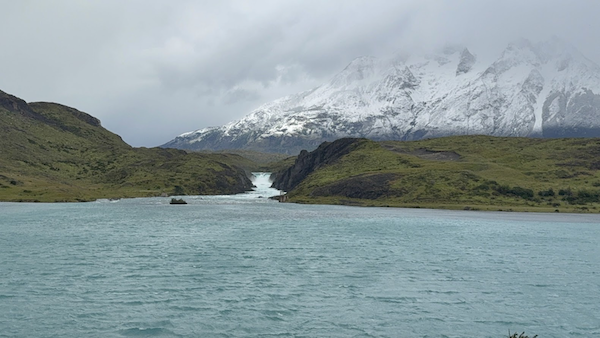
Chile is home to all four members of the camelid family. Llamas and alpacas are more in the North near Peru and we did not get to see any in this trip but we saw plenty of vicunas in the Atacama region. Their larger cousins, guanacos are aplenty in Patagonia. We heard good things about vicuna wool but it was elusive, and we settled for alpaca scarfs, which still brought a smile to my son’s face.
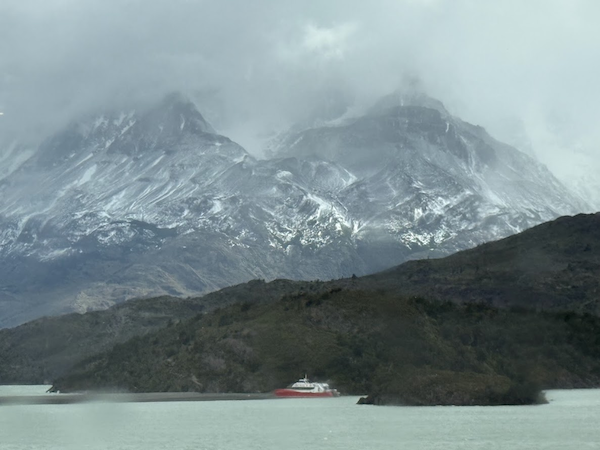
I remember researching the two full day optional excursions the next day, the choice was between Grey Lake Boat and Balmaceda and Serrano Glacier tour. After much difficulty we picked the former, but alas, it had to get canceled because the weather would not cooperate. We thought the cancellation was a blessing in disguise as the 45 minute walk to board the boat on a narrow strip of land on the lake with that kind of wind would have been… uncomfortable?
After taking a few pictures from the warm visitor center, which I was content with, we headed back to Puerto Natales. Feeling bad about the cancellation, the driver took us on a scenic detour through Serrano, affording us breathtaking views of the village and the winding river that enabled us to take some unforgettable snapshots.
Back at Puerto Natales that afternoon, we strolled through the streets shopping, eating and petting dogs. On that note, Chile is very dog friendly, so much so that sometimes it is difficult to tell if they are strays or pets. In fact, except in Santiago, we saw very few dogs on leashes. Most “strays” looked healthy and well fed, and we even saw some business owners leaving water and food outside, and occasionally inviting them in especially when it’s raining. We were touched by it all, but I’ll admit: having them at our restaurant tables was a bit too much.
We made it back to Santiago, this time a louder one than when we left. We witnessed several vehicles with people holding flags and shouting, celebrating and we thought it was about some major Sports victory. Later, our hotel receptionist enlightened us: the jubilant crowds were reacting to the announcement of election results – a far-right candidate had been voted in!
With a whole extra day in Santiago, we savored the city at a leisurely pace, starting with a wander through Barrio Bellavista’s colorful streets, snapping pics of the neighborhood’s quirky, bohemian charm. We nailed it on the second try, conquering San Cristobal hill via funicular (cable car still remained elusive), and soaked up those stunning city views. Our last stop for the day (and for the trip) was Barrio Italia and I got a bit lost in the shops, and my friends had to drag me away from there.
Our Chile adventure drew to a close, leaving us with memories of: dramatic landscapes, diverse (and extreme) climates, and vibrant culture. Sharing the journey with friends and family took the experience to another level – it was the ultimate crew, only thing, no accounts next time please. Overall, I want to say, Chile is worth its length!
Padma Nadella is an IT professional who lives in Eagan, Minnesota, with her husband and 17-year-old son. She manages a Facebook group for Minnesotans to collaborate on events and activities related to health and fitness. The group now has over two thousand members. Jack of all trades, she enjoys playing volleyball, traveling the world, and entertaining, mostly, but dabbles in everything else.
అథ్బుతం