


Six Yards of Everything – Part III: Revival, Reinvention, and the Diaspora Statement

- The diaspora saree carries the weight of performance in a way the saree worn daily in Chennai or Hyderabad does not. When you put on a saree in Michigan, you are making a choice.

Let me tell you where this series began.
I grew up Tamil. A boy on the periphery of something I didn’t have words for yet — the rustle of a Kanjivaram as a woman crosses a wedding hall, the soft percussion of silk against the floor, the composure of women who could carry six yards of fabric and still look like they were doing nothing at all. My Paattis, my Athais, my Periyammas, my Chitthis, my Amma — every woman who raised me wore a saree. I never did. I only watched.
Part I of this series was about the history and the geography — four thousand years of unstitched cloth, from the Indus Valley to the Instagram era, from Kanjivaram to Kota Doria.
Part II was about the cost — the caste system built into the loom, the silkworms boiled alive by the tens of thousands, the child laborers in the reeling units, the master weavers who left for construction sites because the math stopped working. If you haven’t read those parts, they are linked above and worth the time.
This part is about what happens next. The revival and the reinvention. The diaspora and the Golu. The political saree. And a closing to my honest love letter that tries to hold all of it — the beauty and the weight of it — at once.
—————
VI. The Saree Today — Revival, Reinvention, and the Instagram Problem
Something interesting has been happening to the saree over the last decade or so. It is coming back.
Not that it ever fully left — your Paatti never stopped wearing one, nor did hundreds of millions of women across India for whom the saree was never a nostalgic choice but simply Wednesday. But among urban Indians, among the diaspora, among younger women who had grown up in jeans and kurtas and considered the saree something their mothers wore — there has been a genuine, visible, somewhat surprising return.
The question worth asking is: what exactly is coming back, and for whom, and on whose terms?
The #100SareePact
In 2015, two women in Bangalore — Anju Maudgal Kadam and Ally Matthan — made a pact. They would each wear a hundred sarees over the coming months, document them on social media, and share the stories behind each one. Not fashion photography. Not styled shoots. Just women, sarees, and the memories attached to them.
The hashtag took off in a way neither of them anticipated. Thousands of women across India and the diaspora joined in — posting photographs of themselves in sarees worn to offices, to supermarkets, to school pickups, to ordinary Wednesdays. Each post came with a story. This saree was my grandmother’s. This one I wore to my first job interview. This one belonged to a woman who is no longer here and I am wearing it so she is not entirely gone.
What the #100SareePact unlocked was not a fashion movement. It was a memory movement. The saree, it turned out, was not just a garment in most Indian women’s lives — it was a filing system. An archive of occasions and relationships and losses. Each one stored something. The movement gave women permission to open the archive and share what was inside.
For the diaspora especially — Indian women in America, in the UK, in Australia, in the Gulf — it was a particular kind of homecoming. The saree in a foreign country is a different object than the saree at home. It carries more. It has to. When you are far from the place that made you, the things you brought with you — the language, the food, the fabric — do the work that geography used to do. A saree in Michigan or Manchester is not just a garment. It is an argument. An insistence. A way of saying I am still this, even here.
And sometimes, on the right evening, in the right light, with the right women around you — it is also just a saree. Beautiful and ordinary and enough. That ordinariness, that ability to be simply itself without carrying the full weight of diaspora identity every single moment — that is what the women who wore it daily always had, and what the diaspora is slowly, generation by generation, learning to reclaim.
The Designer Reinvention — And Its Discontents
At the other end of the spectrum from the #100SareePact is what happened in the design studios.
A new generation of Indian designers — people like Anavila Misra, whose linen sarees made the garment suddenly legible to women who had found it intimidating; Raw Mango’s Sanjay Garg, who brought a rigorous minimalism and a commitment to handloom craft to a market that had been drowning in embellishment; Abraham & Thakore, whose intellectual approach to Indian textiles put the saree in conversation with international fashion — began treating the saree not as heritage to be preserved but as a living design problem to be solved.
The results have been genuinely beautiful. They have also been genuinely expensive.
A Raw Mango saree costs between ₹15,000 and ₹80,000. An Anavila linen saree — minimal, elegant, technically a daily wear garment — starts around ₹12,000. These are not prices for most Indians. They are prices for a specific class of Indian — urban, professional, culturally confident, with enough disposable income to spend what a handloom weaver earns in two months on a single saree.
For the diaspora especially — Indian women in America, in the UK, in Australia, in the Gulf — #100SareePact was a particular kind of homecoming. The saree in a foreign country is a different object than the saree at home. It carries more. It has to.
There is an uncomfortable irony here that the better designers are aware of and occasionally articulate. The design revival that celebrates handloom craft and talks seriously about weaver communities and responsible sourcing still produces objects that only the wealthy can afford. The weaver whose work is being celebrated remains, in many cases, at the bottom of the economic chain that the celebrity of their craft has created. The saree has been gentrified. The people who make it have not been correspondingly elevated.
This is not an argument against beautiful, thoughtfully made sarees. It is an argument for looking clearly at the whole picture — the designer’s Instagram, yes, but also the weaver’s income, the supply chain, the gap between the story being told and the reality being lived.
The Political Saree
The saree has always been political. It has just not always announced itself as such.
Mamata Banerjee has worn the same style of plain white cotton tant saree — no embroidery, no embellishment, rubber slippers on her feet — for her entire political career. It is a costume of deliberate ordinariness, a studied refusal of the ornamentation that power usually reaches for. In a country where politicians dress to impress, Mamata dresses to belong — to the Bengali street, to the ordinary woman, to a tradition of simplicity that carries its own kind of authority.
Indira Gandhi understood the saree as political communication in a different register. Her sarees were chosen with the precision of a diplomat choosing words — the right regional textile in the right state, the right color for the right occasion, the right degree of formality for the right audience. A Gujarati patola in Gujarat. A Kashmiri saree in Kashmir. The saree as soft power, as cultural fluency, as the projection of a particular kind of Indian womanhood onto the national stage.
And then there was Jayalalithaa — and for anyone who grew up Tamil, no discussion of the political saree is complete without her.
J. Jayalalithaa, six-time Chief Minister of Tamil Nadu, former film star, and one of the most formidable politicians India has produced, wore the saree as total armor. Her silks were always immaculate — bold, saturated colors, usually solid (with matching capes), always with a thick contrasting border, never fussy, never decorated beyond what the fabric itself demanded. She understood, instinctively, that the saree could project authority without softening it. Where other women politicians sometimes used the saree to signal approachability, Jayalalithaa used it to signal power — the sheer presence of a woman who had survived more than most politicians of any gender and intended you to know it.
She also understood the Tamil emotional register of silk in a way that went beyond politics. Her sarees, though very versatile in style, material, and range, were mostly Kanjivaram for important events — always local, always rooted, always a signal to her constituency that she was one of them even when everything else about her suggested otherwise. A 1996 raid showed she had a 10,500 saree collection and that was not surprising to any of us who followed her career publicly. The film star turned Chief Minister, draped in the silk of Tamil Nadu’s most sacred weaving tradition. That was not an accident. It was a very deliberate kind of genius.
The white saree worn by Congress women in solidarity. The saffron-bordered choices of BJP women politicians. The handloom saree worn by a Chief Minister to signal swadeshi values. The designer saree worn by a Bollywood actress to signal cultural pride while also being photographed beautifully. The saree, in Indian public life, is never just a saree. It is always also a statement. The question is only whether the person wearing it knows what statement they are making — or whether the statement is making itself.
Four thousand years of history will do that to a garment. Give it opinions of its own.
The Diaspora Saree
For those of us who grew up Tamil in California, or Kannadiga in New Jersey, or Telugu in Melbourne, or Bengali in London — the saree occupies a particular psychological territory that is difficult to describe to someone who hasn’t lived it.
It is the garment of ceremony. Of return. Of the occasions when you need to be, visibly and unambiguously, the thing you are — Indian, South Asian, from somewhere specific, with a history that predates your American zip code by several thousand years.
The diaspora saree comes out for Navarathri — for Golu season, when Tamil women dress in their finest and visit each other’s homes, sitting before stepped displays of dolls that have been in the family for generations, receiving vethalai paaku and turmeric and kumkum and the particular blessing of being seen by other women who understand exactly what they are seeing. It comes out for Deepavali, for Pongal, for weddings, for temple celebrations in halls that smell like camphor and remind you of something you can’t quite name. It comes out when you want your children to see you as something other than the person who drives them to soccer practice. It comes out when you are far from home and the distance becomes, for a moment, too large to carry without help.
But the diaspora saree also carries the weight of performance in a way the saree worn daily in Chennai or Hyderabad does not. When you put on a saree in Michigan, you are making a choice. A declaration. You are not simply dressed. You are also, always, explaining yourself — to your neighbors, to your colleagues, to the part of yourself that has spent years learning to move through a Western world that was not built for you.
That is both the burden and the beauty of the diaspora saree. It means more than a saree should have to mean. And somehow, being six yards of cotton or silk, it is equal to the task.
VII. Six Yards of Everything — A Closing
Let me take you back to where this series began.
A wedding hall. The smell of jasmine. The sound of silk.
You are seven, or ten, or twelve, sitting cross-legged somewhere you are not supposed to be. The women of your family move through the room with a composure that baffles you. Your Paatti holds her pallu in place without looking at it. Your Periyamma is deep in conversation, gesturing with both hands, the saree somehow staying exactly where it should be despite her complete lack of attention to it. Your Amma catches your eye across the room and gives you the specific look that means sit properly and stop fidgeting — a look she is somehow able to deliver while simultaneously managing six yards of Kanjivaram silk, a plate of sweets, and a conversation about something that happened at someone’s daughter’s wedding three years ago that is apparently still being discussed.
You file it away. You don’t know yet that you are filing it away. You don’t know yet that thirty years later you will sit down to write about it, and it will all still be there — the jasmine, the silk, the sound, the look across the room.
Some things the body keeps even when the mind has moved on.
The saree is four thousand years old and it is still evolving. It crossed the Indus Valley and the Mughal court and the Victorian mission and the independence movement and the Instagram algorithm and it is still here, still six yards of unstitched cloth, still insisting that the body can adapt to the fabric rather than the other way around. There is something in that stubbornness that I find genuinely moving. A garment that has outlasted every empire that tried to define it deserves a certain respect.


I am not asking you to stop wearing silk. I am not asking you to stop loving Kanjivarams or stop buying Banarasis or stop feeling your heart do something complicated when you open your mother’s saree cupboard and the smell of camphor and old fabric comes out to meet you. Love is not negated by knowledge. The jasmine at the wedding smelled the same after I learned about the silkworms. My Paatti’s saree was no less beautiful for knowing what the weaver was paid.
But I am asking— gently, as someone who spent many years on the outside of this garment looking in — that we hold both things at once. The beauty and the cost. The tradition and the question. The six yards and everything hidden inside them.
That is not a diminishment of the saree. It is, I think, the only honest way to love it.
My Paatti is gone now. Most of the women who taught me, without knowing they were teaching me, what a saree looks like when it is worn by someone who has worn one every day of their adult life — they are gone, or older, or far away. The world they inhabited, where the saree was simply the weather, simply Wednesday, simply what you put on because what else would you put on — that world is changing. Not disappearing. Changing. The granddaughters are making different choices, or the same choices in different contexts, or entirely new choices that don’t map neatly onto what came before.
The saree will survive this, as it has survived everything else. It survived the Mughals and the British and the powerloom and synthetic fiber and fast fashion. It will survive Instagram and the designer markup and the GI tag bureaucracy and the slow erosion of the communities that have kept it alive. It is, after all, just a rectangle of cloth.
Just a rectangle of cloth that contains a civilization.
I still can’t drape one. I never learned — it was never mine to learn. But I know the sound it makes when a woman who has worn one for sixty years crosses a room. I know the specific quality of the light that comes off a Kanjivaram under a wedding hall chandelier at eleven in the morning. I know the smell of a cotton saree that has been stored with naphthalene balls and taken out for a festival, and how that smell is somehow also the smell of belonging, of a particular kind of home.
I know, now, what it costs. The silk and the cotton both — the worm and the weaver and the child and the tradition that is also sometimes a cage and the cage that is also sometimes a tradition. I know what my Paatti’s composure was made of. Not magic. Not effortlessness. Sixty years of practice, and the decision, made every single morning, to put on the garment and get on with things.
That, in the end, is what the saree is. Not just fabric. Not just history. Not just beauty or politics or craft or contradiction — though it is all of those things, every yard of it.
It is a decision made every morning by hundreds of millions of women across a civilization, for four thousand years, to get up and get on with things.
I find that, on balance, rather magnificent.I never wore it. I never will. But I have carried it — in the jasmine smell of a wedding hall, in the sound of silk against a marble floor, in the composure of women who put it on every morning and got on with things. That is perhaps the strangest kind of love — the kind held entirely from the outside, by someone who was never invited in. And yet here we are. Thirty years later. Still thinking about it.
—————-
Glossary
Paatti — grandmother. Athai — paternal aunt. Periyamma — mother’s elder sister. Chitthi — mother’s younger sister. Amma — mother.
Golu / Kolu — the display of dolls arranged on stepped platforms during the Navarathri festival, central to Tamil Hindu households.
Vethalai paaku — betel leaves and areca nut, traditionally offered as a gift during Navarathri Golu visits.
Pallu — the decorative end of the saree, typically draped over the shoulder. Kanjivaram — the heavy silk saree from Kanchipuram, Tamil Nadu.
Swadeshi — the movement promoting Indian-made goods, associated with Gandhi and the independence movement.
Tant — the crisp everyday cotton saree of West Bengal. Veshti — the Tamil male dhoti.
GI tag — Geographical Indication, a certification protecting regionally specific products.
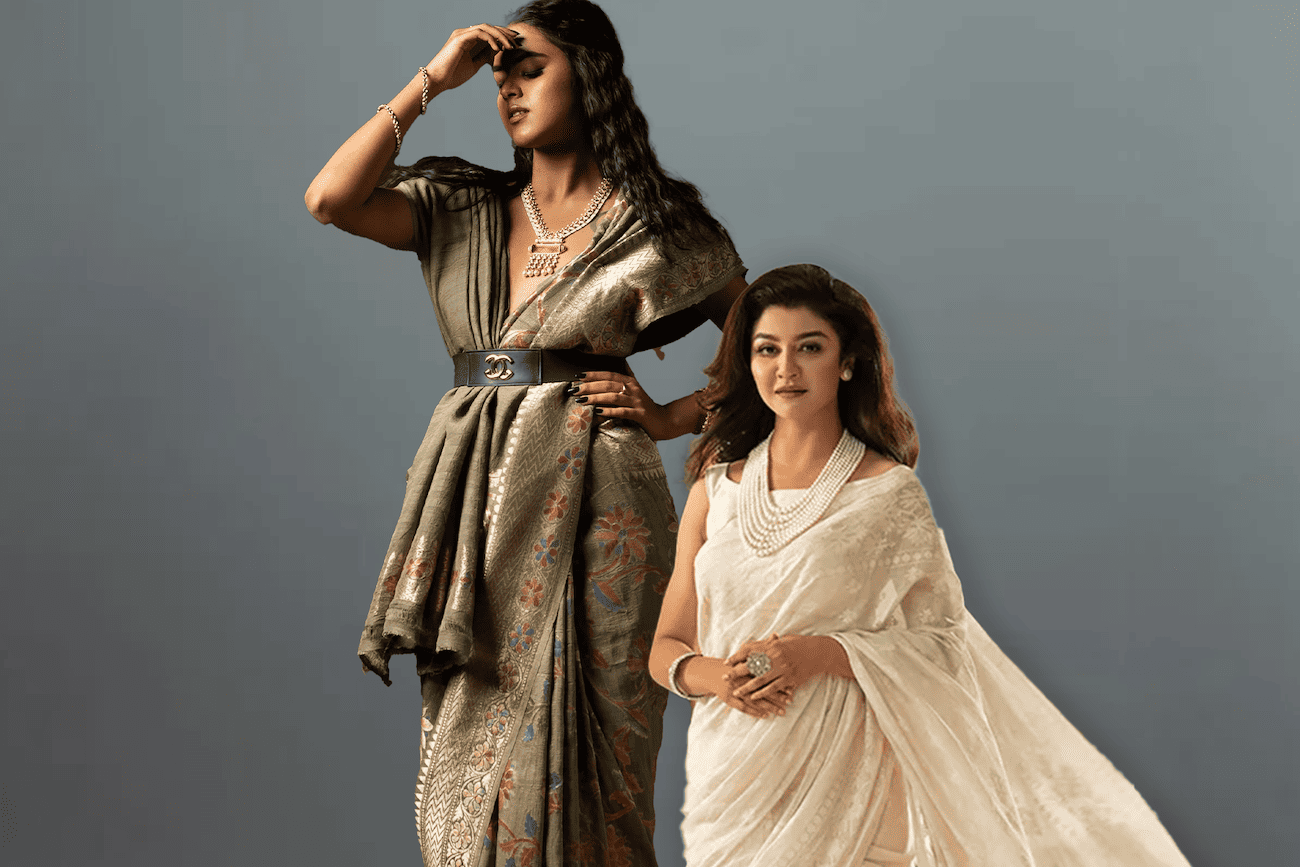
Top images, courtesy of Gauri Saree and Piya Ka Gear.
Ganpy Nataraj is an entrepreneur, author of “TEXIT – A Star Alone” (thriller) and short stories. He is a moody writer writing “stuff” — Politics, Movies, Music, Sports, Satire, Food, etc.