




The Man Who Killed Graham Staines May Walk Free: Revisiting Murders Most Foul a Quarter Century Later

- India's Supreme Court has given the Odisha government until September 2 to decide whether Dara Singh — convicted of burning alive an Australian Christian missionary and his two young sons in 1999 — should be released after 25 years in prison. The case has reignited one of independent India's most haunting acts of religious violence.
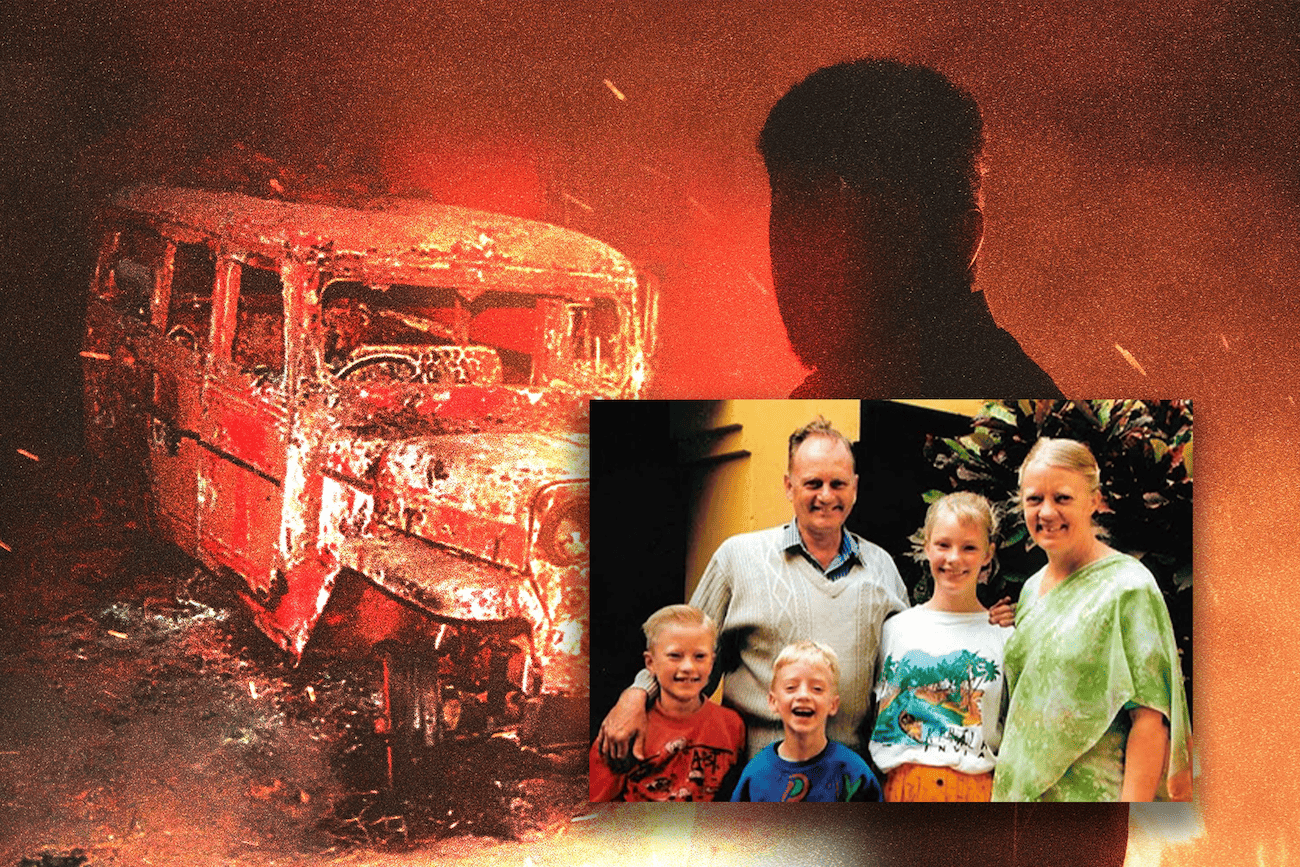

In the early hours of January 22, 1999, Graham Staines — an Australian Christian missionary who had spent thirty years caring for leprosy patients in the eastern Indian state of Odisha — was asleep in his jeep in the remote village of Manoharpur in the Keonjhar district. His two sons, Philip, ten years old, and Timothy, six, were sleeping beside him. They had attended a Christian gathering in the village and stayed the night.
A mob of sixty to seventy people surrounded the vehicle. They set it on fire. When Staines and his children tried to escape, they were pushed back. All three died in the flames.
The man who led that mob was Rabindra Kumar Pal — known by the name he had given himself, Dara Singh. He was a member of Hindu hardline networks and had accused Staines, without evidence, of forcibly converting poor Hindus and tribal communities to Christianity. Staines had spent three decades working among the poorest people of Odisha, treating patients that most of Indian society had abandoned.
The murder drew global condemnation and sent shockwaves through India’s thirty-million-strong Christian community. It remains, more than a quarter century later, one of independent India’s most widely known acts of anti-Christian violence.
Now, as the BBC’s Geeta Pandey reported on August 19, 2026, it is back at the center of Indian public life — because a petition seeking Dara Singh’s release from prison has reached India’s Supreme Court, and the court has given the state of Odisha until September 2 to decide whether to recommend his release.
The Criminal Record: Three Life Sentences, One Death Row Reprieve
Dara Singh was arrested in 2000, a year after the Manoharpur murders, during an overnight raid on a jungle hideout. While he was on the run, Odisha police had put up posters across the state offering an 800,000-rupee reward — approximately $18,000 at the time — for information leading to his capture. Reports described him as being helped by local villagers and tribals who had celebrated him as a folk hero, as Pandey documented in her BBC report.
In 2003, a trial court sentenced him to death for the Staines murders and sent twelve of his associates to prison for life. In 2005, the Odisha High Court commuted his death sentence to life imprisonment, confirmed the life sentence of one accomplice, Mahendra Hembram, and freed eleven others for insufficient evidence.
In January 2011, the Supreme Court upheld his life sentence and refused prosecutors’ plea to reinstate the death penalty.
But the Staines murders were not the only charges against him. In 2007, he was convicted for two additional crimes committed in the same year as the Manoharpur killings. He was sentenced to life imprisonment for leading a mob that set fire to a church and killed Catholic priest Arul Das with an arrow as Das tried to flee the burning building. He received a third life sentence for beating and burning to death a Muslim garment trader named Shaikh Rahaman, as the BBC report documented.
Police had also registered ten cases accusing him of involvement in hijacking trucks belonging to Muslim traders who were transporting cattle. He denied personal involvement in those cases while acknowledging, in a prison interview, that he had been “actively involved in the movement against illegal trade in cows and cow-slaughter.”
Singh is now 62 years old. He has been in prison since 2000.
Gladys Staines’ forgiveness has been cited repeatedly in the debate over Singh’s possible release — by advocates for mercy and by the legal community navigating the question of remission. But forgiveness from the victim’s family is not, under Indian law, a determinative factor in the remission process.
His Own Words: “No Regrets”
The most disturbing dimension of the current debate over Singh’s possible release is not abstract. It is grounded in his own documented statements — made in a prison interview with India Today magazine’s Ruben Banerjee just months after his arrest, and preserved in the public record.
In that interview, Singh denied killing Staines and his children while simultaneously saying he “did not like Graham Staines” and had “spearheaded the movement against missionaries.”
“Missionaries have been targeting our religion. They have been converting Hindus by deceit and inducements. Our religion is under siege. As a true Hindu, it was my responsibility to oppose them,” he said, as the BBC quoted from the India Today interview. He added that “since I was possibly the most famous name in the region, the police implicated me in the killings.”
His statements about the children were more chilling still. “When Hindus die, others don’t cry. Why should we weep when others die? Whatever has happened is right. Whatever will happen will also be right,” he said, as the BBC documented. He said he had “no regrets” and “will never regret” the deaths of the children.
On what he would do if released: “I will go back to what I have been doing — oppose cow slaughter and conversions.” He added a warning: “The government must stop them. If they are not stopped, more people might get killed. Anything can happen.”
The contrast between those documented statements and the language of his 2024 remission petition is stark. In the petition, he “acknowledges and deeply regrets the transgressions committed more than two decades ago” and attributes them to “the fervour of youth, fuelled by impassioned reactions to the brutal history of India,” as the BBC documented. He writes that “the petitioner’s psyche momentarily lost restraint” and that there “was no personal animosity harboured towards any victim.”
The petition — framed in the legal language of remorse and reform — is being evaluated against the background of his own publicly stated absence of remorse in 2000.
The Supreme Court’s Ultimatum — and the State’s Silence
The procedural history of the remission petition is its own story of institutional delay and judicial frustration.
Singh filed his plea for remission in July 2024, arguing he was entitled to release after more than 25 years in prison, citing good conduct in jail. Last year, the Supreme Court asked the Odisha state government to take a decision on the plea. The state has not told the court what it intends to do.
At the August 19, 2026 hearing — the date of the BBC report — the Odisha authorities told the court that the Sentence Review Board, which was examining the petition, was waiting for additional paperwork and sought yet another adjournment, as Pandey documented.
The two-judge bench of Justices Manoj Misra and Vijay Bishnoi expressed their annoyance at the sequence of adjournments. “You take a decision, whichever way you want. If you do not take a decision, then we will,” the bench said, setting a September 2 deadline, as the BBC reported.
On the same day, Wednesday August 20, the court did not hear the case. The date for the next hearing had not been announced as of publication.
The Odisha state government’s silence — its repeated adjournments and its failure to present the Sentence Review Board’s conclusions — has been read by both legal observers and the Christian community as reflecting political calculation rather than administrative delay. The BJP, which governs Odisha and the Union government, has not publicly stated a position on the petition.
Gladys Staines: Forgiveness Without Endorsement
Graham Staines’ widow, Gladys, remained in India with her daughter Esther until July 2004 — five years after her husband and sons were burned alive. Her public response to the crime became one of the most widely discussed acts of public grace in modern Indian history.

“Forgiveness opens up the path of healing,” she said, as the BBC documented. She had “forgiven” Dara Singh in the Christian spirit.
Gladys Staines’ forgiveness has been cited repeatedly in the debate over Singh’s possible release — by advocates for mercy and by the legal community navigating the question of remission. But forgiveness from the victim’s family is not, under Indian law, a determinative factor in the remission process. The Sentence Review Board’s recommendation and the state government’s decision are the operative mechanisms.
“A Public, Theatrical Act of Terror”
Human rights activist and Christian political commentator John Dayal, writing on the Union of Catholic News website, offered what the BBC described as one of the most precise assessments of what is at stake.
Dayal acknowledged that remission after decades in jail is “not unusual” in India and that “the principle behind it — that punishment should allow for reform and eventual return to society — is humane.”
But he argued that the Staines case occupies a different moral category. “The Staines murders were not an ordinary homicide but a public, theatrical act of terror, intended to be seen and understood as a warning,” Dayal wrote. “The killings of Father Arul Doss and Sheikh Rehman extended that same message.”
The anxiety among religious minorities in Odisha, he said, “is not abstract given the state’s history of anti-Christian violence” — citing the Kandhamal riots of 2008, in which dozens were killed and tens of thousands of Christians were displaced from their homes across the state.
“What remains to be seen is not whether Singh will eventually walk free, but how the government conducts itself around that decision,” Dayal wrote, “and whether minority communities are given any reassurance.”
A Community’s Unease
India’s Christian community — estimated at thirty million people, approximately 2.3 percent of the population — has watched the development of the remission petition with what the BBC described as “disquiet.”
That disquiet is grounded not only in memory of the Staines murders but in a documented pattern of anti-Christian violence that has continued through the years of BJP governance. Incidents of attacks on churches, Christian missionaries, and converts from Hinduism have been documented by organizations including the Evangelical Fellowship of India and the United Christian Forum, and have been consistently cited in U.S. State Department reports on international religious freedom.
The prospect that a man who expressed no remorse for the killing of an Australian missionary and his two children — who said the deaths were “right” and that he would return to the same activities if released — might walk free has concentrated those anxieties into a specific, immediate, and irreducible question.
India’s Supreme Court, which has set a September 2 deadline for the Odisha government to decide, will determine what answer the state gives.
Top background illustration, courtesy of Christianity Today. Inset, family photo of Staines.